Painter of the Bible
Jacopo Tintoretto
Jacopo Tintoretto — born Jacopo Robusti in Venice in 1518 or 1519, nicknamed Tintoretto (the little dyer) for his father's trade — was one of the three pillars of late-sixteenth-century Venetian painting and the principa…
.jpg%3Fwidth%3D600&w=2048&q=75)
Their faith
Why Jacopo Tintoretto painted Christ
Jacopo Tintoretto, born in Venice in 1518, was a devout Christian whose faith profoundly influenced his artistic vision. He dedicated his life to religious painting, and his work reflects a deep reverence for scripture and the teachings of Christ. Tintoretto's commitment to his faith is evident in his monumental project for the Scuola Grande di San Rocco, where he painted an extensive cycle of biblical scenes that showcase his devotion. His motto, 'the drawing of Michelangelo and the color of Titian,' underscores his aspiration to create works that not only displayed technical mastery but also conveyed spiritual depth. Tintoretto's artistic process was imbued with prayer and reflection, as he sought to depict the divine in his art, making it accessible to the faithful in his community.
Tintoretto's faith is vividly expressed in his masterpieces, particularly in the dramatic compositions of the Crucifixion and the Last Supper for San Giorgio Maggiore. In the Crucifixion, the intense emotion and dynamic movement invite viewers to engage with the sacrificial love of Christ, while the Last Supper transforms the familiar scene into a moment of divine revelation, filled with swirling angels and agitated figures. These works not only demonstrate Tintoretto's innovative use of light and shadow but also reflect his desire to inspire awe and devotion among those who beheld them. Through his paintings, Tintoretto's unwavering faith continues to resonate, drawing viewers into a deeper understanding of Christ's life and sacrifice, reminding us of the beauty and power of divine love that transcends time.
Life & work
Jacopo Tintoretto — born Jacopo Robusti in Venice in 1518 or 1519, nicknamed Tintoretto (the little dyer) for his father's trade — was one of the three pillars of late-sixteenth-century Venetian painting and the principal religious painter of the city in the generation after Titian. Reportedly briefly apprenticed to Titian in his teens (Titian, the story goes, dismissed him after a few days, jealous of the boy's talent), he set up on his own and worked in Venice for the rest of his life, dying in Venice in 1594.
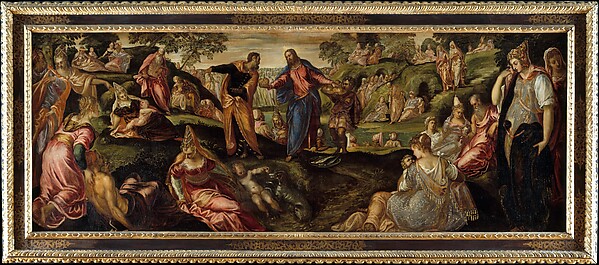
His central project — and the largest single religious cycle by any painter of the Italian Renaissance — was the decoration of the Scuola Grande di San Rocco in Venice, which Tintoretto worked on from 1564 until 1587. He painted the entire upper hall, the lower hall, and the Sala dell'Albergo with cycles of the Old Testament, the Life of the Virgin, and the Life of Christ — over fifty enormous canvases including the Crucifixion (the Sala dell'Albergo, 1565), the Brazen Serpent, the Manna, the Adoration of the Shepherds, and the Last Supper of San Rocco, all of them characterized by the dramatic foreshortening, sudden light, and theatrical staging that defined his mature manner. The Scuola di San Rocco is widely considered the supreme Venetian religious cycle of the sixteenth century.
His work for other Venetian institutions includes the great series for the church of the Madonna dell'Orto (where he is buried), the Last Supper for San Giorgio Maggiore (1592–1594, his last major work and a transformation of the Last Supper subject — the table set diagonally, the figures in agitated motion, the room broken open to a swirl of angels), the Saint Mark cycle for the Scuola di San Marco (now in the Accademia and the Brera), and dozens of smaller commissions for parish churches, scuole, and private patrons.
He worked at extraordinary speed with a large family workshop — his daughter Marietta (the Tintoretta), his sons Domenico and Marco, and a stream of assistants — and produced more square footage of religious painting than any other Venetian master. His motto, painted on his studio wall, was "the drawing of Michelangelo and the color of Titian" — and the late, sometimes almost monochromatic Tintoretto canvases, with their roiling skies and electric chiaroscuro, anticipate by sixty years the coming of Caravaggio and the seventeenth-century Roman Baroque.
Notable works in detail
tintoretto-christ-washing-feet-1pet5
Christ Washing the Disciples' Feet, painted by Jacopo Tintoretto around 1547 and now in the Prado in Madrid (a closely related variant hangs in the Newcastle Shipley Art Gallery), is the supreme Tintoretto treatment of the John 13 episode at the Last Supper. Christ kneels before Peter at the right side of the canvas, washing the apostle's feet in a basin while Peter gestures in protest; the other apostles are scattered in animated postures across the rest of the long horizontal composition — some untying their sandals, some kneeling in conversation, some still finishing the meal at the table that runs along the back of the room. The architectural setting opens through a colonnade onto a deep panoramic landscape with distant Venetian towers. The chromatic palette of crimson, ultramarine, and burnt orange against the cool grey of the marble floor is unmistakably Tintoretto in his early-mature manner; the painting was originally commissioned for the church of San Marcuola in Venice and was sold to the Spanish royal collection in the seventeenth century.