Painter of the Bible
Joos van Cleve
Joos van Cleve was a leading Antwerp painter of the early sixteenth century and one of the principal members of the loose group called the Antwerp Mannerists — the generation that combined the late Early Netherlandish pa…

Their faith
Why Joos van Cleve painted Christ
Joos van Cleve was a prominent painter in the early sixteenth century, deeply rooted in the Christian faith that defined much of his work. As a member of the Antwerp Mannerists, he drew from the rich traditions of Early Netherlandish painting while embracing the innovations of the Italian Renaissance. His commitment to his craft was evident in his role as a master in the Antwerp painters' guild, where he led a productive workshop that produced numerous altarpieces and devotional works. The spiritual significance of scripture was central to his artistic vision, as he dedicated his talents to creating pieces that reflected the beauty and reverence of Christian themes. His Madonna and Child compositions, often featuring the Virgin Mary tenderly holding the Christ Child, reveal a deep devotion that resonates with viewers, inviting them into a sacred moment of maternal love and divine presence.
Van Cleve's faith profoundly shaped his artistic output, particularly in works like the "Death of the Virgin" and the "Adoration of the Magi." In the former, the poignant depiction of the Virgin surrounded by apostles captures the essence of Christian mourning and hope, while the latter illustrates the joyous celebration of Christ's birth through the homage of the Magi. His Madonna of the Cherries, with its intimate portrayal of Mary and Jesus, symbolizes the sweetness of faith and the nurturing aspect of motherhood. The widespread popularity of these compositions speaks to their spiritual impact, as they became beloved devotional images across Europe. Joos van Cleve's enduring legacy lies in his ability to connect the viewer with the divine through his art, reminding us of the beauty of faith and the sacred stories that continue to inspire generations.
Life & work
Joos van Cleve was a leading Antwerp painter of the early sixteenth century and one of the principal members of the loose group called the Antwerp Mannerists — the generation that combined the late Early Netherlandish painting tradition descending from Jan van Eyck and Hans Memling with the new Italianizing Renaissance vocabulary that arrived through prints and travelers in the years between roughly 1500 and 1540. Born in Cleves around 1485, trained almost certainly in the workshop of Jan Joest of Kalkar before settling in Antwerp by 1511, he became a master of the Antwerp painters' guild and ran a productive workshop in the city for the rest of his life. He died in Antwerp around 1540.
His Christian religious work is concentrated in altarpieces, devotional Madonnas, and the Holy Family compositions in his characteristic combination of late Northern Renaissance technique and Italianate Renaissance figural drawing. The Death of the Virgin altarpiece (Cologne, c. 1515 — the central panel showing the Virgin on her deathbed surrounded by the apostles, painted in the standard Antwerp Mannerist horizontal triptych format), the Adoration of the Magi (multiple versions in workshop variants in Madrid, Naples, Detroit, and Dresden), the Madonna of the Cherries (multiple versions, including the famous Cleveland and Brussels variants), the Holy Family (multiple versions in workshop variants), and the Saint Reinhold Altarpiece (Warsaw National Museum) anchor the painted corpus.
His Madonna and Child compositions — the Virgin in three-quarter view holding the Christ Child against her breast, often with a small bunch of cherries or grapes that the Child reaches for, set in a Northern interior with leaded windows opening onto a panoramic landscape — became one of the most-copied Antwerp Mannerist devotional types and were produced in dozens of workshop variants distributed across the European Catholic devotional market.
He worked briefly in France in the early 1530s at the invitation of King Francis I and produced portraits of the king, his mother Louise of Savoy, and the royal children that established his international reputation. The Antwerp workshop continued under his son Cornelis van Cleve and produced workshop variants of his standard altarpiece compositions for several decades after his death.
Notable works in detail
met-436792
The Crucifixion with Saints and a Donor, painted by Joos van Cleve around 1515 in oil on panel and now in the Metropolitan Museum of Art in New York, depicts the moment of Christ's death on the cross attended by saints and a small kneeling donor figure in formal devotional grouping. The cross stands at the upper center against a darkening sky; the Virgin and John the Evangelist kneel at the foot of the cross in the conventional Northern compositional manner; two attendant saints flank them in formal symmetry; the small kneeling donor figure occupies the lower foreground in formal devotional posture. The chromatic palette and the architectural setting demonstrate the early van Cleve combination of late Early Netherlandish technique and the new Italianizing Antwerp Mannerist figural drawing that defined his mature output.
met-436795
Virgin and Child, painted by Joos van Cleve and his workshop around 1520 in oil on panel and now in the Metropolitan Museum of Art in New York, is one of the standard Antwerp Mannerist Marian devotional panels van Cleve and his workshop produced in dozens of variants for the Antwerp domestic and confraternal devotional market. The Virgin sits in three-quarter view holding the Christ Child against her chest, often (as in this version) with a small bunch of cherries that the Child reaches for; the setting is a small Northern interior with leaded windows opening onto a panoramic landscape. The composition was one of the most-copied Antwerp Mannerist devotional types and circulated in workshop variants across the European Catholic devotional market for several decades.
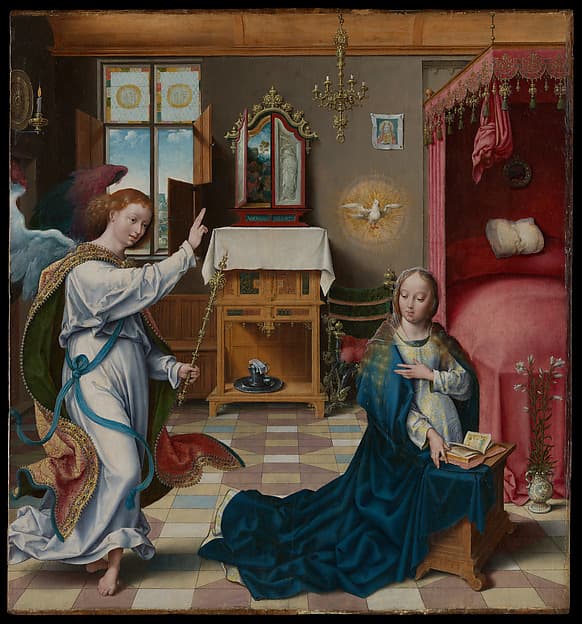
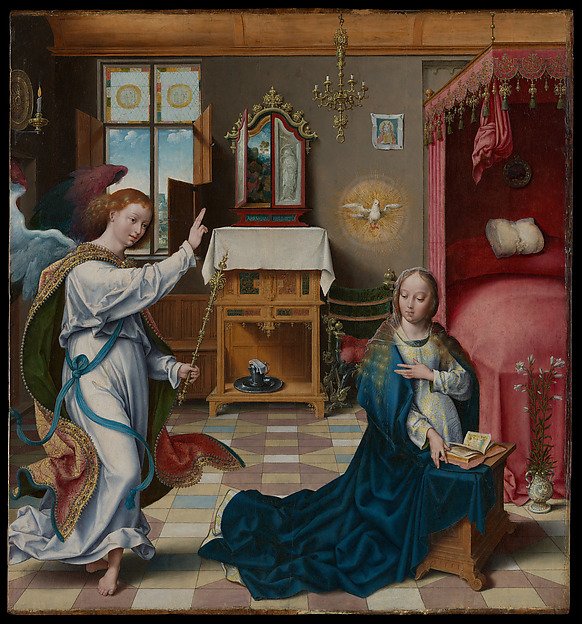
The Annunciation, painted by Joos van Cleve and his workshop around 1520 in oil on panel and now in the Metropolitan Museum of Art in New York, depicts the moment from Luke 1 in which the angel Gabriel appears to the Virgin in her chamber to announce the conception of Christ. Van Cleve stages the scene in a small Northern interior with characteristic Antwerp Mannerist compositional discipline: the Virgin kneels at her prayer-desk on the right, the angel kneels on the left with the lily of purity in one hand, the Holy Spirit descends as a small dove on a beam of golden light through the open window. The chromatic palette of saturated crimson, ultramarine, and warm flesh against the carefully detailed Northern interior is the unmistakable van Cleve workshop signature.
met-436797
The Holy Family, painted by Joos van Cleve and his workshop around 1520 in oil on panel and now in the Metropolitan Museum of Art in New York, depicts the iconographic subject of the Virgin and Christ Child attended by Joseph in formal devotional grouping. Van Cleve composes the scene as a small horizontal interior encounter: the seated Virgin in three-quarter view holding the standing Christ Child upright on her lap, Joseph standing behind in formal attendance, the small interior carefully detailed with leaded windows opening onto a panoramic landscape. The composition belongs to the long sequence of Holy Family devotional images that the van Cleve workshop produced in workshop variants for the Antwerp Catholic devotional market across the 1520s and 1530s.
Bible scenes Joos van Cleve painted
Luke