Painter of the Bible
Pier Francesco Mola
Pier Francesco Mola was a Lombard-born Roman Baroque painter who combined the Bolognese classicizing tradition descending from the Carracci with the Venetian color school of Veronese and Tintoretto into a distinctive mid-seventeenth-century Roman manner.

Their faith
Why Pier Francesco Mola painted Christ
Pier Francesco Mola, a gifted painter of the Roman Baroque, dedicated his life to creating art that reflected his deep Christian faith. Born in 1612 in Coldrerio, he was brought to Rome as a child, where his father worked as an architect. Mola trained under the renowned Cavaliere d'Arpino and later absorbed influences from the Venetian colorists. His devotion to scripture and the Christian tradition is evident in his body of work, which includes numerous altarpieces and devotional paintings. Mola's commitment to his faith was not merely professional; it was a profound aspect of his life that guided his artistic vision and practice. His small-format devotional canvases were particularly cherished by Roman aristocrats and ecclesiastics, suggesting that his art served as a spiritual conduit for both the artist and his patrons.
Mola's faith profoundly shaped his artistic output, particularly in works like "The Vision of Saint Bruno" and "Saint Peter Liberated by an Angel." These pieces not only showcase his technical prowess but also reveal his spiritual vision, emphasizing themes of divine intervention and personal redemption. The dramatic landscapes and solitary figures in his paintings invite viewers into a contemplative space, reflecting Mola's own devotion and reverence for the sacred. His ability to combine the classicizing tradition with a warm, emotive color palette creates an atmosphere of both beauty and spirituality. Even today, Mola's works continue to inspire and uplift, reminding us of the enduring power of faith expressed through art.
Life & work
Pier Francesco Mola was a Lombard-born Roman Baroque painter who combined the Bolognese classicizing tradition descending from the Carracci with the Venetian color school of Veronese and Tintoretto into a distinctive mid-seventeenth-century Roman manner. Born in Coldrerio in the Italian-Swiss border region of Ticino in 1612 (the same year as the Roman painter Pietro Testa), brought to Rome as a child by his architect father, and trained in Rome in the workshop of the late Cavaliere d'Arpino and then in Venice and Bologna in the orbit of the late Venetian colorists and the Bolognese school of Albani and Guercino, he was active in Rome for the rest of his career. He died in Rome in 1666.
His Christian religious work is concentrated in altarpieces, fresco cycles, and small-format devotional canvases. The Vision of Saint Bruno (multiple versions in workshop variants in the Pinacoteca Capitolina and other Italian collections), the Hagar and Ishmael in the Wilderness (Berlin), the Saint Peter Liberated by an Angel (Rome), the great frescoes for the Quirinal Palace (the Joseph Cycle, painted under Pope Alexander VII in the 1650s), and the Penitent Magdalene compositions in workshop variants anchor the painted corpus.
His personal style — combining Bolognese classicizing figural discipline with Venetian warmth of color and a particular fondness for solitary saint-and-hermit subjects in dramatic Italian landscape settings — gave him a distinctive mid-seventeenth-century Roman position between the strict Bolognese classicism of Sacchi and the more theatrical Roman Baroque of Pietro da Cortona. He was particularly admired in his lifetime for his small-format private devotional paintings, which were collected by Roman aristocratic and ecclesiastical patrons across his career.
The 1665–1666 court intrigues that surrounded his late commission to fresco the Costaguti Palace in Rome — disputes with the patron, the artist's accusations of unfair treatment, and the unresolved litigation that followed — provided material for several seventeenth and eighteenth-century artist-biographies as a documented case study of the difficulties of working as a painter under Roman patronage in the high Baroque period. He was buried in Santa Maria del Popolo in Rome.
Notable works in detail
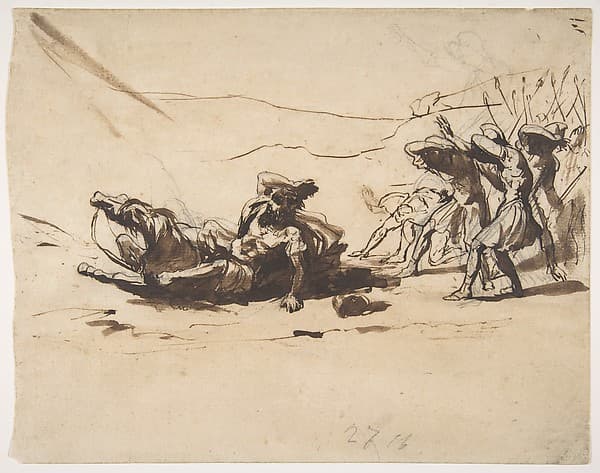
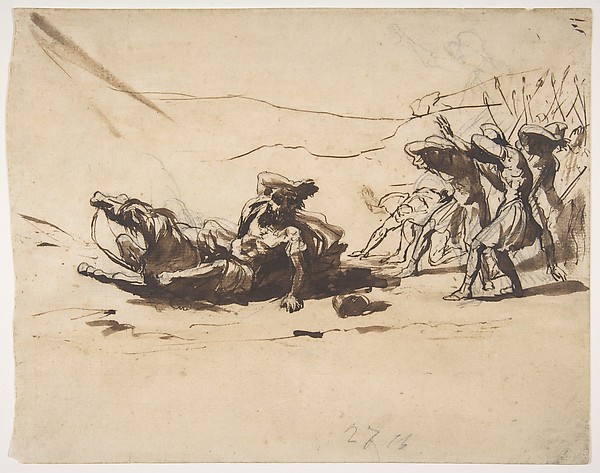
Conversion of Saint Paul, drawn by Pier Francesco Mola around 1650 in pen and brown ink with wash on paper and now in the Metropolitan Museum of Art in New York, illustrates the moment from Acts 9 in which Saul falls from his horse on the road to Damascus blinded by the light from heaven. Mola stages the scene with characteristic mid-seventeenth-century Roman Baroque compositional drama: Saul fallen on the ground in the foreground, his horse rearing in alarm beside him, the divine appearing as a foreshortened Christ in the upper register pulling apart the clouds. The drawing demonstrates Mola's characteristic combination of Bolognese figural discipline with the Venetian color and atmosphere that defined his mid-career Roman manner.
met-340805
Saint John the Baptist Preaching, drawn by Pier Francesco Mola around 1650 in pen and brown ink with wash on paper and now in the Metropolitan Museum of Art in New York, depicts the cousin of Christ in his desert ministry of preaching as recorded in the Synoptic Gospels. Mola stages the scene as a panoramic outdoor encounter: the Baptist standing at the upper center on a small rocky outcrop, his right hand raised in the act of preaching, the assembled crowd of listeners gathered around him in the foreground in postures of attentive listening, the Italian wilderness opening behind. The drawing demonstrates Mola's characteristic preference for the solitary saint-and-hermit subject set in dramatic Italian landscape.
met-437101
The Rest on the Flight into Egypt, painted by Pier Francesco Mola around 1636 in oil on canvas and now in the Metropolitan Museum of Art in New York, depicts the apocryphal subject of the Holy Family pausing in their flight from Herod's persecution. Mola stages the scene as a tender outdoor encounter in a wild Italian landscape: the seated Virgin in profile holding the swaddled Christ Child, Joseph waiting nearby with the small donkey, a small landscape opening behind to a low Italian horizon. The chromatic palette and the careful atmospheric handling demonstrate Mola's characteristic combination of Bolognese figural discipline and Venetian-influenced warm color, painted in the years immediately before his return to Rome from his northern Italian study trips of the 1630s.
Bible scenes Pier Francesco Mola painted
Acts