Painter of the Bible
Segna di Buonaventura
Segna di Buonaventura was a Sienese painter of the early fourteenth century and one of the principal direct pupils of Duccio di Buoninsegna in the workshop that produced the great Maestà altarpiece for Siena Cathedral in 1311.

Their faith
Why Segna di Buonaventura painted Christ
Segna di Buonaventura was a devoted Christian whose artistic journey was deeply intertwined with his faith. As a pupil of the renowned Duccio di Buoninsegna, Segna inherited a rich tradition of sacred art that emphasized the beauty of the divine. His works reflect the calm devotional sweetness characteristic of the Sienese school, a style that invites viewers into a contemplative relationship with the sacred. The altarpieces and devotional panels he created served not only as artistic expressions but also as instruments of worship, guiding the faithful in their spiritual journeys. Segna's commitment to his craft and his religious convictions were evident in his meticulous attention to detail and the vibrant colors he employed, which brought biblical stories to life for the communities he served.
Segna's faith profoundly influenced his artistic output, particularly in works like the "Madonna and Child Enthroned with Saints" and the various panels depicting the Crucifixion. These pieces exemplify his ability to convey deep spiritual truths through visual means, inviting viewers to reflect on the mysteries of Christ's life and sacrifice. The elongated figures and jewel-bright colors, set against gold backgrounds, create a sense of heavenly beauty that draws the observer into a sacred space. Segna's art not only honors the Christian narrative but also serves as a lasting testament to his devotion, allowing contemporary viewers to experience the same reverence and inspiration that guided him in his work. Through his paintings, Segna di Buonaventura continues to touch hearts and inspire faith, reminding us of the beauty and grace found in a life dedicated to Christ.
Life & work
Segna di Buonaventura was a Sienese painter of the early fourteenth century and one of the principal direct pupils of Duccio di Buoninsegna in the workshop that produced the great Maestà altarpiece for Siena Cathedral in 1311. Born in Siena around 1280 (or perhaps slightly earlier), trained in Duccio's late workshop, and active in Siena and the smaller Sienese hill towns for the rest of his career, he died in Siena around 1331. He was the father of the painter Niccolò di Segna, who continued the Sienese workshop tradition into the next generation.
His Christian religious work is concentrated in altarpieces, polyptychs, and small devotional panels in the unmistakable late-Duccian Sienese manner — figures in elongated proportions, jewel-bright tempera color, tooled-gold backgrounds, and the calm devotional sweetness that defined the Sienese school under Duccio. The Madonna and Child Enthroned with Saints altarpiece for the Pieve of Castiglion Fiorentino (1317, now in the Pinacoteca Comunale of Castiglion Fiorentino), the Crucifixion panels in the Pinacoteca Nazionale of Siena, and the dispersed polyptych panels in the Met, the Frick Collection, the Berlin Gemäldegalerie, and the Walters Art Museum in Baltimore fill the painted corpus.
His personal style is closely modeled on his teacher Duccio's — close enough that individual surviving panels were for centuries attributed to Duccio himself before twentieth-century connoisseurship distinguished Segna's slightly weightier figural drawing and slightly cooler chromatic palette from Duccio's own. The Sienese workshop continuation that ran from Segna through his son Niccolò di Segna and into the Lippo Memmi and Simone Martini generation made him one of the principal carriers of the Duccian pictorial tradition through the first generation after Duccio's death in 1319.
He worked principally in the small Sienese hill towns of the contado rather than in the Sienese cathedral or the Palazzo Pubblico, where the more famous Duccian disciples Simone Martini and Lippo Memmi held the major civic commissions. His provincial workshop output was nonetheless substantial and was the principal channel through which the Duccian style reached the smaller Sienese churches in the first half of the fourteenth century.
Notable works in detail
met-437649
Christ Blessing, painted by Segna di Buonaventura around 1306 in tempera and gold on panel and now in the Metropolitan Museum of Art in New York, depicts the iconographic subject of the half-length Salvator Mundi (Christ Saviour of the World) — Christ in three-quarter view raising his right hand in benediction and holding a small book in his left. The chromatic palette of saturated rose, ultramarine, and tooled gold against the patterned gold-tooled background is the unmistakable Sienese late-Duccian signature, and the calm devotional face demonstrates Segna's close stylistic relationship to his teacher Duccio. The panel was almost certainly part of a larger polyptych altarpiece structure with the Madonna and Child at the center and individual saints in the side panels.
met-460152
The Crucifixion, painted by Segna di Buonaventura around 1312 in tempera and gold on panel and now in the Metropolitan Museum of Art in New York, depicts the moment of Christ's death on the cross with the conventional Sienese Trecento attendant figures of the swooning Virgin and the mourning John the Evangelist. The cross stands at the upper center against the tooled-gold background; the Virgin in the arms of the holy women on the left and John on the right are arranged in formal symmetry at the foot of the cross. The chromatic palette and the elongated figural proportions are characteristic of Segna's late-Duccian Sienese workshop manner.
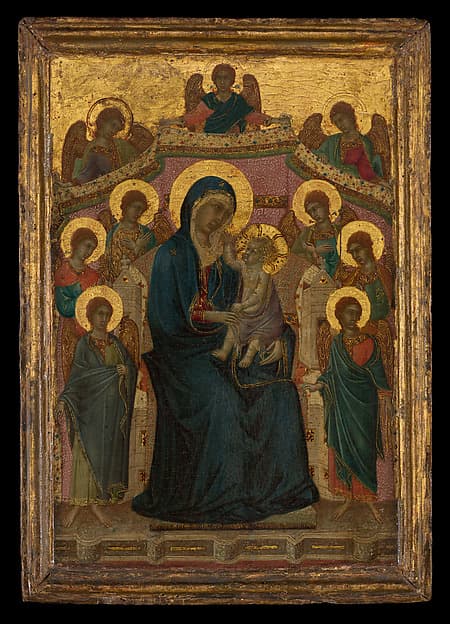
Madonna and Child with Nine Angels
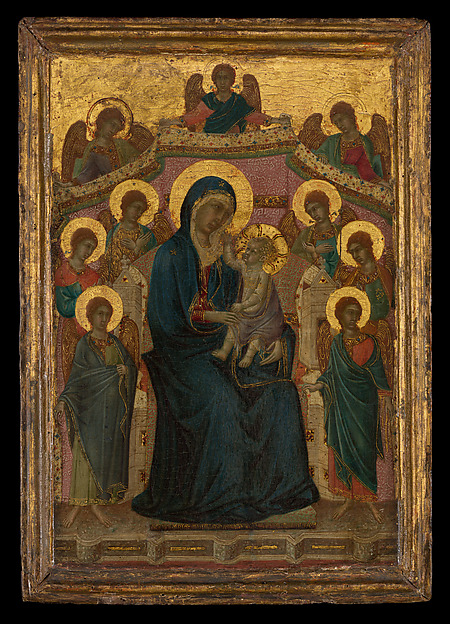
Madonna and Child with Nine Angels, painted by Segna di Buonaventura around 1312 in tempera and gold on panel and now in the Metropolitan Museum of Art in New York, is a small intimate Marian devotional panel from his middle Sienese workshop years. The Virgin sits in three-quarter view holding the standing Christ Child upright on her lap; nine attending angels — in three rows of three — occupy the spaces around the central group. The chromatic palette of saturated crimson, ultramarine, and tooled gold against the patterned gold-tooled background is the unmistakable late-Duccian Sienese signature, and the panel demonstrates Segna's close stylistic relationship to Duccio's contemporary Maestà altarpiece for Siena Cathedral.
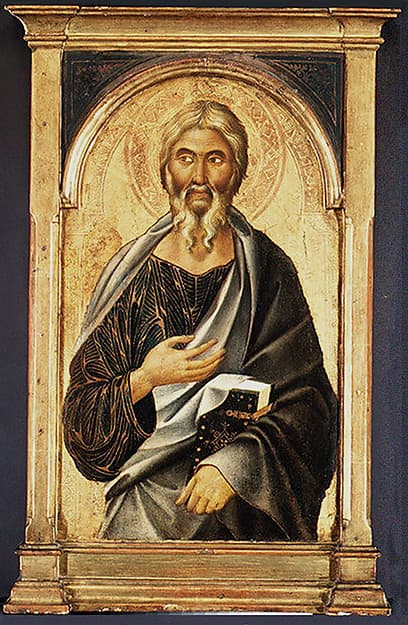
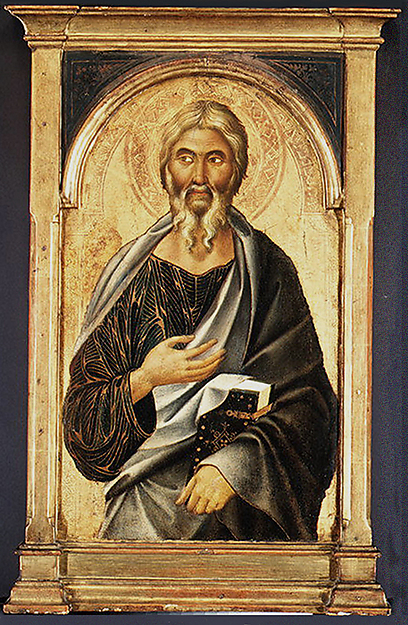
Saint John the Evangelist, painted by Segna di Buonaventura around 1315 in tempera and gold on panel and now in the Metropolitan Museum of Art in New York, depicts the youngest of the four evangelists in the conventional iconographic posture of his apostolic teaching — standing in three-quarter view holding a small book and a small palm of martyrdom. The chromatic palette of saturated rose, ultramarine, and tooled gold against the patterned gold-tooled background is the unmistakable mid-career Segna signature. The panel was originally part of one of his Sienese polyptych altarpieces with the Virgin and Christ Child at the center and individual evangelists in the side panels.
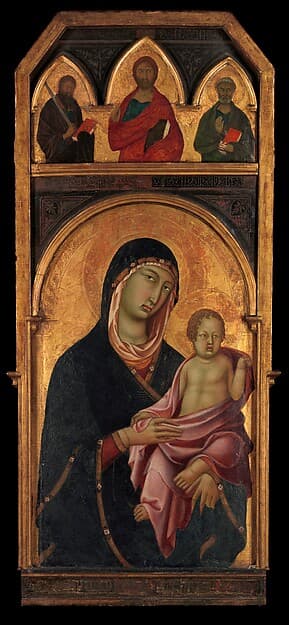
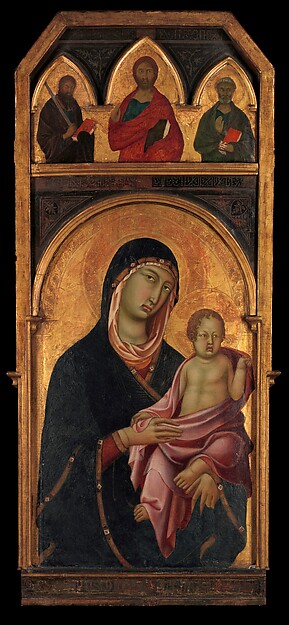
Madonna and Child, painted by Segna di Buonaventura around 1315 in tempera and gold on panel and now in the Metropolitan Museum of Art in New York, is another of his small intimate Marian devotional panels. The Virgin sits in three-quarter view holding the standing Christ Child upright on her lap; the chromatic palette and the tooled-gold background continue the late-Duccian Sienese workshop signature. The painting is among the principal small Segna Madonnas in any American collection and demonstrates the patient Sienese workshop continuation of the Duccian pictorial tradition through the first generation after Duccio's death in 1319.
Bible scenes Segna di Buonaventura painted
Luke
Revelation
Matthew