Who was Harbonah in the Bible?
Harbonah was a royal attendant who pointed out the gallows Haman had built, sealing Haman’s fate.
Royal Eunuch at the King’s Table
5th century BC
Harbonah was a royal attendant who pointed out the gallows Haman had built, sealing Haman’s fate.
Follow the reading trailBEYOND THE NAME
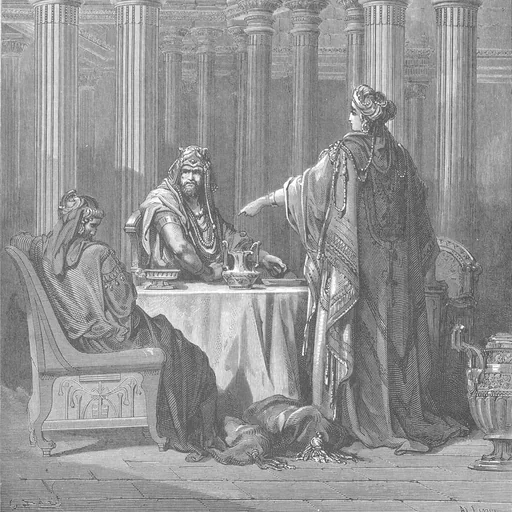
Harbonah was one of the eunuchs who served before King Ahasuerus. At the banquet where Esther exposed Haman’s plot, it was Harbonah who told the king of the tall gallows Haman had prepared at his own house for Mordecai, the man who had once saved the king’s life. At his word the king ordered Haman hanged on that very gallows, and the king’s anger was satisfied.
Themes in the authored commentary
These entries connect the study to the source’s recorded family context. Read their cautions when the family records or identifications differ.
FOLLOW THE PASSAGES
These are chapter studies associated with this record. Their order follows the books and chapters, rather than a reconstructed timeline of the person’s life.
chamberlain who informs the king of the gallows Haman built for Mordecai, prompting the execution order
The whole book of Esther moves toward this room. Twice now the king has promised the queen anything she asks, even to half his kingdom; twice he has waited at her table. Behind one wine cup sits Haman, who has bought from the king, with ten thousand talents of silver, a decree to destroy every Jew in a hundred and twenty-seven provinces - not knowing that the queen across the table is herself a Jew. The reader knows what the king does not, and what Haman cannot imagine.
Chapter overview from the authored study guide.THE PEOPLE AROUND THE PERSON
Relationships follow the source graph. Some are interpretive or uncertain, and individual verse citations are not yet available for every connection.
STUDY & INTERPRETATION
Harbonah speaks only once in Esther 7, yet his words fall at the precise moment that turns the king’s wrath into judgment, completing the great reversal the book has been building toward. By naming the gallows Haman raised for a loyal man, he ensures that the instrument of intended murder becomes the instrument of justice. The scene shows evil undone not by the schemes of the righteous but by the unraveling of the wicked man’s own designs. Through an attendant’s single timely sentence, the story testifies that deliverance and judgment can hinge on the smallest faithful act, and that the snare laid for the innocent has a way of catching the one who set it.
From the Learn of Christ person commentary. Read alongside the linked Scripture passages.KEEP SCRIPTURE CLOSE
1 authored chapter guide features this person. This is guide coverage, not an exhaustive count of biblical mentions.
ASK A BETTER QUESTION
Identity, story, early-life sources, family, and where to read.
Names and spellings in the source: Harbonah · Harbona
Harbonah was a royal attendant who pointed out the gallows Haman had built, sealing Haman’s fate.
Harbonah was one of the eunuchs who served before King Ahasuerus. At the banquet where Esther exposed Haman’s plot, it was Harbonah who told the king of the tall gallows Haman had prepared at his own house for Mordecai, the man who had once saved the king’s life. At his word the king ordered Haman hanged on that very gallows, and the king’s anger was satisfied.
The individualized passage index associates this Harbonah record with Esther. There is 1 distinct indexed verse reference in the 66-book Bible. Browse the book-by-book list below; it separates this identity from other people who share the name. Source assignments and textual identifications can require interpretation.
A separate childhood account for Harbonah is not provided in our current authored profile sources. Begin with Esther 7:9 and the passages linked here for the evidence that is available. The first indexed reference to a name is not a birth record. This profile does not establish a birth date, schooling, or childhood events beyond what its sources state.
The current source graph does not list immediate family for Harbonah. That is a limit of this data, not evidence that Harbonah had no relatives. Read the cited passages for the details they actually give.
Harbonah speaks only once in Esther 7, yet his words fall at the precise moment that turns the king’s wrath into judgment, completing the great reversal the book has been building toward. By naming the gallows Haman raised for a loyal man, he ensures that the instrument of intended murder becomes the instrument of justice.
Answers draw on our existing authored biography and linked chapter studies. Where supplied, verse assignments come from the individualized STEP Bible index. Childhood answers distinguish documented events from gaps in the available sources.
FIND THE PERSON IN THE TEXT
1 distinct verse references in the source’s 66-book index. These are indexed name assignments, rather than every indirect allusion to this person. A name may also refer to descendants, a tribe, or a nation; read each passage to distinguish that usage from the individual.
“And Harbonah, one of the chamberlains, said before the king, Behold also, the gallows fifty cubits high, which Haman had made for Mordecai, who had spoken good for the king, standeth in the house of Haman. Then the king said, Hang him thereon.”
Esther 7:9 · King James Version
References are adapted from STEP Bible / Tyndale House TIPNR (CC BY 4.0). Deduplicated, matched to this identity, and checked against the bundled KJV’s verse bounds. Interpretive assignments and translation/versification differences may remain. This index is separate from evidence for individual family relationships.
YOUR OWN OBSERVATIONS
Notes, saved people, and study marks stay in this browser. They do not sync to your account.
KEEP EXPLORING
People featured in the same study guides. Sharing a chapter does not establish a family relationship.