Who was Esther in the Bible?
Esther was a Jewish woman who became queen of Persia and bravely risked her life to save her people from destruction.
Queen of Persia and Deliverer of Her People
Persian Period
Esther was a Jewish woman who became queen of Persia and bravely risked her life to save her people from destruction.
Follow the reading trailBEYOND THE NAME
Esther, also called Hadassah, was a young Jewish woman raised by her cousin Mordecai who was taken into the royal harem and chosen by King Ahasuerus to be queen. When Haman’s plot to destroy the Jews was set in motion, Mordecai urged her to plead with the king, and she resolved to approach him unsummoned, saying, “If I perish, I perish.” Through her courage and wisdom she exposed Haman and won deliverance for her people, an event remembered in the feast of Purim.
Themes in the authored commentary
FOLLOW THE PASSAGES
Selected passages and introductions help you read this person’s story in context.
young Jewish woman brought into the royal harem who wins the king's favor and becomes queen
Esther enters the royal household and becomes queen, while Mordecai remains involved in her life. The chapter establishes their family connection, her concealed identity, and the court setting in which the later crisis unfolds.
receives Mordecai's plea through messengers, weighs the danger of approaching the king unsummoned, and resolves to act
Mordecai urges Esther to act after the threat against the Jews becomes known. Esther considers the danger of approaching the king and calls for fasting. Her decision moves the story from preparation toward direct intervention.
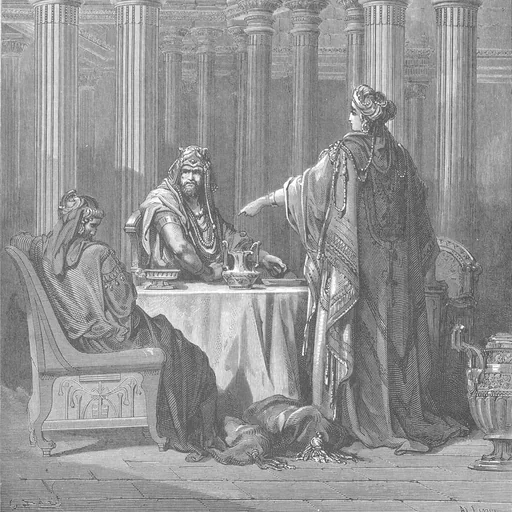
at the second banquet reveals to the king that she is Jewish and that Haman has plotted to destroy her people
At the banquet, Esther identifies herself with the threatened people and names Haman as their adversary. The king’s response overturns Haman’s position. The wider resolution of the danger continues in the following chapters.
THE PEOPLE AROUND THE PERSON
Recorded parents
Relationships follow the source graph. Some are interpretive or uncertain, and individual verse citations are not yet available for every connection.
STUDY & INTERPRETATION
Esther’s story unfolds in a foreign court far from the land of promise, where God’s name is never spoken aloud yet His hand is unmistakable in the turns of events. Mordecai’s words to her, that she had perhaps come to royal position “for such a time as this,” frame her rise as part of a purpose larger than herself. Her willingness to risk her life for her people places her among those who stood in the gap between danger and rescue, interceding at great personal cost. In her courageous mediation on behalf of a condemned people, readers have long glimpsed a foreshadowing of the greater deliverance accomplished by the One who laid down His life to save those marked for death.
From the Learn of Christ person commentary. Read alongside the linked Scripture passages.KEEP SCRIPTURE CLOSE
6 authored chapter guides feature this person. This is guide coverage, not an exhaustive count of biblical mentions.
ASK A BETTER QUESTION
Identity, story, early-life sources, family, and where to read.
Names and spellings in the source: Esther · Hadassah
Esther was a Jewish woman who became queen of Persia and bravely risked her life to save her people from destruction.
Esther, also called Hadassah, was a young Jewish woman raised by her cousin Mordecai who was taken into the royal harem and chosen by King Ahasuerus to be queen. When Haman’s plot to destroy the Jews was set in motion, Mordecai urged her to plead with the king, and she resolved to approach him unsummoned, saying, “If I perish, I perish.” Through her courage and wisdom she exposed Haman and won deliverance for her people, an event remembered in the feast of Purim.
The individualized passage index associates this Esther record with Esther. There are 45 distinct indexed verse references in the 66-book Bible. Browse the book-by-book list below; it separates this identity from other people who share the name. Source assignments and textual identifications can require interpretation.
Esther 2 says Esther had lost both parents and was brought up by Mordecai, her cousin, who took her as his own daughter. It names her also as Hadassah. The book gives this family background without a full account of her childhood.
Esther’s source record lists Abihail (father). These are source-graph relationships; legal family, uncertain identifications, and ancestral language require the cautions below. Individual verse evidence is not yet retained for every family edge.
Esther’s story unfolds in a foreign court far from the land of promise, where God’s name is never spoken aloud yet His hand is unmistakable in the turns of events. Mordecai’s words to her, that she had perhaps come to royal position “for such a time as this,” frame her rise as part of a purpose larger than herself.
Answers draw on our existing authored biography and linked chapter studies. Where supplied, verse assignments come from the individualized STEP Bible index. Childhood answers distinguish documented events from gaps in the available sources.
FIND THE PERSON IN THE TEXT
45 distinct verse references in the source’s 66-book index. These are indexed name assignments, rather than every indirect allusion to this person. A name may also refer to descendants, a tribe, or a nation; read each passage to distinguish that usage from the individual.
“And he brought up Hadassah, that is, Esther, his uncle’s daughter: for she had neither father nor mother, and the maid was fair and beautiful; whom Mordecai, when her father and mother were dead, took for his own daughter.”
Esther 2:7 · King James Version
“And they told to Mordecai Esther’s words.”
Esther 4:12 · King James Version
“And the king said again unto Esther on the second day at the banquet of wine, What is thy petition, queen Esther? and it shall be granted thee: and what is thy request? and it shall be performed, even to the half of the kingdom.”
Esther 7:2 · King James Version
“And the decree of Esther confirmed these matters of Purim; and it was written in the book.”
Esther 9:32 · King James Version
References are adapted from STEP Bible / Tyndale House TIPNR (CC BY 4.0). Deduplicated, matched to this identity, and checked against the bundled KJV’s verse bounds. Interpretive assignments and translation/versification differences may remain. This index is separate from evidence for individual family relationships.
YOUR OWN OBSERVATIONS
Notes, saved people, and study marks stay in this browser. They do not sync to your account.
KEEP EXPLORING
People featured in the same study guides. Sharing a chapter does not establish a family relationship.