
Who was Ahasuerus in the Bible?
Ahasuerus was the king of Persia who removed Queen Vashti, chose Esther as his new queen, and later allowed the Jews to defend themselves.
King of Persia
5th century BC
Ahasuerus was the king of Persia who removed Queen Vashti, chose Esther as his new queen, and later allowed the Jews to defend themselves.
Follow the reading trailBEYOND THE NAME
Ahasuerus ruled a vast empire stretching from India to Cush and reigned from the citadel of Susa, where the book of Esther opens with his lavish banquet. After deposing Queen Vashti for refusing his summons, he chose Esther as queen, elevated Haman to high office, and unknowingly sealed a decree that endangered Esther’s own people. When Esther exposed Haman’s plot, the king turned against his minister and granted the Jews the means to defend themselves.
Themes in the authored commentary
FOLLOW THE PASSAGES
These are chapter studies associated with this record. Their order follows the books and chapters, rather than a reconstructed timeline of the person’s life.
Persian king who hosts a lavish feast and orders Queen Vashti to appear before his guests
The book of Esther opens at the height of imperial Persia. King Ahasuerus - almost certainly Xerxes I (486-465 BC), the same emperor who would shortly march on Greece, lose Thermopylae and Salamis, and limp home - sits on the throne of an empire that runs from India to Ethiopia and includes 127 provinces. The chapter is dated to his third year (483 BC), which Greek historians place exactly on the eve of his Greek campaign. The 180-day feast the chapter describes is, in the most plausible scholarly reconstruction, the war council and propaganda display that preceded the invasion of Greece.
Chapter overview from the authored study guide.king who promotes Haman and grants him authority to seal the decree against the Jews
Esther 3 opens with the king promoting a courtier named Haman the Agagite, son of Hammedatha. The detail of his ancestry is the chapter’s most important footnote: Haman is a descendant of Agag, the Amalekite king Saul was commanded to put to death in 1 Samuel 15 and did not. The Amalekites were the people who attacked Israel from behind in the wilderness immediately after the exodus - and the LORD told Moses, I will utterly put out the remembrance of Amalek from under heaven… the LORD will have war with Amalek from generation to generation (Ex. 17:14, 16). Mordecai, the chapter’s other principal, is a Benjamite - descended from Kish (Esth.
Chapter overview from the authored study guide.extends his golden scepter to Esther and agrees to her request to attend her banquet
Esther 4 closed with the queen’s line that has echoed across two and a half millennia of Jewish and Christian memory: I will go in unto the king, which is not according to the law: and if I perish, I perish (4:16). She had asked Mordecai and the Jews of Susa to fast with her for three days and nights. Chapter 5 opens on the morning of the third day. The same third-day motif the Bible uses for Isaac walking up Moriah (Gen. 22:4), Joseph releasing his brothers from prison (Gen. 42:18), Israel meeting God at Sinai (Ex. 19:11, 16), Jonah emerging from the fish (Jon. 1:17), and Hosea’s promise that God will raise His people up (Hos.
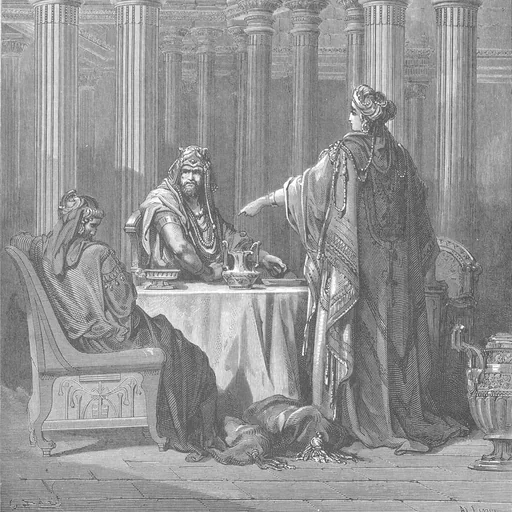
Chapter overview from the authored study guide.enraged by Haman's treachery, orders him hanged on the very gallows he built for Mordecai
The whole book of Esther moves toward this room. Twice now the king has promised the queen anything she asks, even to half his kingdom; twice he has waited at her table. Behind one wine cup sits Haman, who has bought from the king, with ten thousand talents of silver, a decree to destroy every Jew in a hundred and twenty-seven provinces - not knowing that the queen across the table is herself a Jew. The reader knows what the king does not, and what Haman cannot imagine.
Chapter overview from the authored study guide.gives Haman's estate to Esther and grants Mordecai his signet ring, then allows a counter-decree to be written
It is the same day. In the chapter just behind us, Haman’s plot was unmasked at Esther’s banquet and he was hanged that very hour on the gallows he had built for Mordecai. The enemy is gone. But the chapter opens on a sobering truth: the enemy’s word is not gone. The letters Haman sealed in the king’s name - ordering that on the thirteenth day of Adar every Jew, young and old, women and children, be destroyed - have already gone out to all hundred twenty and seven provinces. And the law of the Medes and Persians is unbending: a writing sealed with the king’s ring may no man reverse. Not even the king who wrote it.
Chapter overview from the authored study guide.levies tribute on the land and islands, with his greatness recorded in the royal chronicles
The book of Esther ends almost without a plot. Three verses, and the empire looks much as it did in chapter one. King Ahasuerus levies a tribute on the land and even the distant isles of the sea; his deeds and Mordecai’s deeds are entered in the official chronicles of the kings of Media and Persia; and Mordecai - the Jewish exile who refused to bow to Haman the Agagite, the man for whom a gallows fifty cubits high was built - is now next unto king Ahasuerus. The same king sits on the same throne. The same provinces pay the same taxes. The Jewish people are still a scattered minority within a world-empire that has not been remade.
Chapter overview from the authored study guide.THE PEOPLE AROUND THE PERSON
Recorded parents
Recorded spouses
Recorded children
Relationships follow the source graph. Some are interpretive or uncertain, and individual verse citations are not yet available for every connection.
STUDY & INTERPRETATION
Ahasuerus presides over the events of Esther as a powerful but easily swayed monarch, ruling by impulse, banquet, and the counsel of those nearest him. The book never names God outright, yet the king’s sleepless night, his sudden reading of the royal records, and his timely change of heart reveal a hidden hand guiding events behind the visible throne. Through his decrees and reversals, a people marked for destruction are instead delivered, showing that the highest human authority is itself subject to a purpose it cannot see. The quiet providence that turns a pagan king’s whims toward the rescue of God’s people testifies to the One who works all things toward the preservation of the line through which redemption would come.
From the Learn of Christ person commentary. Read alongside the linked Scripture passages.KEEP SCRIPTURE CLOSE
9 authored chapter guides feature this person. This is guide coverage, not an exhaustive count of biblical mentions.
ASK A BETTER QUESTION
Identity, story, early-life sources, family, and where to read.
Names and spellings in the source: Ahasuerus · Xerxes
Ahasuerus was the king of Persia who removed Queen Vashti, chose Esther as his new queen, and later allowed the Jews to defend themselves.
Ahasuerus ruled a vast empire stretching from India to Cush and reigned from the citadel of Susa, where the book of Esther opens with his lavish banquet. After deposing Queen Vashti for refusing his summons, he chose Esther as queen, elevated Haman to high office, and unknowingly sealed a decree that endangered Esther’s own people. When Esther exposed Haman’s plot, the king turned against his minister and granted the Jews the means to defend themselves.
The individualized passage index associates this Ahasuerus record with Ezra, Esther, Daniel. There are 29 distinct indexed verse references in the 66-book Bible. Browse the book-by-book list below; it separates this identity from other people who share the name. Source assignments and textual identifications can require interpretation.
A separate childhood account for Ahasuerus is not provided in our current authored profile sources. Begin with Ezra 4:6 and the passages linked here for the evidence that is available. The first indexed reference to a name is not a birth record. This profile does not establish a birth date, schooling, or childhood events beyond what its sources state.
Ahasuerus’s source record lists Darius (father), Vashti (spouse), Artaxerxes (child), Darius (child). These are source-graph relationships; legal family, uncertain identifications, and ancestral language require the cautions below. Individual verse evidence is not yet retained for every family edge.
Ahasuerus presides over the events of Esther as a powerful but easily swayed monarch, ruling by impulse, banquet, and the counsel of those nearest him. The book never names God outright, yet the king’s sleepless night, his sudden reading of the royal records, and his timely change of heart reveal a hidden hand guiding events behind the visible throne.
Answers draw on our existing authored biography and linked chapter studies. Where supplied, verse assignments come from the individualized STEP Bible index. Childhood answers distinguish documented events from gaps in the available sources.
FIND THE PERSON IN THE TEXT
29 distinct verse references in the source’s 66-book index. These are indexed name assignments, rather than every indirect allusion to this person. A name may also refer to descendants, a tribe, or a nation; read each passage to distinguish that usage from the individual.
“And in the reign of Ahasuerus, in the beginning of his reign, wrote they unto him an accusation against the inhabitants of Judah and Jerusalem.”
Ezra 4:6 · King James Version
“After these things, when the wrath of king Ahasuerus was appeased, he remembered Vashti, and what she had done, and what was decreed against her.”
Esther 2:1 · King James Version
“Then the king Ahasuerus answered and said unto Esther the queen, Who is he, and where is he, that durst presume in his heart to do so?”
Esther 7:5 · King James Version
“In the first year of Darius the son of Ahasuerus, of the seed of the Medes, which was made king over the realm of the Chaldeans;”
Daniel 9:1 · King James Version
References are adapted from STEP Bible / Tyndale House TIPNR (CC BY 4.0). Deduplicated, matched to this identity, and checked against the bundled KJV’s verse bounds. Interpretive assignments and translation/versification differences may remain. This index is separate from evidence for individual family relationships.
YOUR OWN OBSERVATIONS
Notes, saved people, and study marks stay in this browser. They do not sync to your account.
KEEP EXPLORING
People featured in the same study guides. Sharing a chapter does not establish a family relationship.