Esther 1
People in this chapter
The book of Esther opens at the height of imperial Persia. King Ahasuerus - almost certainly Xerxes I (486-465 BC), the same emperor who would shortly march on Greece, lose Thermopylae and Salamis, and limp home - sits on the throne of an empire that runs from India to Ethiopia and includes 127 provinces. The chapter is dated to his third year (483 BC), which Greek historians place exactly on the eve of his Greek campaign.
The 180-day feast the chapter describes is, in the most plausible scholarly reconstruction, the war council and propaganda display that preceded the invasion of Greece. Everything in the opening verses is calibrated to communicate one thing: this king cannot be refused.
Tap any highlighted phrase to jump to the commentary that unpacks it.
Esther 1:1-4The Empire on Display
1Now it came to pass in the days of Ahasuerus, (this is Ahasuerus which reigned, from India even unto Ethiopia, over an hundred and seven and twenty provinces:) 2That in those days, when the king Ahasuerus sat on the throne of his kingdom, which was in Shushan the palace, 3In the third year of his reign, he made a feast unto all his princes and his servants; the power of Persia and Media, the nobles and princes of the provinces, being before him: 4When he shewed the riches of his glorious kingdom and the honour of his excellent majesty many days, even an hundred and fourscore days.
Ahasuerus is almost certainly the Hebrew transliteration of the Persian throne-name Khshayarsha - the king the Greek world called Xerxes1. He reigned 486-465 BC, son of Darius I, and is the same Xerxes Herodotus describes invading Greece in 480, losing the naval battle of Salamis, and limping home. The Hebrew dates Esther's feast to his third year - 483 BC - which is exactly when Herodotus reports him convening a huge council to plan the Greek invasion2.
The 180-day display of v. 4 is, in the most plausible historical reading, the war council that preceded the campaign. The chapter is documenting an empire at its high-water mark, days before the wave breaks.
Six months of feast. The chapter is not subtle. He shewed the riches of his glorious kingdom and the honour of his excellent majesty many days, even an hundred and fourscore days. The Hebrew piles up the vocabulary of display (osher kavod, “the riches of glory”; yeqar tipheret, “the honor of beauty”) until the reader is exhausted by the inventory. The Chronicler-of-Esther is being intentional. By the time Vashti refuses in v. 12, the reader is supposed to be saturated with the king's sense of his own greatness.
Half a year is what it took to set up the joke.
Esther 1:5-9The Garden Feast - and Vashti's Counter-Feast
5And when these days were expired, the king made a feast unto all the people that were present in Shushan the palace, both unto great and small, seven days, in the court of the garden of the king’s palace; 6Where were white, green, and blue, hangings, fastened with cords of fine linen and purple to silver rings and pillars of marble: the beds were of gold and silver, upon a pavement of red, and blue, and white, and black, marble. 7And they gave them drink in vessels of gold, (the vessels being diverse one from another,) and royal wine in abundance, according to the state of the king. 8And the drinking was according to the law; none did compel: for so the king had appointed to all the officers of his house, that they should do according to every man’s pleasure. 9Also Vashti the queen made a feast for the women in the royal house which belonged to king Ahasuerus.
The detail piles up. Hangings of three colors fastened by linen cords to silver rings and marble pillars. Couches (the “beds” were the dining-couches Persian banquets used) of gold and silver. A four-color marble pavement. Gold vessels every one different. The text is breathless. The chapter is doing for Ahasuerus' banquet what the closing chapters of 1 Kings did for Solomon's temple - itemizing the splendor until the reader feels the weight of it.
The difference is what the splendor is for. Solomon's gold furnished the house of the LORD. Ahasuerus' gold furnishes the house of his own ego.
Verse 8 is one of the chapter's most quietly damning notes. The drinking was according to the law; none did compel. Greek historians describe Persian court banquets as famously coercive - guests were expected to drink whatever and however much the king ordered. Ahasuerus's relaxation of the rule is being framed as a magnanimous favor. But the very fact that the chapter has to mention it tells you what the default was. The king's “freedom” is the freedom an absolute monarch grants when he feels generous. Real freedom does not need to be granted by anyone's law.
Verse 9 is the chapter's most underread sentence. Also Vashti the queen made a feast for the women in the royal house which belonged to king Ahasuerus. The queen has her own party going. She is in her own house, hosting her own guests, presiding over her own assembly. The Bible spends only one short sentence on it, but the geography is the chapter's setup. Vashti has been a queen with her own court.
When the king sends seven chamberlains to fetch her in v. 10, he is summoning her out of one assembly into another - taking her from the role of host and putting her in the role of object. The chapter asks the reader to notice what is being asked.
Esther 1:10-12Vashti Refused
10On the seventh day, when the heart of the king was merry with wine, he commanded Mehuman, Biztha, Harbona, Bigtha, and Abagtha, Zethar, and Carcas, the seven chamberlains that served in the presence of Ahasuerus the king, 11To bring Vashti the queen before the king with the crown royal, to shew the people and the princes her beauty: for she was fair to look on. 12But the queen Vashti refused to come at the king’s commandment by his chamberlains: therefore was the king very wroth, and his anger burned in him.
Seven days into a seven-day garden party, on the seventh day, drunk on royal wine, the king sends seven chamberlains (the chapter is leaning hard on sevens) to bring the queen out for inspection. The Hebrew is blunt: lehar'ot ha'ammim ve-hassarim et yofyah - “to show the peoples and the princes her beauty.” The verb lehar'ot is the same verb used in v. 4 of showing off the riches of the kingdom.
Vashti is being summoned as the final exhibit. She is to walk into the climax of the king's display the same way the gold cups and marble pillars walked in earlier - to be looked at.
Two Hebrew words: vatte'ma'en vashti - “and Vashti refused.” No speech. No protest. No explanation. The text spends six chapters describing what the king commanded and one verb describing what the queen did. The chapter does not tell the reader what to think of her. It just records that she said no, and then it records what her no cost her: the king's anger burned. Hamato ba'arah bo - “his fury burned within him.” The reader is being shown the temperament of the man God will spend the rest of the book working through.
Esther 1:13-17The Panel That Feared Every Wife in Persia
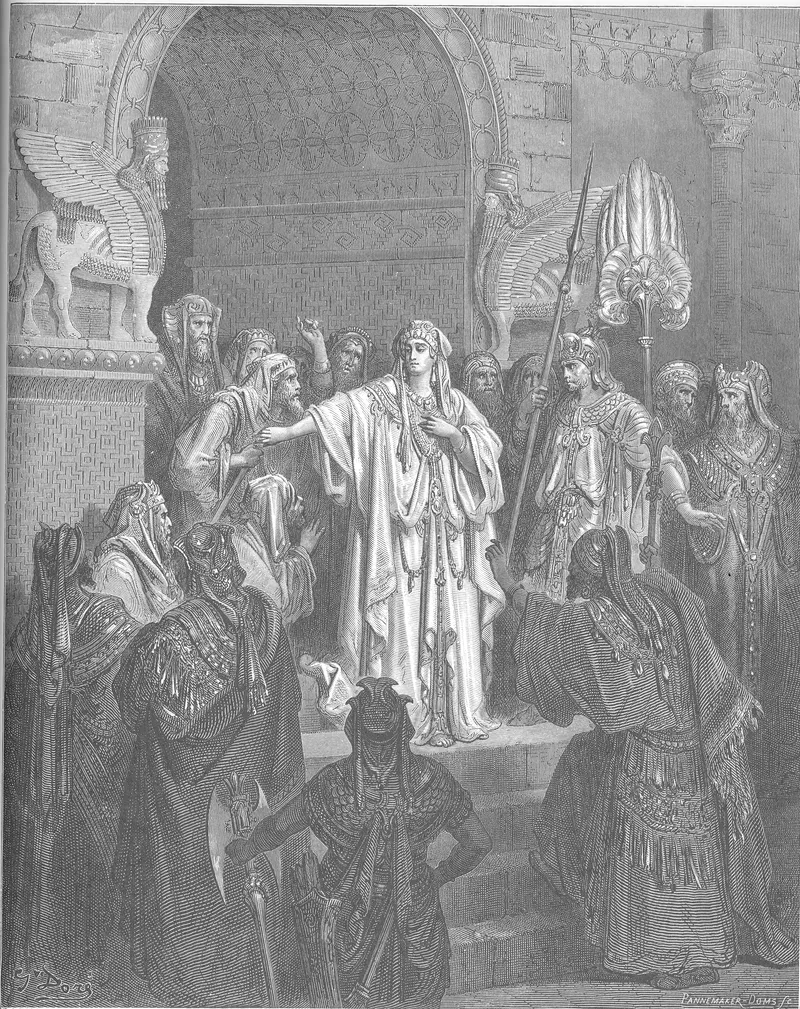
13Then the king said to the wise men, which knew the times, (for so was the king’s manner toward all that knew law and judgment: 15What shall we do unto the queen Vashti according to law, because she hath not performed the commandment of the king Ahasuerus by the chamberlains? 16And Memucan answered before the king and the princes, Vashti the queen hath not done wrong to the king only, but also to all the princes, and to all the people that are in all the provinces of the king Ahasuerus. 17For this deed of the queen shall come abroad unto all women, so that they shall despise their husbands in their eyes, when it shall be reported, The king Ahasuerus commanded Vashti the queen to be brought in before him, but she came not.
The king does not punish Vashti himself. He convenes his “wise men, which knew the times.” The Chronicler-of-Esther is being quietly comic. The greatest empire on earth, the king at the height of his self-display, cannot decide how to handle a queen who said no, and so a panel of seven legal scholars is summoned to draft an emergency response. Memucan's speech in vv. 16-20 is the centerpiece of the chapter's satire.
He argues that if Vashti is not punished, the news will travel to all 127 provinces, and every wife in the empire will refuse her husband. The Persian patriarchy is so fragile that the entire structure can be brought down by one queen who said no on the seventh day of a drinking party.
Esther 1:19-22The Decree the Empire Could Not Take Back
19If it please the king, let there go a royal commandment from him, and let it be written among the laws of the Persians and the Medes, that it be not altered, That Vashti come no more before king Ahasuerus; and let the king give her royal estate unto another that is better than she. 21And the saying pleased the king and the princes; and the king did according to the word of Memucan: 22For he sent letters into all the king’s provinces, into every province according to the writing thereof, and to every people after their language, that every man should bear rule in his own house, and that it should be published according to the language of every people.
Memucan's solution is to write the punishment into the unchangeable laws of the Persians and Medes. The phrase will return in chapter 8 with devastating effect: when Haman's genocidal decree against the Jews has gone out under the same unchangeable Persian law, Esther cannot have it revoked; she can only have a counter-decree issued. The king who in chapter one writes a law to make sure no woman ever refuses him again is the same king who in chapter eight cannot save his own people because his own decrees cannot be undone.
The chapter is planting the seed for the very plot device that will almost destroy the Jews - and then, in Esther's hands, save them.
Research trail
Sources & further study
These references support the historical, linguistic, manuscript, and contextual notes in this chapter. Scripture remains the primary text; external sources are provided so readers can inspect the research directly.
- Esther and the Persian CourtSBL overview of the book of Esther - historical setting under Xerxes I, the hidden-God theme, and the relationship between the Hebrew text and Greek histories of Persia.
- Xerxes' Council Before the Greek InvasionHerodotus 7.8 records a large royal council convened by Xerxes early in his reign to plan the Greek invasion - widely identified by historians with the 180-day display Esther 1 describes in his third year.
- Esther 1 · Hebrew + Jewish commentaryHebrew text with Rashi, Ibn Ezra, and the classical rabbinic interpretation of Ahasuerus's feast and Vashti's refusal - including the Talmud's widely-debated reading (Megillah 12b) that Vashti was commanded to appear wearing only the royal crown.
- Susa and the Achaemenid CourtThe OI's ongoing work on Achaemenid Persia, including the palace at Susa where Esther 1 is set. The audience hall (apadana) and royal apartments excavated by Loftus, Dieulafoy, and de Morgan are the physical setting of the chapter.
Where this echoes in Scripture
The Empire on Display
- Daniel 4:30-32Is not this great Babylon, that I have built… While the word was in the king's mouth…Another Persian-era boast on the eve of a divine humbling - same dynamic as Esther 1.
- 1 Corinthians 7:31The fashion of this world passeth away.Paul on the short shelf-life of every empire's self-display.
The Garden Feast - and Vashti's Counter-Feast
Vashti Refused
The Decree the Empire Could Not Take Back
- Esther 8:8The writing which is written in the king's name, and sealed with the king's ring, may no man reverse.The unchangeable Persian law of chapter one becomes the chapter-eight plot crisis Haman's decree creates.
- Colossians 2:14Blotting out the handwriting of ordinances that was against us, which was contrary to us, and took it out of the way, nailing it to his cross.Paul on the only law that finally outranks the unchangeable ones written against the believer.
- Hebrews 12:24And to Jesus the mediator of the new covenant, and to the blood of sprinkling, that speaketh better things than that of Abel.The newer word - louder than every old decree.