Who was Mordecai in the Bible?
Mordecai was a Jewish man in the Persian capital who raised his orphaned cousin Esther and helped save his people from destruction.
Guardian of Esther and Deliverer of His People
c. 480 BC
Mordecai was a Jewish man in the Persian capital who raised his orphaned cousin Esther and helped save his people from destruction.
Follow the reading trailBEYOND THE NAME
Mordecai, a Benjamite living in Susa, had raised Esther as his own daughter after her parents died, and he kept watch over her even after she became queen. He uncovered a plot against the king, yet refused to bow to the proud official Haman, who then schemed to destroy all the Jews. Through his urging, Esther risked her life to intercede, and in the end Mordecai was honored and raised to high office, with the deliverance of his people remembered ever after.
Themes in the authored commentary
These are other entries using this name. Compare their source passages before treating them as the same or different historical people.
FOLLOW THE PASSAGES
These are chapter studies associated with this record. Their order follows the books and chapters, rather than a reconstructed timeline of the person’s life.
Esther's cousin and guardian who keeps watch at the king's gate on her behalf
After Vashti is set aside, the king’s wrath cools - and an empty throne is left behind. His servants propose a remedy fit for an empire: Let there be fair young virgins sought for the king. Officers are appointed in every province; young women are gathered to Shushan the palace, into the house of the women, under the keeping of Hegai; and a long season of purification begins. The machinery of absolute power turns toward a single question - who will please the king and wear the crown? It is a story about a beauty contest in a pagan court, and on the surface God is nowhere in it.
Chapter overview from the authored study guide.Jewish man at the gate who refuses to bow to Haman, provoking Haman's genocidal plot
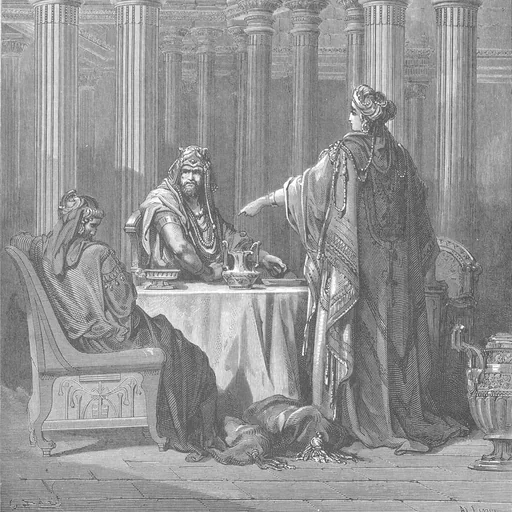
Esther 3 opens with the king promoting a courtier named Haman the Agagite, son of Hammedatha. The detail of his ancestry is the chapter’s most important footnote: Haman is a descendant of Agag, the Amalekite king Saul was commanded to put to death in 1 Samuel 15 and did not. The Amalekites were the people who attacked Israel from behind in the wilderness immediately after the exodus - and the LORD told Moses, I will utterly put out the remembrance of Amalek from under heaven… the LORD will have war with Amalek from generation to generation (Ex. 17:14, 16). Mordecai, the chapter’s other principal, is a Benjamite - descended from Kish (Esth.
Chapter overview from the authored study guide.sits at the king's gate and refuses to stand or bow to Haman, intensifying Haman's fury
Esther 4 closed with the queen’s line that has echoed across two and a half millennia of Jewish and Christian memory: I will go in unto the king, which is not according to the law: and if I perish, I perish (4:16). She had asked Mordecai and the Jews of Susa to fast with her for three days and nights. Chapter 5 opens on the morning of the third day. The same third-day motif the Bible uses for Isaac walking up Moriah (Gen. 22:4), Joseph releasing his brothers from prison (Gen. 42:18), Israel meeting God at Sinai (Ex. 19:11, 16), Jonah emerging from the fish (Jon. 1:17), and Hosea’s promise that God will raise His people up (Hos.
Chapter overview from the authored study guide.receives the honor Haman devised for himself - dressed in royal robes and paraded through the city square
That night - the night before Esther’s second banquet, the night after Haman has ordered a gallows built for Mordecai - could not the king sleep. A sleepless night is the smallest of things, the kind of trivial detail no chronicle bothers to record. But this is the night everything turns on, and it turns on a king who simply cannot close his eyes. Notice that the text gives no reason - no fever, no nightmare, no worry named. It says only that sleep would not come, and leaves the cause unspoken. The book of Esther never once mentions God; it works instead by letting the “accidents” pile up until the reader feels the hand behind them.
Chapter overview from the authored study guide.powerful figure whose fame spreads as the Jews strike their enemies; he and Esther establish the festival of Purim
For eight chapters the book of Esther has done something no other book in Scripture dares: it has told the whole story of a deliverance without once naming God. There are no miracles, no prophets, no voice from heaven - only a banquet, a sleepless night, a lot cast, a queen’s courage, and a chain of coincidences too precise to be chance. And now the appointed day arrives. In the twelfth month, that is, the month Adar, on the thirteenth day, the decree Haman engineered comes due - the day the enemies of the Jews hoped to have power over them. But the verse will not let the hope stand.
Chapter overview from the authored study guide.second in rank to King Ahasuerus, great among the Jews and beloved by his people as their advocate
The book of Esther ends almost without a plot. Three verses, and the empire looks much as it did in chapter one. King Ahasuerus levies a tribute on the land and even the distant isles of the sea; his deeds and Mordecai’s deeds are entered in the official chronicles of the kings of Media and Persia; and Mordecai - the Jewish exile who refused to bow to Haman the Agagite, the man for whom a gallows fifty cubits high was built - is now next unto king Ahasuerus. The same king sits on the same throne. The same provinces pay the same taxes. The Jewish people are still a scattered minority within a world-empire that has not been remade.
Chapter overview from the authored study guide.THE PEOPLE AROUND THE PERSON
Recorded parents
Relationships follow the source graph. Some are interpretive or uncertain, and individual verse citations are not yet available for every connection.
STUDY & INTERPRETATION
Mordecai stands at the center of a story in which the name of God is never spoken, yet His unseen hand governs every turn of events. His quiet faithfulness, his refusal to bow where conscience forbade, and his charge to Esther that she may have come to her position for such a time as this reveal a man who trusts that deliverance will arise for his people whether or not he can see how. The reversal that lifts him from the threat of the gallows to a seat of honor displays the providence that protects the covenant people through whom God’s promises would come. In preserving Israel from annihilation, the events surrounding Mordecai guard the very line through which the Savior of the world would one day be born.
From the Learn of Christ person commentary. Read alongside the linked Scripture passages.KEEP SCRIPTURE CLOSE
8 authored chapter guides feature this person. This is guide coverage, not an exhaustive count of biblical mentions.
ASK A BETTER QUESTION
Identity, story, early-life sources, family, and where to read.
Mordecai was a Jewish man in the Persian capital who raised his orphaned cousin Esther and helped save his people from destruction.
Mordecai, a Benjamite living in Susa, had raised Esther as his own daughter after her parents died, and he kept watch over her even after she became queen. He uncovered a plot against the king, yet refused to bow to the proud official Haman, who then schemed to destroy all the Jews. Through his urging, Esther risked her life to intercede, and in the end Mordecai was honored and raised to high office, with the deliverance of his people remembered ever after.
The individualized passage index associates this Mordecai record with Esther. There are 50 distinct indexed verse references in the 66-book Bible. Browse the book-by-book list below; it separates this identity from other people who share the name. Source assignments and textual identifications can require interpretation.
A separate childhood account for Mordecai is not provided in our current authored profile sources. Begin with Esther 2:5 and the passages linked here for the evidence that is available. The first indexed reference to a name is not a birth record. This profile does not establish a birth date, schooling, or childhood events beyond what its sources state.
Mordecai’s source record lists Jair (father). These are source-graph relationships; legal family, uncertain identifications, and ancestral language require the cautions below. Individual verse evidence is not yet retained for every family edge.
Mordecai stands at the center of a story in which the name of God is never spoken, yet His unseen hand governs every turn of events. His quiet faithfulness, his refusal to bow where conscience forbade, and his charge to Esther that she may have come to her position for such a time as this reveal a man who trusts that deliverance will arise for his people whether or not he can see how.
Answers draw on our existing authored biography and linked chapter studies. Where supplied, verse assignments come from the individualized STEP Bible index. Childhood answers distinguish documented events from gaps in the available sources.
FIND THE PERSON IN THE TEXT
50 distinct verse references in the source’s 66-book index. These are indexed name assignments, rather than every indirect allusion to this person. A name may also refer to descendants, a tribe, or a nation; read each passage to distinguish that usage from the individual.
“Now in Shushan the palace there was a certain Jew, whose name was Mordecai, the son of Jair, the son of Shimei, the son of Kish, a Benjamite;”
Esther 2:5 · King James Version
“Then called Esther for Hatach, one of the king’s chamberlains, whom he had appointed to attend upon her, and gave him a commandment to Mordecai, to know what it was, and why it was.”
Esther 4:5 · King James Version
“And Mordecai came again to the king’s gate. But Haman hasted to his house mourning, and having his head covered.”
Esther 6:12 · King James Version
“For Mordecai the Jew was next unto king Ahasuerus, and great among the Jews, and accepted of the multitude of his brethren, seeking the wealth of his people, and speaking peace to all his seed.”
Esther 10:3 · King James Version
References are adapted from STEP Bible / Tyndale House TIPNR (CC BY 4.0). Deduplicated, matched to this identity, and checked against the bundled KJV’s verse bounds. Interpretive assignments and translation/versification differences may remain. This index is separate from evidence for individual family relationships.
YOUR OWN OBSERVATIONS
Notes, saved people, and study marks stay in this browser. They do not sync to your account.
KEEP EXPLORING
People featured in the same study guides. Sharing a chapter does not establish a family relationship.