Who was Haman in the Bible?
Haman was a powerful official in Persia who plotted to destroy all the Jews but was exposed and brought to ruin.
Adversary of the Jews in Persia
Persian Period
Haman was a powerful official in Persia who plotted to destroy all the Jews but was exposed and brought to ruin.
Follow the reading trailBEYOND THE NAME
Haman the Agagite was raised by King Ahasuerus to the highest position in the empire, and all bowed to him except Mordecai the Jew. Enraged, Haman secured a decree to annihilate every Jew throughout the kingdom and built a tall gallows for Mordecai. His scheme unraveled when Esther exposed him before the king, and he was hanged on the very gallows he had prepared.
Themes in the authored commentary
FOLLOW THE PASSAGES
These are chapter studies associated with this record. Their order follows the books and chapters, rather than a reconstructed timeline of the person’s life.
high official who seeks to destroy all Jews throughout the empire after Mordecai refuses to bow to him
Esther 3 opens with the king promoting a courtier named Haman the Agagite, son of Hammedatha. The detail of his ancestry is the chapter’s most important footnote: Haman is a descendant of Agag, the Amalekite king Saul was commanded to put to death in 1 Samuel 15 and did not. The Amalekites were the people who attacked Israel from behind in the wilderness immediately after the exodus - and the LORD told Moses, I will utterly put out the remembrance of Amalek from under heaven… the LORD will have war with Amalek from generation to generation (Ex. 17:14, 16). Mordecai, the chapter’s other principal, is a Benjamite - descended from Kish (Esth.
Chapter overview from the authored study guide.attends Esther's first banquet but is enraged on his way home when Mordecai again refuses to bow
Esther 4 closed with the queen’s line that has echoed across two and a half millennia of Jewish and Christian memory: I will go in unto the king, which is not according to the law: and if I perish, I perish (4:16). She had asked Mordecai and the Jews of Susa to fast with her for three days and nights. Chapter 5 opens on the morning of the third day. The same third-day motif the Bible uses for Isaac walking up Moriah (Gen. 22:4), Joseph releasing his brothers from prison (Gen. 42:18), Israel meeting God at Sinai (Ex. 19:11, 16), Jonah emerging from the fish (Jon. 1:17), and Hosea’s promise that God will raise His people up (Hos.
Chapter overview from the authored study guide.arrives at the palace intending to ask permission to hang Mordecai, but is instead commanded to honor him publicly
That night - the night before Esther’s second banquet, the night after Haman has ordered a gallows built for Mordecai - could not the king sleep. A sleepless night is the smallest of things, the kind of trivial detail no chronicle bothers to record. But this is the night everything turns on, and it turns on a king who simply cannot close his eyes. Notice that the text gives no reason - no fever, no nightmare, no worry named. It says only that sleep would not come, and leaves the cause unspoken. The book of Esther never once mentions God; it works instead by letting the “accidents” pile up until the reader feels the hand behind them.
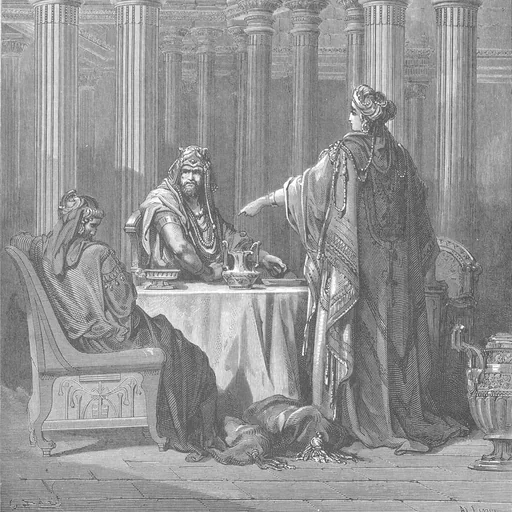
Chapter overview from the authored study guide.exposed as the enemy of the Jews by Esther and hanged on the gallows he prepared for Mordecai
The whole book of Esther moves toward this room. Twice now the king has promised the queen anything she asks, even to half his kingdom; twice he has waited at her table. Behind one wine cup sits Haman, who has bought from the king, with ten thousand talents of silver, a decree to destroy every Jew in a hundred and twenty-seven provinces - not knowing that the queen across the table is herself a Jew. The reader knows what the king does not, and what Haman cannot imagine.
Chapter overview from the authored study guide.THE PEOPLE AROUND THE PERSON
Recorded parents
Recorded spouses
Relationships follow the source graph. Some are interpretive or uncertain, and individual verse citations are not yet available for every connection.
STUDY & INTERPRETATION
Haman embodies the recurring threat to God’s covenant people, a proud enemy who sought to wipe them out for the offense of one man’s refusal to bow. His ancestry as an Agagite links him to Israel’s old foes, deepening the sense of an ancient enmity playing out again. The reversal of his fortunes, falling into the very destruction he had devised, displays a justice that turns the schemes of the wicked back upon themselves. His downfall, woven through events in which God’s name is never named yet His providence is everywhere felt, testifies that no plot against the people of God can finally prevail against the purposes of the Lord who watches over them.
From the Learn of Christ person commentary. Read alongside the linked Scripture passages.KEEP SCRIPTURE CLOSE
4 authored chapter guides feature this person. This is guide coverage, not an exhaustive count of biblical mentions.
ASK A BETTER QUESTION
Identity, story, early-life sources, family, and where to read.
Haman was a powerful official in Persia who plotted to destroy all the Jews but was exposed and brought to ruin.
Haman the Agagite was raised by King Ahasuerus to the highest position in the empire, and all bowed to him except Mordecai the Jew. Enraged, Haman secured a decree to annihilate every Jew throughout the kingdom and built a tall gallows for Mordecai. His scheme unraveled when Esther exposed him before the king, and he was hanged on the very gallows he had prepared.
The individualized passage index associates this Haman record with Esther. There are 45 distinct indexed verse references in the 66-book Bible. Browse the book-by-book list below; it separates this identity from other people who share the name. Source assignments and textual identifications can require interpretation.
A separate childhood account for Haman is not provided in our current authored profile sources. Begin with Esther 3:1 and the passages linked here for the evidence that is available. The first indexed reference to a name is not a birth record. This profile does not establish a birth date, schooling, or childhood events beyond what its sources state.
Haman’s source record lists Hammedatha (father), Zeresh (spouse), Parshandatha (child), Dalphon (child), Aspatha (child), Poratha (child), Adalia (child), Aridatha (child), and 4 additional recorded connections. These are source-graph relationships; legal family, uncertain identifications, and ancestral language require the cautions below. Individual verse evidence is not yet retained for every family edge.
Haman embodies the recurring threat to God’s covenant people, a proud enemy who sought to wipe them out for the offense of one man’s refusal to bow. His ancestry as an Agagite links him to Israel’s old foes, deepening the sense of an ancient enmity playing out again.
Answers draw on our existing authored biography and linked chapter studies. Where supplied, verse assignments come from the individualized STEP Bible index. Childhood answers distinguish documented events from gaps in the available sources.
FIND THE PERSON IN THE TEXT
45 distinct verse references in the source’s 66-book index. These are indexed name assignments, rather than every indirect allusion to this person. A name may also refer to descendants, a tribe, or a nation; read each passage to distinguish that usage from the individual.
“After these things did king Ahasuerus promote Haman the son of Hammedatha the Agagite, and advanced him, and set his seat above all the princes that were with him.”
Esther 3:1 · King James Version
“Then went Haman forth that day joyful and with a glad heart: but when Haman saw Mordecai in the king’s gate, that he stood not up, nor moved for him, he was full of indignation against Mordecai.”
Esther 5:9 · King James Version
“So the king and Haman came to banquet with Esther the queen.”
Esther 7:1 · King James Version
“Because Haman the son of Hammedatha, the Agagite, the enemy of all the Jews, had devised against the Jews to destroy them, and had cast Pur, that is, the lot, to consume them, and to destroy them;”
Esther 9:24 · King James Version
References are adapted from STEP Bible / Tyndale House TIPNR (CC BY 4.0). Deduplicated, matched to this identity, and checked against the bundled KJV’s verse bounds. Interpretive assignments and translation/versification differences may remain. This index is separate from evidence for individual family relationships.
YOUR OWN OBSERVATIONS
Notes, saved people, and study marks stay in this browser. They do not sync to your account.
KEEP EXPLORING
People featured in the same study guides. Sharing a chapter does not establish a family relationship.