Who was Holofernes in the Bible?
Holofernes was the proud Assyrian general sent to crush every nation that would not submit to his king.
Assyrian Commander
Assyrian era (narrative setting of Judith)
Holofernes was the proud Assyrian general sent to crush every nation that would not submit to his king.
Follow the reading trailBEYOND THE NAME
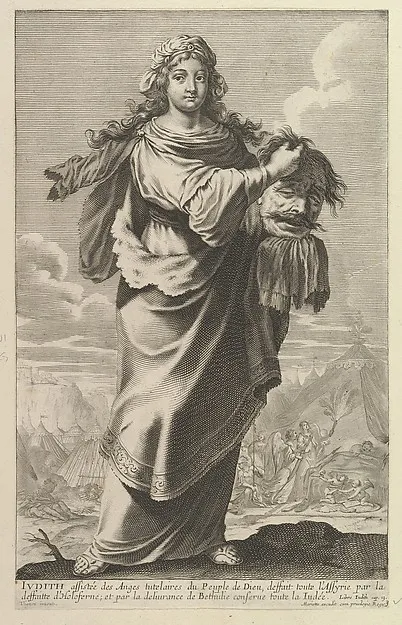
In the book of Judith, Holofernes is the chief commander of Nebuchadnezzar’s armies, dispatched to take vengeance on all the lands that had refused to join the war. He swept through the west with a vast host, demolishing shrines so that the king alone would be worshiped, and laid siege to the people of Bethulia. His campaign of terror ended in his own tent, where the widow Judith took his life and broke the spirit of his army.
Themes in the authored commentary
FOLLOW THE PASSAGES
These are chapter studies associated with this record. Their order follows the books and chapters, rather than a reconstructed timeline of the person’s life.
Assyrian general sent with a vast army to subdue and destroy the nations of the west
The oath of the previous chapter now becomes a campaign. In the thirteenth year of his reign, Nabuchodonosor gathers the elders and governors and officers of war and shares with them the secret of his counsel: his thought is to bring all the earth under his empire. The word goes out from his house that he will revenge himself, and when the plan pleases them all, he summons his general Holofernes and sends him against the kingdoms of the west, against especially those that despised his commandment. The orders are merciless. His eye is to spare no kingdom; every strong city is to be brought under the yoke.
Chapter overview from the authored study guide.general who questions his officers about the Israelites before marching against them
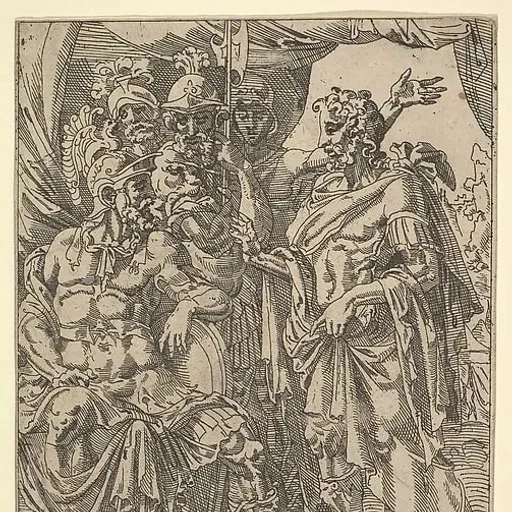
An empire is on the march, and one small people has dared to bar the road. Holofernes, the general who has burned his way across nation after nation, cannot understand it. Why would anyone resist him? He summons his allied chiefs and demands an account of these mountain-dwellers who have not come out to meet him with gifts and surrender. The answer comes from Achior, captain of the children of Ammon, a foreigner whose people have no love for Israel. And what he offers is not flattery. It is the truth, spoken into the most dangerous room imaginable.
Chapter overview from the authored study guide.general who hands Achior over to the Israelites as punishment for his warning
Sometimes telling the truth is the most dangerous thing a person can do. In the previous chapter Achior, a captain among the Ammonites, had warned the Assyrian general Holofernes of a single fact: the people of Israel are protected as long as they are faithful to their God, and no army has ever overcome them while that faith held. It was honest counsel, and it enraged the man who heard it. Judith 6 opens in the heat of that anger. Holofernes does not merely dismiss the warning. He decides to make Achior watch his own words fail, condemning him to die beside the people he dared to defend.
Chapter overview from the authored study guide.receives Judith in his tent and is immediately captivated by her beauty
A prayer has to end somewhere, and then a person has to stand up and live what they asked for. Judith 10 begins the instant her long prayer is finished. She rises from the floor where she had lain before the Lord, and the very next thing she does is act. She lays aside the rough garments of her widowhood, washes, anoints herself, and puts on beauty as deliberately as a soldier puts on armor. Then she walks out of the only safe place she has, through the gates of a city under siege, and down the mountain into the camp of the enemy. The whole chapter holds its breath.
Chapter overview from the authored study guide.listens to Judith's speech, praises her wisdom, and promises to honor her if her words prove true
A woman alone stands in the tent of a conqueror. Outside, her city is dying of thirst behind its walls; inside, the general who put it there is studying her with the eyes of a man used to taking whatever he wants. Judith has come unarmed and unguarded, and the only thing she has brought into that tent is speech. What follows is one of the most daring conversations in Scripture. She praises Holofernes lavishly, she tells him her people are doomed, and she promises to hand him an open road to Jerusalem. He is delighted. He never realizes that he is listening to the instrument of his own undoing.
Chapter overview from the authored study guide.killed in his tent by Judith while asleep after drinking heavily at the banquet
Everything in the book of Judith has narrowed to this room. The city of Bethulia is days from surrender, its cisterns nearly dry, and Holofernes, the Assyrian general, is certain that beauty and wine have finally delivered this Hebrew widow into his hands. The servants withdraw. The doors close. Judith is alone with the most powerful enemy Israel faces, and he is helpless with drink. What she does in the next moments is brutal and decisive, and the text never lets us forget how it was done. Before she touches the sword she prays. With the sword in her hand she prays again.
Chapter overview from the authored study guide.THE PEOPLE AROUND THE PERSON
Relationships follow the source graph. Some are interpretive or uncertain, and individual verse citations are not yet available for every connection.
STUDY & INTERPRETATION
Holofernes embodies the towering pride of an empire that demands worship belonging to God alone, boasting that no power could stand against his king. He scorned the warning of Achior that Israel’s God defends a people who keep faith with Him, and he set his confidence in numbers, terror, and his own appetite. His fall came not by armies but by the hand of a single faithful widow, so that the mighty were brought low and the lowly were lifted up. His story joins the long biblical pattern in which the arrogant who exalt themselves against heaven are humbled, and deliverance comes through unlikely instruments who trust in God.
From the Learn of Christ person commentary. Read alongside the linked Scripture passages.KEEP SCRIPTURE CLOSE
9 authored chapter guides feature this person. This is guide coverage, not an exhaustive count of biblical mentions.
ASK A BETTER QUESTION
Identity, story, early-life sources, family, and where to read.
Holofernes was the proud Assyrian general sent to crush every nation that would not submit to his king.
In the book of Judith, Holofernes is the chief commander of Nebuchadnezzar’s armies, dispatched to take vengeance on all the lands that had refused to join the war. He swept through the west with a vast host, demolishing shrines so that the king alone would be worshiped, and laid siege to the people of Bethulia. His campaign of terror ended in his own tent, where the widow Judith took his life and broke the spirit of his army.
Our authored studies connect Holofernes with Judith. The linked chapters provide reading context, not proof that an unnamed or inferred identity is explicitly named there. A verified, identity-specific verse index is not yet available for this record, so these chapter tags should not be treated as an exhaustive list of mentions.
A separate childhood account for Holofernes is not provided in our current authored profile sources. Begin with Judith 2 and the passages linked here for the evidence that is available. The first indexed reference to a name is not a birth record. This profile does not establish a birth date, schooling, or childhood events beyond what its sources state.
The current source graph does not list immediate family for Holofernes. That is a limit of this data, not evidence that Holofernes had no relatives. Read the cited passages for the details they actually give.
Holofernes embodies the towering pride of an empire that demands worship belonging to God alone, boasting that no power could stand against his king. He scorned the warning of Achior that Israel’s God defends a people who keep faith with Him, and he set his confidence in numbers, terror, and his own appetite.
Answers draw on our existing authored biography and linked chapter studies. Where supplied, verse assignments come from the individualized STEP Bible index. Childhood answers distinguish documented events from gaps in the available sources.
YOUR OWN OBSERVATIONS
Notes, saved people, and study marks stay in this browser. They do not sync to your account.
KEEP EXPLORING
People featured in the same study guides. Sharing a chapter does not establish a family relationship.