Judith 5
People in this chapter
An empire is on the march, and one small people has dared to bar the road. Holofernes, the general who has burned his way across nation after nation, cannot understand it. Why would anyone resist him? He summons his allied chiefs and demands an account of these mountain-dwellers who have not come out to meet him with gifts and surrender. The answer comes from Achior, captain of the children of Ammon, a foreigner whose people have no love for Israel. And what he offers is not flattery. It is the truth, spoken into the most dangerous room imaginable.
Tap any highlighted phrase to jump to the commentary that unpacks it.
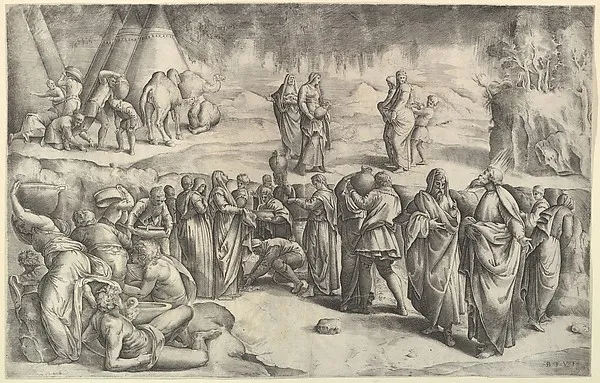
Judith 5:1-5Holofernes Rages; Achior Rises to Tell the Truth
1And it was told Holofernes the general of the army of the Assyrians, that the children of Israel prepared themselves to resist, and had shut up the ways of the mountains. 2And he was transported with exceeding great fury and indignation, and he called all the princes of Moab and the leaders of Amman.
The scene opens on a collision. On one side stands the vast Assyrian war machine, fresh from crushing every nation in its path. On the other stands a single small people who have done the unthinkable: they have closed the mountain passes and prepared to resist. The image is almost absurd in its disproportion. Yet the story has been built precisely so the reader will ask the question Holofernes is about to ask aloud. What could possibly make so weak a people refuse so strong a foe?
Holofernes is "transported with exceeding great fury." Rage is the native language of unchallenged power, and resistance reads to him as insult, a thing to be punished. So he gathers the chiefs of Moab and Ammon, the local rulers who know this land and these people. He wants intelligence, but more than that he wants to understand the affront. The chapter will turn on the fact that the man with all the power asks the right question and then refuses to accept the true answer.
3And he said to them: Tell me what is this people that besetteth the mountains: or what are their cities, and of what sort, and how great: also what is their power, or what is their multitude: or who is the king over their warfare: 5Then Achior captain of all the children of Ammon answering, said: If thou vouch safe, my lord, to hear, I will tell the truth in thy sight concerning this people, that dwelleth in the mountains, and there shall not a false word come out of my mouth.
Holofernes asks the natural questions of a conqueror taking the measure of an enemy. How many are they? How strong are their cities? Who is their king, the man who commands their armies? Each question assumes that strength is a thing you can count, that the secret of any nation lies in its walls and its soldiers and its ruler. The whole point of the answer Achior is about to give is that the question is aimed at the wrong place. The strength of this people cannot be tallied, because it does not rest in them.
Of all the men in that tent, the one who tells the truth is an outsider. Achior is captain of the Ammonites, a people with a long history of hostility toward Israel, and he has every political reason to flatter the general who could destroy him. Instead he asks leave to speak honestly and pledges that not one false word will leave his mouth. There is something arresting about a pagan chief insisting on truth before the most powerful man alive.
He becomes, for a moment, a witness to the works of a God who is not his own, and the courage it takes to be that witness is the quiet center of the chapter.
Judith 5:6-9A People Born of a Turning From Idols
6This people is of the offspring of the Chaldeans. 7They dwelt first in Mesopotamia, because they would not follow the gods of their fathers, who were in the land of the Chaldeans. 8Wherefore forsaking the ceremonies of their fathers, which consisted in the worship of many gods,
Achior begins with a conversion. This people, he says, came from the Chaldeans, and their whole identity was born of a great turning: they forsook the worship of many gods and gave themselves wholly to "one God of heaven," and that God called them out from the land of their birth to follow Him into the unknown. Achior is retelling the story of Abraham, the man who left Ur at the call of the one God (Genesis 12:1). What defines Israel, the foreign chief understands, is allegiance to a single God who calls and is obeyed.
There is a striking theology hidden in Achior's summary. He does not say Israel was simply assigned a different god than its neighbors. He says they turned from many gods to the one God of heaven, the God who made and rules the heavens themselves. And that turning was costly: it meant leaving home, leaving the familiar shrines and customs, walking out at the word of a God they could not see. Faith, in this telling, begins as a departure.
To belong to this God is to be willing to let go of everything else that claimed worship and to go where He sends.
9They worshipped one God of heaven, who also commanded them to depart from thence, and to dwell in Charan. And when there was a famine over all the land, they went down into Egypt, and there for four hundred years were so multiplied, that the army of them could not be numbered.
Famine drives the family down into Egypt, and there a single household becomes a multitude beyond counting. The detail matters. Holofernes asked how many they were, expecting a number he could weigh against his own. Achior answers that this people grew under God's hand until they "could not be numbered," echoing the very promise made to Abraham that his descendants would be as the stars (Genesis 15:5). The growth was not their achievement; it was the keeping of a word spoken generations before.
Already the foreign captain is teaching the general that the story of Israel is the story of a promise being kept.
Judith 5:10-16Plagues, the Parted Sea, and Bread From Heaven
10And when the king of Egypt oppressed them, and made slaves of them to labour in clay and brick, in the building of his cities, they cried to their Lord, and he struck the whole land of Egypt with divers plagues. 12The God of heaven opened the sea to them in their flight, so that the waters were made to stand firm as a wall on either side, and they walked through the bottom of the sea and passed it dry foot.
The pattern of deliverance begins where it so often does in Scripture: at the bottom. The people are enslaved, broken down to labor in clay and brick, and out of that misery they cry to their Lord. Achior does not soften the bondage. He names it, and then he names what God did in answer: He struck Egypt with plague after plague until the chains were broken. The foreign chief is recounting the Exodus to a man who is about to play Pharaoh's part, and the warning is unmistakable even if Holofernes cannot hear it.
The God of this people answers their cry, and He answers it against empires.
Achior comes to the great miracle at the center of Israel's memory. The God of heaven opened the sea, and the waters "stood firm as a wall on either side" while the people walked across on dry ground. This is the moment that defined what kind of God Israel served: One who makes a road where there is none, who turns the very forces of nature into the path of His people's rescue.
Holofernes commands an army; Achior is describing a God who commands the sea. The contrast is the whole argument. No general, however vast his forces, is fighting on level ground against a God like this.
13And when an innumerable army of the Egyptians pursued after them in that place, they were so overwhelmed with the waters, that there was not one left, to tell what had happened to posterity. 15There bitter fountains were made sweet for them to drink, and for forty years they received food from heaven. 16Wheresoever they went in without bow and arrow, and without shield and sword, their God fought for them and overcame.
The same sea that opened for Israel closed over the army that pursued them. Achior states it starkly: of that innumerable Egyptian host, "there was not one left." He is speaking to a general who leads exactly such a host, and he is telling him plainly what became of the last empire that set itself against this people in their flight. The story is a mirror held up to Holofernes. He cannot see his own reflection in it, but the reader can, and so the chapter builds its quiet dread.
In the wilderness where no one could live, the people lived. Bitter water turned sweet; for forty years bread came down from heaven. Achior is recalling the manna, the daily gift that taught Israel to depend on the word and hand of God for every morning's provision. It is a tender detail to find in the mouth of a war captain, and it widens the portrait of this God beyond mere power. He feeds His people in the desert, day by day, with bread they did not earn.
Achior reaches the line that gathers the whole history into a single truth: wherever this people went, even "without bow and arrow, and without shield and sword, their God fought for them and overcame." Here is the answer to Holofernes' question about their power. Their strength was a God who fought their battles for them. An unarmed people who win is the most frightening enemy an army can face, because it means the war is against the One who stands behind them.
Judith 5:17-21The Thread Beneath the Story
17And there was no one that triumphed over this people, but when they departed from the worship of the Lord their God. 18But as often as beside their own God, they worshipped any other, they were given to spoil, and to the sword, and to reproach. 19And as often as they were penitent for having revolted from the worship of their God, the God of heaven gave them power to resist.
Now Achior names the thread that runs beneath every battle he has recounted. No one ever overcame this people except when "they departed from the worship of the Lord their God." Their only true vulnerability was unfaithfulness. As long as they held to their God, they could not be beaten; the moment they turned to other gods, they were handed over to the sword and the spoil. This is the heart of Achior's counsel, and it is a theology as old as Israel itself.
The danger to the faithful never comes from outside. It comes from within, from the heart that wanders.
And then comes the mercy that completes the pattern. As often as the people repented of their wandering and returned to their God, "the God of heaven gave them power to resist." The story is a cycle in which repentance always opens the door back to strength. However far this people fell, turning back restored them. Achior has unknowingly preached the gospel of return: there is no failure so complete that genuine repentance cannot reverse it, because the God who fights for them is also the God who welcomes them home.
21And as long as they sinned not in the sight of their God, it was well with them: for their God hateth iniquity.
Achior sums it up in a single sentence: "as long as they sinned not in the sight of their God, it was well with them: for their God hateth iniquity." This is the key that unlocks everything. The God of Israel is holy, and He hates iniquity even in those He loves, so His protection is bound to their faithfulness. A foreign chief has grasped what Israel so often forgot: their God's favor is real, but it is moral. He cannot be enlisted to bless what He hates.
Judith 5:22-29Honest Counsel Meets a Proud Lie
24Now therefore, my lord, search if there be any iniquity of theirs in the sight of their God: let us go up to them, because their God will surely deliver them to thee, and they shall be brought under the yoke of thy power: 25But if there be no offense of this people in the sight of their God, we can not resist them, because their God will defend them: and we shall be a reproach to the whole earth.
Achior's counsel arrives, and it is breathtaking in its honesty. He tells the most powerful man alive to investigate Israel's conscience before targeting her walls. Find out whether they have sinned against their God. If they have, attack, and their God will hand them over. But if they are faithful, "we can not resist them, because their God will defend them." He is advising a conqueror to call off a conquest. He is staking his own safety on the claim that a faithful Israel is simply unconquerable, and warning that to attack them anyway would make the whole army "a reproach to the whole earth."
It is the boldest sentence a courtier could speak, and it is true.
26And it came to pass, when Achior had ceased to speak these words, all the great men of Holofernes were angry, and they had a mind to kill him, saying to each other: 29That every nation may know that Nabuchodonosor is god of the earth, and besides him there is no other.
The truth is met with fury. Achior has barely finished speaking before the captains want him dead. His honesty does not move them; it enrages them, because it threatens the story they have told themselves about their own invincibility. This is the way power often answers a true word it does not wish to hear. It does not argue. It silences. The man who told the truth in good faith now stands condemned for it, and the chapter lets us feel how dangerous it is to be the only honest voice in a room committed to a lie.
The camp's answer to Achior arrives as a creed, the assertion that needs no argument: "Nabuchodonosor is god of the earth, and besides him there is no other." It is a deliberate blasphemy, a hollow parody of the confession Israel makes of the true God. The empire has crowned a man in the place of God and declared there is no other. The chapter ends by setting two confessions side by side. Achior has testified to the living God of heaven who fights for His faithful people.
The army has enthroned a mortal king as god of the earth. The reader already knows which confession the rest of the book will vindicate, and which one is hurtling toward a fall.
Where this echoes in Scripture
Holofernes Rages; Achior Rises to Tell the Truth
- Proverbs 21:30There is no wisdom nor understanding nor counsel against the LORD.Holofernes counts cities and soldiers, but no strategy can prevail against the One who defends His people.
- Acts 5:29We ought to obey God rather than men.Achior, like the apostles, tells the truth to power, whatever the cost of honesty.
- Proverbs 12:19The lip of truth shall be established for ever: but a lying tongue is but for a moment.The true witness will outlast the boast that answers him.
A People Born of a Turning From Idols
- Genesis 12:1Now the LORD had said unto Abram, Get thee out of thy country... unto a land that I will shew thee.The call Achior describes: the one God draws a people out from the land of idols.
- Joshua 24:2Your fathers dwelt on the other side of the flood in old time... and they served other gods.Israel's own memory agrees with Achior: their story began among idolaters and turned.
- Genesis 15:5Look now toward heaven, and tell the stars... So shall thy seed be.The multitude that "could not be numbered" is a promise being kept.
Plagues, the Parted Sea, and Bread From Heaven
- Exodus 14:14The LORD shall fight for you, and ye shall hold your peace.The exact truth Achior names: the people's strength was a God who fought for them.
- John 6:51I am the living bread which came down from heaven: if any man eat of this bread, he shall live for ever.The manna of the wilderness foreshadows the true bread from heaven.
- Colossians 2:15And having spoiled principalities and powers, he made a shew of them openly, triumphing over them in it.God wins His greatest victory for the defenseless, as Achior's witness anticipates.
The Thread Beneath the Story
- Judges 2:14-16And the anger of the LORD was hot against Israel... Nevertheless the LORD raised up judges, which delivered them.The very cycle Achior names: wandering brings defeat, return brings deliverance.
- 2 Chronicles 7:14If my people... shall humble themselves, and pray... then will I hear from heaven, and will forgive their sin.Repentance always reopens the door to God's help.
- 1 John 1:9If we confess our sins, he is faithful and just to forgive us our sins.The way back that Achior describes runs straight into the gospel of return.
Honest Counsel Meets a Proud Lie
- Isaiah 14:13-15I will ascend into heaven... I will be like the most High. Yet thou shalt be brought down to hell.The boast that a man is god of the earth is the oldest pride, and it always ends in a fall.
- Daniel 4:30-31Is not this great Babylon, that I have built... While the word was in the king's mouth, there fell a voice from heaven.A real Nebuchadnezzar learns the hard way that he is not god of the earth.
- Acts 12:22-23It is the voice of a god, and not of a man. And immediately the angel of the Lord smote him.A ruler who accepts the worship due to God alone meets the end the boast invites.