Judith 6
People in this chapter
Sometimes telling the truth is the most dangerous thing a person can do. In the previous chapter Achior, a captain among the Ammonites, had warned the Assyrian general Holofernes of a single fact: the people of Israel are protected as long as they are faithful to their God, and no army has ever overcome them while that faith held. It was honest counsel, and it enraged the man who heard it. Judith 6 opens in the heat of that anger.
Holofernes does not merely dismiss the warning. He decides to make Achior watch his own words fail, condemning him to die beside the people he dared to defend.
Tap any highlighted phrase to jump to the commentary that unpacks it.
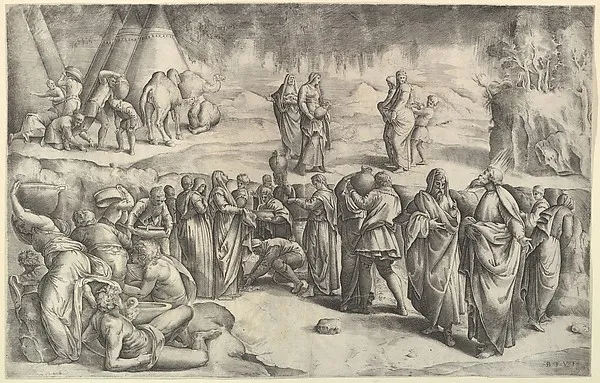
Judith 6:1-5There Is No God but Nabuchodonosor
1And it came to pass when they had left off speaking, that Holofernes being in a violent passion, said to Achior: 2Because thou hast prophesied unto us, saying: That the nation of Israel is defended by their God, to shew thee that there is no God, but Nabuchodonosor:
The chapter opens in the silence right after honest words have been spoken. Achior had told the general a simple truth, and now the room waits to see how power will answer it. Holofernes answers in a "violent passion," a fury that needs no argument because it has an army behind it. There is a kind of anger that erupts precisely when someone has said something true and unwelcome, and it is the surest sign that the truth landed. The man who cannot refute a word tries instead to silence the one who said it.
Here is the heart of the conflict in a single sentence. Holofernes declares that there is no God but Nabuchodonosor, the Assyrian king he serves. It is the ancient lie of every empire that mistakes its own might for the highest power in the universe. Achior had pointed to the God of heaven who defends His people; the general counters by enthroning a man in God's place. The whole drama of the book hangs on this claim, and the chapters ahead will test it.
When a kingdom names itself ultimate, it has set itself against the One who actually holds the heavens, and that is a contest no kingdom wins.
3When we shall slay them all as one man, then thou also shalt die with them by the sword of the Assyrians, and all Israel shall perish with thee: 5But if thou think thy prophecy true, let not thy countenance sink, and let the paleness that is in thy face, depart from thee, if thou imaginest these my words cannot be accomplished.
Holofernes mocks Achior's fear with a sneer. If your prophecy is really true, he taunts, then why has the color drained from your face? It is the cruelty of a strong man toward a frightened one, twisting the captain's very fear into evidence that he does not believe his own words. Yet the taunt exposes the general more than the prisoner. He assumes that confidence belongs to whoever holds the sword, and that faith without armies is just a pale and trembling thing.
The story is about to show how wrong that assumption is, for the trembling man told the truth, and the boasting man is the one walking toward ruin.
Judith 6:6-9Bound and Left for Israel to Find
6And that thou mayst know that thou shalt experience these things together with them, behold from this hour thou shalt be associated to their people, that when they shall receive the punishment they deserve from my sword, thou mayst fall under the same vengeance. 7Then Holofernes commanded his servants to take Achior, and to lead him to Bethulia, and to deliver him into the hands of the children of Israel.
Holofernes means his sentence as the worst possible punishment. He binds Achior's fate to Israel's, certain that both will be destroyed together. From this hour, he says, you belong to them, so that you can die with them. The general intends to humiliate the captain by tying him to a doomed people. But the words carry an irony he cannot see. To be joined to the people of God is no curse. In the providence that runs quietly beneath this whole story, the man cast out toward Israel is being handed the one place of safety in the land.
There is a deep reversal hidden in this command. Holofernes orders his servants to "deliver" Achior into the hands of the children of Israel, imagining he is sending the captain to his grave. Instead he is delivering him into rescue. The word he chooses for ruin turns out to mean salvation. Again and again in Scripture, the schemes the proud devise for the destruction of the faithful become the very road by which God saves them. What the general sends out as a death sentence, heaven receives as a homecoming.
8And the servants of Holofernes taking him, went through the plains: but when they came near the mountains, the slingers came out against them. 9Then turning out of the way by the side of the mountain, they tied Achior to a tree hand and foot, and so left him bound with ropes, and returned to their master.
The soldiers do not even dare to reach the city. Israel's slingers drive them back from the heights, so they tie Achior to a tree at the foot of the mountain and flee. Picture him there: bound hand and foot, abandoned between two peoples, helpless and alone, left for whatever comes first. It is a portrait of utter powerlessness. And yet this is exactly where deliverance finds him. He cannot free himself, cannot run, cannot fight.
He can only be found. Some of the truest rescues in Scripture come to people who have been brought to the end of their own strength and can do nothing but wait to be loosed.
Judith 6:10-13They Loosed Him and Brought Him to the City
10And the children of Israel coming down from Bethulia, came to him, and loosing him they brought him to Bethulia, and setting him in the midst of the people, asked him what was the matter, that the Assyrians had left him bound.
The people of Bethulia come down to the stranger tied at their border, and their first act is mercy. They loose his ropes and bring him inside the city, into the midst of the assembly. They do not interrogate him as an enemy or leave him to the elements as a foreigner. They welcome the man their attacker tried to throw away. There is something quietly beautiful in a frightened, besieged people who still stop to untie a bound stranger.
The kindness of the lowly toward the cast-off is one of the surest marks that the God of heaven is at work among them.
12And Achior related in the midst of the ancients, and in the presence of all the people, all that he had said being asked by Holofernes: and how the people of Holofernes would have killed him for this word, 13And how Holofernes himself being angry had commanded him to be delivered for this cause to the Israelites: that when he should overcome the children of Israel, then he might command Achior also himself to be put to death by diverse torments, for having said: The God of heaven is their defender.
Achior tells the whole story, and at its center is the single sentence that nearly cost him his life: "The God of heaven is their defender." He had said it to a hostile general at great risk, and he says it again now to the very people it concerns. Notice what kind of witness God uses here. The truth about Israel's God is carried into Bethulia by an outsider, a man from Ammon, who saw clearly what he was looking at and refused to deny it.
God has a way of raising up unexpected witnesses, and the testimony of one honest stranger can strengthen the faith of a whole frightened city.
Judith 6:14-18Look on Our Low Condition
14And when Achior had declared all these things, all the people fell upon their faces, adoring the Lord, and all of them together mourning and weeping poured out their prayers with one accord to the Lord, 15Saying: O Lord God of heaven and earth, behold their pride, and look on our low condition, and have regard to the face of thy saints, and shew that thou forsakes not them that trust on thee, and that thou humblest them that presume of themselves, and glory in their own strength.
This is the turning point of the chapter: the whole city falls on its face. The natural response to Achior's report might have been alarm, or a frantic council of war, or despair at the size of the army outside. The people of Bethulia drop to the ground and worship. Their first move against an empire is to mourn and weep and pour out their hearts to the Lord "with one accord," every voice joined into one cry.
They answer overwhelming power with overwhelming dependence. Before they lift a single weapon, they lift their faces to the only One who can save them.
The prayer itself is a model of how the lowly approach the high God. They do not pretend to be strong. They lay their two facts before heaven side by side: "behold their pride, and look on our low condition." On one side stands the arrogance of the enemy; on the other, the smallness of God's people. And then they ask God to be God, to keep faith with those who trust Him and to bring down those who glory in their own strength.
There is no boasting here, no claim that they deserve rescue. There is only the confidence that the God of heaven and earth notices the difference between the proud who presume on themselves and the humble who lean entirely on Him.
17Saying: the God of our fathers, whose power thou hast set forth, will make this return to thee, that thou rather shalt see their destruction. 18And when the Lord our God shall give this liberty to his servants, let God be with thee also in the midst of us: that as it shall please thee, so thou with all thine mayst converse with us.
When their weeping is done, the people turn to comfort Achior, and their comfort is a kind of prophecy. The God whose power you proclaimed, they tell him, will turn this around so that you live to see the enemy's downfall, your own reversal complete. Then they open their community to him: when the Lord delivers us, stay and dwell among us. The stranger who confessed Israel's God is invited to belong to Israel's people.
It is a glimpse of something that runs all through Scripture, the way the household of God keeps widening to take in the outsider who turns toward the Lord. The man brought in as a prisoner is welcomed as a brother.
Judith 6:19-21A Supper, and Prayer All the Night
19Then Ozias, after the assembly was broken up, received him into his house, and made him a great supper. 20And all the ancients were invited, and they refreshed themselves together after their fast was over.
The day that began with a general's rage ends at a shared table. Ozias, a leader of the city, takes Achior into his own house and spreads a great supper for him, and the elders gather to refresh themselves together. The man who was bound to a tree that morning is seated as an honored guest that night. There is a holy ordinariness to it: after the worship and the weeping, the people of God eat together and draw the stranger in.
A shared meal has always been one of the deepest signs of belonging, and this one says plainly that Achior is no longer an outsider looking on. He has been given a place among them.
21And afterwards all the people were called together, and they prayed all the night long within the church, desiring help of the God of Israel.
The chapter closes the way it found its strength: in prayer. After the meal, the whole community gathers again and prays through the entire night, "desiring help of the God of Israel." This is a people who have understood where their defense lies. The enemy at their gates trusts in numbers and iron; Bethulia keeps watch on its knees. There is a quiet courage in a city that answers a siege not with frantic preparation alone but with a night-long appeal to heaven.
It is the posture the whole chapter has been teaching, and the book will soon show that the God of Israel was listening the whole night through.
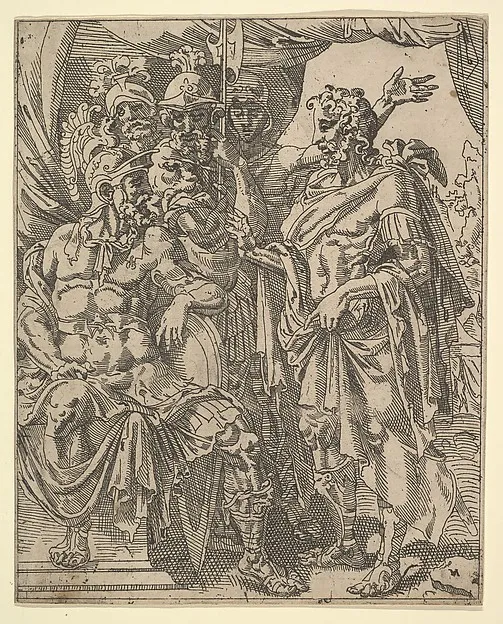
Where this echoes in Scripture
There Is No God but Nabuchodonosor
- Proverbs 16:18Pride goeth before destruction, and an haughty spirit before a fall.The general's boast is the very arrogance Scripture says walks ahead of ruin.
- Daniel 4:30-31Is not this great Babylon, that I have built... While the word was in the king's mouth, there fell a voice from heaven.A king crowns his own power and heaven answers, just as this chapter warns.
- James 4:6God resisteth the proud, but giveth grace unto the humble.The exact contest Judith 6 stages between Holofernes and the praying city.
Bound and Left for Israel to Find
- Genesis 50:20But as for you, ye thought evil against me; but God meant it unto good, to save much people alive.The proud intend ruin; God turns the same act into rescue, as He does for Achior.
- Psalm 146:7The LORD looseth the prisoners.The bound man at the tree is exactly the one the Lord delights to free.
- Psalm 107:14He brought them out of darkness and the shadow of death, and brake their bands in sunder.Israel loosing Achior's ropes is a small picture of the God who breaks every band.
They Loosed Him and Brought Him to the City
- Psalm 33:20Our soul waiteth for the LORD: he is our help and our shield.Achior names the God of Israel exactly as the Psalms do: their shield and defense.
- Joshua 2:11For the LORD your God, he is God in heaven above, and in earth beneath.Rahab, another outsider, confesses Israel's God just as Achior does here.
- Matthew 8:10I have not found so great faith, no, not in Israel.Jesus, too, finds clear faith in an outsider, as Bethulia finds it in an Ammonite.
Look on Our Low Condition
- Luke 1:52He hath put down the mighty from their seats, and exalted them of low degree.Mary sings the very reversal Bethulia prays for: the proud cast down, the lowly raised.
- Psalm 138:6Though the LORD be high, yet hath he respect unto the lowly: but the proud he knoweth afar off.The exact distinction the city's prayer rests on between the humble and the proud.
- 2 Chronicles 20:12We have no might against this great company... neither know we what to do: but our eyes are upon thee.Another besieged people answer overwhelming odds with the prayer of the helpless.
A Supper, and Prayer All the Night
- Hebrews 13:2Be not forgetful to entertain strangers: for thereby some have entertained angels unawares.Ozias welcomes the stranger to his table, the very hospitality Scripture commends.
- Luke 6:12He went out into a mountain to pray, and continued all night in prayer to God.Bethulia's night of prayer foreshadows the One who Himself prayed through the night.
- Psalm 121:1-2I will lift up mine eyes unto the hills... My help cometh from the LORD, which made heaven and earth.The city, ringed by mountains, looks past them to the God who is their real help.