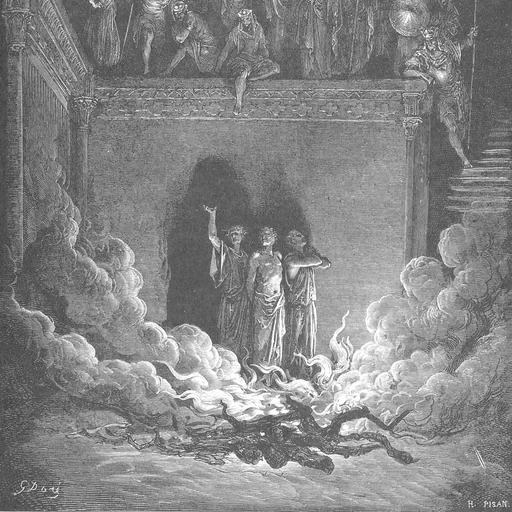
Who was Meshach in the Bible?
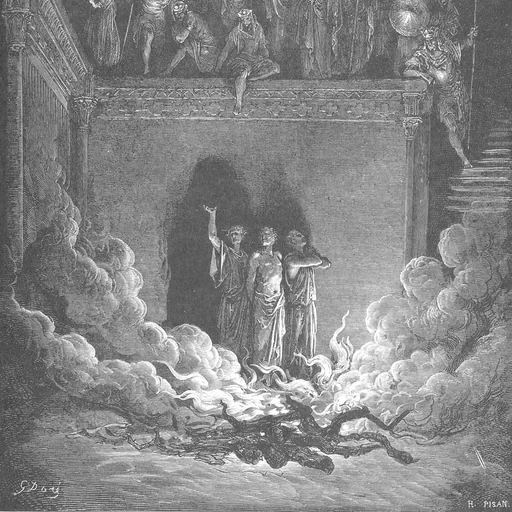
Meshach was one of Daniel’s three friends who would not worship the golden statue and was rescued from the fiery furnace.
Faithful Judean exile in Babylon
6th century BC
Meshach was one of Daniel’s three friends who would not worship the golden statue and was rescued from the fiery furnace.
Follow the reading trailBEYOND THE NAME
Meshach, whose Hebrew name was Mishael, was among the young Judeans carried to Babylon and given a Babylonian name and training. With Shadrach and Abednego he kept faith with God by refusing the king’s food and then refusing to bow to Nebuchadnezzar’s golden image. Cast into the furnace, he was delivered untouched, and the watching king confessed the power of their God.
Themes in the authored commentary
These entries connect the study to the source’s recorded family context. Read their cautions when the family records or identifications differ.
FOLLOW THE PASSAGES
These are chapter studies associated with this record. Their order follows the books and chapters, rather than a reconstructed timeline of the person’s life.
companion of Daniel renamed and trained in the Babylonian court
Jerusalem falls. The sacred vessels of the temple are carried into Shinar, into the treasure house of a foreign god, and with them go the finest of Judah’s young men. Babylon does not merely conquer these four; it sets out to absorb them - new language, new learning, new names, the king’s own rich table set before them daily. Every detail is engineered to remake Judah’s brightest from the inside.
Chapter overview from the authored study guide.appointed to provincial administration after Daniel's intercession
A dream wakes the most powerful man on earth and will not let him sleep. Nebuchadnezzar sets his wise men an impossible test: not just interpret the dream, but first tell me what I dreamed - and fail, and you die. They cannot. No human craft pulls a forgotten dream from a king’s head; that belongs to the gods, whose dwelling is not with flesh (v. 11). Enraged, the king signs a death warrant for them all. It reaches a young exile named Daniel.
Chapter overview from the authored study guide.refuses to worship the golden image and is cast into the fiery furnace
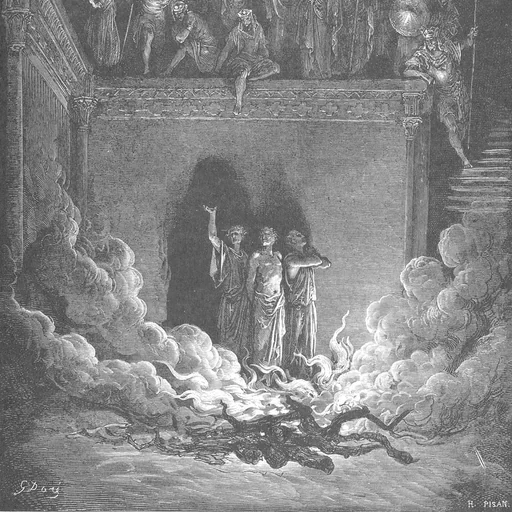
A statue of gold rises on the plain of Dura, ninety feet of it, glittering over the empire. The music swells, and every people, nation, and language falls on its face. Bow at the sound, or burn. Among the kneeling multitude, three young Judeans stay on their feet. No speech, no riot. They just will not do the one easy thing the moment demands, and it is enough to get them dragged before the most powerful man alive.
Chapter overview from the authored study guide.companion of Daniel cited by the mother as one of the three young men in the fire
A mother has watched all seven of her sons tortured to death in a single day, each refusing to forsake the law. Now the author hands her the floor. He even writes out the wail she had every right to pour - seven children have I borne and am left childless (v. 6) - then tells us she spoke none of it. This Greek work argues that reverence for God can master any feeling. Here is the case meant to settle it.
Chapter overview from the authored study guide.one of the three young men in the fire named by the father in his recital of the faithful who suffered and were not abandoned
The seven sons are gone. Their mother is gone. The eulogy is finished. So the book turns one last time to the living - obey this law (v. 1) - and gives the mother a final word. She remembers her husband, who taught you the law and the prophets (v. 10), and names the stories he told: Abel, Isaac, Joseph, the three young men in the fire, Daniel in the den. The whole roll of those who trusted God when it cost them, set in a child’s memory long before the child would need it.
Chapter overview from the authored study guide.THE PEOPLE AROUND THE PERSON
Relationships follow the source graph. Some are interpretive or uncertain, and individual verse citations are not yet available for every connection.
STUDY & INTERPRETATION
Meshach’s story is inseparable from that of his two companions, and together they show what loyalty to God looks like when the cost is death. Their reply to the king, calm and resolute, refuses to make obedience depend on rescue. The fire that should have consumed them instead consumed only the cords that bound them, while a fourth figure walked with them in the flames. Through this account Scripture testifies that God meets His people in the furnace itself, a presence that finds its fullest expression in the Savior who shares every affliction of His own.
From the Learn of Christ person commentary. Read alongside the linked Scripture passages.KEEP SCRIPTURE CLOSE
5 authored chapter guides feature this person. This is guide coverage, not an exhaustive count of biblical mentions.
ASK A BETTER QUESTION
Identity, story, early-life sources, family, and where to read.
Names and spellings in the source: Meshach · Mishael
Meshach was one of Daniel’s three friends who would not worship the golden statue and was rescued from the fiery furnace.
Meshach, whose Hebrew name was Mishael, was among the young Judeans carried to Babylon and given a Babylonian name and training. With Shadrach and Abednego he kept faith with God by refusing the king’s food and then refusing to bow to Nebuchadnezzar’s golden image. Cast into the furnace, he was delivered untouched, and the watching king confessed the power of their God.
The individualized passage index associates this Meshach record with Daniel. There are 18 distinct indexed verse references in the 66-book Bible. Browse the book-by-book list below; it separates this identity from other people who share the name. Source assignments and textual identifications can require interpretation.
A separate childhood account for Meshach is not provided in our current authored profile sources. Begin with Daniel 1:6 and the passages linked here for the evidence that is available. The first indexed reference to a name is not a birth record. This profile does not establish a birth date, schooling, or childhood events beyond what its sources state.
The current source graph does not list immediate family for Meshach. That is a limit of this data, not evidence that Meshach had no relatives. Read the cited passages for the details they actually give.
Meshach’s story is inseparable from that of his two companions, and together they show what loyalty to God looks like when the cost is death. Their reply to the king, calm and resolute, refuses to make obedience depend on rescue.
Answers draw on our existing authored biography and linked chapter studies. Where supplied, verse assignments come from the individualized STEP Bible index. Childhood answers distinguish documented events from gaps in the available sources.
FIND THE PERSON IN THE TEXT
18 distinct verse references in the source’s 66-book index. These are indexed name assignments, rather than every indirect allusion to this person. A name may also refer to descendants, a tribe, or a nation; read each passage to distinguish that usage from the individual.
“Now among these were of the children of Judah, Daniel, Hananiah, Mishael, and Azariah:”
Daniel 1:6 · King James Version
“There are certain Jews whom thou hast set over the affairs of the province of Babylon, Shadrach, Meshach, and Abednego; these men, O king, have not regarded thee: they serve not thy gods, nor worship the golden image which thou hast set up.”
Daniel 3:12 · King James Version
“And he commanded the most mighty men that were in his army to bind Shadrach, Meshach, and Abednego, and to cast them into the burning fiery furnace.”
Daniel 3:20 · King James Version
“Then the king promoted Shadrach, Meshach, and Abednego, in the province of Babylon.”
Daniel 3:30 · King James Version
References are adapted from STEP Bible / Tyndale House TIPNR (CC BY 4.0). Deduplicated, matched to this identity, and checked against the bundled KJV’s verse bounds. Interpretive assignments and translation/versification differences may remain. This index is separate from evidence for individual family relationships.
YOUR OWN OBSERVATIONS
Notes, saved people, and study marks stay in this browser. They do not sync to your account.
KEEP EXPLORING
People featured in the same study guides. Sharing a chapter does not establish a family relationship.