
- Starting price
- $9.99/mo or $59.99/yr
- Free tier
- No
- Platforms
- iOS · Android
- Developer
- Dwell Inc.
- Launched
- 2018
- Updated
- May 24, 2026
The verdict
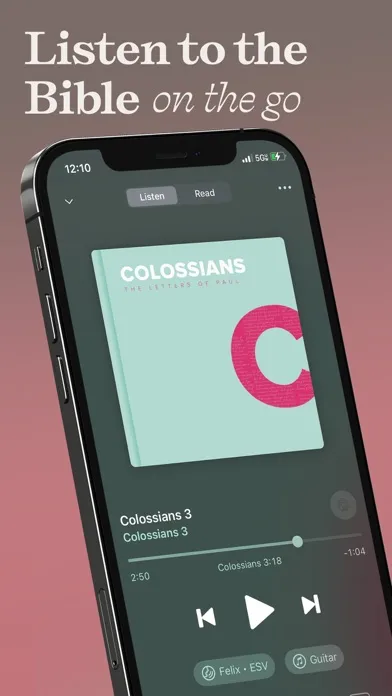
Dwell has quietly become the favorite of people who listen to Scripture rather than read it - commuters, parents, insomniacs, runners. It is the most thoughtfully produced audio Bible on the market, and the subscription is the price of admission.
Try Dwell ↗Opens dwellapp.io
Dwell is an audio-first Bible app. That framing matters, because almost every other "Bible app" on the market is a reading app that happens to also play audio. Dwell is the inverse - the entire product is built around the assumption that the user is going to close their eyes, put in earbuds, and listen to the text for thirty minutes at a stretch.
It does not try to be a study Bible. It does not try to be a community feed. It does not try to be a verse-of-the-day push notification. It is a listening environment for Scripture, designed by people who think hard about narration, pacing, ambient music, and how a passage should actually sound in your ears at 11pm with the lights off.
The catch - and there is one - is the price. Dwell is a paid subscription at $9.99/month or $59.99/year, in a category where the most popular competitors (YouVersion, Bible.is) are completely free. The rest of this review is mostly an answer to one question: is the Dwell experience different enough from the free options to justify a real subscription? For the right user, yes. For most casual readers, probably not.
✓ The good
- Best-in-class audio production - the narrators, pacing, music beds, and mastering are in a different league from free audio Bibles
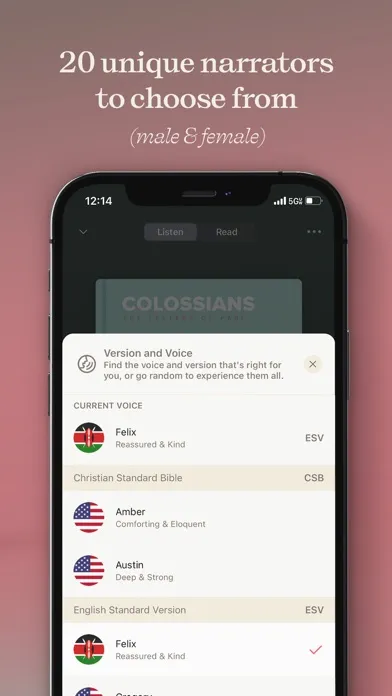
- 20+ professional narrators to pick from - match the voice to the passage or the mood, swap between male and female readers, classic or contemporary feel
- Background music that actually works - instrumental, classical, ambient, and nature beds you can mix in or turn off entirely
- Themed passages for sleep, anxiety, gratitude, grief - curated Scripture sequences designed to be listened to in a single sitting
- A genuinely good sleep mode - fade-out timers, soft narrators, looping ambient beds; one of the few Christian apps a parent can fall asleep to
- Reading (listening) plans that work in audio - short, themed, and finishable, not 90-day Bible-in-a-year guilt trips
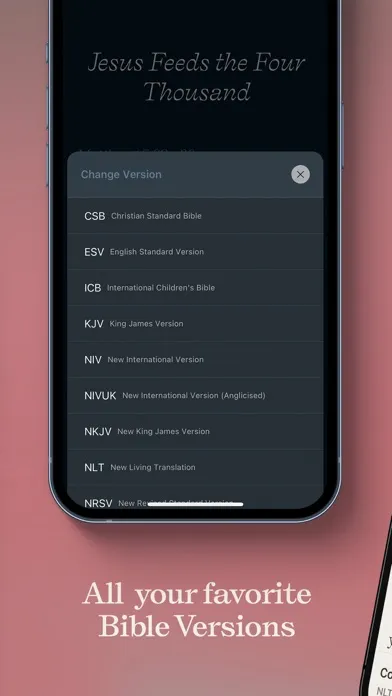
- Multiple translations included in the sub - NIV, ESV, KJV, NLT, CSB, NKJV, plus a handful of Spanish options
✗ Watch out
- No free tier - a short trial only; everything past that is paywalled
- No web app - phone and tablet only, no desktop or browser listening (yet)
- No study features - no commentaries, no cross-references, no original languages; it is a listening product, full stop
- Limited community features - no friends, no shared plans, no public reading log
- Translations are good but not exhaustive - no NASB, no NRSV, no Message at the time of writing
- Lifetime plans are rare and pricey - the occasional sale runs around $200, and the standard option is the annual sub
Best for
- Commuters and runners who listen more than they read
- Parents and shift workers who use Scripture to fall asleep
- Auditory learners who absorb the text better spoken aloud
- People who already pay for Spotify, Audible, or Calm and treat audio as a real medium
Avoid if
- You want a free Bible app and will not pay a subscription
- You primarily read on a laptop or desktop
- You want commentary, cross-references, or original-language tools
- You need a community or social-feed layer around your reading
What Dwell is
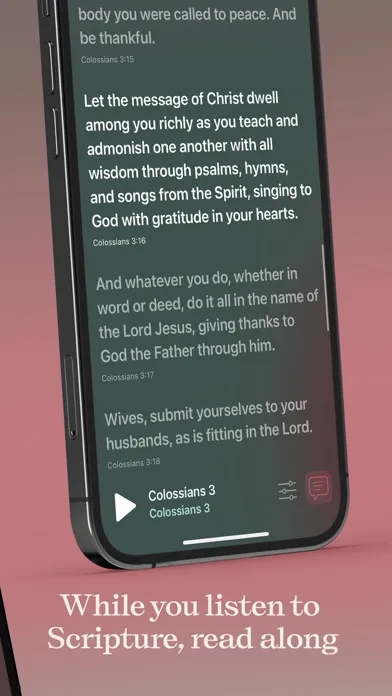
Dwell is a subscription audio Bible app for iOS and Android, built by an independent team that launched on Kickstarter in 2018 and has been iterating on the listening experience ever since. The product centers on three things: a roster of more than twenty professional narrators, a library of original instrumental music beds you can mix into the reading, and a set of curated "passages" that group Scripture by theme - sleep, gratitude, anxiety, grief, identity, the life of Christ.
Around that core sit the things you would expect from a modern Bible app - listening plans, bookmarks, a daily verse, a sleep timer, a small handful of major English translations and a couple of Spanish ones. What you will not find is a study layer. No commentaries, no cross-references, no Greek or Hebrew tools. Dwell is a listening environment, and it stays in its lane on purpose.
Why audio-first readers prefer Dwell
The single biggest practical difference between Dwell and the free audio Bibles is production quality. Bible.is and YouVersion both ship perfectly serviceable audio Bibles - a single narrator, dry recording, no music, one track per chapter. They are functional. They are also a hard listen for thirty minutes straight, the same way a single-voice audiobook with no production design is a hard listen for thirty minutes straight.
Dwell sounds like a podcast made by people who love podcasts. The narrators were cast and directed, not just hired. The music beds were composed for the app and mastered against the voices. The themed passages were sequenced by someone who thought about what should come after what. None of that is theology - it is craft - and the craft is the thing you are paying for. If you have ever bounced off a free audio Bible because the reading felt flat or rushed, this is the app that solves that.
Voice + music customization: the personalization that hooks people
Dwell ships with more than twenty professional narrators, and you can pick which one reads any given passage. Some are warm and grandfatherly, some are crisp and broadcast-style, some are women, some are British, some lean classical and some lean contemporary. There is a default for each translation, but the moment you start swapping voices - using a softer reader for the Psalms, a more dramatic one for the Prophets, a quieter one for sleep - the app stops feeling like a Bible player and starts feeling like a personal listening environment.
The music side is the other half. Every passage can be played dry, or with one of several scored beds underneath - instrumental, classical, ambient, nature. The mix is yours, the volume of the bed is yours, and you can turn it off entirely on any track. This sounds like a small thing. In practice it is transformative. The combination of a chosen voice and a chosen bed is what turns "I should listen to the Bible" into "I want to listen to the Bible right now", and it is the single feature most subscribers point to when they explain why they kept paying after the trial.
Themed passages: Scripture sequenced for a moment, not a chapter
A "passage" in Dwell is not a chapter - it is a curated sequence of verses grouped by theme and meant to be listened to in a single sitting. The sleep passages pull from the Psalms, the gospels, and the wisdom literature, sequenced and scored so the listener can drift off without jarring transitions. The anxiety passages collect the verses people actually search for when they are anxious. The gratitude passages do the same for thanksgiving. There are passages for grief, for identity, for waiting, for the life of Christ, for Advent, for Lent.
The thoughtful person's objection to a "Bible app theme" is that it is just a topical concordance with a music bed. The thoughtful person is wrong here, because the value is in the curation and the sequencing, not the lookup. Anyone can search "anxiety" in a concordance. Almost nobody will sit down and assemble a thirty-minute Scripture playlist about it, scored and paced, that they can press play on at 10pm on a bad night. Dwell did that for you, dozens of times over, and the passages are the feature that turn the app into a habit rather than a tool.
Reading plans built for listeners, not readers
Reading plans in most Bible apps are written for readers - a chapter or two of text a day, designed to be skimmed at a desk. Dwell's plans are written for listeners, which means they are shorter, more themed, and built around finishing. A typical Dwell plan is a couple of weeks of ten- to twenty-minute audio sessions, organized around a book, a theme, or a season of the church year. The Gospels are broken into walkable, runnable, commute-able chunks. Advent and Lent get their own seasonal plans.
The Bible-in-a-year plan is in there too, and it works in audio in a way it rarely works in text - a thirty-minute daily session, picked up in the car or on a walk, with no chapter-counting and no guilt about falling behind because audio does not surface a streak the way reading apps do. The plans library is not enormous, but it is curated, finishable, and tuned for the medium. Most users do not need a hundred plans. They need five good ones they will actually complete, and Dwell gets that.
Pricing
Free trial
7 days
Full access to narrators, music, themed passages, and plans. Auto-converts to paid unless cancelled.
Monthly
$9.99 / month
Full app access, all translations, all narrators, all music beds. Cancel anytime.
Annual
$59.99 / year
Same as monthly, billed once a year. Works out to roughly $5/month - the way most subscribers buy it.
Lifetime (occasional sale)
~$200 one-time
Runs as a limited promo a few times a year - typically around Easter, Advent, and Black Friday. Pays for itself in roughly three years.
Dwell is a paid app, and the team is not shy about it. There is a seven-day free trial; everything past that is on a subscription. The monthly plan is $9.99, the annual plan is $59.99 (the way most people buy it - works out to about $5 a month), and a lifetime plan runs as an occasional promo at around $200.
In a category where YouVersion is free and Bible.is is free, that is a real ask. The honest framing is that Dwell is priced like Calm, Headspace, or a premium podcast app - because that is the category it actually competes in. If you already pay for Spotify, Audible, or a meditation app and use them daily, the math on a five-dollar-a-month audio Bible is the same math.
The annual is the right tier for almost everyone. The monthly exists for people who want to try it for a couple of months. The lifetime is worth waiting for if you can - it usually pops up around Easter, Advent, and Black Friday, and pays for itself in roughly three years against the annual.
There is no family plan, no student tier, and no ad-supported free version. If the price is a hard no for you, the right move is a free alternative - and the rest of this review tells you which one to pick.
Where Dwell falls behind
No web app. Dwell is phone and tablet only. There is no browser version, no desktop client, and no Apple Watch app at the time of writing. If you do most of your Bible work at a laptop - sermon prep, study notes, copy-paste into a doc - Dwell is not where that happens, and it is not trying to be.
No study layer. No commentaries, no cross-references, no Greek or Hebrew, no maps, no topical concordance, no study notes. The team made the explicit decision to ship a listening product and leave the study product to Logos, Olive Tree, and Blue Letter Bible. That is the right call for the app, but it means Dwell sits next to your study tools rather than replacing them.
No community. There are no friends, no shared plans, no public reading log, no comment threads, no church groups. Some users love this. Others miss the YouVersion-style social layer where a friend can see they finished a plan. If accountability is the thing that keeps you in the Word, Dwell will not provide it.
Translation library is good but not exhaustive. NIV, ESV, KJV, NLT, CSB, NKJV, and a couple of Spanish translations are all in. NASB, NRSV, and the Message are not, at the time of writing. For most readers this is a non-issue. For NASB loyalists it is a dealbreaker.
Lifetime sales are rare. The $200 lifetime tier is the best long-term value the app sells, but it only surfaces a few times a year. If you miss the window, the annual is the next-best option and you wait.
Dwell vs. Bible.is vs. YouVersion audio
These are the three apps most people compare when they decide how they are going to listen to the Bible, and they are not really competing for the same job. Dwell is a paid, produced, audio-first listening environment. Bible.is is a free, mission-driven audio Bible from Faith Comes By Hearing with the widest language library on the planet. YouVersion is a free Bible reading app that also plays audio, almost as a side feature.
Different strengths. Bible.is is better at coverage - over 1,800 languages, dramatized and non-dramatized versions, offline downloads, completely free, the right answer if you want the Bible in Tagalog or Swahili or a language a paid app will never get to. YouVersion is broader (reading plans, community, verse art, kids app, 2,000+ translations on the text side) and the audio is fine - single narrator, no music, perfectly usable for a chapter at a time. Dwell is narrower than either of them but deeper on the listening experience - twenty-plus narrators, scored music, themed passages, sleep mode, plans built for audio.
The right call depends on what you actually want. If you want a free audio Bible and you will use it as a utility, Bible.is is the answer and it is genuinely great. If you want one app for everything - reading, audio, plans, community, kids - YouVersion is the answer and it is also free. If you want Scripture as a listening habit the way you have a Spotify habit or a podcast habit, and you are willing to pay for the production value, Dwell is the answer and nothing else on the market is close.
The bottom line
Dwell is the thoughtful person's audio Bible. It does not try to be a study tool, a community feed, or a free utility. It is a beautifully produced listening environment for Scripture, with the narrators, music, sleep mode, and themed passages to back it up, at a real subscription price in a category where the free options are very good. For people who actually listen to the Bible - commuters, runners, parents, insomniacs, anyone whose ears do more of the work than their eyes - it is worth every dollar. For everyone else, the free alternatives are real and worth knowing about.
Alternatives to Dwell
 YouVersionThe free everything-app. Audio is fine rather than great, but the reading plans, community, and translation library are unmatched.
 Bible Gateway AppFree reader with a huge translation library and solid audio on many versions. The right pick if translation choice is the priority.
 HallowPremium Catholic prayer and audio app - guided prayer, Scripture audio, sleep stories, celebrity narrators. The closest production-quality competitor outside the Bible-only category.
 her.BIBLEA free complete NLT audio Bible read by 31 women, with a restrained non-dramatized style and synchronized text.
Frequently asked questions
Is Dwell really worth $59.99/year when YouVersion is free?
If you primarily listen to the Bible, yes - Dwell sounds and feels like a different category of product. If you primarily read, no - YouVersion will do almost everything you need for free. The question is not "which is better in the abstract", it is "do you actually use audio".
Does Dwell have a free version or a permanent free tier?
No. There is a seven-day free trial, and after that every feature is paywalled. There is no ad-supported tier and no free-forever plan.
What translations are included in the subscription?
At the time of writing: NIV, ESV, KJV, NLT, CSB, NKJV, and a couple of Spanish translations. NASB, NRSV, and the Message are not included.
Does Dwell work offline?
Yes. You can download passages, books, and plans for offline listening - useful on planes, on runs, or anywhere with bad signal.
Is there a web or desktop version of Dwell?
Not at the time of writing. Dwell is iOS and Android only. If you need to listen at a laptop, the app is not for you (yet).
Can the whole family share one Dwell account?
There is no formal family plan, but a household sharing one account on multiple devices is common practice - same as any other audio subscription.
How often does the lifetime deal go on sale?
Typically a few times a year - around Easter, Advent, and Black Friday. The price is usually around $200. If you are committed to the app long-term, waiting for one of those windows is the best value the app sells.
Sources & further reading
More Audio Bible Apps
 Scripture - Audio Bible ReaderA deliberately small Apple-only Bible listener with offline chapters, word-following text and no ads—pleasantly focused, but its translation and privacy disclosures need clearer reconciliation.
 audibible: audio bible appaudibible combines narrated Scripture, synchronized word highlighting, background music, ambient soundscapes, focus mode, plans, podcasts, downloads, playlists, bookmarks, and a sleep timer—but translation and voice provenance are not publicly documented, lifetime pricing varies dramatically, and “no data collected” is hard to reconcile with accounts, history, purchases, and website analytics.her.BIBLEA complete, free NLT audio Bible voiced by a diverse group of women, created especially for listeners who connect with female voices—simple, generous, and narrower than a full Bible-study app.
 Through the WordA free, ad-free audio Bible that reads you a chapter and then explains it in about ten minutes - engineered for the commute, the dish-pile, and the stroller walk.
 Truth & Life Dramatized BibleA celebrity-voiced, movie-quality radio drama of the Catholic New Testament - 70+ actors, an original score, and a Vatican imprimatur - that turns Scripture into something you experience rather than just hear.
 Daily Audio BibleBrian Hardin's daily through-the-Bible podcast has quietly become one of the most loyal audiences in Christianity - and 20 years in, it still does one thing better than anyone else.