
- Starting price
- Free
- Free tier
- Yes
- Platforms
- Web · Email newsletters · Regional events · Send Network app ecosystem
- Developer
- Southern Baptist Convention
- Launched
- 1845 (as Domestic Mission Board); reorganized as NAMB in 1997
- Updated
- May 24, 2026
The verdict
NAMB is the operational backbone of Southern Baptist missions in North America - church planting at a scale no other evangelical agency matches, plus a disaster-relief arm that quietly shows up at almost every major US disaster. The website itself is a clearinghouse, not a teaching site, and that’s the right way to use it.
Try North American Mission Board (NAMB) ↗Opens namb.net
The North American Mission Board has quietly become the single largest church-planting engine in evangelical North America. Through its Send Network, NAMB has helped start thousands of new churches across the United States and Canada over the past decade - more than any other denominational or non-denominational planting network on the continent. If you have driven past a new evangelical church in a US suburb, a Canadian city, or a Spanish-speaking storefront congregation in the last ten years, the odds are non-trivial that NAMB had a hand in it.
Namb.net itself is not really a teaching site. It is the public storefront for an enormous operational machine. It doesn’t host a Bible reading plan. It doesn’t publish a daily devotional. It doesn’t try to be a content destination. What it does is route the right person to the right pipeline - prospective church planters to Send Network, disaster-response volunteers to Send Relief, military and first-responder families to chaplaincy, prospective missionaries to one of several deployment tracks, and donors to the Annie Armstrong Easter Offering and Cooperative Program giving.
For Southern Baptists, NAMB is a known quantity - funded by the Cooperative Program and the Annie Armstrong offering, structurally accountable to SBC messengers, and tightly aligned with the Baptist Faith and Message 2000. For everyone else, it is one of the most consequential and least understood organizations in North American Christianity: a quasi-government-scale missions operation that touches church planting, chaplaincy, and disaster response at a footprint most non-Baptists never realize exists.
✓ The good
- Largest evangelical church-planting pipeline in North America - Send Network has launched thousands of churches across the US and Canada and is the operational gold standard for denominational planting
- Send Relief is a serious disaster-response operation - yellow-hatted volunteers are typically on the ground within 24-48 hours of major US disasters, often alongside the Red Cross
- Cooperative Program funding model means most of what NAMB does is genuinely free at the point of service - planters, chaplains, and volunteers are not paying to participate
- Real career pipelines, not just inspiration - assessment, residency, coaching, and funding are all in-house for church planters
- Chaplaincy endorsement is one of the largest in the US - military, prison, healthcare, public safety, corporate, and disaster-relief chaplains all run through NAMB
- Canadian operations are integrated, not bolted on - Send Network Canada is structured as a peer, not a satellite
- Strong Spanish-language and ethnic-specific church-planting tracks - Send Network is one of the most multi-ethnic planting networks in the country
✗ Watch out
- Theologically and ecclesiologically Southern Baptist - not denomination-neutral and not trying to be
- The website is utilitarian - almost no content for casual Bible readers, devotional users, or non-Baptist visitors
- Internal SBC politics occasionally spill into public view - the agency has been the subject of intramural Southern Baptist disputes over the last several years
- Resources for non-planters can be hard to find - the site is optimized for planters, donors, and prospective missionaries, not the average church member
- Send Network and Send Relief sometimes feel like separate brands - discovery between them is not as seamless as it could be
- Limited international footprint by design - for missions outside the US and Canada, you need the IMB
Best for
- Prospective Southern Baptist church planters
- Volunteers looking to serve at a US disaster site
- Military, prison, or healthcare chaplaincy candidates
- SBC churches looking to partner with a sending agency
Avoid if
- You are looking for non-denominational missions training
- You want international missions deployment (use the IMB)
- You need devotional content or Bible study material
- You want a tradition-neutral church-planting network
What North American Mission Board (NAMB) is
The North American Mission Board (NAMB) is the Southern Baptist Convention’s missions agency for the United States and Canada. It traces its lineage to the Domestic Mission Board, founded in 1845 at the same convention that organized the SBC, and took its current form in 1997 when the SBC consolidated its home-missions, brotherhood, and stewardship work. NAMB is governed by trustees elected by SBC messengers and operates under the doctrinal framework of the Baptist Faith and Message 2000.
In practice, NAMB runs four interlocking operations. Send Network is the church-planting arm - assessment, training, residencies, coaching, and funding for planters in cities across the US and Canada. Send Relief is the disaster-response and compassion arm - the yellow-shirt-and-hat volunteers who show up after hurricanes, floods, and fires, plus year-round Send Relief Centers in major US cities. Chaplaincy endorses Southern Baptist chaplains across military, prison, healthcare, public safety, corporate, and disaster contexts. And missionary deployment places longer-term workers in strategic North American settings - often in partnership with state conventions and local churches.
Why Southern Baptist churches lean on NAMB
The single biggest practical difference between NAMB and most other missions organizations is that NAMB is not a parachurch ministry asking churches for partnership - it is, structurally, an agency of those churches. The Cooperative Program means that an SBC congregation in rural Alabama, an SBC congregation in Toronto, and an SBC congregation in Phoenix are all already funding NAMB through the same shared rail. When a planter shows up in a new city, the funding behind that planter has already been pooled. The question is not "will we be supported" but "which of the existing pipelines fits."
That changes the posture of the relationship. Planters do not have to spend their first two years raising support before they can move. Disaster-relief volunteers do not have to fundraise to show up at a hurricane site. Chaplains do not have to negotiate endorsement letters with a parachurch board. The trade-off is straightforward: you are inside a Southern Baptist ecosystem, accountable to SBC structures, and aligned with the BF&M 2000. For SBC churches and SBC-leaning planters, that is the model that respects their work. For everyone else, it is something to know going in.
Send Network: the largest church-planting pipeline in evangelical North America
Send Network is NAMB’s church-planting arm and, by volume, the largest evangelical planting operation on the continent. The pipeline is unusually complete. A prospective planter starts with assessment - a multi-day evaluation by trained assessors that measures calling, character, capability, and family fit. From there, qualifying candidates move into a planter residency, typically hosted by an established Sending Church. Residencies last roughly one to two years and combine theological coursework, hands-on ministry, coaching, and a launch plan for a specific city. Send Network then helps connect the planter to funding (a mix of CP, AAEO, partner churches, and state convention support), ongoing coaching, and a citywide network of other planters.
The scale is hard to overstate. Across the US and Canada, Send Network supports planting in dozens of major metros - New York, Toronto, Vancouver, Montreal, Boston, Chicago, Seattle, San Francisco, Los Angeles, Miami, and many more - plus rural and ethnic-specific contexts. Send Network Español is its own significant track, and Canadian work runs as a peer operation, not an afterthought. For a Southern Baptist or SBC-aligned planter, this is functionally the default option, and even non-SBC observers tend to treat it as the benchmark for what a denominational planting pipeline can look like.
Send Relief: the disaster-response arm that quietly shows up everywhere
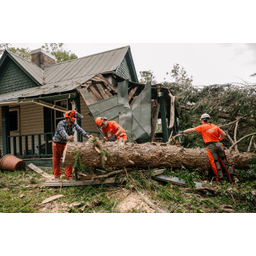
Send Relief is NAMB’s compassion and disaster-response brand, and it is one of the largest faith-based disaster-response operations in the United States. The visible piece is the yellow shirts and yellow hats - Southern Baptist Disaster Relief volunteers who deploy chainsaw crews, mud-out teams, feeding units, shower and laundry trailers, and chaplaincy support to communities after hurricanes, floods, tornadoes, wildfires, and ice storms. SBDR is one of the largest mobile-feeding operations in the country and has long-standing partnerships with the American Red Cross and federal emergency agencies.
The less visible piece is the year-round work. Send Relief Centers in major cities - Las Vegas, New Orleans, the Appalachian region, the US-Mexico border, Clarkston (Atlanta), Toronto, and others - run ongoing ministries around poverty, refugees, foster care, anti-trafficking, and orphan care. The model is "show up, stay, and partner with local churches" rather than parachuting in. For volunteers, Send Relief offers structured short-term trips, training pipelines, and deployment paths, almost all of it free at the point of service. This sounds like a small thing. In practice it is transformative: most other evangelical disaster-response groups have to raise the cost from volunteers; Send Relief largely doesn’t.
Chaplaincy + missionary deployment: a quieter pipeline at unusual scale
NAMB Chaplaincy is one of the largest endorsing bodies for Christian chaplains in the United States. It endorses chaplains across the US military (active, reserve, and National Guard), federal and state prison systems, hospitals and hospice agencies, police and fire departments, corporate workplaces, and disaster-relief contexts. For chaplain candidates, that endorsement is the operational credential that opens doors with the Department of Defense, the Federal Bureau of Prisons, and most major hospital systems. NAMB also runs ongoing training, retreats, and care for endorsed chaplains and their families - the part of chaplaincy that no candidate thinks about until they are three years in and burned out.
Alongside chaplaincy, NAMB deploys longer-term missionaries to strategic North American settings - often in partnership with state conventions, Send Cities, and local sending churches. These are not short-term trips; they are multi-year assignments in places like Quebec, the Northeast US, the Pacific Northwest, or specific people-group concentrations within major metros. Funding comes through the Annie Armstrong Easter Offering and the Cooperative Program, which is why NAMB makes such a public push around AAEO every spring - that single offering is the financial spine of North American missionary deployment for the SBC.
Pricing
Public access
Free
All of namb.net - Send Network materials, Send Relief volunteer signup, chaplaincy info, missionary profiles, and giving pages - is free to read and use.
Send Network church planter
Cooperative Program funded
Assessment, residency, coaching, and planter funding are subsidized for qualifying SBC-affiliated planters. There is no flat tuition; the cost is covered through CP giving and partner churches.
Send Relief volunteer
Free to volunteer; travel often self-funded
Volunteers are not charged. Some deployments and Send Relief Centers ask volunteers to cover travel and lodging; many local mobilizations are no-cost.
Annie Armstrong Easter Offering
Donation-based
The flagship annual offering that funds North American missionaries. 100% of gifts to AAEO are designated to missionary support.
Cooperative Program
Donation-based
The shared SBC funding stream that splits across state conventions, NAMB, the IMB, seminaries, and the Executive Committee. The primary funding rail for the entire enterprise.
Nothing on namb.net costs the visitor anything. The website, the volunteer signup forms, the planter assessment intake, and the chaplaincy info are all free to access.
The real economic story is the Cooperative Program. SBC churches contribute a percentage of their undesignated receipts to their state convention, and a share of that flows to NAMB, the IMB, the seminaries, and the SBC Executive Committee. NAMB does not invoice planters or chaplains for participation; the work is funded upstream.
The Annie Armstrong Easter Offering is the second big rail. AAEO is collected by churches each spring and is designated entirely to North American missionary support. NAMB publicly commits that 100% of AAEO gifts go to the field, with administrative costs covered by CP - the kind of transparency that matters once you start paying attention to ratios.
For Send Relief volunteers, the practical cost is usually travel and lodging on deployments outside your immediate region. Local mobilizations are typically no-cost. Send Network planters and chaplains have their own funding pathways that route through SBC structures rather than personal fundraising.
Where North American Mission Board (NAMB) falls behind
No general content for non-planters. The site is built around four user journeys - plant a church, respond to disaster, become a chaplain, give - and almost nothing is written for the casual SBC member who just wants to understand what NAMB is. Bible Gateway and the BibleProject are content destinations; namb.net is a portal.
No tradition-neutral framing. NAMB does not pretend to be ecumenical, and it should not be evaluated as if it were. Catholic, Orthodox, Anglican, Lutheran, Methodist, Pentecostal, non-denominational, and LDS readers will all find a site that is unapologetically Southern Baptist in its doctrinal commitments. That is the design, not a defect - but it is worth knowing if you are arriving from outside the SBC.
No international footprint. NAMB is, by mandate, North America only. For international missions, the SBC has a separate agency - the International Mission Board (imb.org). The two agencies share a funding rail (the Cooperative Program) but operate independently. If you assumed NAMB was the SBC’s global missions arm, you were thinking of the IMB.
Internal SBC turbulence shows up. Over the last several years NAMB has been the subject of public disputes within Southern Baptist life - over leadership, funding decisions, planter allocation, and relationships with state conventions. None of that is unique to NAMB among large denominational agencies, but a careful observer will notice it. The work continues on the ground; the public conversation can get loud.
Volunteer onboarding is uneven by region. Send Relief at the national level is well-coordinated, but the actual volunteer experience is mediated through state Baptist conventions, which differ. Some states run extremely tight training and deployment pipelines; others are thinner. The quickest path is usually through a local SBC church already plugged into its state convention’s disaster relief team.
NAMB vs. the IMB vs. Cru
These three are often mentally lumped together as "the big evangelical missions organizations," and they are all serious operations. They are also doing very different things. Different mandates. Different funding models. Different relationships to local churches.
NAMB is the SBC’s North America agency. Church planting via Send Network, disaster response via Send Relief, chaplaincy endorsement, and missionary deployment across the US and Canada. Funded primarily by the Cooperative Program and the Annie Armstrong Easter Offering. Accountable to SBC trustees. Doctrinal framework: Baptist Faith and Message 2000.
The International Mission Board (IMB) is NAMB’s overseas counterpart inside the SBC. Same Cooperative Program funding rail, same denominational governance, but the IMB sends and supports long-term missionaries everywhere outside the US and Canada - currently in the thousands across more than 100 countries. The Lottie Moon Christmas Offering is to the IMB what AAEO is to NAMB. If a Southern Baptist talks about "going overseas as a missionary," they almost always mean through the IMB.
Cru (formerly Campus Crusade for Christ) is something else entirely: a non-denominational parachurch ministry, founded in 1951 at UCLA, that focuses on evangelism and discipleship - historically on college campuses (Cru on campus), with branches in the military (Military Ministry), professional life (Priority Associates), athletics (Athletes in Action), and global staff work. Cru is not a church-planting agency, and Cru staff raise their own personal support rather than drawing from a denominational rail.
Different strengths. NAMB is better at church planting and disaster response at scale inside North America. The IMB is broader internationally - long-term, cross-cultural, residential missionary work in dozens of countries. Cru is the thoughtful person’s campus-evangelism organization, and is meaningfully ecumenical in a way the two SBC agencies are not. Most users do not need all three; the choice usually picks itself based on whether you are planting in Dallas, translating in West Africa, or discipling sophomores at a state school.
The bottom line
NAMB is doing serious work - and it is doing it at a scale most non-Baptists never see. Send Network is the largest evangelical church-planting pipeline in North America. Send Relief shows up at almost every major US disaster. Chaplaincy endorsement opens doors at the Pentagon and the federal prison system. The website itself is utilitarian, the agency is unambiguously Southern Baptist, and the international and devotional gaps are real, but they are worth knowing about going in rather than dealbreakers. If you are inside the SBC orbit, this is your default. If you are not, NAMB is still one of the most consequential organizations in North American Christianity, and worth understanding for that reason alone.
Alternatives to North American Mission Board (NAMB)
 CruNon-denominational parachurch focused on campus evangelism, discipleship, and global staff work. Personal support model rather than denominational funding.
 Samaritan’s PurseInternational Christian relief organization run by Franklin Graham. Disaster response, medical missions, and Operation Christmas Child at global scale.
 LifewayThe SBC’s sister entity for resources and curriculum - Bibles, small-group materials, and church publishing - where NAMB does missions, Lifeway does materials.
 The Gospel CoalitionReformed-leaning evangelical content network. Not a missions agency, but a frequent partner in conversation about church planting and theology.
Frequently asked questions
Is NAMB the same as the SBC?
No. NAMB is one of several agencies of the Southern Baptist Convention. The SBC also operates the International Mission Board (IMB) for global missions, six seminaries, the Executive Committee, Lifeway Christian Resources, the Ethics & Religious Liberty Commission, and GuideStone Financial Resources. NAMB is the North American missions arm of that larger SBC family.
Do you have to be Southern Baptist to plant with Send Network?
Functionally, yes. Send Network planters are expected to affirm the Baptist Faith and Message 2000 and to plant churches that will affiliate with the SBC and cooperate with a state Baptist convention. Send Network exists to plant SBC churches, not to plant generic evangelical ones. For non-denominational or other-denominational planting, networks like Acts 29, ARC, or Stadia are closer fits.
How is NAMB funded?
Primarily by two streams: the Cooperative Program (a shared SBC funding rail that pools undesignated giving from SBC churches and distributes it across SBC entities) and the Annie Armstrong Easter Offering (an annual offering designated entirely to North American missionary support). NAMB publishes financial information and is audited annually.
What’s the difference between NAMB and the IMB?
Geography and mandate. NAMB covers the United States and Canada - church planting, disaster relief, chaplaincy, and North American missionary deployment. The International Mission Board covers everywhere else, sending long-term missionaries to more than 100 countries. They share the SBC funding rail but operate as separate agencies with separate trustees.
How do I volunteer with Send Relief after a disaster?
The fastest path is through a local SBC church plugged into its state Baptist convention’s disaster relief team. State conventions run the training and deployment pipelines, and Send Relief at the national level coordinates across them. Namb.net’s Send Relief section has a volunteer signup that routes you to the right state contact.
Does NAMB endorse chaplains for the military?
Yes. NAMB is one of the larger endorsing bodies for US military chaplains and also endorses chaplains for federal and state prisons, hospitals and hospice, police and fire departments, corporate workplaces, and disaster-relief contexts. Endorsement is the credential required to serve in most of these settings, and NAMB also provides ongoing training and care for endorsed chaplains.
Is Send Network only in the United States?
No. Send Network operates across both the United States and Canada, with Canadian work structured as a peer operation rather than a subordinate one. Send Network Español also runs as a significant Spanish-language church-planting track. International church planting outside North America runs through the IMB, not NAMB.
Sources & further reading
More Teaching & Theology Websites
 Life.Church Open NetworkOne of the church world’s most generous resource libraries, serving leaders since 2006 with free sermons, curriculum, creative files, worship material, training, partner content, and ministry apps—but “free” is a tightly scoped noncommercial license, not open ownership or permission to edit and repost everything.
 The Odin ProjectA completely free, open-source path from web-development beginner to portfolio-building full-stack learner—excellent for disciplined self-study, demanding in time and independence.
 BibleProjectA nonprofit studio that turned the entire Bible into animated explainers, free seminary-grade courses, and a deep-dive theology podcast - and somehow gave it all away.
 Lessons.ChurchA genuinely free, open-source curriculum platform with 1,167 video lessons from preschool through adult, printable resources, classroom scheduling, presenter mode, TV caching, and volunteer access—but each church still needs to review doctrine, permissions, safeguarding, account governance, and recovery before Sunday depends on it.
 Christian Classics Ethereal LibraryThe Christian Classics Ethereal Library is possibly the oldest Christian site on the internet, and it is still the single best free source for the public-domain canon - from Augustine to Spurgeon, with the entire 38-volume Ante-Nicene and Nicene-and-Post-Nicene Fathers in the middle.
 Christian History InstituteThe quiet workhorse of popular church history publishing for forty years - and almost everything they have ever printed is sitting online for free.