
- Starting price
- Free, then around $2.99/mo Pro
- Free tier
- Yes
- Platforms
- iOS · Android
- Developer
- Andy Geers / Discipleship Tech
- Launched
- 2012
- Updated
- May 24, 2026
The verdict
If your prayer life has more names, missionaries, and requests than your brain can keep track of, PrayerMate is the app. It's the closest thing the Christian app world has to a personal CRM for intercession - and the free tier is enough to run a serious prayer practice without paying a dollar.
Try PrayerMate ↗Opens prayermate.net
PrayerMate has quietly become the favorite of every evangelical who has ever felt guilty about forgetting to pray for the missionary couple in Central Asia. With somewhere north of a quarter-million downloads, a free core, and a small Pro tier at around $2.99/mo, it has no real direct competitor - partly because almost nobody else has tried to build a prayer-list manager that actually works the way a serious intercessor's brain works. Hallow is bigger. Echo Prayer is more polished on the surface. Neither has done what PrayerMate has done with prayer-list organization specifically.
It is not, despite the structure, a heavy app. It doesn't try to guide you through audio sessions. It doesn't read scripture aloud to you. It doesn't pretend to be a daily devotional. What it does is take the actual problem most committed Christians have - too many people, too many requests, too many ministries, all worth praying for, none of which fit in working memory - and treat it as a list-management problem with a spiritual purpose. Categories. Subjects. Rotation. Notes. Answered prayer. The mental model is closer to Getting Things Done than to Calm, and the people who love it really love it.
The result is a tool that has become standard issue in serious intercession circles, missionary support networks, and church prayer teams worldwide. That is a strong claim, and it's the claim the steady drip of reviews from missionary-sending agencies, church prayer pastors, and personal users keeps making. The app is not perfect - the UI is utilitarian, the onboarding throws a lot of structure at you on day one, and the design language has aged - but it is the most genuinely useful prayer-organizer in the category, and anyone who has ever said "I should be praying more systematically" should at least install the free tier.
✓ The good
- Best-in-class for organizing a real prayer list - categories, subjects, sub-subjects, notes, and dates all work the way a serious intercessor actually thinks
- Rotation scheduling is the killer feature - you set how often each request comes up and the app builds your daily prayer session for you, no decisions required
- Prayer-letter import pulls missionary updates straight from email or RSS into your existing prayer subjects - the support-network use case nothing else handles
- Free tier is unusually generous - unlimited categories, unlimited subjects, unlimited rotation, and the core import workflow all stay free
- Answered-prayer tracking is built in and used - mark a request answered and the app preserves the history rather than just deleting it
- Strong privacy stance - your prayer list lives on your device with optional encrypted backup, not in a marketing database
- Active developer (Andy Geers) ships updates regularly and responds personally to support emails, which is rare at any price
✗ Watch out
- UI is functional rather than beautiful - clearly built by someone who cares more about the workflow than the visual design
- Onboarding is steeper than the category average - categories, subjects, schedules, and feeds all get introduced at once and it takes a session to click
- No guided-audio prayer content - this is an organizer, not a Hallow- or Pray.com-style listening app, and it doesn't pretend to be
- Limited cross-device sync (yet) - backup exists but the seamless multi-device experience most people now expect is still a rough edge
- Sharing prayer lists with a spouse or small group works but isn't the polished feature it could be - most couples end up with two separate copies of the same list
Best for
- Serious intercessors with too many people to pray for
- Missionary supporters and prayer-team leaders
- Anyone who keeps prayer notes in a notebook now
- Pastors and small-group leaders tracking congregational requests
Avoid if
- You want guided audio prayer sessions
- You bounce off apps that require setup
- You want a polished, Apple-design-language UI
- You only pray for two or three things and don't need a system
What PrayerMate is
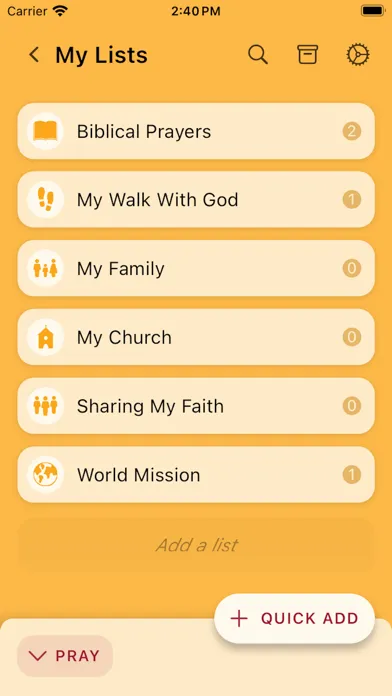
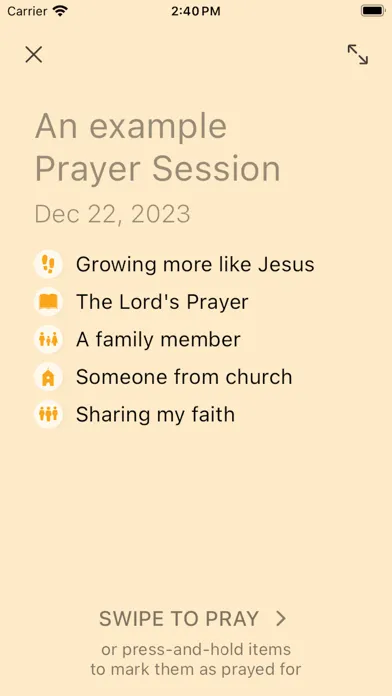
PrayerMate is a structured prayer-list organizer built around three primitives: categories (Family, Missions, Persecuted Church, Salvation, Church), subjects (a specific person, family, ministry, or request inside a category), and schedules (how often each subject surfaces in your daily prayer session). Open the app and tap Pray Now and it builds a session for you by walking the rotation - today you might get your spouse, two missionary families, a salvation request, and the persecuted-church country of the day, all because that's what the schedule said was due.
Around that core sit the features serious intercessors actually use: prayer-letter import from email and RSS so missionary newsletters land directly inside the relevant subject; subject notes so you can record what someone asked you to pray for last month and pick it back up next week; answered-prayer marking so a request doesn't disappear into the void when God answers it; and category-level scheduling so the entire Persecuted Church category can cycle through one country per day for a year. It is, in spirit, a personal CRM for prayer.
Why serious intercessors prefer PrayerMate
The single biggest practical difference between PrayerMate and every other prayer app is that PrayerMate takes the actual constraint of intercession seriously: there are more people and requests you want to pray for than you can hold in your head, and the answer is not willpower. It's structure. Most apps treat prayer as a thing you should do (guided sessions, devotional content, scripture reminders) and assume you already know what to pray about. PrayerMate flips that - it assumes you already want to pray and the problem is keeping track of what.
That mental model is what lets the app become genuinely indispensable for people whose prayer lists have grown beyond memory. A missionary supporter who's on the prayer team for twelve families. A pastor with a hundred congregation members. A grandmother praying for nineteen grandchildren by name. A college student tracking salvation requests for ten friends. For all of them, the daily question shifts from "who am I forgetting today?" to "the app picked these five - let's pray." That sounds like a small thing. In practice it's transformative, because the friction of starting drops to zero and the guilt of forgetting drops with it.
Category-based prayer list organization: the spine of the app
Categories are the top-level container in PrayerMate, and the choice of how to slice yours is the most important setup decision in the app. The defaults nudge you toward Family, Friends, Church, Missions, Persecuted Church, Salvation, and a few topical ones (Government, Revival, World Events), but the structure is fully customizable. Inside each category you create subjects - a specific person, family, missionary couple, ministry, country, request. Subjects can hold notes, dates, scripture references, even attached photos, and they're the unit the rotation engine works on. The deeper you commit to the model, the more useful the app becomes.
What makes the category system work in practice is that it maps cleanly onto how committed intercessors already think about their prayer life. Most serious pray-ers already mentally bucket their requests - "my family," "our missionaries," "the unreached," "people I'm praying for to come to faith" - and PrayerMate lets you make that mental model the actual structure of your prayer time. The payoff is that you stop dropping whole categories for weeks at a time. Missions doesn't get skipped because today is a Family day; both come up in the rotation because the scheduler honors the structure. For users who have tried (and failed) to maintain a paper prayer list, this is the moment the app clicks.
Rotation scheduling: pray for everything on a cycle
Rotation is the feature that distinguishes PrayerMate from every notes app you could have used instead. Each subject gets a schedule - daily, every two days, weekly, monthly, the country-of-the-day for Persecuted Church, the missionary-of-the-week for your sending agency - and the app's daily session is assembled by walking the rotation and picking what's due. Open Pray Now and you get a curated list of, say, five to seven subjects today, drawn from across your categories according to the cadence you set. Tomorrow's list will be different. The cycle keeps moving so nothing falls off forever.
The reason this matters is volume. The intercessor's nightmare is the prayer list that grows until it's unprayable - sixty subjects, all of them important, none of them prayed for. Rotation solves that without asking you to drop anything. You don't have to pray for every missionary family every day; you have to pray for the two the app surfaced today, and trust the schedule for the rest. Most users find that within a week or two the daily session feels right-sized - focused enough to actually pray through, broad enough that the whole list cycles in a fortnight or a month depending on cadence. Most users do not need to micro-tune the schedules. The defaults handle 80 percent of the work and the app's calmer for it.
Prayer-letter import: missionaries, ministries, and the support network
Prayer-letter import is the feature that quietly makes PrayerMate indispensable for anyone on a missionary support team. The app can pull updates from email forwards, RSS feeds, and a growing list of partner ministries and sending agencies - Operation World, the Joshua Project, SIM, OMF, individual missionary newsletters - and attach those updates directly to the relevant subject in your prayer list. So when the Joneses' quarterly update arrives, it doesn't sit in your inbox for three weeks; it lands inside the Jones subject in your Missions category, ready to surface the next time that subject comes up in the rotation.
The use case that drives this is mundane and very common: you said you'd pray for ten missionary families, you mean to, you forget, and the quarterly newsletters pile up unread. Prayer-letter import collapses that gap. The newsletter becomes the prayer prompt - when the Jones family is due in your rotation, you're praying through their actual current update, not what you vaguely remember from last year. For the missionaries themselves, it solves the inverse problem ("are people actually praying through these updates or just deleting them?"), which is why a lot of sending agencies now ship PrayerMate-ready feeds. There is no other app in the prayer category that handles this workflow at all, let alone well.
Pricing
Free
$0
Unlimited categories, unlimited subjects, full rotation scheduling, prayer-letter import, answered-prayer history. The entire core workflow is free.
PrayerMate Pro Monthly
Around $2.99/mo
Removes the small in-app sponsorship cards, unlocks theming and a couple of power-user touches. Mostly a tip-jar tier that keeps the lights on.
PrayerMate Pro Annual
Around $24.99/yr
Same as monthly Pro at a small discount. Genuinely the right tier for anyone who uses the app daily and wants to support the developer.
PrayerMate's pricing is gentle and refreshingly old-school. The free tier is real - unlimited categories, unlimited subjects, full rotation scheduling, the full prayer-letter import workflow, answered-prayer history. There is no functional paywall on the core experience. You can run a serious daily intercession practice on the free tier indefinitely and never pay a dollar, and a lot of users do exactly that.
PrayerMate Pro at around $2.99/mo (or roughly $24.99/yr if you go annual, depending on store and region) is essentially a tip-jar tier. It removes the small sponsorship cards that occasionally surface in the daily session, unlocks a couple of themes, and tells the developer you appreciate what he's doing. The annual tier is the right one for anyone who opens the app daily - it's a small line item, and PrayerMate is one of the few apps in this category not backed by a venture-funded subscription engine.
There's also a path to support specific ministries and sending agencies inside the app - some prayer-letter feeds are produced by partner organizations who you can choose to support directly. Worth noting, since the model lines up with how many users want to give: not to a generic subscription, but to the missionaries they're already praying for.
Worth flagging: there is no aggressive upsell pressure. The free-tier experience does not constantly nag you to upgrade. Sponsorship cards are gentle and dismissible. If you've been burned by faith-tech apps that feel like funnels, the contrast here is striking - and probably the single most common reason users end up subscribing voluntarily.
Where PrayerMate falls behind
No guided-audio prayer content. PrayerMate organizes what you pray for; it does not produce a session you listen to. There is no Rosary, no Examen audio, no celebrity-led prayer, no sleep stories. Pair it with Hallow or Lectio 365 if you want the audio-session experience alongside the list management - the two app categories barely overlap.
Onboarding is steeper than the category average. Categories, subjects, schedules, feeds, notes, and answered-prayer tracking all get introduced in the first session, and the model takes a sit-down to fully grasp. Casual users sometimes bounce. The app is genuinely worth the half-hour setup, but the half-hour is real.
UI design is functional, not beautiful. PrayerMate is clearly built by someone who cares more about the workflow than the visual polish. The icons, typography, and screen layouts all do their job but feel a generation behind apps like Hallow or Echo Prayer. For some users this is a feature (no noise, just the list); for others it's a wall.
Cross-device sync is a rough edge. Encrypted backup and restore exist, and you can move your list between devices, but the seamless multi-device experience most users now expect - open it on iPad, open it on iPhone, see the same state - isn't quite there (yet). Power users tend to pick a primary device and stick with it.
Shared prayer lists for couples and small groups aren't a first-class feature. You can share subjects and feeds, but most spouses who want to pray the same list end up with two parallel copies they re-sync manually. For a tool this good at single-user organization, the multi-user story is the obvious next frontier.
PrayerMate vs. Echo Prayer vs. Hallow
Different jobs. PrayerMate is a prayer-list organizer - its job is to remember what you want to pray for and surface it on the right cadence. Echo Prayer is a prayer-tracker with a stronger social and small-group emphasis - its job is to let you share requests with a circle and pray together. Hallow is a guided-audio prayer app - its job is to lead you through a Catholic prayer session you listen to. All three are called "prayer apps" in the app stores, but they barely compete on features.
Different strengths. PrayerMate is better at structured personal intercession (categories, rotation, prayer-letter import, missionary support) and is the only app in the category that takes large prayer lists seriously. Echo Prayer is broader on the social and small-group side (shared lists, group prayer, request feeds) and lighter on personal-organization tooling. Hallow is in a different category entirely - it doesn't try to manage your list at all; it tries to lead you in prayer through guided audio sessions, daily Rosaries, the Examen, and seasonal challenges like Pray40.
Pricing is wildly different across the three. PrayerMate Pro runs around $2.99/mo or $24.99/yr (and the free tier is fully usable). Echo Prayer is free with optional support. Hallow+ runs $69.99/yr. For a personal intercessor with a long list, PrayerMate is the obvious starting point and the free tier alone may be all you ever need. For a small-group leader who wants shared prayer requests with a circle, Echo Prayer fits the use case better. For someone who wants to be led through Catholic prayer rather than organize their own, Hallow is the right answer. Plenty of serious pray-ers run all three - PrayerMate for the list, Echo for the group, Hallow for the audio session.
The bottom line
PrayerMate is the thoughtful intercessor's prayer app - the one that takes the actual problem of a long, complicated prayer list seriously and treats it as a structure problem rather than a willpower problem. The rotation engine, the category model, and the prayer-letter import workflow have no real competitor in the category, the free tier is enough to run a real daily practice, and the Pro tier at around $2.99/mo is one of the gentlest pricing models in faith-tech. If you have ever said the words "I should be praying more systematically," install it today. If you want guided audio prayer instead, pair it with Hallow or Lectio 365 - they don't compete; they complement.
Alternatives to PrayerMate
 HallowThe leading guided-audio prayer app - Catholic-first, deep catalog, celebrity-led sessions, Pray40 for Lent. Pair with PrayerMate, not instead of.
 Lectio 36524-7 Prayer's free daily prayer app - morning, midday, and night-time guided audio sessions in a contemplative Protestant frame.
 Pray.comThe broad Protestant-evangelical prayer and audio-Bible app - bigger library, daily prayer with a wide range of voices, around $69.99/yr.
 AbideThe veteran Christian meditation app - thousands of scripture-anchored guided meditations and a much-loved sleep-story library.
 Pray FirstA completely free guided-prayer app from Church of the Highlands with six structured plans, audio, reminders, and a synchronized prayer list. Easier to begin with; less powerful for long-term intercession organization.
 Redeeming TimeDiscipleship Tech’s free companion app that turns spare minutes into whole-book Bible reading and short daily plans rather than organizing intercession.
Frequently asked questions
Is PrayerMate free?
Yes - the free tier is real and unusually generous. Unlimited categories, unlimited subjects, full rotation scheduling, prayer-letter import, and answered-prayer tracking all stay free. PrayerMate Pro at around $2.99/mo (or about $24.99/yr) removes a small sponsorship card from the daily session and unlocks a couple of theming touches; it functions more as a tip jar than a paywall.
What does PrayerMate actually do?
It organizes everything you want to pray for into categories (Family, Missions, Salvation, Persecuted Church, etc.) and subjects (a specific person, ministry, or request), then uses a rotation schedule to surface the right ones each day. You open the app, tap Pray Now, and it hands you a curated list of five to seven subjects to pray through - drawn from across your categories on whatever cadence you set. Nothing falls off the list and you stop relying on memory.
Who is PrayerMate for?
Anyone whose prayer list has outgrown their memory - missionary supporters, prayer-team leaders, pastors tracking congregational requests, parents with long family-and-friends lists, anyone praying for a circle of salvation requests. If you've ever kept a prayer notebook on paper or felt guilty for forgetting to pray for someone, this is the app that fixes that problem.
Can I import missionary prayer letters?
Yes - this is one of the app's signature features. PrayerMate can pull updates from email forwards, RSS feeds, and partner ministries (Operation World, the Joshua Project, individual sending agencies, and many specific missionary newsletters) directly into the relevant subjects in your list. When you pray for the family next, you're praying through their actual current update, not something you half-remember.
How is PrayerMate different from Hallow?
Different jobs. PrayerMate organizes what you pray for; Hallow leads you through guided audio prayer sessions. PrayerMate is a structured list manager, Hallow is closer to a Calm-style listening app inside a Catholic prayer frame. Most serious intercessors who own both use PrayerMate for the list and Hallow for the daily Rosary or Examen - they're complements, not competitors.
Does PrayerMate sync across devices?
Encrypted backup and restore exist, so you can move your list between devices, but the seamless real-time multi-device experience most users now expect isn't quite there. Most power users pick a primary device (usually their phone) and treat that as the home of their list. Cross-device sync is on the developer's roadmap and the app is actively maintained.
Who built PrayerMate?
Andy Geers, a UK-based developer, started PrayerMate in 2012 and has been shipping it through his small studio (Discipleship Tech) ever since. The app is genuinely independent - no venture funding, no aggressive growth engine, no large team. Geers responds personally to support emails, which is part of why the app has the loyal user base it does.
Sources & further reading
More Prayer Apps
 School Prayer ChallengeA free, donor-supported map that turns a broad desire to pray for schools into three named commitments and a visible nationwide goal—useful structure, with public counters that require careful interpretation.
 Champion PrayerA voice-first social prayer journal that can make intercession feel personal across distance, with public and private circles and answered-request tracking—but highly sensitive stories, recordings and images demand stronger privacy documentation and careful group leadership.
 Prayer LibraryA completely free, ad-free collection that helps people find words for prayer by naming an emotion, then turns those discoveries into lists, notes and a gentle daily rhythm—but its recommendation method and sensitive-data practices need fuller documentation.
 Simplified PrayerA genuinely free prayer organizer for remembering people, grouping requests, focusing one need at a time and following up on answers—calm and practical, though “private” marketing needs to be read beside broad cloud-data and App Store disclosures.
 still: pray together & gospelAn ambitious iPhone prayer environment combining shared requests, a Screen Time app lock, journey visualization, journaling and personalized devotionals—more coherent than its crowded feature list suggests, but expensive, new and currently missing an accessible official privacy page.
 Prayer GlobalPrayer Global turns an enormous missions-prayer goal into one guided minute at a time, with unusually useful church relays—best when its maps and metrics serve prayer rather than define people or measure devotion.