- Starting price
- Free, then ~$69.99/yr Premium
- Free tier
- Yes
- Platforms
- iOS · Android · Web
- Developer
- Pray.com, Inc.
- Launched
- 2016
- Updated
- May 24, 2026

The verdict
Pray.com has quietly become the default prayer app for casual Protestant listeners who want polished audio, celebrity-narrated bedtime Bible stories, and family-friendly devotionals without a learning curve. It is broader than Hallow on the Protestant side and deeper than Abide on content, but it is not the right pick if you want catechetical depth or a single curated daily practice.
Try Pray.com ↗Opens pray.com
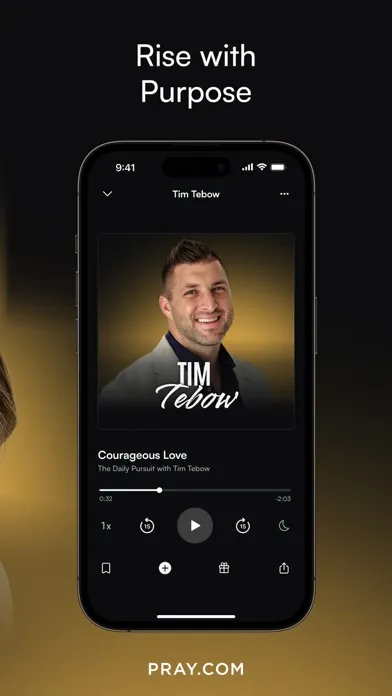
Pray.com has quietly become the favorite of casual Protestant listeners who want a prayer app that feels more like a premium podcast network than a spiritual gym. Where competing apps lean into structure - novenas, lectio cycles, examen scripts - Pray.com leans into voice. Open it for the first time and the home screen is mostly thumbnails of audio: a Pastor Mike daily prayer, a James Earl Jones-narrated bedtime Bible story, a Phil Wickham worship moment, a Bible in a Year track, a family devotional, a sleep-time Psalm read over ambient strings.
It does not push you toward a liturgical hour. It does not require a daily streak to be useful. It does not assume you came in knowing the difference between vespers and compline. The pitch, instead, is that you already pray a little, you already listen to podcasts a lot, and you would probably pray more if the audio felt as good as the rest of your library. That is a smaller ambition than Hallow has - but for the 17 million-plus users Pray.com has accumulated, it is the right one.
This review covers what Pray.com does well, where it is genuinely thin, what the ~$69.99/yr Premium tier actually unlocks, and how it stacks up against Hallow on the Catholic side and Abide on the meditation side. The short version: it is the strongest pick in its lane, with some real gaps that are worth knowing about going in rather than dealbreakers.
✓ The good
- Best-in-class audio production - narration, music beds, and engineering are closer to a Spotify original than a typical faith app
- Celebrity narration nobody else can match - James Earl Jones bedtime Bible stories, Phil Wickham worship moments, athlete and pastor cameos throughout
- Family-friendly by default - kids content, bedtime stories, and devotionals for couples and households all live in the same app without a separate kids tier
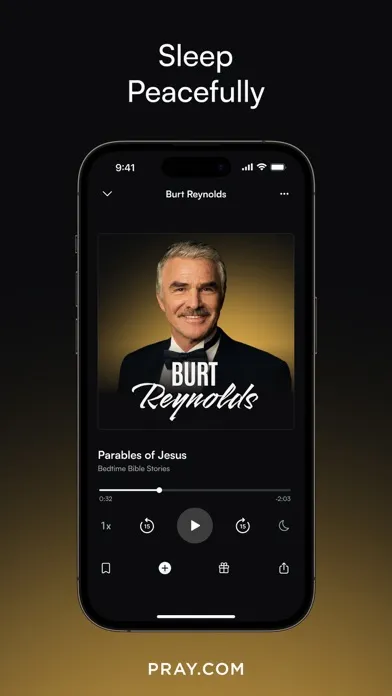
- Genuinely strong sleep content - Psalms over ambient music, scripture lullabies, and long-form Bible narration that runs through the night
- Daily prayer that does not require a tradition - Pastor Mike-style guided prayers work for nondenominational, Baptist, Methodist, and most evangelical listeners
- Bible in a Year track with multiple voices and pacing options, not just one host
- Free tier is generous - daily prayer, a rotating selection of stories, and a workable Bible in a Year sample without paying
✗ Watch out
- Thinner Catholic content than Hallow - rosary, novenas, and saints content exist but are clearly not the priority
- No serious original-language or study tools - this is a prayer/listening app, not a study app
- Premium paywall hits fast on the kids and sleep content most parents actually want
- Discovery is podcast-style, not curriculum-style - you can scroll forever without a clear "do this next" path
- No LDS, Orthodox, or liturgical-hour structure - the assumed user is broadly Protestant
- Annual price (~$69.99/yr) is identical to Hallow, which has more total content hours
Best for
- Casual Protestant listeners who want polished audio prayer
- Parents who want bedtime Bible stories for kids
- Couples and families looking for short shared devotionals
- Anyone who falls asleep to podcasts and wants to swap in scripture
Avoid if
- You want catechetical depth (Hallow is stronger)
- You want original-language or commentary tools (Logos, Olive Tree)
- You want a single, structured daily practice with no scrolling
- You are looking for LDS, Orthodox, or strongly liturgical content
What Pray.com is
Pray.com is a prayer, devotional, and audio Bible app aimed at a broadly Protestant, broadly American audience. Founded in 2016 and headquartered in Santa Monica, it has grown to more than 17 million users and over 100 million podcast downloads across its in-app content. The product is iPhone, Android, and web - with the mobile apps doing the overwhelming majority of the listening.
Functionally, it sits in the same room as Hallow, Abide, and Glorify, but with a different center of gravity. Hallow is built around Catholic liturgy and celebrity-led seasonal challenges. Abide is built around Christian meditation and sleep. Pray.com is built around audio storytelling - bedtime Bible stories, narrated scripture, daily guided prayer, family devotionals, and worship moments - produced at a level that feels more like a media company than a chapel.
Why everyday Protestant listeners prefer Pray.com
The single biggest practical difference between Pray.com and Hallow is the assumed user. Hallow assumes you want to pray a specific historic prayer - a rosary, a novena, a chaplet - and meets you with a structured guide. Pray.com assumes you want to feel calmer, sleep better, raise kids who know the Bible, and pray with a voice you trust, and meets you with a library. Neither is wrong. They are aiming at different listeners.
For the everyday Protestant audience - the parent winding down at night, the commuter who already listens to podcasts, the couple who wants ten minutes of devotional before bed - Pray.com is the model that respects your existing media habits. It does not ask you to learn a tradition. It does not ask you to commit to a daily examen. It sits in your podcast app slot and gives you audio that, in most cases, sounds better than the podcast it is replacing. For the casual Protestant listener, that is the thoughtful person's prayer app.
Bedtime Bible Stories: the James Earl Jones killer feature
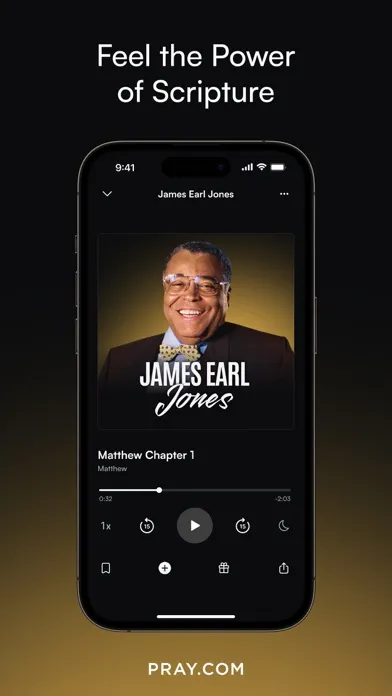
Pray.com's flagship content is its catalog of bedtime Bible stories - narrated by James Earl Jones, Phil Wickham, and a rotating cast of pastors, worship artists, and broadcasters. The James Earl Jones recordings, in particular, are the kind of asset no other prayer app on the market has. They are produced like an audiobook - score, sound design, full performance reads - and run long enough that most listeners fall asleep before the story ends. That, by design, is the point.
This sounds like a small thing. In practice it is transformative for the user pattern Pray.com is actually solving for: an adult who lies in bed scrolling, then opens a sleep app or a podcast, then loses thirty minutes to whatever the algorithm serves. Replace that loop with a Psalm or a story from Genesis read by James Earl Jones over strings, and the behavioral switch is small but the spiritual switch is not. Hallow has sleep content. Abide has sleep content. Neither has a bench of narrators at this level.
Family prayer and devotionals - the household-mode bet
A significant chunk of Pray.com's catalog is built explicitly for the household: short devotionals for couples, prayer guides for parents, age-appropriate Bible stories for kids, family prayers for mealtimes and bedtime, and seasonal content around Advent, Lent, Easter, and back-to-school. The kids material is not walled off in a separate app the way YouVersion handles Bible App for Kids - it sits in the main library and is meant to be played by a parent for a child, or by the whole family together.
For households where one parent is more comfortable leading family prayer than the other - which is most households - this is a quiet superpower. The app does the leading. You press play, and a pastor or actor walks the family through a five-minute devotional with a scripture, a prayer, and a single application question. It is not deep theology. It is not catechesis. But for the family that wants to do something rather than nothing, Pray.com is the lowest-friction option in the category by a wide margin.
Daily prayer with Pastor Mike and the daily content engine
The third pillar is the daily prayer track - most prominently associated with Pastor Mike Novotny, whose short, warm, conversational prayers anchor the home screen most days. Around that are daily devotionals, daily scripture readings, a Bible in a Year track, and rotating series tied to the church calendar. Pray.com publishes new daily content the way a podcast network publishes new daily episodes: relentlessly, on a schedule, with cover art and a hook.
For users who have tried and bounced off rigid daily-office apps, this is the format that finally sticks. You open the app, you press the top thing, and within five to ten minutes you have prayed, heard scripture, and been pointed at one practical thought for the day. There is no streak shame if you skip. There is no liturgical structure to learn. The price of that accessibility is that you will not, by following the daily track alone, develop the kind of depth a structured Hallow or Logos workflow would build. That tradeoff is the entire Pray.com thesis.
Pricing
Free
$0
Daily prayer, a rotating selection of stories and devotionals, sample episodes of premium series, and a workable Bible in a Year track.
Pray.com Premium (Annual)
~$69.99/yr
Full library - all bedtime Bible stories, all sleep content, all family devotionals, full Bible in a Year, ad-free across the app.
Pray.com Premium (Monthly)
~$9.99/mo
Same library, monthly billing. Useful if you want to trial Premium during Advent or Lent without an annual commitment.
Pricing is straightforward and roughly matches Hallow. The free tier is genuinely useful - daily prayer, a rotating selection of bedtime Bible stories, sample episodes of premium series, and a workable Bible in a Year track. Most users can get a real feel for whether the app fits their household without paying.
Premium runs around $69.99 a year or roughly $9.99 a month as of writing, and unlocks the full library: every James Earl Jones bedtime story, the full sleep catalog, all family devotionals, the complete Bible in a Year track, and ad-free playback. The annual price is identical to Hallow+, which makes the two products direct head-to-head competitors on cost.
Most users do not need to subscribe in the first week. The right move is to use the free tier for two to three weeks, identify which two or three pieces of content you actually open repeatedly - bedtime stories for the kids, the sleep Psalms, the Bible in a Year track - and then decide whether Premium pays for itself. For households that use the bedtime and family content daily, it does. For users who only want the daily prayer, the free tier is likely enough.
Free trials of Premium come and go, usually around Advent, Lent, and the new year. If you can wait for one of those windows, you can usually get a 7- to 14-day trial without committing.
Where Pray.com falls behind
No serious study tools. Pray.com is not trying to be Logos, Olive Tree, or Blue Letter Bible, and it shows. There is no original-language support, no commentary integration, no cross-references, no notes you can take against a verse. If you want to study the passage you just heard, you have to leave the app.
Thinner Catholic depth than Hallow. The rosary, novenas, and saints content exist on Pray.com, but they are clearly not the editorial priority, and the production polish that defines the Protestant-leaning content does not always carry over. A Catholic user is better served by Hallow as a primary app, with Pray.com as a secondary option for sleep and family content.
No LDS or Orthodox structure. The app does not include the Book of Mormon, Doctrine and Covenants, or Pearl of Great Price, and there is no liturgical-hour or Divine Liturgy content for Orthodox users. The assumed user is broadly Protestant, and the rest of the audience has to import their own framework.
Discovery can feel scroll-y. With as much content as Pray.com has, the home screen can read like a streaming carousel - a row of bedtime stories, a row of devotionals, a row of sleep content, a row of new releases. Users who want a single "do this next" recommendation can get lost. Hallow's seasonal challenges (Pray40 for Lent, Advent Pray25) handle this better.
Premium paywall hits fast on the content most parents actually want. The free tier is generous on daily prayer, but a parent who opens the app specifically for bedtime Bible stories will hit the Premium wall within a week. That is fair as a business model - it is the obvious upsell - but new users should know going in that "free forever" understates how quickly the family-mode use case wants Premium.
Pray.com vs. Hallow vs. Abide
Different strengths. Hallow is better at structured Catholic prayer - rosaries, novenas, lectio divina, the liturgy of the hours, and big seasonal challenges led by celebrities like Jonathan Roumie and Mark Wahlberg. Pray.com is broader on the Protestant side - bedtime Bible stories with James Earl Jones, Pastor Mike daily prayer, family devotionals, Bible in a Year, and a sleep catalog that runs all night. Abide is narrower than both - Christian meditation and sleep as the entire product, with less daily-prayer infrastructure.
On price, Pray.com and Hallow are effectively tied at around $69.99 a year. Abide is in a similar range. The deciding factor is rarely cost. It is what you want the app to do. If you want a single tradition's historic prayers performed well, Hallow. If you want a meditation-style audio practice with sleep front and center, Abide. If you want a podcast-network-quality prayer and devotional library aimed at the everyday Protestant household, Pray.com.
Many users end up with two of these installed - Hallow for structured prayer, Pray.com for bedtime and family content, or Pray.com for daily and Abide for sleep. There is no rule that you have to pick one, and at roughly $70 a year each, the math on running two depends on how often you actually open the second one. For most users, picking the one that matches the dominant use case and using YouVersion for everything else is the cleaner stack.
The bottom line
Pray.com is the strongest prayer app on the market for casual Protestant listeners, parents who want bedtime Bible stories the kids will actually sit through, and anyone who already lives in podcast and sleep-audio apps and wants to swap in scripture. It is not as deep on Catholic liturgy as Hallow, not as study-focused as Logos or Olive Tree, and not built around LDS or Orthodox content. But within its lane - celebrity-narrated audio, family devotionals, and a daily prayer that does not require learning a tradition - it is the model that respects your existing media habits, and at around $69.99 a year, Premium is fair value for the household that uses it.
Alternatives to Pray.com
 HallowThe Catholic flagship - rosaries, novenas, liturgy of the hours, and celebrity-led seasonal challenges. Deeper on Catholic distinctives, narrower for Protestant households.
 DwellAudio Bible app built around narrated scripture, reading plans, and ambient music. Stronger if you primarily want to listen to the Bible itself rather than guided prayer.
 YouVersionThe free Bible app that almost everyone already has. Pairs naturally with Pray.com - YouVersion for reading and plans, Pray.com for guided prayer and sleep audio.AbideChristian meditation and sleep app - narrower than Pray.com on daily prayer, similar on sleep content. Worth a look if meditation is your primary use case.
Frequently asked questions
Is Pray.com free?
Yes - there is a real free tier with daily prayer, a rotating selection of bedtime Bible stories, sample episodes of premium series, and a workable Bible in a Year track. Premium is around $69.99 a year or roughly $9.99 a month and unlocks the full library plus ad-free playback.
Did James Earl Jones really narrate bedtime Bible stories for Pray.com?
Yes. James Earl Jones recorded a catalog of bedtime Bible stories that remain one of Pray.com's flagship pieces of content. Phil Wickham and a rotating cast of pastors, athletes, and broadcasters also narrate stories and lead worship moments throughout the app.
Is Pray.com Catholic or Protestant?
Pray.com is non-denominational with a broadly Protestant editorial center of gravity. There is some Catholic content - rosary, novenas, saints - but the catalog is not as deep on Catholic distinctives as Hallow. Users who want a primarily Catholic prayer experience will be better served by Hallow.
Is Pray.com safe for kids?
Yes. A significant portion of the catalog is built for families and children - bedtime Bible stories, family devotionals, mealtime prayers, and age-appropriate scripture. The kids content lives in the main app and is meant to be played by a parent for a child or by the whole family together.
Pray.com vs. Hallow - which should I get?
Hallow is the better pick if you want structured historic prayers - rosaries, novenas, liturgy of the hours - and seasonal challenges like Pray40 and Advent Pray25. Pray.com is the better pick if you want celebrity-narrated bedtime Bible stories, family devotionals, daily Protestant-style guided prayer, and a long-form sleep catalog. At roughly $69.99 a year each, the choice is about use case, not cost.
Does Pray.com have a Bible in a Year?
Yes. Pray.com offers a Bible in a Year track with multiple narrators and pacing options. The free tier gives you a workable version of it; the full track, plus longer narrated readings and ambient sleep mixes, is in Premium.
Can I cancel Pray.com Premium anytime?
Yes. Subscriptions purchased through the iOS App Store, Google Play, or the web all cancel through their respective billing systems. After canceling, you keep Premium access through the end of the billing period you already paid for, then revert to the free tier.
Sources & further reading
More Prayer Apps
 School Prayer ChallengeA free, donor-supported map that turns a broad desire to pray for schools into three named commitments and a visible nationwide goal—useful structure, with public counters that require careful interpretation.
 Champion PrayerA voice-first social prayer journal that can make intercession feel personal across distance, with public and private circles and answered-request tracking—but highly sensitive stories, recordings and images demand stronger privacy documentation and careful group leadership.
 Prayer LibraryA completely free, ad-free collection that helps people find words for prayer by naming an emotion, then turns those discoveries into lists, notes and a gentle daily rhythm—but its recommendation method and sensitive-data practices need fuller documentation.
 Simplified PrayerA genuinely free prayer organizer for remembering people, grouping requests, focusing one need at a time and following up on answers—calm and practical, though “private” marketing needs to be read beside broad cloud-data and App Store disclosures.
 still: pray together & gospelAn ambitious iPhone prayer environment combining shared requests, a Screen Time app lock, journey visualization, journaling and personalized devotionals—more coherent than its crowded feature list suggests, but expensive, new and currently missing an accessible official privacy page.
 Prayer GlobalPrayer Global turns an enormous missions-prayer goal into one guided minute at a time, with unusually useful church relays—best when its maps and metrics serve prayer rather than define people or measure devotion.