1 Chronicles 11
People in this chapter
For years David was the hunted man, hiding in caves with a price on his head. Now all Israel comes to Hebron and says, "We are thy bone and thy flesh." They anoint him king. Then the chapter does something strange. It stops the story and reads out a list of names - the mighty men, the warriors who stood with David before the crown was ever his 1.
Tap any highlighted phrase to jump to the commentary that unpacks it.
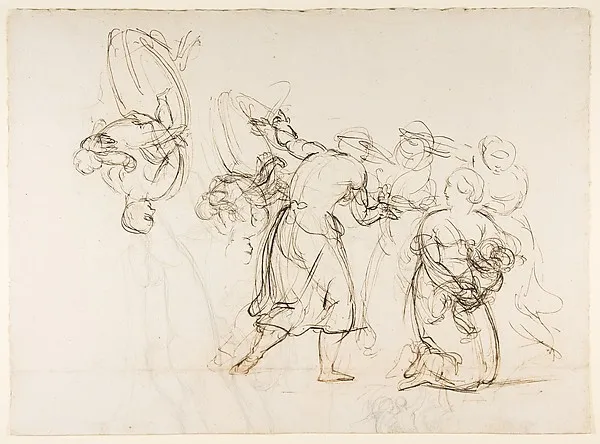
1 Chronicles 11:1-3All Israel Gathers to Anoint David King
1Then all Israel gathered themselves to David unto Hebron, saying, Behold, we are thy bone and thy flesh. 2And moreover in time past, even when Saul was king, thou wast he that leddest out and broughtest in Israel: and the LORD thy God said unto thee, Thou shalt feed my people Israel, and thou shalt be ruler over my people Israel. 3Therefore came all the elders of Israel to the king to Hebron; and David made a covenant with them in Hebron before the LORD; and they anointed David king over Israel, according to the word of the LORD by Samuel.
This is kinship language, the words a man uses of his own family. They say, in effect, "You are one of us. Your blood is our blood." Nobody imposes David on the nation from outside. The people are recognizing what God settled long ago, that this king is bone of their bone, and so fit to lead them from the inside. 2
A covenant binds two parties into one body, one purpose, going deeper than any exchange of terms. So the elders seal themselves to David, and he seals himself to them. And the act is done "before the Lord." God is not a bystander to the agreement. He is its witness and its guarantor, which means breaking faith with the king is breaking faith with God 1.
The people anoint David king. The anointing is the visible sign of God's choice - oil poured on the head, set apart for the Lord's purpose. And the text says this anointing follows "the word of the Lord by Samuel" - echoing the secret anointing Samuel performed at David's home when he was still the youngest, the shepherd boy. Now the whole nation affirms what God spoke through the prophet.
1 Chronicles 11:4-5The Stronghold of Zion Taken
4And David and all Israel went to Jerusalem, which is Jebus; where the Jebusites were, the inhabitants of the land. 5And the inhabitants of Jebus said to David, Thou shalt not come hither. Nevertheless David took the castle of Zion, which is the city of David.
The Jebusites occupy the stronghold of Jerusalem, a place so fortified that they say to David, "Thou shalt not come hither." It is a place of security, a capital worthy of a king. But it is not yet David's - it must be taken. The city is called Jebus after its inhabitants, but will be renamed the city of David when he takes it.
1 Chronicles 11:6-9Joab Made Chief; David Waxes Greater
6And David said, Whosoever smiteth the Jebusites first shall be chief and captain. So Joab the son of Zeruiah went first up, and was chief. 7And David dwelt in the castle; therefore they called it the city of David. 8And he built the city round about, even from Millo round about: and Joab repaired the rest of the city. 9So David waxed greater and greater: for the LORD of hosts was with him.
Joab, the son of Zeruiah (David's sister), is the one who goes up first against the stronghold. David had promised that whoever smote the Jebusites first would be chief and captain, and Joab wins that title by leading the charge, while David is the one who takes the castle of Zion (1 Chronicles 11:5–6). Joab is ferocious in battle, loyal to David, and yet often troubled - he will commit murders that grieve David, yet David cannot bring himself to execute him. Here, he is the first warrior, the one who leads the assault on Jerusalem.
1 Chronicles 11:10-19The Water of Bethlehem Poured Out as an Offering
10These also are the chief of the mighty men whom David had, who strengthened themselves with him in his kingdom, and with all Israel, to make him king, according to the word of the LORD concerning Israel. 11And this is the number of the mighty men whom David had; Jashobeam, an Hachmonite, the chief of the captains: he lifted up his spear against three hundred slain by him at one time. 12And after him was Eleazar the son of Dodo, the Ahohite, who was one of the three mighties. 13He was with David at Pasdammim, and there the Philistines were gathered together to battle, where was a parcel of ground full of barley; and the people fled from before the Philistines. 14And they set themselves in the midst of that parcel, and delivered it, and slew the Philistines; and the LORD saved them by a great deliverance.
David is hidden in a cave; his three best men cut through enemy lines for a cup of water. He pours it out as an offering. Some loyalty cannot be drunk.
15Now three of the thirty captains went down to the rock to David, into the cave of Adullam; and the host of the Philistines encamped in the valley of Rephaim. 16And David was then in the hold, and the Philistines’ garrison was then at Bethlehem. 17And David longed, and said, Oh that one would give me drink of the water of the well of Bethlehem, that is at the gate! 18And the three brake through the host of the Philistines, and drew water out of the well of Bethlehem, that was by the gate, and took it, and brought it to David: but David would not drink of it, but poured it out to the LORD, 19And said, My God forbid it me, that I should do this thing: shall I drink the blood of these men that have put their lives in jeopardy? for with the jeopardy of their lives they brought it. Therefore he would not drink it. These things did these three mightiest.
David is in a stronghold, hiding from the Philistines. Bethlehem - his own hometown, the "house of bread" - is occupied by the enemy. A longing comes upon him, perhaps a homesickness, or the memory of simpler days: "Oh that one would give me drink of the water of the well of Bethlehem!" It is a longing spoken aloud, overheard by the three mighty men nearby.
Here is the turn you would not expect. The water is finally in David's hands, bought at the risk of three lives, and he will not drink a drop. It has become too costly to swallow. So he pours it out on the ground before the Lord. Watch what he is doing with it. A gift that dear cannot simply be consumed; it has to be lifted up and given away to God. When someone has bled for you, you may find the same instinct rising in your own chest.
1 Chronicles 11:20-21Abishai - Chief of the Three
20And Abishai the brother of Joab, he was chief of the three: for lifting up his spear against three hundred, he slew them, and had a name among the three. 21Of the three, he was more honourable than the two; for he was their captain: howbeit he attained not to the first three.
1 Chronicles 11:22-25Benaiah - Warrior of Extraordinary Courage
22Benaiah the son of Jehoiada, the son of a valiant man of Kabzeel, who had done many acts; he slew two lionlike men of Moab: also he went down and slew a lion in a pit in a snowy day. 23And he slew an Egyptian, a man of great stature, five cubits high; and in the Egyptian’s hand was a spear like a weaver’s beam; and he went down to him with a staff, and plucked the spear out of the Egyptian’s hand, and slew him with his own spear. 24These things did Benaiah the son of Jehoiada, and had the name among the three mighties. 25Behold, he was honourable among the thirty, but attained not to the first three: and David set him over his guard.
Benaiah, son of Jehoiada, has a reputation as a man of valor. He smote two "lionlike men of Moab" - men whose strength and courage were like that of lions. The comparison is not incidental; in ancient warfare, to be described as "lionlike" was to be recognized as fearsome, nearly unstoppable.
In the dead of winter, in time of snow, Benaiah goes down into a pit and slays a lion. It is an act of extraordinary daring - a deliberate descent into the creature's own territory, in the cold when even natural predators seek shelter. The act speaks to Benaiah's willingness to face danger in its worst conditions.
An Egyptian of great stature - five cubits, roughly seven and a half feet tall - comes with a spear as large as a weaver's beam. Benaiah has only a staff. Yet he goes to the Egyptian, plucks the spear from his hand, and slays him with his own weapon. It is a reversal: the weak man takes the strong man's instrument of death and turns it against him.
1 Chronicles 11:26-47The Thirty Mighty Men - A Community of the Valiant
26Also the valiant men of the armies were, Asahel the brother of Joab, Elhanan the son of Dodo of Bethlehem, 27Shammoth the Harorite, Helez the Pelonite, 28Ira the son of Ikkesh the Tekoite, Abiezer the Antothite, 29Sibbecai the Hushathite, Ilai the Ahohite, 30Maharai the Netophathite, Heled the son of Baanah the Netophathite,
The roster begins with Asahel, Joab's brother - swift and strong in battle. Then come warriors from the towns of Israel: Bethlehem, the Tekoite region, the lands of the Pelonites and Hushathites. Each name is tied to a place, a home. The mighty men are not generic soldiers; they are known men from known communities.
31Ithai the son of Ribai of Gibeah, that pertained to the children of Benjamin, Benaiah the Pirathonite, 32Hurai of the brooks of Gaash, Abiel the Arbathite, 33Azmaveth the Baharumite, Eliahba the Shaalbonite, 34The sons of Hashem the Gizonite, Jonathan the son of Shage the Hararite, 35Ahiam the son of Sacar the Hararite, Eliphal the son of Ur,
More names, more families: men from Benjamin and the Pirathon, from the hills and brooks of Gaash. Some are brothers fighting alongside each other - the sons of Hashem, Jonathan and his father Shage. The repetition of names and places draws us into a world of kinship networks and tribal bonds. David's army is not a collection of individuals; it is a weaving together of families and communities.
36Hepher the Mecherathite, Ahijah the Pelonite, 37Hezro the Carmelite, Naarai the son of Ezbai, 38Joel the brother of Nathan, Mibhar the son of Haggeri, 39Zelek the Ammonite, Naharai the Berothite, the armourbearer of Joab the son of Zeruiah, 40Ira the Ithrite, Gareb the Ithrite,
Here the text reveals something remarkable: Zelek the Ammonite and Naharai the Berothite stand shoulder to shoulder with men born in Israel. These are foreigners, men from outside the covenant people, who have chosen to covenant with David. Naharai holds the armourbearer's post of Joab himself, a position of trust and intimacy. David's kingdom gathers men from beyond Israel's borders as well as within them.
41Uriah the Hittite, Zabad the son of Ahlai, 42Adina the son of Shiza the Reubenite, a captain of the Reubenites, and thirty with him, 43Hanan the son of Maachah, and Joshaphat the Mithnite,
The roll of David's mighty men continues, adding warriors such as Uriah the Hittite and Adina the Reubenite, who brought thirty of his own men into David's service.
44Uzzia the Ashterathite, Shama and Jehiel the sons of Hothan the Aroerite, 45Jediael the son of Shimri, and Joha his brother, the Tizite, 46Eliel the Mahavite, and Jeribai, and Joshaviah, the sons of Elnaam, and Ithmah the Moabite, 47Eliel, and Obed, and Jasiel the Mesobaite.
The final segment of the roster includes Uriah the Hittite (whose name will be darkened by David's later sin, but here is simply a valiant warrior), and Ithmah the Moabite. Brother pairs are woven through the list - Joha and Jediael, Shama and Jehiel. And notably, Adina the Reubenite brings thirty men with him, an entire company united under his captaincy. The mighty men are a network of families, companions, and captains, all bound to David.
Read the roster slowly and a surprise surfaces. Not every name is an Israelite. Uriah the Hittite is here. Ithmah the Moabite, Zelek the Ammonite, Naharai the Berothite. Men from outside the covenant people stand shoulder to shoulder with men of Judah and Benjamin, and the text honors them with the same ink. Birth did not put them on this list. Allegiance did. They came to David, bound themselves to him, and fought under his banner, and that was enough to be counted among his mighty men.
The list itself is the reward. These men fought together and bled together, and someone took care to write each one down by name. To be recorded here is to be remembered, marked forever as one who belonged to David's kingdom. The roster is a monument, and every name on it is a man God refused to let history forget.
Research trail
Sources & further study
These references support the historical, linguistic, manuscript, and contextual notes in this chapter. Scripture remains the primary text; external sources are provided so readers can inspect the research directly.
Where this echoes in Scripture
The Water of Bethlehem Poured Out as an Offering
- Matthew 26:27-28Drink ye all of it; for this is my blood of the new testament, which is shed for many for the remission of sins.The cup David refused; the cup Christ pours out.
- Micah 5:2But thou, Bethlehem Ephratah, though thou be little among the thousands of Judah, yet out of thee shall he come forth unto me that is to be ruler in Israel.The well's town becomes the Messiah's birthplace.
- John 6:35I am the bread of life: he that cometh to me shall never hunger.The house of bread yields the Bread of Life.
- Philippians 2:17Yea, and if I be offered upon the sacrifice and service of your faith, I joy, and rejoice with you all.A life poured out as a drink offering, like the water on the ground.