Exodus 38
People in this chapter
Exodus 38 follows the workmen out of the holy place and into the open court, where the things a worshipper meets first are made. Bezaleel builds the altar of burnt offering of shittim wood overlaid with brass, foursquare, with a horn at each corner and a full set of vessels - pots and shovels and basons and fleshhooks and firepans - and a brazen grate and staves to carry it (vv. 1-7). This is the great altar of sacrifice, the first thing inside the gate, where the offering is given up to God.
Everything about it is deliberate: the square base, the four horns, the rings for the poles. The place where a life is laid down for sin is not thrown together carelessly.1
Tap any highlighted phrase to jump to the commentary that unpacks it.
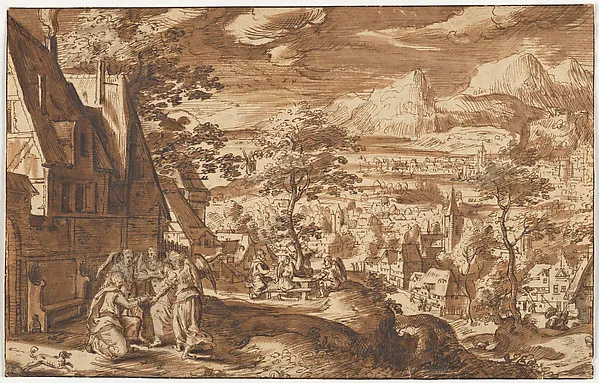
Exodus 38:1-4The Altar of Burnt Offering
1And he made the altar of burnt offering of shittim wood: five cubits was the length thereof, and five cubits the breadth thereof; it was foursquare; and three cubits the height thereof. 2And he made the horns thereof on the four corners of it; the horns thereof were of the same: and he overlaid it with brass. 3And he made all the vessels of the altar, the pots, and the shovels, and the basons, and the fleshhooks, and the firepans: all the vessels thereof made he of brass. 4And he made for the altar a brasen grate of network under the compass thereof beneath unto the midst of it.
The workmen step out of the holy place into the open court, and the first thing they build is the great altar: And he made the altar of burnt offering of shittim wood… it was foursquare; and three cubits the height thereof (v. 1). This is the largest single object in the whole sanctuary - roughly seven and a half feet on each side - and it stands just inside the gate, the first thing any worshipper meets.
Its purpose is plain in its name: it is the place of burnt offering, where the animal is killed and laid on the fire and given up wholly to God. Everything a person brought to the LORD passed across this altar first. And notice the care taken with it. It is built of acacia wood and then overlaid… with brass (v. 2), for brass alone could bear the heat of the perpetual fire. A worshipper coming through the gate did not stroll straight up to God; the very first structure in his path was the altar, and on it a death.
Before there is any drawing near, there is sacrifice. The arrangement of the court preaches its own gospel: the way to God begins at the place where a life is laid down.1
Exodus 38:5-7The Rings and Staves to Bear It
5And he cast four rings for the four ends of the grate of brass, to be places for the staves. 6And he made the staves of shittim wood, and overlaid them with brass. 7And he put the staves into the rings on the sides of the altar, to bear it withal; he made the altar hollow with boards.
Two details of the altar repay a closer look. First, the horns thereof on the four corners of it; the horns thereof were of the same (v. 2) - four projections, one rising from each corner, carved as one piece with the altar rather than fastened on. The horns were no ornament. The blood of the offering was put on them; a man fleeing for his life could lay hold of them and find sanctuary; they were the very strength and refuge of the altar, reached up toward heaven.
To take hold of the horns of the altar was to take hold of mercy. Second, the altar is fitted with rings and staves of shittim wood overlaid with brass, to bear it withal (vv. 5-7). The place of sacrifice was made to travel. As Israel moved through the wilderness, the altar moved with them; wherever they pitched, atonement could be made. And it was made hollow with boards (v. 7) - an empty frame, not a solid block - so that it could be carried and so that the fire could draw.
Every feature serves the one purpose: a portable, enduring place where the sacrifice for sin is offered, with horns of refuge a sinner could grasp.
Exodus 38:8The Laver of Mirrors
8And he made the laver of brass, and the foot of it of brass, of the lookingglasses of the women assembling, which assembled at the door of the tabernacle of the congregation.
After the altar comes the laver, and the order is the whole point: And he made the laver of brass, and the foot of it of brass (v. 8). This is the great basin of water that stood between the altar and the holy place, and at it the priests washed their hands and their feet before they went in to minister - on pain of death if they neglected it. After the place of sacrifice, the place of washing.
The blood at the altar dealt with guilt once; the water at the laver dealt with the daily defilement a man picks up simply by walking through the world, the dust on the hands and the feet. A priest could be atoned for at the altar and still need the laver before he drew nearer. There is a tender realism in this. God does not pretend His servants stay spotless once they are reconciled to Him; He sets a basin in the court precisely because they will get dirty and will need to be washed again and again.
And it is made of brass, like the altar - the two stand together, the place of blood and the place of water, and a worshipper who would come near has business at both.
Now the detail that has arrested readers for three thousand years: the laver was made of the lookingglasses of the women assembling, which assembled at the door of the tabernacle (v. 8). Mirrors in that world were not glass but polished bronze, and they were among a woman's most personal possessions - the one means she had of seeing her own face. The women who served and gathered at the door of the tabernacle brought these mirrors and gave them up, and they were melted down and cast into the basin where the priests would wash.
Think of what is being surrendered. The instrument made for looking at oneself becomes the basin where a man sees his need and washes it away. Self-regard is handed over to be reforged into a means of cleansing for others. The text does not name a single one of these women; it remembers them only by what they gave. But their offering is built into the very structure of worship, into every priest who ever rinsed his hands before he went in to God.
The thing they once used to study their own reflection became the thing that helped others come clean.2
Exodus 38:9-13The Four Sides of the Court
9And he made the court: on the south side southward the hangings of the court were of fine twined linen, an hundred cubits: 10Their pillars were twenty, and their brasen sockets twenty; the hooks of the pillars and their fillets were of silver. 11And for the north side the hangings were an hundred cubits, their pillars were twenty, and their sockets of brass twenty; the hooks of the pillars and their fillets of silver. 12And for the west side were hangings of fifty cubits, their pillars ten, and their sockets ten; the hooks of the pillars and their fillets of silver. 13And for the east side eastward fifty cubits.
Exodus 38:14-17Pillars, Sockets, and Silver
14The hangings of the one side of the gate were fifteen cubits; their pillars three, and their sockets three. 15And for the other side of the court gate, on this hand and that hand, were hangings of fifteen cubits; their pillars three, and their sockets three. 16All the hangings of the court round about were of fine twined linen. 17And the sockets for the pillars were of brass; the hooks of the pillars and their fillets of silver; and the overlaying of their chapiters of silver; and all the pillars of the court were filleted with silver.
Around the altar and the laver Bezaleel raises the court itself - a wall of fine twined linen a hundred cubits long down each of the two long sides and fifty across each end, hung on pillars set in brasen sockets with hooks… and… fillets… of silver (vv. 9-17). The effect was a clean white rectangle in the wilderness, a bright boundary that marked off holy ground from the camp around it. There is a gate, but apart from the gate the linen wall said plainly: you do not wander into the presence of God from any direction you please; there is an appointed way in.
And the whole enclosure is exact - measured, symmetrical, every pillar spaced and counted. Holiness here is not vague or chaotic; it has dimensions. The white linen speaks of purity, the boundary of separation, and the single gate of an appointed approach. Yet notice what stands inside that boundary: a court holding the altar and the laver - that is, atonement and cleansing. The wall keeps out what is unclean, but the door is open and what waits within is the means of being made fit to draw near.
The boundary is God's way of marking the road in.
Exodus 38:18-20The Gate of Blue, Purple, and Scarlet
18And the hanging for the gate of the court was needlework, of blue, and purple, and scarlet, and fine twined linen: and twenty cubits was the length, and the height in the breadth was five cubits, answerable to the hangings of the court. 19And their pillars were four, and their sockets of brass four; their hooks of silver, and the overlaying of their chapiters and their fillets of silver. 20And all the pins of the tabernacle, and of the court round about, were of brass.
The one opening in the white wall is given special beauty: the hanging for the gate of the court was needlework, of blue, and purple, and scarlet, and fine twined linen (v. 18). All around ran plain white linen; at the gate alone the colours blaze - the blue of heaven, the royal purple, the deep scarlet - worked by an embroiderer into a wide curtain twenty cubits across. The gate is broad, bright, and unmistakable, the most beautiful thing on the perimeter, placed on the east so the morning sun lit it for the whole camp to see.
A people looking toward the tabernacle could not miss where to come in. And the colours themselves carry weight, the same three that ran through the veil and the high priest's robes, binding the gate to the holy things within. The message of the design is welcome. There is one way in, yes - but that one way is made as inviting as skilled hands could make it, flung wide and shining toward the people, as if to say: here, this is where you come.
Exodus 38:21-24The Sum of the Tabernacle
21This is the sum of the tabernacle, even of the tabernacle of testimony, as it was counted, according to the commandment of Moses, for the service of the Levites, by the hand of Ithamar, son to Aaron the priest. 22And Bezaleel the son of Uri, the son of Hur, of the tribe of Judah, made all that the LORD commanded Moses. 23And with him was Aholiab, son of Ahisamach, of the tribe of Dan, an engraver, and a cunning workman, and an embroiderer in blue, and in purple, and in scarlet, and fine linen. 24All the gold that was occupied for the work in all the work of the holy place, even the gold of the offering, was twenty and nine talents, and seven hundred and thirty shekels, after the shekel of the sanctuary.
The chapter turns into a ledger: This is the sum of the tabernacle… as it was counted, according to the commandment of Moses… by the hand of Ithamar (v. 21). Every grain of metal the people gave is weighed and recorded, and the accounting is put in the hand of a named priest, openly, under Moses' command. There is something quietly remarkable in this. The house of God is built with the books kept in plain sight.
In a world where what is given to a sacred cause so easily disappears into the dark, here the totals are published - gold, silver, and brass, down to the shekel - so that nothing can be skimmed and nothing forgotten. And the builders are named too: Bezaleel the son of Uri… made all that the LORD commanded Moses. And with him was Aholiab… an engraver, and a cunning workman, and an embroiderer (vv. 22-23). Two men from two different tribes, one filled to lead and one skilled to embroider, both remembered by name.
God keeps the record of who gave and of who built. The tabernacle is called the tabernacle of testimony - the place where His covenant is witnessed - and even its ledger testifies to the kind of God who is being served: one who sees every gift, every hand, every honest weight.
Exodus 38:25-26A Bekah for Every Man
25And the silver of them that were numbered of the congregation was an hundred talents, and a thousand seven hundred and threescore and fifteen shekels, after the shekel of the sanctuary: 26A bekah for every man, that is, half a shekel, after the shekel of the sanctuary, for every one that went to be numbered, from twenty years old and upward, for six hundred thousand and three thousand and five hundred and fifty men.
The heart of the inventory is the silver, and where it came from changes everything: the silver of them that were numbered of the congregation was an hundred talents and more (v. 25), and the next verse tells how it was gathered - A bekah for every man, that is, half a shekel… for every one that went to be numbered, from twenty years old and upward (v. 26). This was the census payment commanded back in Exodus 30, where each man counted in the congregation gave a half-shekel as a ransom for his soul… that there be no plague among them, and where the LORD said plainly, the rich shall not give more, and the poor shall not give less (Exod. 30:12-15).
One price, exactly, from every soul. Six hundred and three thousand five hundred and fifty men, each laying down the identical half-shekel - the prince and the pauper, the strong man and the weak, every one at the same rate. The arithmetic itself preaches: before God, no man could buy a larger share of redemption, and no man was priced out of it. The ransom for a soul is not scaled to a soul's wealth.
Each was counted, and each was bought at one price.
Exodus 38:27-31The Sockets Cast from Ransom-Silver
27And of the hundred talents of silver were cast the sockets of the sanctuary, and the sockets of the vail; an hundred sockets of the hundred talents, a talent for a socket. 28And of the thousand seven hundred seventy and five shekels he made hooks for the pillars, and overlaid their chapiters, and filleted them. 29And the brass of the offering was seventy talents, and two thousand and four hundred shekels. 30And therewith he made the sockets to the door of the tabernacle of the congregation, and the brasen altar, and the brasen grate for it, and all the vessels of the altar, 31And the sockets of the court round about, and the sockets of the court gate, and all the pins of the tabernacle, and all the pins of the court round about.
Now watch where the ransom-silver goes: And of the hundred talents of silver were cast the sockets of the sanctuary, and the sockets of the vail; an hundred sockets of the hundred talents, a talent for a socket (v. 27). The sockets were the heavy foundation-blocks the upright boards of the tabernacle stood in - the base on which the whole structure rested. And they were made of the atonement money, a full talent of redemption-silver under each one.
Take in what that means. The house of God did not rest on stone or on common metal; it rested on the ransom paid for the people's souls. The very foundation of the dwelling-place of God was redemption. Every board, every wall, every covering of the sanctuary bore down ultimately onto silver that had been given as a ransom - one price, paid alike by every numbered soul. The dwelling of God among His people stood on the price of their redemption, and on nothing else.
It is a picture too deliberate to be accidental: a holy house whose entire weight is carried by ransom, the same ransom for the great and the small, sunk out of sight into the ground as the thing everything else is built upon.
The ledger ends with the brass: the brass of the offering was seventy talents, and two thousand and four hundred shekels (v. 29) - and the writer follows it, like the silver, all the way to its use, naming each thing it became: the sockets at the tabernacle door, the brasen altar, and the brasen grate for it, and all the vessels of the altar… the sockets of the court… and all the pins (vv. 30-31).
Even the tent-pins are counted. Nothing is too small to name; nothing given is left unaccounted. This is the same open-books integrity the chapter began with, carried right down to the last peg driven into the ground. And there is a fitting closing thought in the metals themselves. The gold filled the holy place within, near to God; the silver of redemption became the hidden foundation; and the brass - the metal that could bear the fire - became the altar and the things of the court, out where the people came and the sacrifice burned.
Each gift found its exact place. The God who is served here is not careless with what is given to Him: He weighs it, He records it, He sets every grain of it to its proper use, and even the least pin in His house is remembered.
Research trail
Sources & further study
These references support the historical, linguistic, manuscript, and contextual notes in this chapter. Scripture remains the primary text; external sources are provided so readers can inspect the research directly.
- Exodus 38 - Translators' NotesThe NET Bible's detailed footnotes on Exodus 38 - the construction of the brazen altar and its vessels (vv. 1-7), the meaning and the surrender of the women's mirrors in verse 8, the layout and measurements of the court (vv. 9-20), and the large metal totals of the closing inventory, including the weight of a talent and a shekel (vv. 24-29).
- Exodus 38 · Hebrew + classical Jewish commentaryThe Hebrew text of Exodus 38 with Rashi, Ibn Ezra, and other classical commentators side by side - useful for kiyyor (v. 8, the “laver,” the basin for the priests' washing), for the much-discussed mar'oth (v. 8, the “lookingglasses” of the serving women), and for the bekah and the shekel of the sanctuary by which the atonement-silver was weighed (vv. 24-26).
- Exodus 38 ↔ Exodus 30 · Hebrews 10 · 1 Peter 1Traces the threads tying Exodus 38 to the rest of Scripture - the half-shekel atonement money of the numbered (vv. 25-26) read back to its command in Exodus 30:11-16, the altar and laver standing together (vv. 1-8) read beside the blood and the washing of Hebrews 10:22, and the redemption-silver of the foundation (v. 27) read beside not… with corruptible things, as silver and gold… but with the precious blood of Christ (1 Pet. 1:18-19).
Where this echoes in Scripture
The Rings and Staves to Bear It
- Exodus 27:1-2And thou shalt make an altar of shittim wood... and thou shalt make the horns of it upon the four corners thereof.The command this chapter fulfils - the altar of verses 1-2 built exactly as the LORD directed.
- Hebrews 10:22Let us draw near... having our hearts sprinkled from an evil conscience, and our bodies washed with pure water.The altar and the laver together (vv. 1, 8) - the blood that sprinkles and the water that washes.
- Leviticus 1:3-4he shall offer it... and it shall be accepted for him to make atonement for him.What the altar of verse 1 was for - the burnt offering given up to God in a worshipper's place.
- 1 Kings 1:50-51Adonijah feared... and went and caught hold on the horns of the altar.The horns of verse 2 as a place of refuge - a man laying hold of mercy.
- Hebrews 13:10We have an altar, whereof they have no right to eat which serve the tabernacle.The altar of verse 1 read forward - the sacrifice the whole court was built around.
The Gate of Blue, Purple, and Scarlet
- Exodus 30:18-21Thou shalt also make a laver of brass... for Aaron and his sons shall wash their hands and their feet thereat.The command behind verse 8 - the laver appointed for the washing that the priests dared not skip.
- James 1:23-25he is like unto a man beholding his natural face in a glass... But whoso looketh into the perfect law of liberty, and continueth therein.The mirror of verse 8 turned inward - the word that shows us ourselves and sends us to be washed.
- Ephesians 5:26That he might sanctify and cleanse it with the washing of water by the word.The laver of verse 8 read forward - the washing that makes the church clean.
- Psalm 24:3-4Who shall ascend into the hill of the LORD?... He that hath clean hands, and a pure heart.Why the laver stands in the court (v. 8) - clean hands for those who would draw near.
- John 10:9I am the door: by me if any man enter in, he shall be saved.The one bright gate of verses 18-19 read forward - the appointed, welcoming way in.
The Sockets Cast from Ransom-Silver
- Exodus 30:11-16then shall they give every man a ransom for his soul... The rich shall not give more, and the poor shall not give less.The command behind verses 25-26 - the half-shekel atonement money, one price for every soul.
- 1 Peter 1:18-19ye were not redeemed with corruptible things, as silver and gold... but with the precious blood of Christ.The ransom-silver of verses 26-27 read forward - the redemption no metal could buy.
- Ephesians 2:20built upon the foundation of the apostles and prophets, Jesus Christ himself being the chief corner stone.The sockets of redemption-silver (v. 27) read forward - the house of God founded on the One who paid the ransom.
- 1 Timothy 2:5-6one mediator between God and men, the man Christ Jesus; who gave himself a ransom for all.The atonement money of verse 26 named in person - the ransom given once for all.
- Luke 16:10He that is faithful in that which is least is faithful also in much.The open-books accounting of verses 21-31 - even the pins counted, nothing too small to be kept faithfully.