Micah 1
People in this chapter
The book opens with a heading and then a thunderclap. The heading tells us who and when: The word of the LORD that came to Micah the Morasthite in the days of Jotham, Ahaz, and Hezekiah, kings of Judah, which he saw concerning Samaria and Jerusalem (v. 1). Micah was a countryman from the small town of Moresheth, given a word about the two great capitals - Samaria in the north and Jerusalem in the south.
But the summons he delivers throws its arms wide to the whole world: Hear, all ye people; hearken, O earth, and all that therein is: and let the Lord GOD be witness against you, the Lord from his holy temple (v. 2). The whole earth is called to court, and the witness against it is God Himself.1
Tap any highlighted phrase to jump to the commentary that unpacks it.
Micah 1:1-2Hear, All Ye People
1The word of the LORD that came to Micah the Morasthite in the days of Jotham, Ahaz, and Hezekiah, kings of Judah, which he saw concerning Samaria and Jerusalem. 2Hear, all ye people; hearken, O earth, and all that therein is: and let the Lord GOD be witness against you, the LORD from his holy temple.
The opening verse sets the word in a real time and a real place. The word of the LORD that came to Micah the Morasthite in the days of Jotham, Ahaz, and Hezekiah, kings of Judah (v. 1). Micah is named for his hometown - he is the man from Moresheth, a modest farming town in the low hills southwest of Jerusalem, far from the corridors of power. He is not a court insider or a temple official; he is a countryman from the margins, and that distance gives his voice a certain freedom.
The reigns he served under span a long and turbulent stretch, including the years when the northern kingdom of Israel was swept away by Assyria and Judah trembled under the same threat. And the scope of his vision is stated plainly: he saw his message - the prophets often see the word before they speak it - concerning Samaria and Jerusalem, the two capitals, north and south. From the very first line the book takes in both kingdoms together, refusing to let either think the warning is meant only for the other.
Then the summons goes out, and its reach is breathtaking: Hear, all ye people; hearken, O earth, and all that therein is: and let the Lord GOD be witness against you, the Lord from his holy temple (v. 2). A word that began as a message about two cities suddenly addresses the whole earth and everything in it. The scene is a courtroom - but a courtroom the size of creation. The call to hear and hearken is the language of a trial being convened, the bailiff's cry for the court to come to order.
And the one who takes the stand against the accused is the Lord GOD Himself, speaking from his holy temple - a witness whose testimony is wholly true and whose judgment carries none of the partiality or error that any human judge would bring. This matters. The charges Micah is about to bring are the testimony of God. The universal scope is part of the point: what God does with His own people is not a local affair tucked away in one corner of the world.
It is a public reckoning, set before all nations, with the Judge of all the earth as the witness. Before a single sin is named, the chapter establishes that the verdict will be true.1
Micah 1:3-9The LORD Cometh Forth Out of His Place
3For, behold, the LORD cometh forth out of his place, and will come down, and tread upon the high places of the earth. 4And the mountains shall be molten under him, and the valleys shall be cleft, as wax before the fire, and as the waters that are poured down a steep place. 5For the transgression of Jacob is all this, and for the sins of the house of Israel. What is the transgression of Jacob? is it not Samaria? and what are the high places of Judah? are they not Jerusalem? 6Therefore I will make Samaria as an heap of the field, and as plantings of a vineyard: and I will pour down the stones thereof into the valley, and I will discover the foundations thereof. 7And all the graven images thereof shall be beaten to pieces, and all the hires thereof shall be burned with the fire, and all the idols thereof will I lay desolate: for she gathered it of the hire of an harlot, and they shall return to the hire of an harlot. 8Therefore I will wail and howl, I will go stripped and naked: I will make a wailing like the dragons, and mourning as the owls. 9For her wound is incurable; for it is come unto Judah; he is come unto the gate of my people, even to Jerusalem.
The little word behold in verse 3 is a summons to look, and what Micah shows is God in motion: For, behold, the LORD cometh forth out of his place, and will come down, and tread upon the high places of the earth (v. 3). The phrase out of his place is striking. He comes forth, He comes down, He sets His feet on the earth. This is the language the Scriptures use again and again for God stepping personally into history - not sending a message about the world, but entering it.
And the earth cannot hold steady under His weight. The mountains shall be molten under him, and the valleys shall be cleft, as wax before the fire, and as the waters that are poured down a steep place (v. 4). Two images press the point: the most solid things imaginable, the mountains, go soft as candle-wax held to a flame; and the valleys split open and rush away like a flash flood pouring off a cliff face.
The picture is of all creation undone by the nearness of its Maker. The God who is coming is no abstraction and no local idol. When He arrives, the very ground melts.
Now the reason for the descent is named, and the chapter refuses to be vague about it: For the transgression of Jacob is all this, and for the sins of the house of Israel (v. 5). All of it - the coming down, the melting mountains, the splitting valleys - is provoked by sin. Then Micah asks two pointed questions and answers them himself: What is the transgression of Jacob? is it not Samaria? and what are the high places of Judah? are they not Jerusalem? The genius of the question is that it locates the sin in the capitals themselves.
Samaria, the seat of the northern kingdom, has become the very embodiment of Jacob's transgression; and the high places - the hilltop shrines where worship had been corrupted - are summed up in Jerusalem, the holy city itself. The point is uncomfortable and deliberate. The rot sits at the center, in the places that should have been the source of faithfulness. The leadership, the worship, the institutions meant to keep the nation true had themselves become the heart of the problem.
Judgment begins, as it so often does, with the household of God.
The sentence on Samaria is total. Therefore I will make Samaria as an heap of the field, and as plantings of a vineyard: and I will pour down the stones thereof into the valley, and I will discover the foundations thereof (v. 6). The proud capital, set on its hill, will be tumbled stone by stone down the slope until it is no more than a heap of rubble in a field - a place fit only for planting vines, its very foundations laid bare to the open sky.
And the cause is named with painful precision: her idols. All the graven images thereof shall be beaten to pieces, and all the hires thereof shall be burned with the fire, and all the idols thereof will I lay desolate (v. 7). The word hires points to the ugly logic underneath the idolatry. She gathered it of the hire of an harlot, and they shall return to the hire of an harlot. The wealth lavished on these gods had been gotten, the prophet says, the way a harlot earns her wage - the worship of Israel had become a kind of spiritual prostitution, the people selling their devotion to whatever god promised prosperity.
So the riches will go back out the way they came: stripped from the fallen shrines and carried off as the spoil of a conquering army, to fund the idol-shrines of the very enemies God is sending. What was won by unfaithfulness is lost to unfaithfulness.
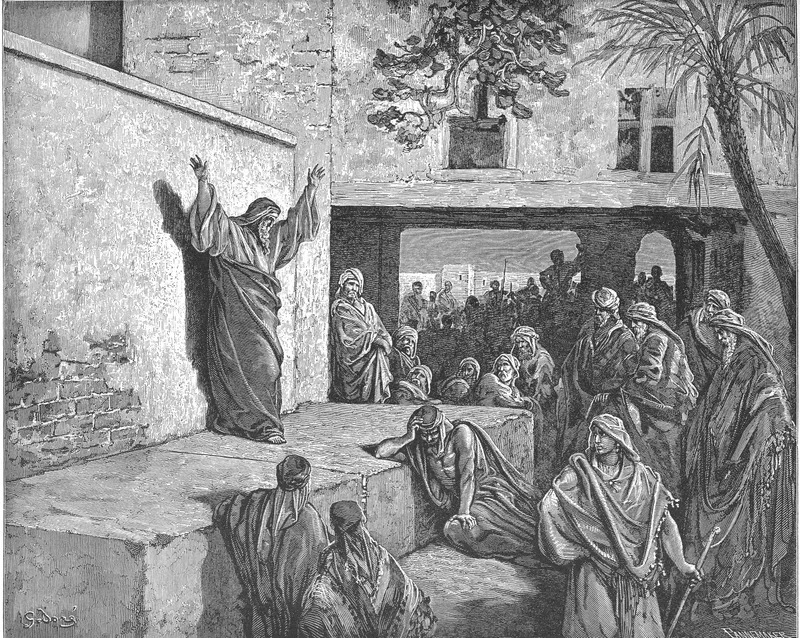
Then the voice changes, and it is one of the most important turns in the chapter. The prophet who has just pronounced the sentence suddenly falls apart over it: Therefore I will wail and howl, I will go stripped and naked: I will make a wailing like the dragons, and mourning as the owls (v. 8). Micah strips off his outer garments and walks barefoot and exposed - the ancient posture of a captive being led away, and of a mourner overwhelmed with grief.
He compares his cries to the eerie wail of jackals in the wilderness and the desolate hooting of owls in the ruins. This is no cold pronouncement of doom from a man who relishes being proved right. The prophet loves the people he must warn, and the prospect of their ruin breaks him. It is a crucial thing to see, because it tells us something about the heart behind the judgment itself. The God who comes down in wrath is not eager for the destruction; His own messenger is grieving, and the grief is a window onto the divine reluctance.
Judgment, when it falls, is never God's delight. The one who carries the sentence carries it weeping.
And now the reason for the grief is laid bare: For her wound is incurable; for it is come unto Judah; he is come unto the gate of my people, even to Jerusalem (v. 9). Two terrible things are said in a single breath. First, the wound is incurable - the sickness has gone past every human remedy; there is no medicine left on the shelf, no treatment that can reach it. Second, the infection has spread.
What began as Samaria's wound has travelled south; the disaster is already at the gate of my people, even to Jerusalem. The phrase the gate is ominous: the gate was the heart of a city's life and its last line of defense, and the trouble has reached it. The northern kingdom's collapse was not a faraway event Judah could watch from a safe distance; the same judgment is now knocking at Judah's own door.
There is a sober realism here that the chapter will not flinch from. Some wounds, left to fester through long refusal to repent, reach a point where no human hand can heal them. But the word incurable is not the last word in Scripture about such wounds - it is precisely the kind of wound the God who comes down would one day come to heal.
Micah 1:10-16The Roll-Call of Mourning
10Declare ye it not at Gath, weep ye not at all: in the house of Aphrah roll thyself in the dust. 11Pass ye away, thou inhabitant of Saphir, having thy shame naked: the inhabitant of Zaanan came not forth in the mourning of Bethezel; he shall receive of you his standing. 12For the inhabitant of Maroth waited carefully for good: but evil came down from the LORD unto the gate of Jerusalem. 13O thou inhabitant of Lachish, bind the chariot to the swift beast: she is the beginning of the sin to the daughter of Zion: for the transgressions of Israel were found in thee. 14Therefore shalt thou give presents to Moreshethgath: the houses of Achzib shall be a lie to the kings of Israel. 15Yet will I bring an heir unto thee, O inhabitant of Mareshah: he shall come unto Adullam the glory of Israel. 16Make thee bald, and poll thee for thy delicate children; enlarge thy baldness as the eagle; for they are gone into captivity from thee.
The closing section is a lament built out of place-names, and it is one of the most intricate passages in the prophets. Micah runs down a list of towns in the Judean lowlands - his own home country - and on almost every name he makes a grim pun, so that the very sound of each town becomes an omen of its fate. It begins: Declare ye it not at Gath, weep ye not at all: in the house of Aphrah roll thyself in the dust (v. 10).
Gath sounds like the Hebrew for “tell” - tell it not in Tell-town - an echo of David's old lament not to let the enemy gloat. Aphrah sounds like the word for “dust”, so the prophet cries, in Dust-town, roll yourself in the dust. The wordplay is not a clever game; it is the language of grief, the way sorrow fastens onto everything in sight and turns it into a sign of the loss.
These are the towns Micah grew up among, and one by one he sees them swept into the disaster rolling down from the north. To name them is to mourn them.
The puns continue down the line, each one binding a town's name to its doom. Pass ye away, thou inhabitant of Saphir, having thy shame naked (v. 11): Saphir means “beautiful” or “fair”, and fair-town is stripped to its shame. Zaanan sounds like “come out”, yet its people came not forth. Maroth resembles the word for “bitter”, and bitter-town waited carefully for good: but evil came down from the LORD unto the gate of Jerusalem (v. 12).
Then comes a sharp word to a more famous town: O thou inhabitant of Lachish, bind the chariot to the swift beast: she is the beginning of the sin to the daughter of Zion (v. 13). Lachish echoes the word for “steeds” - harness your fast horses and flee - and it is singled out as a gateway through which sin entered Judah. The chain runs on through Moreshethgath and the houses of Achzib, whose name means “deception” and which will prove a lie to the kings who trusted it (v. 14), and to Mareshah, whose name plays on “heir”: yet will I bring an heir unto thee - a conqueror to dispossess them (v. 15).
Across the whole roll-call one truth lands: there is no town in the lowlands the disaster will pass over, and the prophet names each one with a catch in his voice.1
The lament ends where grief always cuts deepest - with the children. Make thee bald, and poll thee for thy delicate children; enlarge thy baldness as the eagle; for they are gone into captivity from thee (v. 16). To make bald and to poll - to shave the head - was a recognized sign of mourning in the ancient world, a public, bodily token of grief too great for words. Micah calls the land to shave itself bald as a vulture or an eagle, stripped of its plumage, in mourning for its young.
And the reason is the most devastating note in the chapter: thy delicate children… are gone into captivity from thee. The delicate children are the cherished ones, the tenderly raised - and they are being marched away into exile, torn from the arms of those who love them. This is what all the wordplay and all the falling towns finally come to: mothers and fathers shaving their heads over empty rooms, the cost of long refusal counted in the people they love.
The chapter that opened with God treading the high places of the earth closes with a parent's grief over a child carried off. It is the cost of the long refusal to turn back, counted at last in the only currency that truly registers.
Research trail
Sources & further study
These references support the historical, linguistic, manuscript, and contextual notes in this chapter. Scripture remains the primary text; external sources are provided so readers can inspect the research directly.
- Micah 1 - Translators' NotesThe NET Bible's detailed footnotes on Micah 1 - the courtroom summons of verse 2, the theophany language of verses 3-4, the “harlot-hire” of verse 7, and the intricate puns on the names of the Judean towns in verses 10-15 that drive the closing lament.
- Micah 1 · Hebrew + classical Jewish commentaryThe Hebrew text of Micah 1 with Rashi, Radak, and other classical commentators side by side - useful for the phrase yotze mi-mqomo (v. 3, the LORD “coming forth out of his place”), for anushah (v. 9, the wound that “is incurable”), and for the chain of place-name wordplays in verses 10-15.
- Micah 1 ↔ Exodus 19 · Psalm 18 · John 1 · Luke 19Traces the threads tying Micah 1 to the rest of Scripture - the LORD who cometh forth out of his place and will come down (vv. 3-4) read beside Sinai (Exod. 19:18-20) and he bowed the heavens also, and came down (Ps. 18:9), and the prophet who wails over the doomed city (v. 8) read beside the One who wept over Jerusalem (Luke 19:41-42).
Where this echoes in Scripture
Hear, All Ye People
- Deuteronomy 32:1Give ear, O ye heavens, and I will speak; and hear, O earth, the words of my mouth.The same courtroom summons as verse 2 - heaven and earth called to witness God's case against His people.
- Isaiah 1:2Hear, O heavens, and give ear, O earth: for the LORD hath spoken, I have nourished and brought up children, and they have rebelled against me.A prophet of the same era opening with the same wide call (v. 2) - the whole creation summoned to the trial.
- Psalm 50:1-4The mighty God, even the LORD, hath spoken... He shall call to the heavens from above, and to the earth, that he may judge his people.God calling heaven and earth as He comes to judge His people - the scene Micah convenes in verse 2.
- Habakkuk 2:20But the LORD is in his holy temple: let all the earth keep silence before him.The LORD speaking and witnessing from His holy temple (v. 2) - before whom all the earth falls silent.
The LORD Cometh Forth Out of His Place
- Exodus 19:18-20And mount Sinai was altogether on a smoke, because the LORD descended upon it in fire... and the whole mount quaked greatly.The LORD coming down so the mountain itself shakes - the descent Micah sees in verses 3-4.
- Psalm 18:7-9He bowed the heavens also, and came down; and darkness was under his feet... The hills moved and were shaken.The same coming-down that melts mountains (vv. 3-4) - God leaving His place to act, and creation quaking.
- Micah 5:2But thou, Bethlehem Ephratah... out of thee shall he come forth unto me that is to be ruler in Israel.Micah's own later word - the God who “cometh forth” in verse 3 foretells One who would “come forth” from Bethlehem.
- Luke 19:41-42And when he was come near, he beheld the city, and wept over it, saying, If thou hadst known... the things which belong unto thy peace!The grief of verse 8 echoed - the One who wept over the same city whose wound had reached its gate.
- Jeremiah 30:12-17Thy bruise is incurable, and thy wound is grievous... For I will restore health unto thee, and I will heal thee of thy wounds, saith the LORD.The incurable wound of verse 9 answered - the LORD Himself healing what no human cure could reach.
The Roll-Call of Mourning
- 2 Samuel 1:20Tell it not in Gath, publish it not in the streets of Askelon; lest the daughters of the Philistines rejoice.The lament David sang - the very phrase Micah echoes in verse 10, grief that the enemy should not gloat.
- Ezekiel 33:11I have no pleasure in the death of the wicked; but that the wicked turn from his way and live.The heart behind the judgment that “came down from the LORD” (v. 12) - God desiring not ruin but repentance.
- Isaiah 53:5he was wounded for our transgressions, he was bruised for our iniquities: the chastisement of our peace was upon him.The stroke that “came down” in judgment (v. 12) borne at last by Another - the chastisement laid on the Son.
- Hebrews 13:12Jesus also, that he might sanctify the people with his own blood, suffered without the gate.The judgment that reached the gate of Jerusalem (v. 12) answered - the One who went outside the gate to bear it.
- Lamentations 2:11Mine eyes do fail with tears... for the destruction of the daughter of my people; because the children and the sucklings swoon in the streets.The same grief as verse 16 - a prophet weeping over the little ones caught up in the city's fall.