Psalms 140
People in this chapter
Psalm 140 carries the heading To the chief Musician, A Psalm of David, and it is a prayer offered from inside real danger. The enemies are not vague; they are described with unsettling precision - men who imagine mischiefs, who gather for war, whose tongues are sharpened… like a serpent, who have hidden a snare and spread a net in the path. This is a person under organized, intentional attack. And yet the psalm is not a battle plan; it is a prayer.
David's whole response to the violence around him is to turn and speak to God.1
Tap any highlighted phrase to jump to the commentary that unpacks it.
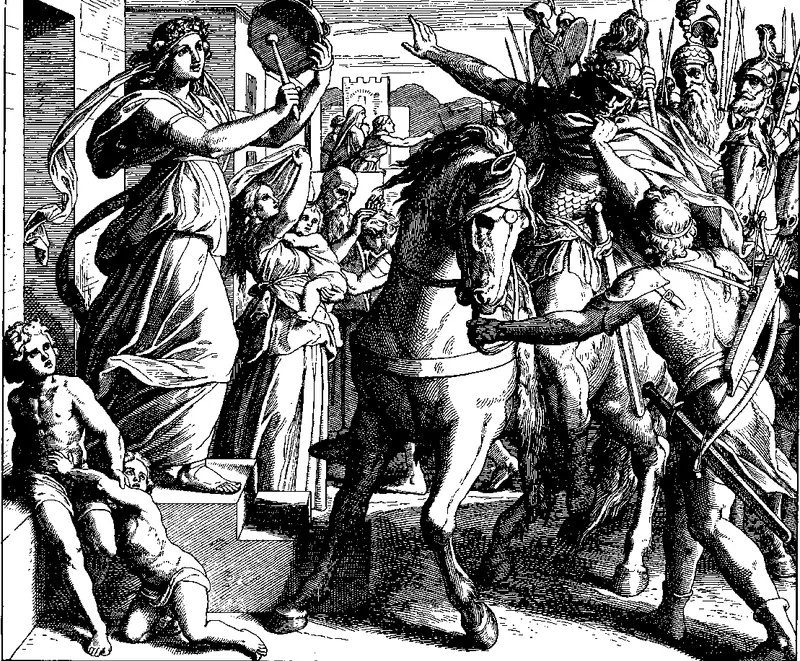
Psalm 140:1-5 · A Psalm of DavidAdders' Poison Is Under Their Lips
1Deliver me, O LORD, from the evil man: preserve me from the violent man; 2Which imagine mischiefs in their heart; continually are they gathered together for war. 3They have sharpened their tongues like a serpent; adders’ poison is under their lips. Selah. 4Keep me, O LORD, from the hands of the wicked; preserve me from the violent man; who have purposed to overthrow my goings. 5The proud have hid a snare for me, and cords; they have spread a net by the wayside; they have set gins for me. Selah.
The prayer opens with two near-identical pleas wrapped around the same conviction: Deliver me, O LORD, from the evil man: preserve me from the violent man (v. 1), and again Keep me, O LORD, from the hands of the wicked; preserve me from the violent man (v. 4). The repetition is not redundancy; it is the way real fear prays, circling back to the same cry because the same danger has not gone away.
Two verbs carry the weight - preserve and keep - and both ask God for the same thing: a guarding, a watching-over, a hand placed between the psalmist and those who mean him harm. Notice that David does not ask, at least not first, to be made strong enough to win the fight himself. He asks to be kept - the request of someone who knows he is outmatched and turns to a stronger hand than his own.
And he names the enemy honestly: not critics, not rivals, but the wicked and the violent man, people who have purposed to overthrow my goings - who have set their will, deliberately, on tripping him up and bringing him down. The danger is real, and the psalm refuses to pretend otherwise. But the very first move it makes with that danger is to hand it to God.
The enemies' weapon is named with chilling exactness: They have sharpened their tongues like a serpent; adders' poison is under their lips (v. 3). It is the tongue, not the sword, that the psalm fears most here. The image works on two levels. A sharpened tongue is a blade - honed, pointed, made for cutting; words can wound as surely as steel, and these men have whetted theirs for the purpose. And then the picture shifts from blade to venom: adders' poison is under their lips. The harm is not only in the cut but in what the cut delivers - lies, slander, accusation, the slow toxin that spreads through a reputation and a community long after the words are spoken.
The comparison to the serpent reaches back to the oldest deception in Scripture, the creature whose speech first turned a true word of God into a half-truth and a doubt. To liken these men to it is to say their real danger is what they say and how they twist it. Many a sufferer in the Psalms faces swords; this one faces something more insidious, because poison does its work unseen, and a slandered man often cannot even find the wound to bind it.
Alongside the poisoned word runs the hidden trap: The proud have hid a snare for me, and cords; they have spread a net by the wayside; they have set gins for me (v. 5). The vocabulary is borrowed entirely from the hunter. A snare is a concealed loop that springs shut on the foot; cords are the lines that bind; a net is spread flat and unseen along the path; gins are spring-traps set to catch.
Heaped one on another, the words paint a man who feels hunted - not pursued in the open, but stalked by people who have rigged his ordinary path with concealed devices, so that any step might be the one that closes a trap on him. And the architects of it are the proud. The psalm quietly links the two: pride and predation grow from the same root. The proud man, certain of his own right to whatever he wants, comes in time to see other people as prey - obstacles to be trapped, used, removed.
The image of the hidden snare also explains the helplessness in the prayer. You cannot fight what you cannot see. A trap works precisely because it is concealed, and a person who knows traps have been laid for him, but not where, can do little but walk carefully and cry out to the One who sees what is hidden. Which is exactly what David does.
Psalm 140:6-13The Strength of My Salvation
6I said unto the LORD, Thou art my God: hear the voice of my supplications, O LORD. 7O GOD the Lord, the strength of my salvation, thou hast covered my head in the day of battle. 8Grant not, O LORD, the desires of the wicked: further not his wicked device; lest they exalt themselves. Selah. 9As for the head of those that compass me about, let the mischief of their own lips cover them. 10Let burning coals fall upon them: let them be cast into the fire; into deep pits, that they rise not up again. 11Let not an evil speaker be established in the earth: evil shall hunt the violent man to overthrow him. 12I know that the LORD will maintain the cause of the afflicted, and the right of the poor. 13Surely the righteous shall give thanks unto thy name: the upright shall dwell in thy presence.
The whole psalm pivots on a single sentence: I said unto the LORD, Thou art my God: hear the voice of my supplications, O LORD (v. 6). Up to this point David has been looking outward, describing the enemy - their tongues, their snares, their war. Now he turns and looks up, and the first thing out of his mouth is not another description of the danger but a claim about his relationship: Thou art my God. That little possessive carries enormous weight.
It is not a statement of theology in the abstract; it is the language of belonging, of covenant, of a man taking hold of the One he is bound to and saying, in effect, “You are mine, and I am yours - so this trouble is yours to hear.” And what he asks for is simply to be heard: hear the voice of my supplications. Before any specific request, he wants the assurance that his cry is not lost - that there is Someone on the other end of the prayer who is listening.
This is the quiet center of the psalm. Everything before it was the problem; everything after it flows from the conviction that the God to whom he belongs is a God who hears. The man surrounded by violent voices steadies himself on one voice that will answer.
Here the psalm turns to face the wicked directly, and the petition needs to be read with care: As for the head of those that compass me about, let the mischief of their own lips cover them (v. 9). Two things steady this verse. First, the shape of the request. David asks that the harm the wicked have aimed at others fall back on themselves - that the mischief of their own lips, the poison they prepared for him in verse 3, cover them instead.
It is the prayer that evil prove self-defeating, that the trap spring on the one who set it. This is not a fresh cruelty invented by the psalmist; it is a plea that justice take its natural course and that violence recoil on the violent. Second, and crucially, the doing of it is left entirely to God. David does not say “let me bring the mischief of their lips back on them.” He hands the whole matter upward and asks God to act.
There is no sword drawn here, no private vengeance plotted - only a longing for justice laid before the only One who can rightly carry it out. The same restraint runs through the verses that follow (vv. 10-11), with their vivid imagery of burning coals and deep pits: these are not threats David makes but judgments he asks God to make, the language of a man who wants the reign of cruelty ended and is willing to leave the ending of it in God's hands rather than seize it in his own.
To pray this way is to refuse both passivity and revenge - to care about justice fiercely, and to entrust it wholly to the God who judges rightly.
The imprecation reaches its summary in verse 11: Let not an evil speaker be established in the earth: evil shall hunt the violent man to overthrow him. The phrase evil speaker renders a Hebrew expression that means, literally, “a man of tongue” - which keeps the whole psalm focused on the same wound it began with: the destructive power of the poisoned word. David's petition is that such a man not be established, not put down roots, not be allowed to set up a lasting place of power from which to do harm.
And then the verse states what David trusts to be a settled law of God's world: evil shall hunt the violent man to overthrow him. Notice the reversal buried in those words. In verse 5 it was the proud who hunted the psalmist, spreading nets and setting gins along his path. Here the hunting turns: the violent man becomes the hunted, and what hunts him is the very evil he committed, circling back to run him down.
It is the same conviction the whole Bible keeps returning to - that wickedness is not finally a stable foundation, that the pit a man digs has a way of becoming his own grave. David is not gloating over this; he is resting on it. The reason he can stop fighting and start praying is that he believes the moral universe is not neutral - that a violence built on lies carries, inside itself, the seeds of its own overthrow, because the God who governs it is just.1
Research trail
Sources & further study
These references support the historical, linguistic, manuscript, and contextual notes in this chapter. Scripture remains the primary text; external sources are provided so readers can inspect the research directly.
- Psalm 140 - Translators' NotesThe NET Bible's detailed footnotes on Psalm 140 - the hunting-and-trapping vocabulary of the snare, net, and gins in verse 5, the difficult imprecation of verses 9-11, and the closing confidence that the LORD will maintain the cause of the afflicted in verse 12.
- Psalm 140 · Hebrew + classical Jewish commentaryThe Hebrew text of Psalm 140 with Rashi, Ibn Ezra, and other classical commentators side by side - useful for the phrase behind “the violent man” (ish chamasim, v. 1, literally “a man of violences”), for natsar and shamar (“preserve” / “keep,” vv. 1, 4), and for yeshuah (“salvation,” v. 7).
- Psalm 140 ↔ Romans 3 · Luke 1 · Matthew 5 · John 17Traces the threads tying Psalm 140 to the New Testament - the poison… under their lips Paul folds into his catena on universal sin (Rom. 3:13 quoting v. 3), the lifting of the afflicted and the poor that Mary sings (Luke 1:52-53 echoing v. 12), and the upright who dwell in God's presence as the pure in heart who shall see God (Matt. 5:8 with v. 13).
Where this echoes in Scripture
Adders' Poison Is Under Their Lips
- Romans 3:13with their tongues they have used deceit; the poison of asps is under their lips.Verse 3 woven into Paul's catena showing that all have sinned - the poisoned tongue as a universal symptom.
- Genesis 6:11The earth also was corrupt before God, and the earth was filled with violence.The same word - chamas, violence - that names the “violent man” (ish chamasim) of verses 1 and 4.
- James 3:8But the tongue can no man tame; it is an unruly evil, full of deadly poison.The poisoned tongue of verse 3 named again - the venom under the lips as the hardest thing to master.
- Psalm 64:2-4who whet their tongue like a sword... that they may shoot in secret at the perfect.A companion prayer with the same twin weapons - the sharpened tongue and the hidden ambush of verses 3 and 5.
The Strength of My Salvation
- Luke 1:52-53He hath put down the mighty from their seats, and exalted them of low degree.Mary sings the conviction of verse 12 - the God who takes up the cause of the afflicted and the poor.
- Matthew 5:8Blessed are the pure in heart: for they shall see God.The upright who “dwell in thy presence” (v. 13) - the pure in heart promised the sight of God.
- John 17:12those that thou gavest me I have kept, and none of them is lost.The covering and keeping of verse 7 carried into the Son who loses none of His own.
- Romans 12:19Vengeance is mine; I will repay, saith the Lord.The reckoning of the wicked left to God, not seized by the sufferer - the posture of verses 9-12.
- Psalm 9:18For the needy shall not alway be forgotten: the expectation of the poor shall not perish for ever.The same assurance as verse 12 - that God will not finally fail the cause of the afflicted and the poor.