Zechariah 6
People in this chapter
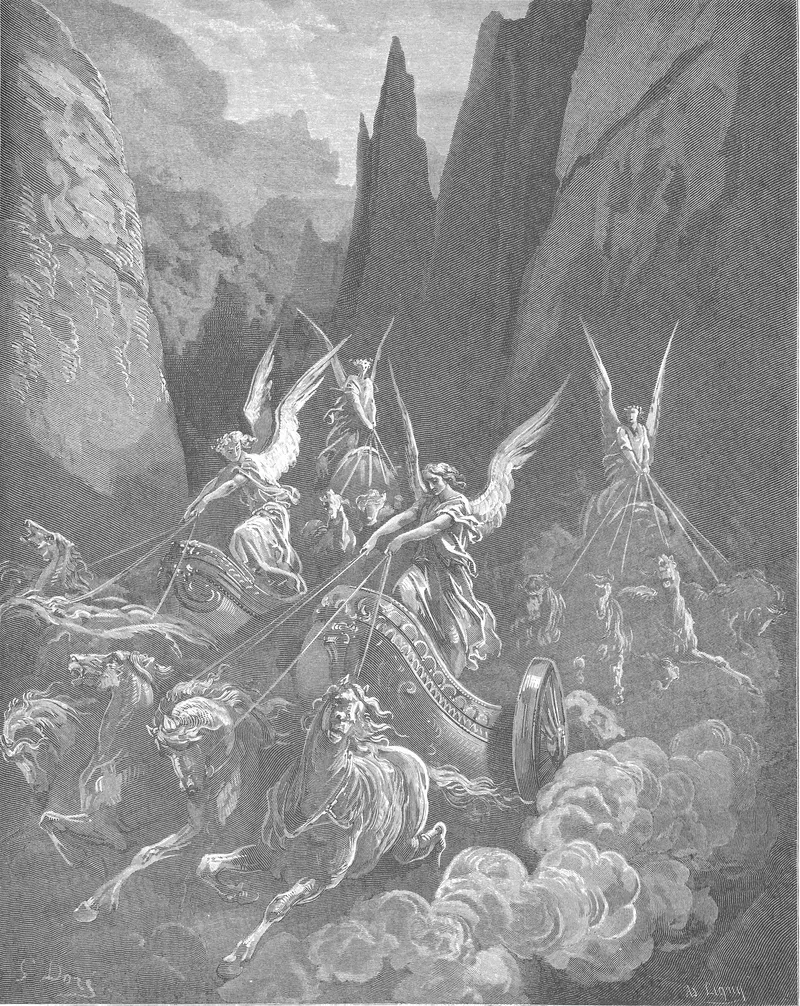
The night that began back in chapter 1 with a man among the myrtle trees now comes to its end. Zechariah lifts his eyes one last time and sees four chariots burst out from between two mountains; and the mountains were mountains of brass (v. 1), drawn by horses of red, black, white, and grizzled. When he asks what they are, the angel answers in words that frame the whole scene: These are the four spirits of the heavens, which go forth from standing before the Lord of all the earth (v. 5).
They are dispatched to patrol the world, and when those sent into the troubled north return, the LORD declares His spirit quieted there (v. 8). The visions of the night close with an assurance: the God who rules all the earth has His agents moving through it, and the unrest of the nations is under His hand.1
Tap any highlighted phrase to jump to the commentary that unpacks it.
Zechariah 6:1-8The Four Chariots from Between the Mountains
1And I turned, and lifted up mine eyes, and looked, and, behold, there came four chariots out from between two mountains; and the mountains were mountains of brass. 2In the first chariot were red horses; and in the second chariot black horses; 3And in the third chariot white horses; and in the fourth chariot grisled and bay horses. 4Then I answered and said unto the angel that talked with me, What are these, my lord? 5And the angel answered and said unto me, These are the four spirits of the heavens, which go forth from standing before the LORD of all the earth. 6The black horses which are therein go forth into the north country; and the white go forth after them; and the grisled go forth toward the south country. 7And the bay went forth, and sought to go that they might walk to and fro through the earth: and he said, Get you hence, walk to and fro through the earth. So they walked to and fro through the earth. 8Then cried he upon me, and spake unto me, saying, Behold, these that go toward the north country have quieted my spirit in the north country.
The last of the night-visions opens with motion and noise: there came four chariots out from between two mountains; and the mountains were mountains of brass (v. 1). Each chariot is drawn by horses of a distinct color - red… black… white… grisled and bay (vv. 2-3) - and the whole company comes charging out from a gateway of two bronze mountains. The picture deliberately echoes the very first vision of the book, the riders among the myrtle trees who patrolled the earth (Zech. 1:8-11); the night that began with horsemen now ends with chariots, and the long sequence is being drawn to a close.
The two mountains of brass - an unyielding, gleaming metal - suggest a fixed gateway out of the very presence of God, the place from which His purposes are launched into the world. We should not press each color into a rigid code; Scripture itself does not decode them here. What the scene communicates is force and dispatch: chariots, the war-machines of the ancient world, surging out under orders. The God whose presence these come from is not a distant idea but a sovereign who sends.
The reader is meant to feel the energy of heaven mobilized and moving.1
When Zechariah asks the plain question - What are these, my lord? (v. 4) - the angel gives the key that unlocks the vision: These are the four spirits of the heavens, which go forth from standing before the Lord of all the earth (v. 5). Two things in that answer carry the weight. First, these chariots are heaven's agents, sent out to do God's bidding across the world; they are not loose forces of nature but servants under command.
Second, and more arresting, is where they come from: from standing before the Lord of all the earth. Before they ride out, they stand in attendance, like servants awaiting orders in a throne room. They move only on dispatch. And the title given to God here is the controlling note of the whole passage - the Lord of all the earth. Not the LORD of Judah only, not a local deity hemmed in by borders, but the One whose authority covers every country these chariots will visit.
The directions confirm it: the horses go into the north country and toward the south country and to and fro through the earth (vv. 6-7), reaching the lands where the great empires sat. Wherever they ride, they ride as the servants of the One who owns the ground beneath every throne.
The vision lands on a single, striking sentence. After the chariots sent toward the north return, the angel cries out: Behold, these that go toward the north country have quieted my spirit in the north country (v. 8). The north was, for Judah, the direction of dread - the road every conquering army took as it came down upon Jerusalem, and the way to Babylon, the empire that had burned the temple and carried the people off.
To say the LORD's spirit is quieted in the north is to say that the matter is settled: the unrest, the threat, the unfinished reckoning with the power that humbled His people is now under His control. The word translated quieted carries the sense of a stirred-up agitation finally brought to rest, like a sea that has stopped heaving. This is the reassurance the whole battered community most needed. They were a small, exposed remnant, freshly home from captivity, ringed by powers far stronger than they.
The vision tells them that the God of all the earth has already dealt with the great threat from the north - His patrols have gone out, His purpose is accomplished, and His spirit is at rest. They can build in peace.
Zechariah 6:9-11Take Silver and Gold, and Make Crowns
9And the word of the LORD came unto me, saying, 10Take of them of the captivity, even of Heldai, of Tobijah, and of Jedaiah, which are come from Babylon, and come thou the same day, and go into the house of Josiah the son of Zephaniah; 11Then take silver and gold, and make crowns, and set them upon the head of Joshua the son of Josedech, the high priest;
With verse 9 the chapter shifts gears entirely. The visions are over; now comes a plain command - the word of the LORD came unto me, saying - and Zechariah is told to perform an act in the waking world. The instructions are concrete and dated, the way real history is: go that same day to the house of Josiah, and take silver and gold of three men which are come from Babylon - Heldai, Tobijah, and Jedaiah (v. 10).
These are returned exiles, men of the captivity who have made the long road home and brought with them an offering of precious metal, perhaps gathered from those still in Babylon for the work of God's house. The detail matters. What is about to become a towering messianic sign is built out of the ordinary generosity of ordinary people just back from exile. The LORD does not send to heaven for gold; He sends to the gift of three named men who carried it from Babylon.
There is something quietly fitting in it: the sign of the coming King-Priest is fashioned from the freewill offering of the restored remnant, the very people whose hope it is meant to anchor.
Then comes the deliberately startling instruction: Then take silver and gold, and make crowns, and set them upon the head of Joshua the son of Josedech, the high priest (v. 11). Every part of this would have stopped a faithful Israelite in his tracks. A crown - the Hebrew word here is the ornate, royal crown - belonged on the head of a king, and Judah's kings came from the house of David, the tribe of Judah.
But the crowns are set on Joshua the high priest, a man of the tribe of Levi and the line of Aaron, who by every rule of the Law could never sit on David's throne. The offices were kept strictly apart for good reason; when King Uzziah once dared to take up a priest's duty he was struck with leprosy (2 Chron. 26:16-21). To crown a priest, then, is to stage something that ought not to be - and that is precisely the point.
The act is a living parable, designed to provoke the question, How can a priest wear a crown? Joshua himself is not being made king; he is made, for a moment, a walking sign. The crown on the priest's head is a finger pointing forward to One in whom the impossible joining will be no violation at all but the very glory of His person. The sign hangs in the air, waiting for the word that will explain it.1
Zechariah 6:12-15Behold the Man Whose Name Is The BRANCH
12And speak unto him, saying, Thus speaketh the LORD of hosts, saying, Behold the man whose name is The BRANCH; and he shall grow up out of his place, and he shall build the temple of the LORD: 13Even he shall build the temple of the LORD; and he shall bear the glory, and shall sit and rule upon his throne; and he shall be a priest upon his throne: and the counsel of peace shall be between them both. 14And the crowns shall be to Helem, and to Tobijah, and to Jedaiah, and to Hen the son of Zephaniah, for a memorial in the temple of the LORD. 15And they that are far off shall come and build in the temple of the LORD, and ye shall know that the LORD of hosts hath sent me unto you. And this shall come to pass, if ye will diligently obey the voice of the LORD your God.
Now the word arrives that explains the crown, and it does not stay on Joshua. Zechariah is told to speak unto him a message from the LORD of hosts, and the message points past the man standing there to Another: Behold the man whose name is The BRANCH; and he shall grow up out of his place, and he shall build the temple of the LORD (v. 12). Behold the man - the eye is lifted from Joshua to a figure on the horizon.
The title The BRANCH is no fresh invention; Zechariah has used it once already of God's servant (Zech. 3:8), and the prophets before him had made it a settled name for the promised son of David - a Branch shall grow out of his roots (Isa. 11:1), a righteous Branch, and a King shall reign (Jer. 23:5). So the crowned priest becomes a sign of the coming King from David's line.
And note the verb: he shall grow up out of his place. The BRANCH does not seize his office by force or arrive as an import from outside; he grows, springing up organically, in his own appointed place and time, as a living shoot rises from a root. There is a quiet inevitability in the image - not the clatter of conquest but the unstoppable, patient force of something planted by God breaking into leaf.
Verse 13 gathers everything the sign promised into one dense and astonishing sentence. The BRANCH shall build the temple of the LORD - said twice for emphasis, Even he shall build the temple of the LORD - and then four things are laid on Him in a row: He shall bear the glory, He shall sit and rule upon his throne, He shall be a priest upon his throne, and the counsel of peace shall be between them both. The first three pile royal and priestly honors together on one head.
He bears the glory - the royal majesty; He sits and rules on a throne - the king's seat; and yet He is a priest while He reigns - holding, in His own person, the office Israel kept utterly distinct from the crown. The last clause is the tender resolution: the counsel of peace shall be between them both. The phrase has been understood in more than one way - harmony between the two offices of king and priest now united in Him, or the peaceful accord between the LORD and His Anointed who carries them.
Either way the note struck is peace. Where in Israel's history the throne and the altar could stand in tension, in the BRANCH they meet in perfect concord, and the fruit of that union is peace - a settled rightness between God and His people, secured by the One who is at once their King and their Priest.
The sign closes with the crowns themselves and a promise that opens outward. The crowns are not left on Joshua's head; they are laid up for a memorial in the temple of the LORD (v. 14), entrusted to the men who gave the silver and gold - so that the prophecy hangs in God's house as a standing witness, a kept token of the King-Priest still to come. Then the horizon widens: they that are far off shall come and build in the temple of the LORD (v. 15).
The temple this BRANCH raises will not be built by the returned remnant alone; those far off - distant peoples beyond Judah's borders - will come and have a hand in it. It is a quiet anticipation of a house of God built from far more than one nation. And the chapter ends, as so much of Zechariah does, by binding promise to response: all this shall come to pass, if ye will diligently obey the voice of the LORD your God. The glorious future is sure on God's side; the call on the hearer's side is steady, attentive obedience - to diligently obey, to keep listening and keep building, trusting the word that has been given.
Research trail
Sources & further study
These references support the historical, linguistic, manuscript, and contextual notes in this chapter. Scripture remains the primary text; external sources are provided so readers can inspect the research directly.
- Zechariah 6 - Translators' NotesThe NET Bible's detailed footnotes on Zechariah 6 - the four chariots and the “four spirits” of verses 1-8, the difficult plural “crowns” set on a single head in verse 11, and the way the oracle of verses 12-13 unites the offices of king and priest in the figure of the BRANCH.
- Zechariah 6 · Hebrew + classical Jewish commentaryThe Hebrew text of Zechariah 6 with Rashi, Radak, and other classical commentators side by side - useful for tsemach (v. 12, “The BRANCH”), for the crowns of verses 11 and 14 (the Hebrew noun is plural), and for the much-discussed phrase kohen al kis'o in verse 13, “a priest upon his throne.”
- Zechariah 6 ↔ Hebrews 7 · Psalm 110 · Jeremiah 23Traces the threads tying Zechariah 6 to the rest of Scripture - the BRANCH who is a priest upon his throne (vv. 12-13) read alongside the priest-king of Psalm 110 (“a priest for ever after the order of Melchizedek”) and the King-Priest of Hebrews 7, and the Davidic BRANCH read beside Jeremiah 23:5 and Isaiah 11:1.
Where this echoes in Scripture
The Four Chariots from Between the Mountains
- Zechariah 1:8-11I saw by night, and behold a man riding upon a red horse... These are they whom the LORD hath sent to walk to and fro through the earth.The first night-vision, which this last one answers - the LORD's patrols going to and fro through the earth.
- Psalm 24:1The earth is the LORD's, and the fulness thereof; the world, and they that dwell therein.The title that controls verses 5-8 - the LORD of all the earth, whose authority crosses every border.
- Daniel 7:13-14there was given him dominion, and glory, and a kingdom, that all people, nations, and languages, should serve him.The universal rule the chariots serve - dominion over all the earth given to the Son of man.
- Matthew 28:18All power is given unto me in heaven and in earth.The authority of the Lord of all the earth (v. 5) handed to the risen Christ.
- Revelation 6:1-8And I saw, and behold a white horse... and there went out another horse that was red... and lo a black horse... and behold a pale horse.Horses of distinct colors going out under heaven's command - the same imagery as verses 2-3, sent across the earth.
Take Silver and Gold, and Make Crowns
- Zechariah 3:1-5Now Joshua was clothed with filthy garments... Take away the filthy garments from him... I have caused thine iniquity to pass from thee.The same Joshua, earlier accused and reclothed - the forgiven priest who is now crowned in verse 11.
- 2 Chronicles 26:16-21But when he was strong, his heart was lifted up... he transgressed against the LORD his God, and went into the temple of the LORD to burn incense... the leprosy even rose up in his forehead.Why crowning a priest is so startling (v. 11) - in Israel the king could not take the priest's office.
- Luke 1:31-32thou shalt call his name JESUS... and the Lord God shall give unto him the throne of his father David.The One the crowned Joshua signifies - Jesus, given David's throne, the King of the messianic promise.
- Mark 12:41-44this poor widow hath cast more in, than all they which have cast into the treasury.The pattern of verses 10-11 - God taking up the small freewill gift for great purposes.
- Hebrews 7:14For it is evident that our Lord sprang out of Juda; of which tribe Moses spake nothing concerning priesthood.The very difficulty the sign raises (v. 11) - how One of Judah's royal line can also be priest.
Behold the Man Whose Name Is The BRANCH
- Psalm 110:1-4The LORD said unto my Lord, Sit thou at my right hand... Thou art a priest for ever after the order of Melchizedek.The same union as verse 13 - a king enthroned at God's right hand who is also a priest for ever.
- Jeremiah 23:5I will raise unto David a righteous Branch, and a King shall reign and prosper, and shall execute judgment and justice in the earth.The title of verse 12 - the BRANCH as the promised reigning son of David.
- Hebrews 7:1-3For this Melchisedec, king of Salem, priest of the most high God... King of righteousness, and after that also King of Salem, which is, King of peace.The pattern of the priest-king (v. 13) - both throne and priesthood held in one person, in peace.
- Ephesians 2:20-22built upon the foundation of the apostles and prophets, Jesus Christ himself being the chief corner stone... an holy temple in the Lord.The temple the BRANCH builds (vv. 12-13) - a house of living people, with those far off (v. 15) brought in.
- Colossians 1:20having made peace through the blood of his cross, by him to reconcile all things unto himself.The counsel of peace of verse 13 - the peace secured by the King who is also the Priest.