Painter of the Bible
Agostino Carracci
Agostino Carracci was the older brother of Annibale and one of the three founders of the Bolognese Carracci reform — the late-sixteenth-century turn against Mannerist artifice toward classical figural construction, direc…

Their faith
Why Agostino Carracci painted Christ
Agostino Carracci, born in Bologna in 1557, was not only a masterful artist but also a devout Christian whose faith deeply influenced his work. He was one of the founders of the Bolognese Carracci reform, which sought to return to the classical roots of art, emphasizing direct observation and a dialogue with the High Renaissance. His commitment to his faith is evident in his artistic endeavors, as he produced numerous religious works, including the poignant 'Last Communion of Saint Jerome' and various altarpieces. Agostino's dedication to scripture and the teachings of Christ shaped his understanding of beauty and truth, which he sought to express through his art. His early biographers noted his scholarly pursuits, including poetry and treatises, suggesting a mind that was not only creative but also deeply reflective on matters of faith and spirituality.
The impact of Agostino's faith is particularly visible in his religious paintings, where he skillfully blended theological themes with a classical approach to form and color. In works like 'The Assumption of the Virgin,' he captures the divine moment with grace and reverence, inviting viewers to contemplate the sacred. His ability to convey spiritual truths through the beauty of his art reflects a profound understanding of the relationship between faith and creativity. Although his life was cut short at the age of forty-five, Agostino Carracci's devotion continues to resonate through his works, inspiring viewers to seek a deeper connection with Christ and the beauty of the divine in their own lives.
Life & work
Agostino Carracci was the older brother of Annibale and one of the three founders of the Bolognese Carracci reform — the late-sixteenth-century turn against Mannerist artifice toward classical figural construction, direct observation, and a renewed dialogue with the High Renaissance. Born in Bologna in 1557, trained in his father's tailor shop and then in painting and engraving (Agostino was the most technically accomplished of the three Carracci as an engraver), he was a co-founder with Annibale and his cousin Ludovico of the Accademia degli Incamminati in Bologna in the late 1580s. He died in Parma in 1602, only forty-five years old.
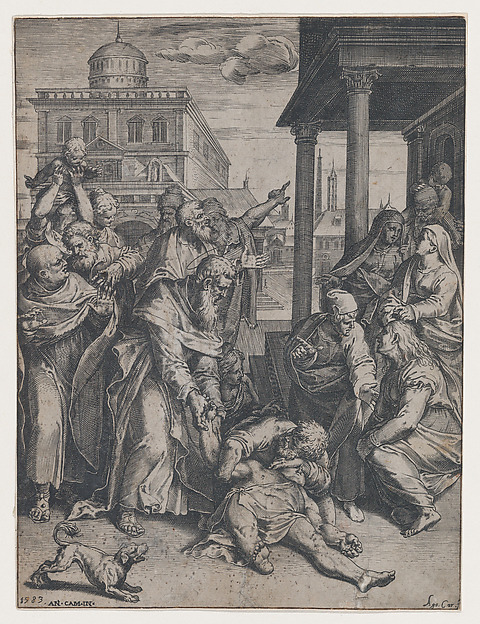
His Christian religious work falls in two distinct categories. As a painter he produced a smaller corpus than his brother — the Last Communion of Saint Jerome (Pinacoteca Nazionale, Bologna, c. 1591–1592, a composition that his pupil Domenichino later borrowed for his own famous Vatican version), the Assumption of the Virgin in the Bolognese Pinacoteca, and various Madonnas and altarpieces in churches in Bologna and Parma. As an engraver he produced about 250 plates, including reproductive engravings after Veronese, Tintoretto, Correggio, Parmigianino, Federico Barocci, and his own brother Annibale, that circulated through European print collections and made the Carracci reform program visible far beyond Bologna.
His most ambitious painted project, the cycle for the Camerino at the Palazzo del Giardino in Parma — commissioned by Duke Ranuccio Farnese in 1598 and left incomplete at his death — used mythological subjects of the Loves of the Gods to demonstrate the Carracci synthesis of color and design at a princely scale. The room remains substantially as he left it.
He was reputed by his early biographers to be the more learned of the brothers — a published author of poetry and treatises, fluent in Latin, with a serious interest in mathematics and music. The 1602 Parma move and his early death cut short what would likely have been a major late career; the Carracci synthesis as it became influential across the rest of the seventeenth century was carried more by Annibale and by their pupils (Domenichino, Reni, Albani, Lanfranco) than by Agostino's own continuing output.
Bible scenes Agostino Carracci painted
Acts