Painter of the Bible
Anthony van Dyck
Sir Anthony van Dyck was the leading Flemish painter of the seventeenth century after Rubens and the principal portraitist of the early Stuart court of Charles I in England.

Their faith
Why Anthony van Dyck painted Christ
Sir Anthony van Dyck was a deeply devoted Christian whose faith informed much of his artistic output. Although he is best known for his portraits of the English court, his religious works reveal a profound reverence for Christ and the teachings of the Church. Van Dyck's early years in Antwerp, where he was influenced by the vibrant Catholic culture and the teachings of the Church, played a significant role in shaping his spiritual vision. His apprenticeship under Rubens, a master of religious art, further deepened his understanding of sacred subjects. Throughout his life, Van Dyck maintained a commitment to his faith, as evidenced by his creation of altarpieces and other religious works that reflect his devotion and the importance of scripture in his life.
This devotion is beautifully illustrated in his altarpiece, "The Crucifixion," which captures the emotional intensity of Christ's sacrifice, drawing viewers into a moment of profound reflection. Similarly, his painting "The Lamentation of Christ" evokes deep sorrow and compassion, showcasing Van Dyck's ability to convey spiritual themes through art. His later works, such as the Pietà compositions for English Catholic patrons, reveal a softer palette and a more mature style, yet they remain anchored in the same faith that inspired his early creations. Van Dyck's legacy continues to inspire viewers today, as his devotion to Christ resonates through the beauty and depth of his religious art, inviting us to reflect on our own faith journeys.
Life & work
Sir Anthony van Dyck was the leading Flemish painter of the seventeenth century after Rubens and the principal portraitist of the early Stuart court of Charles I in England. Born in Antwerp in 1599 to a wealthy silk merchant, apprenticed at age ten to Hendrick van Balen and registered as a master in the Antwerp painters' guild by 1618, he entered Rubens's workshop in his late teens and became his most important assistant for several years before traveling to Italy in 1621. He spent six years in Italy — principally in Genoa, where he painted aristocratic portraits, and in Rome, Venice, and Sicily — and returned to Antwerp in 1627. His final relocation to England in 1632 made him principal painter to Charles I; he died in London in 1641, just forty-two years old.
His Christian religious work is concentrated in altarpieces produced during the Antwerp years (both the early pre-Italian and the post-Italian phases) and in the Genoese commissions of his Italian sojourn. The Crucifixion altarpieces in Mechelen and Antwerp Cathedral, the Lamentation of Christ (Munich, c. 1635), the Crowning with Thorns (Madrid), the Saint Augustine in Ecstasy (Antwerp), the Mocking of Christ (Madrid), and the late Pietà compositions for English Catholic patrons in the 1630s anchor his religious output. The early altarpieces show the muscular, deeply saturated chromatic Rubens manner that Van Dyck absorbed during his apprentice years; the later altarpieces have the slimmer figural proportions and softer chromatic palette that mark his independent mature manner.
His portrait practice — the great series of Charles I, Henrietta Maria, the royal children, the leading English aristocracy, and his own self-portraits — defined the iconographic conventions of European court portraiture for the next two hundred years. Gainsborough, Reynolds, and the entire eighteenth-century English portrait tradition descend directly from his work. He was knighted by Charles I in 1632, granted a yearly pension, and given the official title Principalle Paynter in Ordinarie to their Majesties.
Notable works in detail
met-436262
Virgin and Child with Saint Catherine of Alexandria, painted by Anthony van Dyck around 1625 in oil on canvas during his Italian sojourn (probably in Genoa, where he lived and worked between 1621 and 1627) and now in the Metropolitan Museum of Art in New York, depicts the iconographic subject of the mystic marriage of Saint Catherine. The seated Virgin holds the Christ Child upright on her lap; Catherine kneels in profile on the right with her wheel of martyrdom visible behind her, and the Christ Child reaches forward to slip a small ring onto her finger. The chromatic palette of warm flesh, deep crimson, and pale blue against the darkened ground reflects van Dyck's recent Italian study of Titian and Veronese, the two great Venetian colorists whose work he absorbed during his Genoese years.
met-369073
Rest on the Flight into Egypt, painted by Anthony van Dyck around 1630 in oil on canvas, depicts the apocryphal subject of the Holy Family pausing in their flight from Herod's persecution as recorded in Matthew 2. Van Dyck stages the scene as a tender outdoor encounter: the seated Virgin in profile holding the swaddled Christ Child, Joseph waiting nearby with the small donkey, two attendant angels in the upper foreground playing the lute and the violin to soothe the Child to sleep. The chromatic palette of warm rose, pale silver-grey, and deep saturated blue against the soft Italian-Northern landscape combines van Dyck's Italian-period color with the careful Antwerp post-Rubensian figural drawing that defined his mature manner.
met-335448
Christ on the Cross (with Saint Jerome Reading by Candlelight on the verso), drawn by Anthony van Dyck around 1610 in pen and brown ink on paper and now in the Metropolitan Museum of Art in New York, is among the early van Dyck preparatory drawings from his Antwerp apprentice years in the orbit of his teacher Hendrick van Balen and (slightly later) of Peter Paul Rubens. The recto shows the body of Christ on the cross at the moment immediately after his death; the verso shows Saint Jerome — the early Church Father in his hermit years — seated reading by candlelight. The double-sided sheet demonstrates van Dyck's early facility for both the Passion subject and the Catholic devotional saint-portrait genre that would define his mature altarpiece practice.
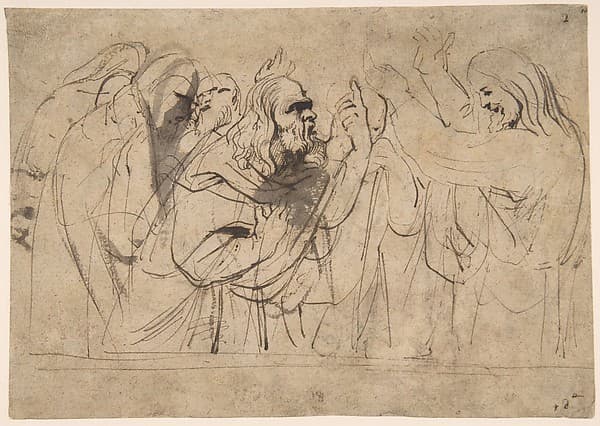
Christ and the Pharisees; verso; Christ and a Pharisee
Christ and the Pharisees (with Christ and a Pharisee on the verso), drawn by Anthony van Dyck around 1610 in pen and brown ink on paper, is another early van Dyck preparatory sheet from his Antwerp workshop years. The recto shows Christ disputing with a small group of Pharisees gathered around him in the conventional iconographic composition of the Gospel-debate subject; the verso shows a single Pharisee facing Christ in a more focused two-figure composition. Such drawings — small-scale rapid studies of biblical-narrative subjects — were the working currency of the Antwerp Catholic painting workshop, and van Dyck's drawn output was particularly large and particularly accomplished even at this early stage of his career.
met-335451
Study of the Christ Child and the Hand of the Madonna, drawn by Anthony van Dyck around 1615 in his Antwerp workshop in pen and ink with brown wash on paper, is a small preparatory drawing for one of his early Madonna and Child compositions. The drawing shows the small Christ Child in the foreground and a separate study of the Madonna's hand reaching to touch him — the kind of focused detailed study that van Dyck would later use as the working pattern for the more finished half-length Madonnas of his Antwerp and English periods. The sheet is one of the principal early van Dyck preparatory drawings in any American collection.
Bible scenes Anthony van Dyck painted
John
