Painter of the Bible
Carlo Maratti
Carlo Maratti — sometimes spelled Maratta — was the leading Roman painter of the late seventeenth century and the artist whose late-Baroque-into-classicizing manner defined Roman religious painting in the decades immedia…

Their faith
Why Carlo Maratti painted Christ
Carlo Maratti, born in 1625 in Camerano, Italy, was a devout Christian whose faith deeply influenced his artistic journey. Apprenticed to the renowned painter Andrea Sacchi in Rome, Maratti embraced the rich traditions of the Catholic Church and the beauty of scripture. His dedication to his craft was not merely about technique but was also an expression of his spirituality. As he painted, Maratti sought to convey the divine through his works, often creating altarpieces for significant Roman churches and private devotional pieces for prominent ecclesiastical patrons. His faith was evident in the way he approached his art, seeing it as a form of worship and a means to inspire others in their spiritual lives.
Maratti's artistic legacy is profoundly marked by his religious works, which include masterpieces such as "The Adoration of the Shepherds" and "The Birth of the Virgin." These paintings exemplify his ability to blend monumental High Renaissance composition with the emotional warmth of late-Baroque style, inviting viewers into a deeper contemplation of the divine mysteries. His depictions of the Madonna, characterized by soft eyes and serene expressions, became the standard for Roman devotional imagery in the late seventeenth century. Through his art, Maratti not only captured the essence of biblical narratives but also created a lasting impact on Christian devotion, as his works were reproduced and cherished across Europe and the Americas. Today, Maratti's devotion continues to resonate, reminding us of the beauty and grace found in faith-filled artistry.
Life & work
Carlo Maratti — sometimes spelled Maratta — was the leading Roman painter of the late seventeenth century and the artist whose late-Baroque-into-classicizing manner defined Roman religious painting in the decades immediately before the rise of the eighteenth-century Roman school. Born in Camerano in the Marche in 1625, sent to Rome as a young apprentice to the painter Andrea Sacchi (the principal exponent of the Roman classicizing tradition that descended from Annibale Carracci through Domenichino), and active in Rome for the rest of his career, he became the city's principal religious painter from the 1660s onward and was eventually appointed Restorer of the Vatican paintings under Pope Clement XI. He died in Rome in 1713.
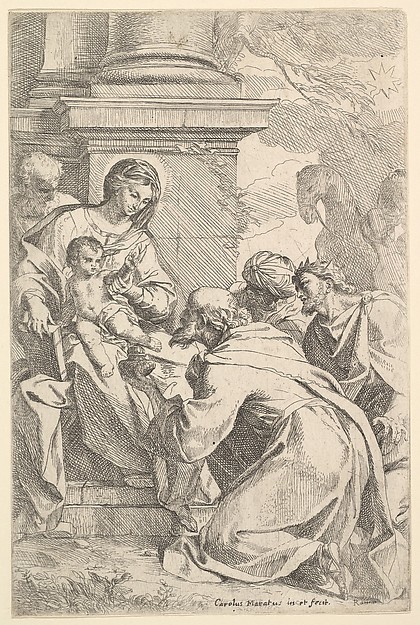
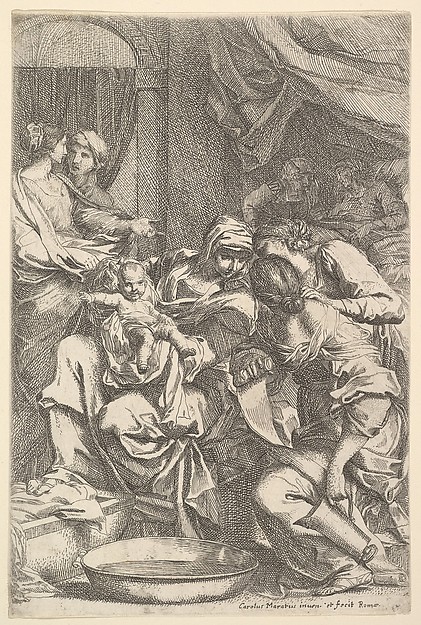
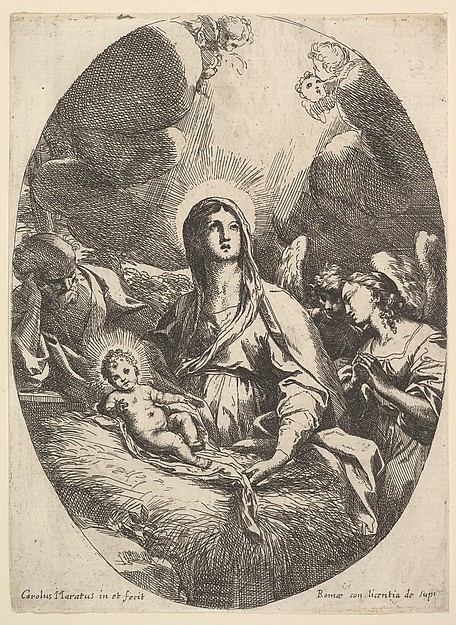
His Christian religious work is concentrated in altarpieces of the great Roman churches and in private devotional paintings for the Roman aristocratic and ecclesiastical patrons of the Barberini, Chigi, and Rospigliosi-Pallavicini families. The Adoration of the Shepherds, the Madonna and Child with Saints, the Death of Saint Joseph, the Vision of Saint John the Evangelist, the Birth of the Virgin (Santa Maria della Pace, Rome, 1689), and the great altarpieces in San Marco al Campidoglio, San Carlo al Corso, and Santa Maria del Popolo all show his characteristic combination of monumental High Renaissance composition with the warm color and soft handling of late-Baroque practice.
His Madonnas — soft-eyed, placid, dressed in deep cobalt blue and rose, with the Christ Child in graceful proportional contrast — became the standard Roman devotional image of the late seventeenth century and were copied, reproduced in engraving, and circulated as small devotional pictures throughout Catholic Europe and the Americas. His engraved reputation, supported by the prolific Carlo Cesi and other Roman printmakers who reproduced his compositions, carried the Maratta type into eighteenth-century devotional practice from Naples to Lima.
He was also a major draftsman and a lifelong teacher; the Maratta school produced most of the leading Roman religious painters of the next generation, including Niccolò Berrettoni, Giuseppe Chiari, and Pier Leone Ghezzi. He was buried in Santa Maria degli Angeli in Rome.
Notable works in detail
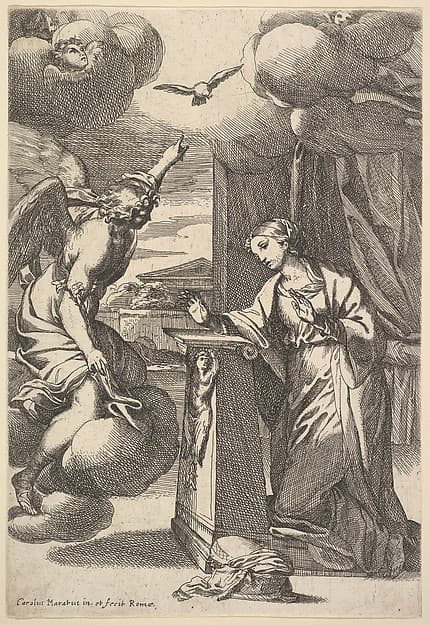
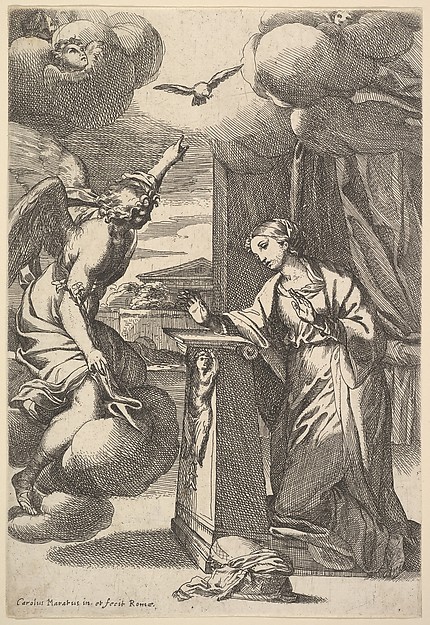
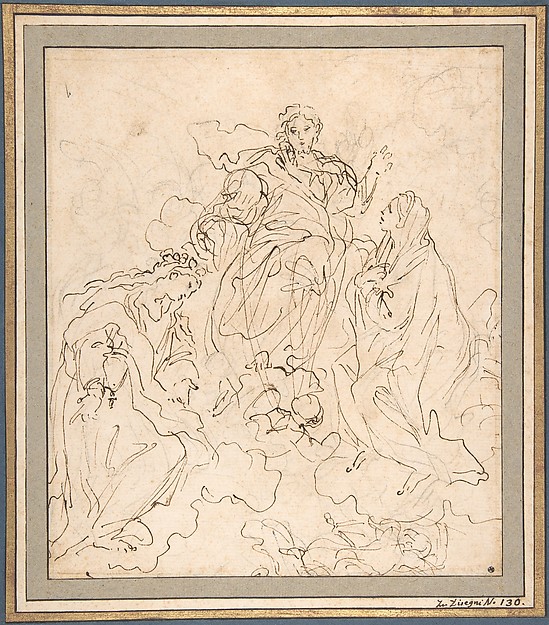
The Annunciation, drawn by Carlo Maratti around 1670 in pen and ink with brown wash on paper and now in the Metropolitan Museum of Art in New York, is a preparatory drawing for one of his many painted Annunciation altarpieces of his late Roman career. The drawing shows the moment from Luke 1 in which the angel Gabriel appears to the Virgin in her chamber to announce the conception of Christ: the Virgin kneels at her prayer-desk on the right, the angel descends from the upper left in an attitude of greeting, the Holy Spirit appears as a small dove on a beam of light between them. Maratti's late Roman drawings — pen-and-wash compositional studies for altarpieces and ceiling decorations — are the principal record of his working method and demonstrate the calm classicizing manner that defined his entire devotional output.
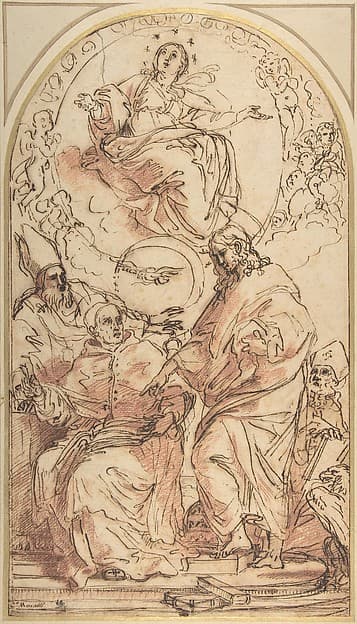
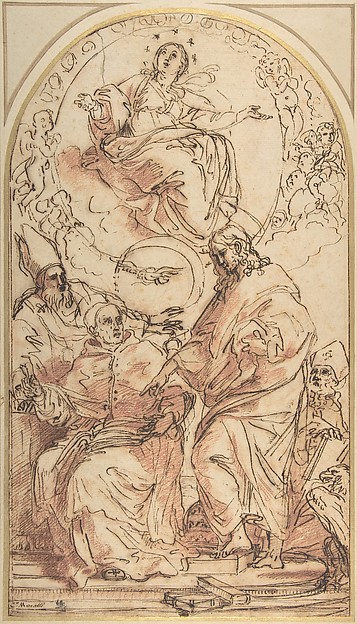
The Virgin Immaculate with the Four Doctors of the Church, drawn by Carlo Maratti around 1670 in his late Roman workshop, is a preparatory drawing for an altarpiece commission depicting the Catholic doctrine of the Immaculate Conception attended by the four early Latin Church Fathers — Augustine, Ambrose, Jerome, and Gregory the Great — whose theological writings were among the principal authorities for Counter-Reformation Mariology. Maratti stages the scene as a vertical composition with the standing Virgin at the upper center surrounded by attendant angels, the four bearded Latin Fathers ranged in the lower foreground in formal attendance with their books and identifying attributes. The drawing demonstrates the late Maratti workshop discipline at full mature statement.
met-816629
The Flight into Egypt, painted by Carlo Maratti around 1659 in oil on canvas and now in the Metropolitan Museum of Art in New York, depicts the apocryphal subject of the Holy Family fleeing from King Herod's persecution as recorded in Matthew 2. Maratti stages the scene as a tender outdoor encounter: the Virgin riding on the small donkey holding the swaddled Christ Child, Joseph leading the donkey on foot while looking back over his shoulder for pursuit, a small attending angel guiding them along the road through an Italian landscape. The chromatic palette of warm flesh, deep crimson, and soft Italian blue against the dusty road and the soft hilly horizon is the unmistakable late-Roman Maratti signature, and the painting is one of the principal Maratti Flight scenes in any American collection.
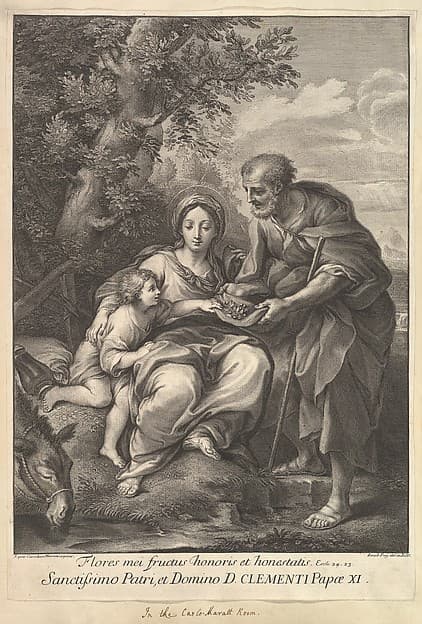
The Virgin and Joseph with the Young Jesus
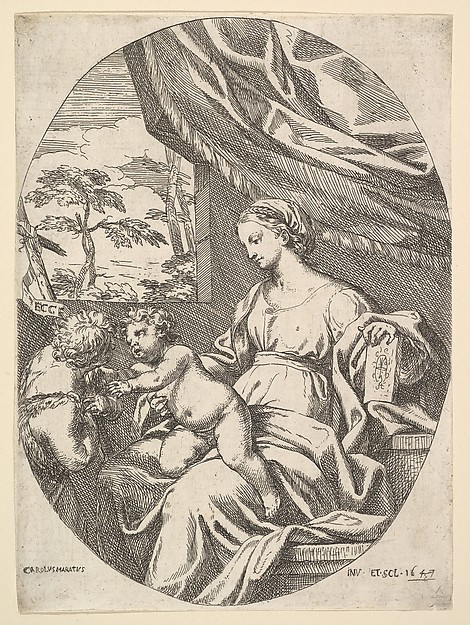
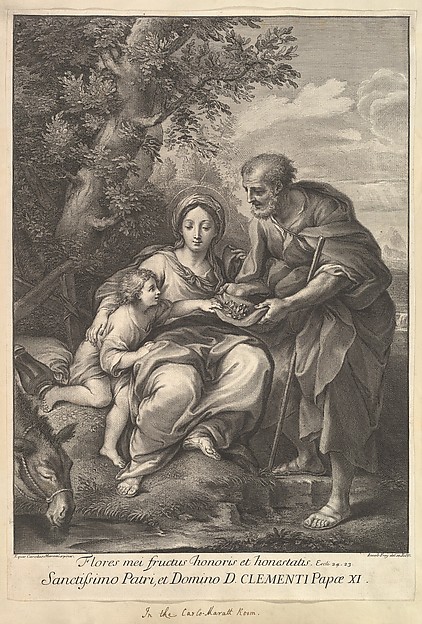
The Virgin and Joseph with the Young Jesus, drawn by Carlo Maratti around 1710 in his very late Roman workshop years, is a small preparatory drawing for one of the many small Holy Family devotional paintings produced by Maratti's workshop in the years before his death. The drawing shows the seated Virgin holding the small Christ Child standing on her lap, with Joseph behind her holding a tall flowering staff (the iconographic attribute that, in the late-medieval Marian tradition, identified Joseph as the chosen husband of the Virgin from among all the suitors). The composition demonstrates the late Maratti's reliance on the small intimate Holy Family devotional type that his Roman workshop turned out in workshop variants for private patrons throughout the late seventeenth and early eighteenth centuries.