Painter of the Bible
Eugène Delacroix
Eugène Delacroix is the great Romantic painter of nineteenth-century France, and the religious commission that crowned his career was a chapel mural cycle finished in his last decade.

Their faith
Why Eugène Delacroix painted Christ
Eugène Delacroix, a prominent figure in the Romantic movement, dedicated much of his artistic life to exploring profound themes, including spirituality and faith. His commitment to religious subjects culminated in his monumental chapel murals, particularly at the Chapel of the Holy Angels at Saint-Sulpice in Paris. Delacroix's works reflect a deep reverence for scripture and the divine, as he sought to convey the emotional intensity of biblical narratives through his vibrant color palette and dynamic compositions. His journal entries reveal a man deeply engaged in the struggles of his craft, often turning to prayer and reflection as he navigated the challenges of his artistic journey. This devotional practice not only shaped his artistic output but also underscored his belief in the power of art to communicate spiritual truths.
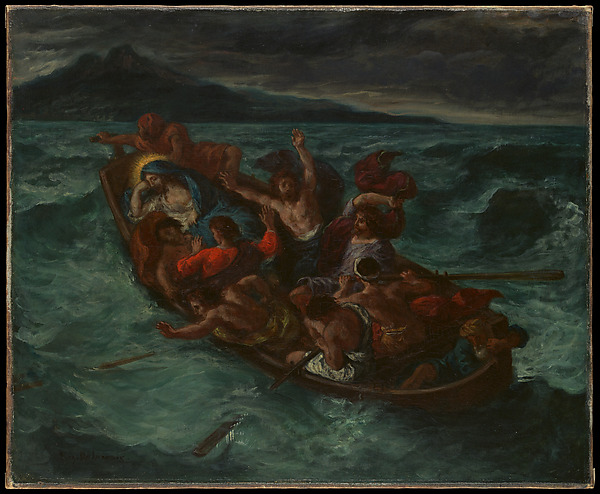
Delacroix's faith is vividly expressed in several of his masterpieces, most notably in his series of paintings depicting Christ, such as the poignant Christ on the Cross and the stirring Christ on the Sea of Galilee. In these works, the viewer is invited to witness the divine presence in moments of human struggle and vulnerability. The raw emotion captured in the faces of his figures and the dramatic use of light and shadow serve to elevate the spiritual experience, allowing viewers to connect with the sacred narratives on a personal level. Delacroix's artistic legacy continues to inspire, as his devotion to portraying Christ and biblical themes resonates with audiences today, reminding us of the enduring power of faith and the beauty found in the struggle for spiritual understanding.
Life & work
Eugène Delacroix is the great Romantic painter of nineteenth-century France, and the religious commission that crowned his career was a chapel mural cycle finished in his last decade. Born in 1798 near Paris and trained in the studio of Pierre-Narcisse Guérin, he made his name in his twenties with the Massacre at Chios and the Death of Sardanapalus, traveled in Morocco and Algeria in 1832, and developed across forty years a body of history, mythological, and religious painting whose color and gestural brushwork would become the direct inheritance of the Impressionists.
His religious paintings are dispersed across his career and across French churches. He painted Christ on the Cross repeatedly, in versions ranging from the modest Vannes panel to the great altarpiece in the church of Saint-Paul-Saint-Louis in the Marais. His Christ on the Sea of Galilee — the disciples in their pitching boat, Christ asleep in the stern, painted in at least six versions between 1841 and 1854 — is one of the defining Romantic biblical images. The Pietà of the Saint-Denys-du-Saint-Sacrement (Paris, 1844) and the Entombment for the same church set monumental Counter-Reformation compositions in the rough, layered handling of his late style.
Between 1853 and 1861 he frescoed the Chapel of the Holy Angels at Saint-Sulpice in Paris with two enormous wall paintings and a ceiling: Jacob Wrestling with the Angel (the angel pinning Jacob in a tangled forest of acanthus and oak), Heliodorus Driven from the Temple (an Old Testament Maccabees scene exploding into a vault of horsemen and angels), and Saint Michael Defeating the Devil overhead. The chapel had been badly fitted out, the lighting was wrong, his health failed multiple times during the work, and the public reception of the finished cycle was uneven. The chapel itself, however, has steadily climbed in critical estimation since his death; a generation of twentieth-century painters from Cézanne to Matisse made it a pilgrimage site.
He died in Paris in 1863 and is buried in Père Lachaise. The Journal he kept from 1822 onward, published posthumously, is one of the great working diaries of any nineteenth-century artist; passages on his struggles in the Saint-Sulpice chapel are among its most-quoted entries.