Painter of the Bible
Fra Bartolomeo (Bartolomeo di Paolo del Fattorino)
Fra Bartolomeo — born Bartolomeo di Paolo del Fattorino in Florence in 1472 — was a leading Florentine painter of the High Renaissance and the principal Dominican-friar painter of his generation.

Their faith
Why Fra Bartolomeo (Bartolomeo di Paolo del Fattorino) painted Christ
Fra Bartolomeo, originally named Bartolomeo di Paolo del Fattorino, was born in Florence in 1472 and became a prominent figure in the High Renaissance as a painter and a devout member of the Dominican order. His faith was profoundly shaped by the apocalyptic teachings of Girolamo Savonarola, whose fervent preaching inspired him to join the Dominican order in 1500, shortly after Savonarola's tragic execution. Living at the convent of San Marco, Fra Bartolomeo dedicated his life to creating art that reflected his deep spiritual convictions. His work was characterized by a commitment to the principles of the Dominican faith, emphasizing clarity and devotion in religious imagery. His artistic journey was not just a profession but a form of worship, as he sought to convey the beauty and truth of scripture through his paintings.
This devotion is beautifully illustrated in works such as "The Vision of Saint Bernard" and "Madonna and Child with Saints." In these pieces, Fra Bartolomeo combines the compositional discipline of the High Renaissance with the emotional depth derived from his Dominican beliefs. His altarpieces are not merely decorative; they serve as portals to the divine, inviting viewers into a deeper understanding of faith and spirituality. The calm and deliberate style, enhanced by the soft sfumato technique, creates a serene atmosphere that encourages contemplation. Even today, the reverence embedded in his art continues to inspire and uplift those who encounter it, reminding us of the enduring power of faith expressed through beauty.
Life & work
Fra Bartolomeo — born Bartolomeo di Paolo del Fattorino in Florence in 1472 — was a leading Florentine painter of the High Renaissance and the principal Dominican-friar painter of his generation. Trained in Florence in the workshop of Cosimo Rosselli alongside his lifelong friend and frequent collaborator Mariotto Albertinelli, he was deeply influenced by the apocalyptic preaching of the Dominican friar Girolamo Savonarola in the 1490s and entered the Dominican order at the convent of San Marco in 1500, two years after Savonarola's execution by hanging and burning in the Piazza della Signoria. He spent the rest of his life as Fra Bartolomeo at San Marco and died in Florence in 1517.
His Christian religious work is concentrated in altarpieces and devotional panels in his characteristic combination of Florentine High Renaissance compositional discipline and a deep Dominican-Savonarolan emotional gravity. The Vision of Saint Bernard altarpiece (Galleria dell'Accademia, Florence, c. 1504), the Madonna and Child with Saints (Pitti, 1512), the Madonna della Misericordia (Lucca, 1515), the Risen Christ with the Four Evangelists (Pitti, 1516), the Pietà (Pitti, 1515 — left unfinished at his death and completed by Fra Paolino), and the Marriage of Saint Catherine altarpieces (Louvre and Pitti) anchor the painted corpus.
His personal style — calm, deliberate, with carefully balanced compositional symmetry and a soft sfumato modeling derived in part from Leonardo da Vinci (whom he met during Leonardo's second Florentine residence) and in part from Raphael (with whom he formed a close personal and stylistic friendship during Raphael's Florentine years of 1504–1508) — combined the Florentine High Renaissance figural discipline with the Dominican-Savonarolan preference for clear, devotionally accessible religious imagery.
He visited Venice in 1508, where he absorbed the warm Venetian color of Giovanni Bellini and the early Titian; the late Florentine altarpieces of his last decade show the Venetian chromatic influence on his characteristically calm Florentine compositions. He was buried in his Dominican convent of San Marco — the same convent in which Fra Angelico had lived and worked seventy years earlier and in which Savonarola had been confined before his execution.
Notable works in detail
met-435614
Madonna and Child with the Young Saint John the Baptist, painted by Fra Bartolomeo around 1492 in his early Florentine workshop years (before his Dominican vows and his entry into the convent of San Marco) in tempera and oil on panel and now in the Metropolitan Museum of Art in New York, is among the small early Madonnas from his pre-monastic period. The seated Virgin holds the Christ Child upright on her lap; the small John the Baptist stands in profile beside them, embracing the Christ Child from the side. The chromatic palette and the careful figural drawing demonstrate the early Fra Bartolomeo absorption of his teacher Cosimo Rosselli's Florentine workshop discipline at the moment immediately before he entered Florence's High Renaissance generation.
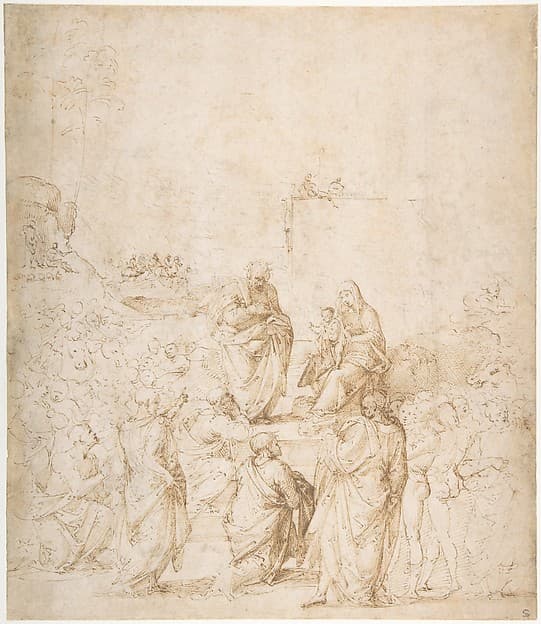
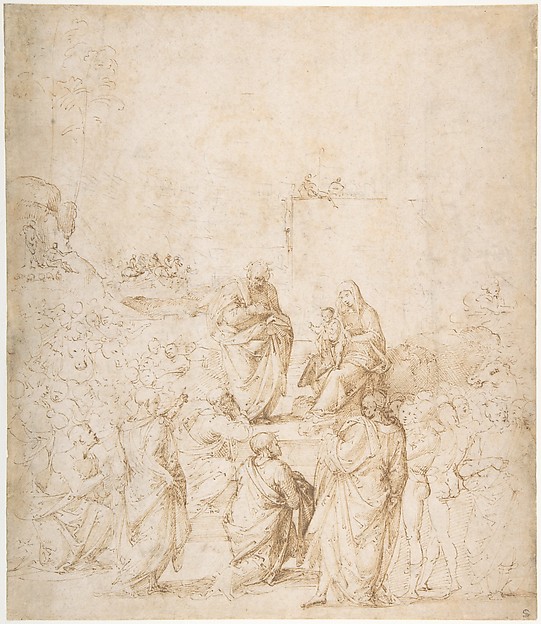
The Adoration of the Magi, drawn by Fra Bartolomeo around 1495 in pen and brown ink on paper and now in the Metropolitan Museum of Art in New York, is a small preparatory drawing from his early Florentine workshop years. The drawing shows the visit of the three kings to the infant Christ as recorded in Matthew 2: the seated Virgin holding the Christ Child at the center, the eldest king kneeling in profile in the foreground offering his gift, the second and third kings standing behind in formal attendance with their large attending retinue. The drawing demonstrates the early Fra Bartolomeo draughtsmanship and the rapid confident pen technique that defined his preparatory working method throughout his career.
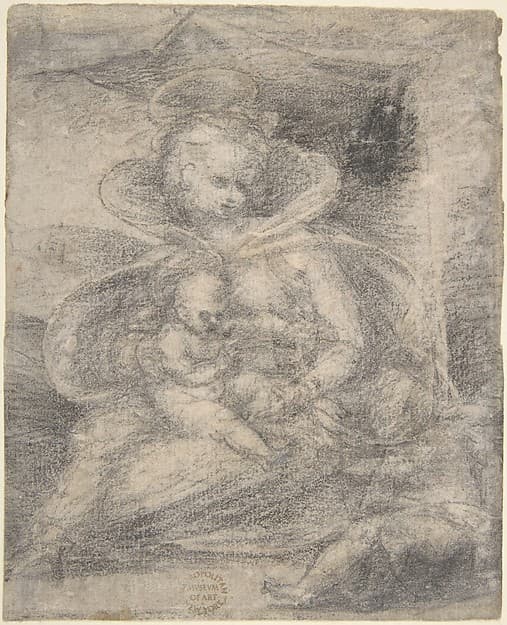
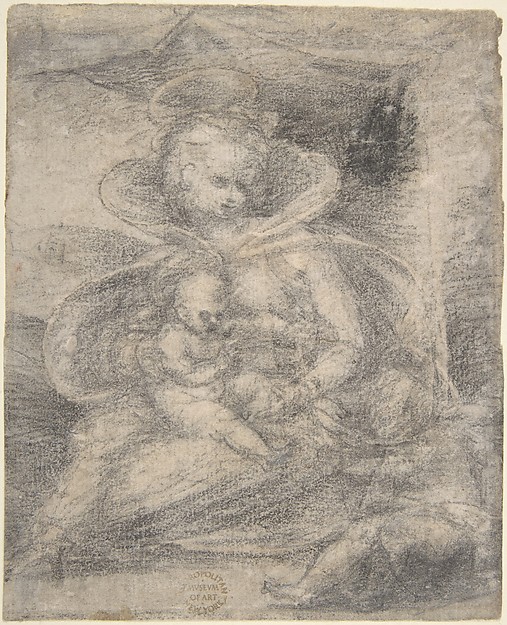
The Virgin and Child, drawn by Fra Bartolomeo around 1510 in red and black chalk on paper and now in the Metropolitan Museum of Art in New York, is a preparatory drawing from his mature Dominican workshop years at the convent of San Marco in Florence. The drawing shows the seated Virgin holding the standing Christ Child upright on her lap; the soft sfumato modeling derived in part from Leonardo da Vinci (whom Fra Bartolomeo met during Leonardo's second Florentine residence) and in part from Raphael (with whom he formed a close personal and stylistic friendship during Raphael's Florentine years of 1504–1508) is at full mature statement here, and the drawing is one of the principal mature Fra Bartolomeo Madonnas in any American collection.
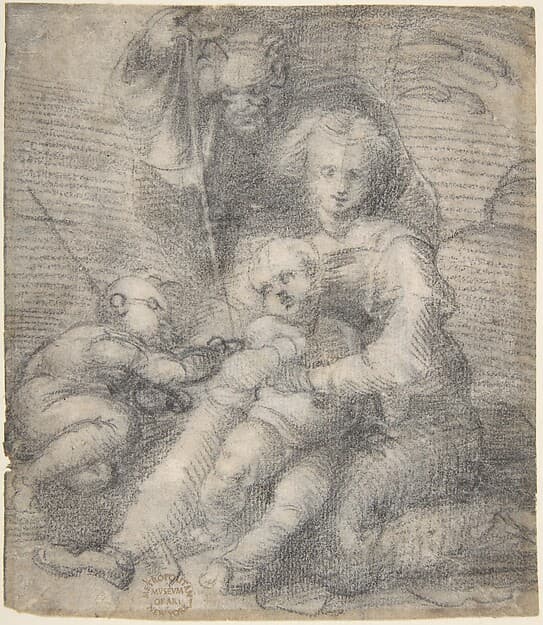
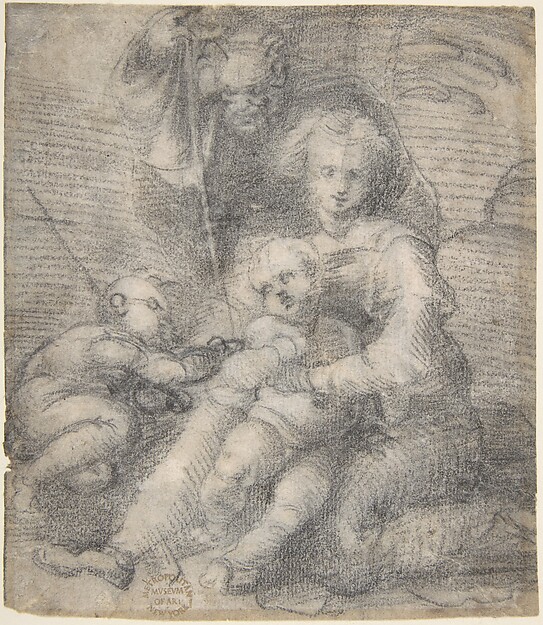
The Holy Family with Saint John the Baptist
The Holy Family with Saint John the Baptist, drawn by Fra Bartolomeo around 1510 in red and black chalk on paper and now in the Metropolitan Museum of Art in New York, is a preparatory drawing for one of his mature painted Holy Family compositions. The drawing shows the seated Virgin holding the small Christ Child, with the small John the Baptist embracing the Christ Child from the side and Joseph standing in formal attendance behind. The combination of red and black chalk on paper — a particular Fra Bartolomeo technical preference — gives the figures a soft sfumato modeling characteristic of his mature Dominican workshop years at San Marco.
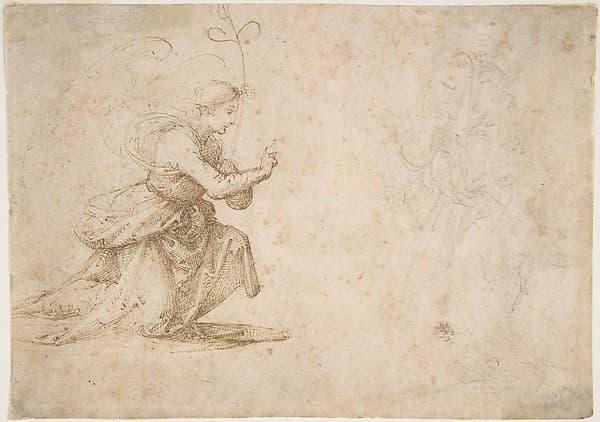
The Annunciation (recto); Faint View of Buildings (verso)
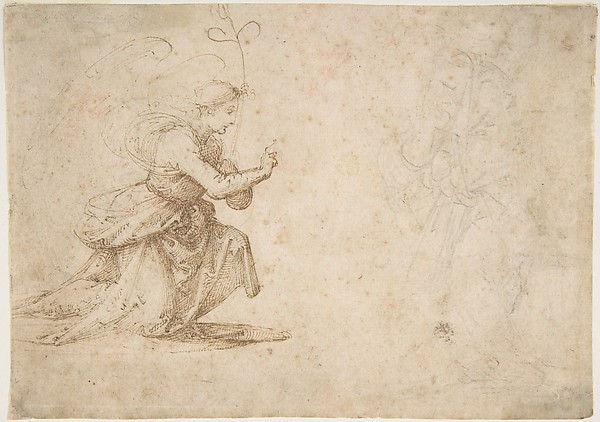
The Annunciation, drawn by Fra Bartolomeo (with a faint view of buildings on the verso) around 1500 in pen and brown ink on paper and now in the Metropolitan Museum of Art in New York, is a small preparatory drawing from his early Dominican period at the convent of San Marco. The drawing shows the moment from Luke 1 in which the angel Gabriel appears to the Virgin in her chamber to announce the conception of Christ: the Virgin kneels at her prayer-desk on the right, the angel kneels on the left in an attitude of greeting, the Holy Spirit appears as a small dove on a beam of light. The drawing demonstrates the rapid confident pen technique that defined Fra Bartolomeo's preparatory working method.