Painter of the Bible
Giovanni Battista Tiepolo
Giovanni Battista Tiepolo (also called Giambattista Tiepolo) was the supreme Italian fresco painter of the eighteenth century and the principal late voice of the Venetian school of color and luminous atmosphere that descended from Veronese and Tintoretto.

Their faith
Why Giovanni Battista Tiepolo painted Christ
Giovanni Battista Tiepolo, born in Venice in 1696, was a master of the late-Baroque style, celebrated for his vibrant use of color and light. His faith as a devout Christian deeply influenced his artistic endeavors, particularly in his numerous religious works. Tiepolo's commitment to his craft was evident in his meticulous approach to scripture and the sacred themes he portrayed. He dedicated much of his career to creating altarpieces and frescoes for churches, reflecting a profound reverence for the divine. His works often served as visual sermons, inviting viewers to contemplate the spiritual truths of the Christian faith. Tiepolo's artistic journey was not just a profession but a spiritual calling, as he sought to glorify God through his art, a sentiment echoed in the church commissions he received throughout his life.
Tiepolo's faith is vividly expressed in his renowned ceiling fresco at the Carmelite church of Santa Maria del Carmelo, where he depicted heavenly scenes that inspire awe and devotion. His ability to capture the ethereal light and divine presence in works like the Stations of the Cross at the Oratorio del Crocifisso showcases his desire to elevate the viewer's spirit towards God. The luminous palette he employed, characterized by soft pinks and vibrant blues, not only highlights the beauty of creation but also serves as a metaphor for the divine light of Christ illuminating the world. Through his art, Tiepolo continues to reach viewers, inviting them into a deeper understanding of faith and the beauty of God's creation, reminding us that art can be a powerful vessel for spiritual reflection and inspiration.
Life & work
Giovanni Battista Tiepolo (also called Giambattista Tiepolo) was the supreme Italian fresco painter of the eighteenth century and the principal late voice of the Venetian school of color and luminous atmosphere that descended from Veronese and Tintoretto. Born in Venice in 1696, trained briefly in the workshop of Gregorio Lazzarini before establishing himself independently in his late teens, he ran the leading Venetian decorative-painting workshop for almost half a century. He worked across northern Italy and Germany — the great Würzburg Residenz frescoes of 1750–1753 are his masterpiece — and ended his career in Madrid at the Spanish royal court, where he died in 1770.
His Christian religious work is concentrated in altarpieces, oratory ceiling cycles, and church decoration commissions across the Veneto and northern Italy. The ceiling fresco of the Carmelite church Santa Maria del Carmelo in Venice (1740–1743), the Stations of the Cross at the Oratorio del Crocifisso in San Polo (1747–1749), the great altarpieces in the Gesuati church on the Zattere, the Saints Maximus and Oswald (Padua, c. 1740), the Madonna of Mount Carmel altarpieces produced in multiple workshop variants, and the late altarpieces for the Spanish royal court fill the religious painted corpus. The chromatic palette of luminous chalk-pinks, electric blues, and silvery cool whites against the bright sunlight of his Venetian skies became the canonical late-Baroque Italian altarpiece signature.
His Würzburg ceiling — the Apollo and the Four Continents in the Treppenhaus and the great Imperial Hall frescoes painted for the Prince-Bishop of Würzburg between 1750 and 1753 — is widely held to be the supreme Italian fresco achievement of the eighteenth century. He was assisted in the project by his sons Giandomenico and Lorenzo, who continued the workshop after his death.
He died in Madrid in 1770, having spent his last eight years working at the Spanish royal court under Charles III. The neoclassical reaction of the late eighteenth century pushed his late-Baroque manner out of fashion almost immediately; the modern rediscovery of Tiepolo as a major figure dates from the early twentieth century.
Notable works in detail
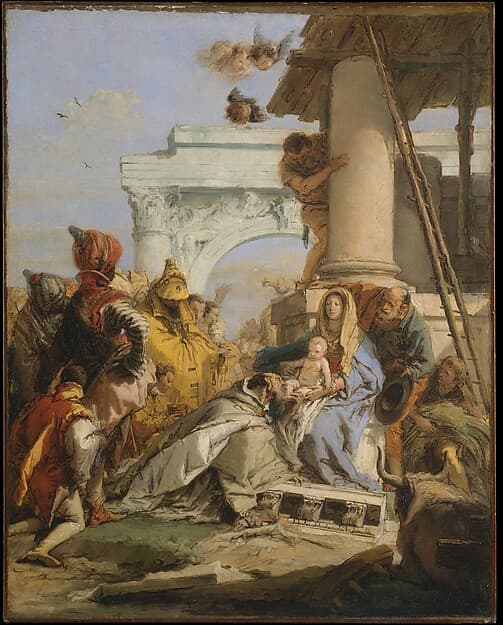
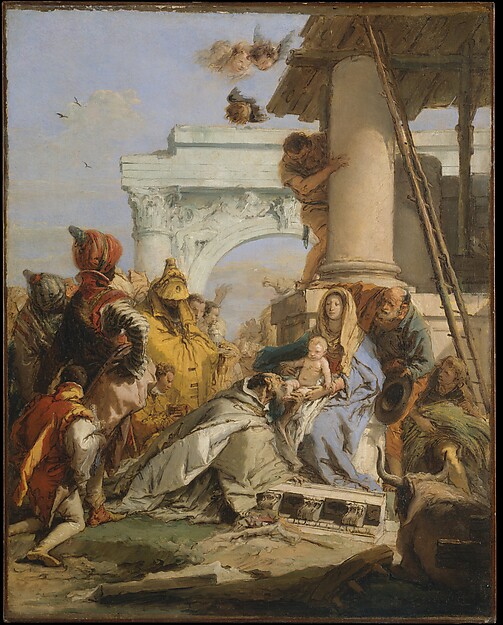
The Adoration of the Magi, painted by Giovanni Battista Tiepolo in 1757 in oil on canvas and now in the Metropolitan Museum of Art in New York, depicts the visit of the three kings to the infant Christ as recorded in Matthew 2. Tiepolo composes the scene as a luminous vertical encounter under an open architectural canopy: the seated Virgin and the Christ Child on the right, the eldest king kneeling in profile in the foreground offering his gift, the second king standing behind in formal attendance, the third king arriving with a small attending retinue. The chromatic palette of pale chalk-pink, electric blue, and silvery cool white against the bright eighteenth-century Venetian sky is the unmistakable mature-Tiepolo signature, and the painting demonstrates his characteristic ability to combine the late-Baroque grand-manner composition with a particularly Venetian luminosity of color and atmosphere.
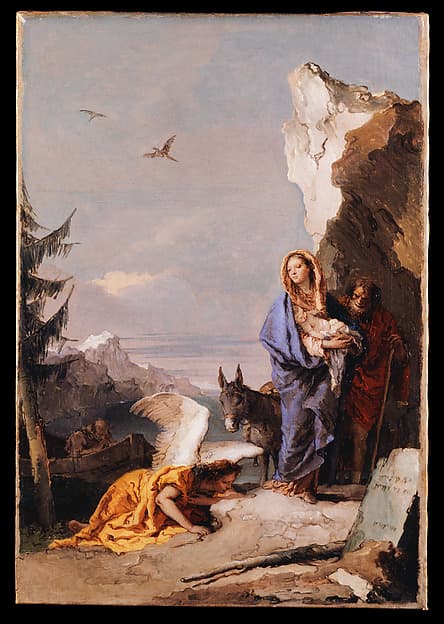
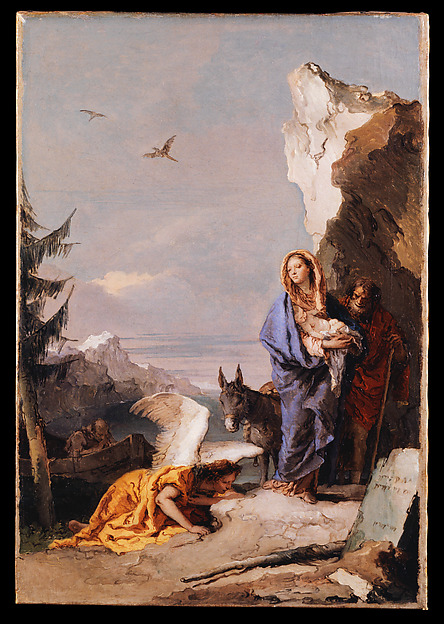
The Flight into Egypt, painted by Giovanni Battista Tiepolo in 1767 in oil on canvas during his late Madrid years and now in the Metropolitan Museum of Art in New York, depicts the apocryphal subject of the Holy Family fleeing from King Herod's persecution. Tiepolo stages the scene as a small intimate encounter: the Virgin holding the swaddled Christ Child seated on the small donkey, Joseph leading the donkey on foot, a small attending angel guiding them across a luminous Italian landscape with distant hills fading into atmospheric haze. The chromatic palette of pale rose, silver-blue, and warm flesh against the soft sky is the unmistakable late-Tiepolo Madrid signature, painted during his last years at the Spanish royal court before his death in 1770.
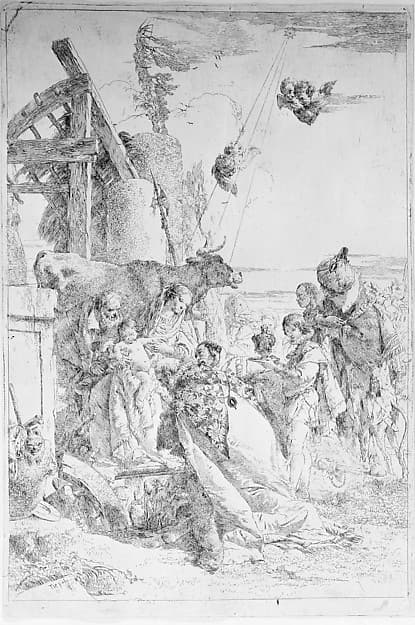
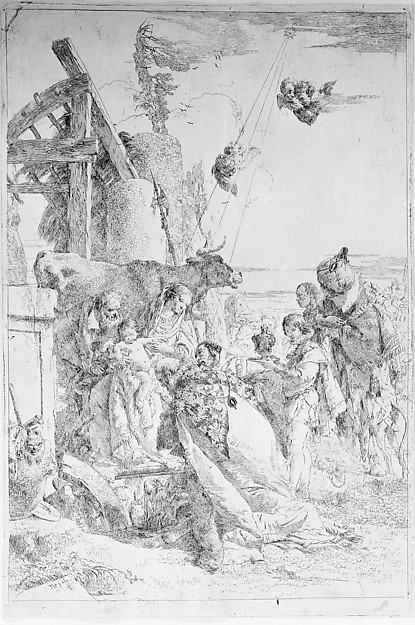
Adoration of the Magi, drawn by Giovanni Battista Tiepolo around 1733 in pen and brown ink with wash on paper and now in the Metropolitan Museum of Art in New York, is a preparatory drawing from his middle career — the productive Venetian decade between his Würzburg trip and his eventual Madrid relocation. The drawing shows the three Magi approaching the Holy Family in his characteristic dense Baroque grouping: the seated Virgin holding the Christ Child at the center, the eldest king kneeling in profile in the foreground, the second and third kings standing in formal attendance with their large attending retinue of horses, exotic animals, and gift-bearing attendants. The drawing demonstrates the rapid confident pen-and-wash technique that defined Tiepolo's drawn output throughout his career and that the eighteenth-century connoisseurs collected as virtuoso autograph examples.
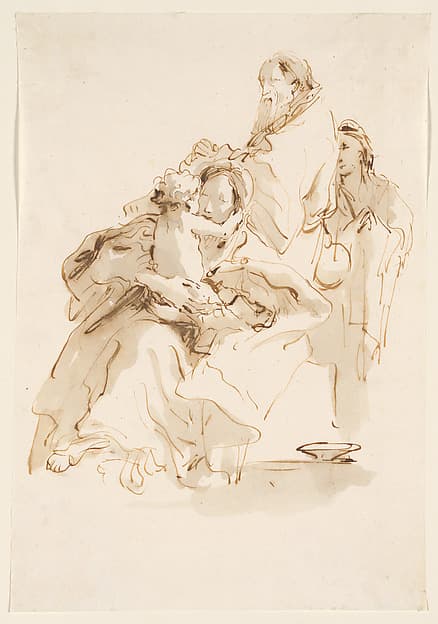
The Holy Family with Saint John
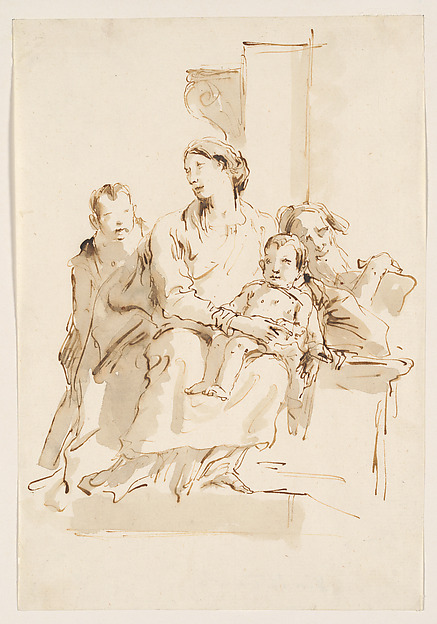
The Holy Family with Saint John, painted by Giovanni Battista Tiepolo around 1751 in oil on canvas during his middle Venetian career, is one of the small intimate Holy Family devotional compositions Tiepolo produced for private patrons across his entire career. The composition shows the seated Virgin holding the small Christ Child, with the boy John the Baptist embracing the Christ Child from the side and Joseph waiting in the background. The chromatic palette of pale chalk-pink, electric blue, and silvery cool white against the soft Venetian-Baroque background is the unmistakable mature-Tiepolo signature, and the painting belongs to the long sequence of Holy Family devotional images that Tiepolo's workshop produced in workshop variants for Venetian aristocratic and ecclesiastical patrons through the 1740s and 1750s.
met-339443
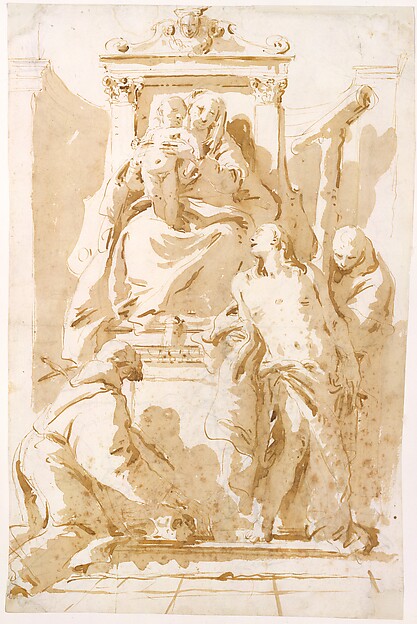
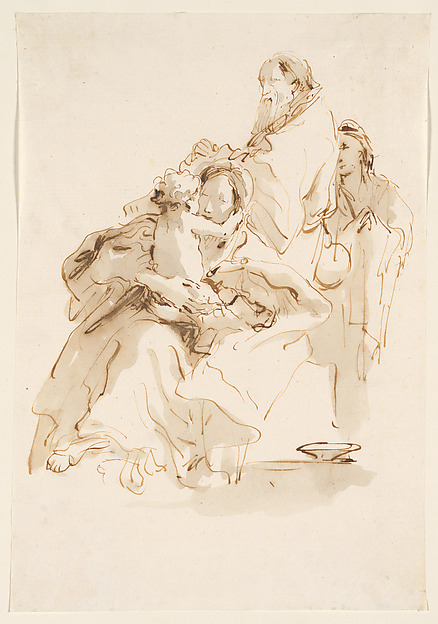
The Virgin and Child Enthroned with Saint Sebastian and Saint Lucy, drawn by Giovanni Battista Tiepolo around 1735 in pen and brown ink with wash on paper, is a preparatory drawing for an altarpiece commission of his middle Venetian career. The drawing shows the seated Virgin with the Christ Child on her lap on a small architectural throne; Saint Sebastian stands on the left in his iconographic posture (bound to a tree, his body pierced with arrows); Saint Lucy stands on the right holding a small dish with her eyes (the iconographic attribute that distinguishes her from any other female saint). The composition demonstrates the late-Baroque sacra conversazione altarpiece type at full mature Venetian statement and is one of the principal Tiepolo preparatory drawings in any American collection.