Painter of the Bible
Jacob Jordaens
Jacob Jordaens was the third member, alongside Rubens and Anthony van Dyck, of the great triumvirate of seventeenth-century Antwerp Baroque painters and, after Rubens's death in 1640, the principal Flemish religious painter of his generation.

Their faith
Why Jacob Jordaens painted Christ
Jacob Jordaens was a dedicated Lutheran artist who made a profound impact on the religious art scene in 17th-century Antwerp. Born into a well-to-do family, he trained under Adam van Noort and later married his mentor's daughter. Jordaens's faith was evident in his commitment to creating religious works that resonated deeply with both Catholic and Protestant patrons. His conversion to Lutheranism around 1650 marked a significant turn in his artistic journey, yet he remained open to producing altarpieces for Catholic churches, demonstrating a spirit of inclusivity and devotion that transcended denominational boundaries. His workshop flourished for decades, reflecting his steadfast dedication to his craft and faith.
Jordaens's religious convictions profoundly influenced his artistic vision, leading him to create powerful narratives from both the Old and New Testaments. In works like "The Adoration of the Shepherds" and "The Last Supper," he captured the essence of Christian devotion through vibrant colors and dynamic compositions filled with life and emotion. His ability to depict sacred themes with a sense of warmth and humanity invites viewers into a deeper understanding of Christ's message. Jordaens's art continues to inspire, reminding us that the act of creating is itself a form of worship, and through his paintings, his devotion to Christ reaches across the centuries, encouraging us to reflect on our own faith journeys.
Life & work
Jacob Jordaens was the third member, alongside Rubens and Anthony van Dyck, of the great triumvirate of seventeenth-century Antwerp Baroque painters and, after Rubens's death in 1640, the principal Flemish religious painter of his generation. Born in Antwerp in 1593 to a wealthy linen-draper, trained in the workshop of the Antwerp painter Adam van Noort (whose daughter Catharina van Noort he later married), and never traveling to Italy or France, he ran his Antwerp workshop almost continuously from his late teens until his death in Antwerp in 1678 at the age of eighty-five.
His Christian religious work is concentrated in altarpieces and large-format Old and New Testament narrative paintings produced for both Catholic and Protestant patrons across the Spanish Netherlands and the Dutch Republic. The Adoration of the Shepherds (multiple versions in Antwerp, Brussels, and the Hermitage), the Last Supper (Antwerp Cathedral, c. 1655), the Christ Driving the Money Changers from the Temple (Louvre, c. 1650), the Triumph of the Eucharist (multiple altarpieces in Antwerp churches), and the great series of Old Testament patriarchal subjects (Susanna and the Elders, Moses Striking the Rock, Abraham Sacrificing Isaac) anchor the painted corpus.
His personal style — large heavy figures painted with broad confident brushwork in a deeply saturated chromatic palette, with a particular fondness for crowded multi-figure compositions filled with peasants, animals, fruits, and household objects — combined the muscular Rubensian Antwerp Baroque manner with a distinctive Flemish-domestic sensibility. He was a Lutheran convert (around 1650) but continued to accept Catholic altarpiece commissions throughout his life, producing both for the Catholic churches of Antwerp and for the Calvinist Dutch patrons who collected his secular and Old Testament work.
His extensive workshop continued issuing his characteristic compositions for several decades after his death. The Antwerp painters' guild registered him as the youngest of the three great post-Rubens Antwerp masters; the modern critical assessment treats him as a slightly less inventive but more emotionally direct alternative to van Dyck's aristocratic refinement.
Notable works in detail
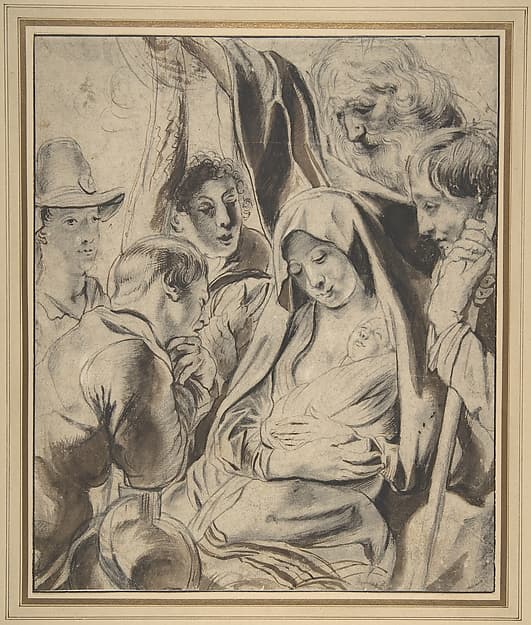
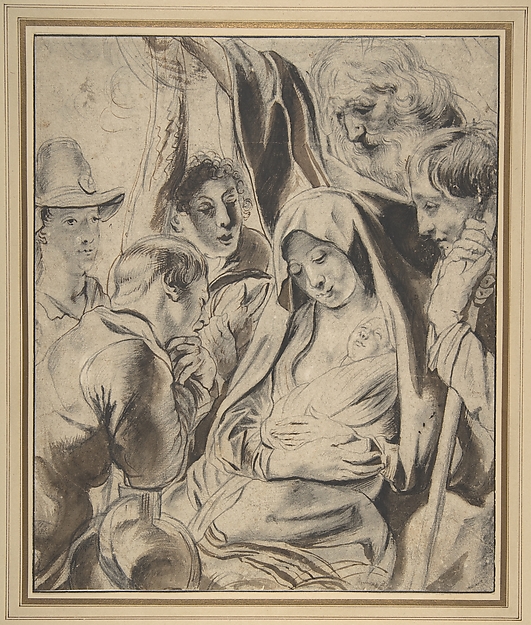
Adoration of the Shepherds, drawn by Jacob Jordaens around 1620 in pen and brown ink with wash on paper and now in the Metropolitan Museum of Art in New York, depicts the moment from Luke 2 in which the shepherds, having heard the angels' announcement of the birth of Christ, arrive at the small dwelling at Bethlehem to find the newborn child laid in the manger. Jordaens stages the scene with characteristic Antwerp-domestic compositional density: the seated Virgin holding the swaddled Christ Child, Joseph waiting behind, three Flemish-peasant shepherds in the foreground in postures of recognition and tender adoration. The drawing demonstrates the rapid confident pen-and-wash technique that Jordaens used as his standard preparatory currency and that the Antwerp post-Rubens generation refined to a high pitch of virtuosity.
met-335629
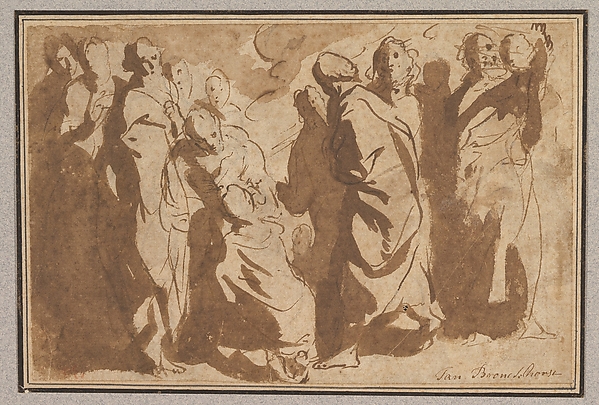
Saint Paul at Lystra, drawn by Jacob Jordaens around 1620 in pen and brown ink with wash on paper and now in the Metropolitan Museum of Art in New York, illustrates the episode from Acts 14 in which the apostles Paul and Barnabas, after the healing of the lame man at Lystra, are mistaken by the Lystrans for the gods Hermes and Zeus and are about to be offered sacrifice — the moment immediately before Paul tears his garments in horrified protest. Jordaens stages the scene with characteristic Antwerp Baroque compositional drama: Paul standing on the right gesturing in protest, the priest with the sacrificial bull in the foreground, the assembled crowd of Lystrans in postures of curiosity and devotion. The drawing demonstrates Jordaens's characteristic ability to compress a complex multi-figure narrative composition into a small preparatory format.
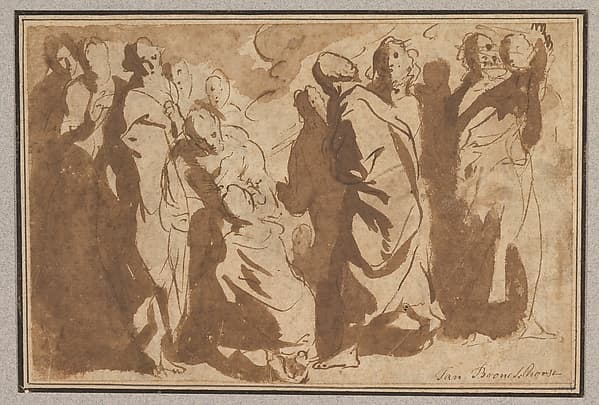
Christ Healing the Paralytic, etched by Jacob Jordaens around 1616 in his Antwerp workshop, illustrates the Gospel episode from Mark 2 in which Christ heals the paralytic man let down through the roof of the house in Capernaum. Jordaens stages the scene as a dense Antwerp Baroque interior composition: Christ standing in the center of the room with his right arm extended in command, the paralytic on his stretcher in the foreground in the act of rising, the four friends who had let him down through the roof visible at the upper register, the assembled crowd of disciples and Pharisees gathered around in postures of attentive observation. The print belongs to the relatively small body of original Jordaens etchings and demonstrates his ability to translate his characteristic painterly Baroque manner into the engraved devotional format.
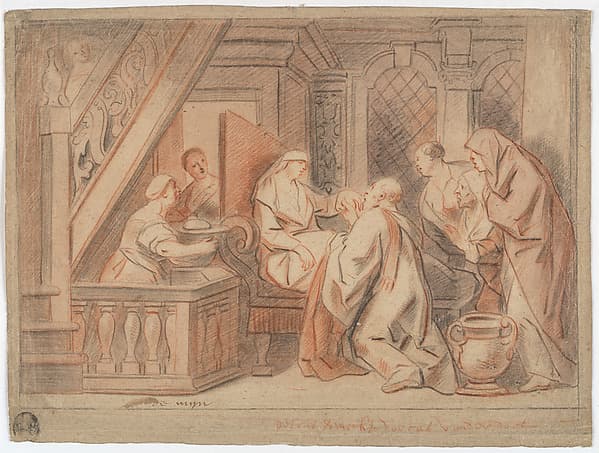
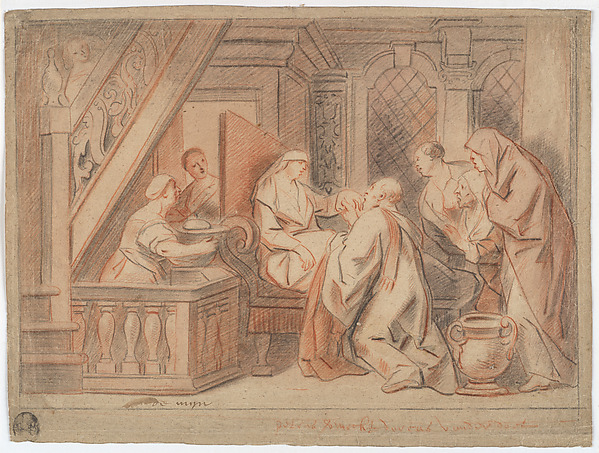
Dorcas Raised From the Dead by Saint Peter
Dorcas Raised From the Dead by Saint Peter, drawn by Jacob Jordaens around 1667 in his late Antwerp workshop in pen and brown ink with wash on paper and now in the Metropolitan Museum of Art in New York, illustrates the episode from Acts 9 in which the apostle Peter, summoned to the bedside of the dead Dorcas (also called Tabitha) at Joppa, raises her from the dead in answer to the prayers of the Joppan widows. Jordaens stages the scene as a tender domestic encounter: Peter standing on the right with his right arm extended in command, Dorcas in the bed in the act of rising, the assembled widows gathered around in postures of grief and astonishment. The drawing belongs to the late Jordaens output and demonstrates the continued vigor of his draftsmanship into his final decade.