Painter of the Bible
Jacopo Bassano (Jacopo da Ponte)
Jacopo Bassano — born Jacopo dal Ponte in Bassano del Grappa around 1510, taking his professional name from his hometown — was a Venetian Renaissance painter who worked outside Venice in the Veneto countryside and develo…

Their faith
Why Jacopo Bassano (Jacopo da Ponte) painted Christ
Jacopo Bassano, born Jacopo dal Ponte, was an Italian painter deeply rooted in his Christian faith. His upbringing in a devout family and training under his father, Francesco the Elder, instilled in him a reverence for sacred subjects. Bassano's artistic journey was marked by a commitment to translating biblical narratives into the familiar context of rural life in the Veneto countryside. This unique approach not only reflected his personal devotion but also made the divine accessible to the everyday viewer. His works often depict scenes of Christ's life and the stories of the Bible, showcasing his belief in the importance of faith in daily life. The warmth of his palette and the intimacy of his subjects invite viewers to experience the sacred in a relatable manner, demonstrating how scripture can inform and enrich our understanding of the world around us.
Bassano's faith profoundly influenced his artistic vision, as seen in masterpieces such as "The Adoration of the Shepherds" and "The Way to Calvary." In these works, he masterfully integrates biblical events with pastoral elements, placing holy figures amidst the familiar landscapes of his homeland. This blend of the sacred and the everyday not only highlights the universality of Christ's message but also reflects Bassano's desire to connect the divine with the lives of ordinary people. His characteristic style, with its earthy tones and detailed depictions of rural life, serves as a testament to his belief that the divine can be found in the simplicity of daily existence. Through his art, Bassano continues to inspire viewers, reminding them of the beauty and accessibility of faith in their own lives.
Life & work
Jacopo Bassano — born Jacopo dal Ponte in Bassano del Grappa around 1510, taking his professional name from his hometown — was a Venetian Renaissance painter who worked outside Venice in the Veneto countryside and developed an unmistakable rural-pastoral religious manner that filled the late-sixteenth-century Venetian market and shaped the entire Bassano family workshop, which his sons Francesco, Leandro, Giambattista, and Gerolamo carried into the seventeenth century. Trained in his father Francesco the Elder's workshop and then briefly with the Venetian painter Bonifacio de' Pitati in Venice, he returned to Bassano del Grappa in his twenties and worked there for almost his entire career. He died in Bassano in 1592.
His Christian religious work is concentrated in altarpieces and devotional panels that translate biblical narrative into the rural-domestic register of the Venetian terra ferma countryside. The Way to Calvary (London, c. 1545), the Adoration of the Shepherds (Hampton Court, c. 1546), the Last Supper (Borghese, c. 1546), the Saints Peter and Paul (Modena), the Annunciation to the Shepherds (Washington), the Two Hunting Dogs (Uffizi — a freestanding fragment from a larger biblical painting), and a long sequence of Old Testament narratives (the Animals Entering the Ark, the Forge of Vulcan transposed as Cain and Abel, the Shepherds in the Fields) anchor the painted reputation.
His characteristic compositional move — a biblical scene set in the foreground of a Veneto rural landscape, with peasants, animals, baskets of vegetables, and household tools accumulated around the central narrative — became the Bassano signature and was repeated, in painted versions, by his sons and the workshop for two generations. The combination of biblical narrative with carefully observed rural genre detail directly anticipated and influenced the seventeenth-century Bolognese genre painting (the Carracci's early peasant scenes) and the Dutch Golden Age combination of religious narrative with everyday domestic observation.
He worked in close collaboration with his sons; many surviving canvases are catalogued under the family name "Bassano" rather than under any single member, and the workshop kept replicating his standard biblical compositions — the Adoration of the Shepherds, the Animals Entering the Ark, the Crossing of the Red Sea — through the 1620s. His personal style — warm earth-tone palette, a particular skill at painting livestock and dogs, and the distinctive Veneto evening light — gave him a place in the late Cinquecento Venetian school as the principal voice of the painted countryside.
Notable works in detail
The Annunciation to the Shepherds
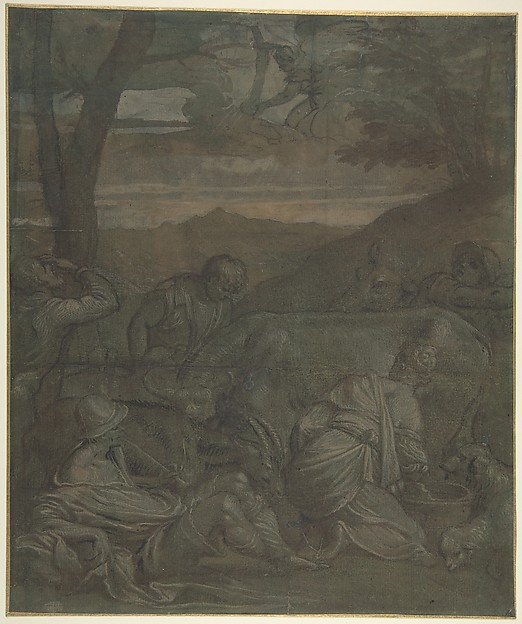
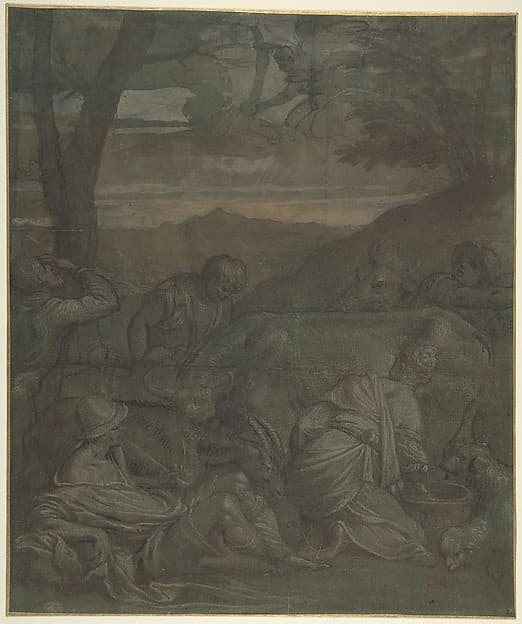
The Annunciation to the Shepherds, painted by Jacopo Bassano around 1510 (the dating is somewhat early — Jacopo was probably born around 1510 himself, and the painting may be slightly later) in oil on canvas and now in the Metropolitan Museum of Art in New York, depicts the moment from Luke 2 in which the angel of the Lord appears to the shepherds in the fields outside Bethlehem to announce the birth of Christ. Bassano stages the scene with characteristic Veneto-rural compositional density: the shepherds in the foreground startled in the act of tending their flocks, the angel descending from the upper left in a luminous burst of light, the small flock of sheep scattered across the night-darkened pasture. The chromatic palette of warm earth tones and dramatic single-source angelic light is the unmistakable Bassano signature.
met-440393
The Baptism of Christ, painted by Jacopo Bassano around 1585 in oil on canvas and now in the Metropolitan Museum of Art in New York, is a late composition from his last decade of work in his hilltown of Bassano del Grappa. The painting depicts the moment from Matthew 3 in which John the Baptist baptizes Christ in the river Jordan: Christ stands waist-deep in the water at the lower center, his hands folded in prayer; the Baptist on the left pours water from a small shell over Christ's head; the Holy Spirit descends as a small dove on a beam of light from the upper register. The chromatic palette and the late-Mannerist compositional handling — figures slightly elongated, the atmosphere thickened with smoke and storm — are characteristic of the late Bassano workshop manner that his sons would continue into the seventeenth century.
met-372543
Christ Appearing to Saint Mary Magdalen (Noli Me Tangere), painted by Jacopo Bassano around 1555 in oil on canvas and now in the Metropolitan Museum of Art in New York, depicts the moment from John 20 in which the risen Christ appears to Mary Magdalene in the garden outside the empty tomb on the morning of the Resurrection. Bassano stages the encounter in a small Veneto-rural landscape with the half-naked risen Christ standing on the right with one hand raised in the gesture of withholding (the moment immediately before he addresses the Magdalene with the Latin words Noli me tangere — Touch me not), and the Magdalene kneeling on the left in profile reaching up toward him with the open ointment jar at her feet. The composition is among the most reproduced Bassano Easter-cycle paintings.
Bible scenes Jacopo Bassano (Jacopo da Ponte) painted
Luke