Painter of the Bible
Jusepe de Ribera (called Lo Spagnoletto)
Jusepe de Ribera, called Lo Spagnoletto (the Little Spaniard) by his Italian contemporaries, was the leading Spanish painter working in Italy in the first half of the seventeenth century and one of the great Caravaggesque masters.

Their faith
Why Jusepe de Ribera (called Lo Spagnoletto) painted Christ
Jusepe de Ribera, known as Lo Spagnoletto, was a deeply devout Christian whose faith permeated his artistic endeavors. Born in 1591 in Játiva, Spain, Ribera trained under the influential painter Francisco Ribalta, who likely instilled in him a reverence for sacred subjects. Moving to Italy in his early twenties, he settled in Naples, a city under Spanish rule, where he became the leading painter of his time. Ribera's commitment to his faith is evident in the sheer volume of his Christian-themed works, which number in the hundreds. His paintings often reflect a profound engagement with scripture, showcasing his dedication to portraying the divine and the human experience of faith. His ability to capture the emotional and spiritual depth of his subjects reveals a man who sought to glorify God through his art, making him a significant figure in the history of religious painting.
Ribera's faith is beautifully illustrated in works such as "The Martyrdom of Saint Philip," where the apostle's suffering is depicted with intense chiaroscuro, a technique inspired by Caravaggio that emphasizes the struggle between light and darkness—symbolic of the Christian journey. In this painting, Ribera not only captures the physical agony of martyrdom but also evokes a sense of spiritual transcendence. Similarly, his portrayal of saints and biblical figures, such as in the "Holy Family" and various martyrdom scenes, showcases his reverence for their sacrifices and divine missions. Ribera's art continues to inspire viewers today, inviting them to reflect on their own faith journeys and the beauty of divine love expressed through sacrifice. His legacy as a painter of profound spiritual significance endures, reminding us of the power of art to connect us with the sacred.
Life & work
Jusepe de Ribera, called Lo Spagnoletto (the Little Spaniard) by his Italian contemporaries, was the leading Spanish painter working in Italy in the first half of the seventeenth century and one of the great Caravaggesque masters. Born in Játiva, near Valencia, in 1591, trained in Spain — almost certainly in the Valencian workshop of the painter Francisco Ribalta — and in Italy by his early twenties, he settled in Naples around 1616 and worked there under successive Spanish viceroys until his death in 1652. Naples was Spanish-ruled at the time, and Ribera's combination of Spanish patronage and Neapolitan production gave him a uniquely double national identity.
His Christian religious work runs to several hundred surviving canvases. The Martyrdom of Saint Philip (Prado, 1639) — for years catalogued as a Saint Bartholomew, then re-identified — shows the apostle bound to a cross, his weight pulling at the ropes, in the dark-light contrasts that came directly from Caravaggio's Roman period. The Bearded Woman (Hospital de Tavera, Toledo, 1631), the Drunken Silenus (Capodimonte, Naples), the Boy with a Clubfoot (Louvre, 1642), and a long sequence of penitent saints, ascetic apostles, and martyrdom scenes — Saint Sebastian, Saint Andrew, Saint Bartholomew, the Magdalene, the Holy Family — fill the great collections of Spain, Naples, and the Vatican.
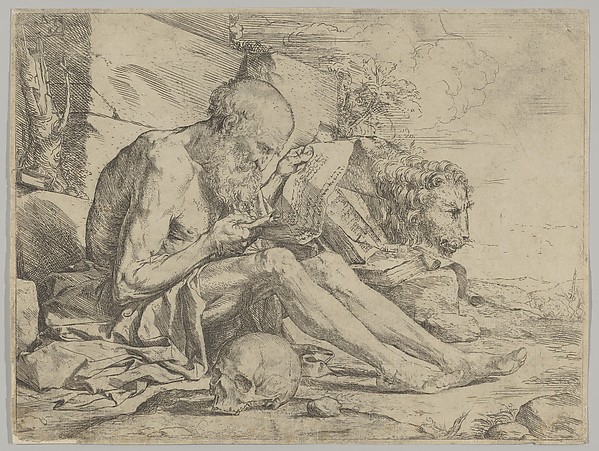
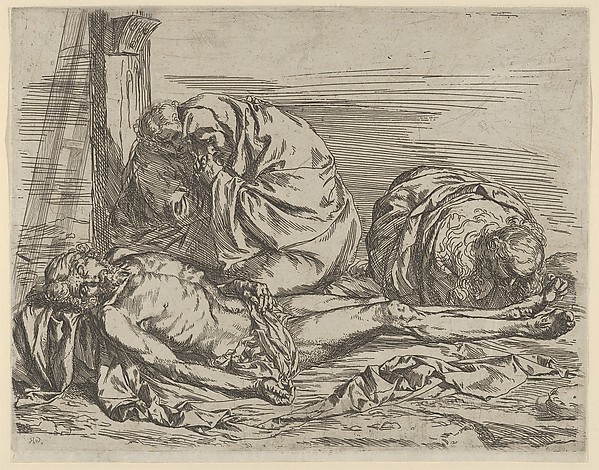
He was equally a major etcher. His suite of religious and mythological etchings of the 1620s and 1630s — the Drunken Silenus, the Saint Jerome, the Crucifixion, the Saint Bartholomew Drawn Up by Two Henchmen — circulated across Europe and brought him commissions and pupils from Madrid to Rome. The strong Caravaggesque chiaroscuro of his etched line was directly studied by Rembrandt in the Netherlands a generation later.
Ribera's late style — broadly brushed, almost monochromatic, with the surface of the paint visibly worked over by the brush — anticipated by a century the painterly freedom that the eighteenth-century Spanish school would develop in Goya's hands. He never returned to Spain. His Spanish viceroyal patrons sent his paintings home in large numbers, and the Spanish royal collection now holds the largest single body of his work, in the Prado.
Notable works in detail
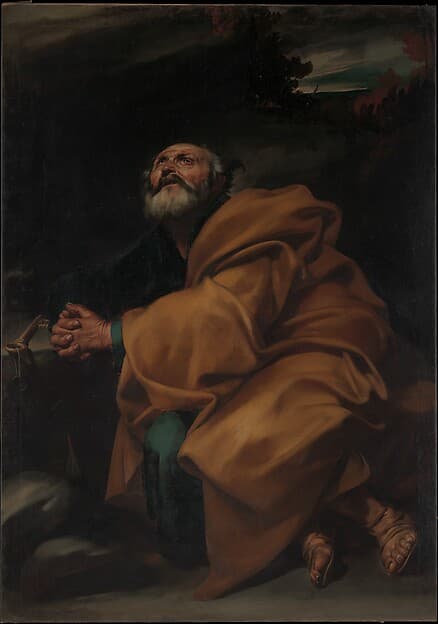
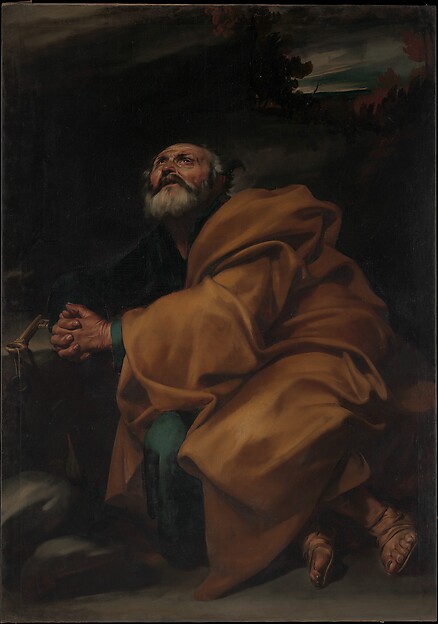
The Tears of Saint Peter, painted by Jusepe de Ribera around 1612 in oil on canvas and now in the Metropolitan Museum of Art in New York, depicts the apostle Peter in the moment of his repentance after the threefold denial of Christ recorded in the Synoptic Gospels. Ribera shows the saint in three-quarter view, his eyes lifted heavenward, tears streaming down his cheeks, his clasped hands raised in supplication; the dark neutral background and the dramatic single-source raking light from the upper left are the unmistakable signatures of Ribera's early Caravaggesque manner. The Tears of Saint Peter was a particular preoccupation of seventeenth-century Counter-Reformation devotional painting — the subject combined the intimacy of personal penitence with the Catholic doctrine of the perfectibility of the apostle who had failed his Lord — and Ribera produced multiple painted versions across his career.
met-397952
Saint Jerome Hearing the Trumpet of the Last Judgment, painted by Jusepe de Ribera around 1616 in oil on canvas and now in the Metropolitan Museum of Art in New York, depicts the early Church Father in the conventional iconographic posture of his hermit years in the Syrian desert — half-naked, kneeling on his rocks, with his lion (the saint's iconographic attribute) at his feet — but Ribera adds the dramatic moment in which an angel descends from the upper left blowing the trumpet that announces the Last Judgment. Jerome looks up in startled recognition. The composition is among the most dramatic Ribera treatments of the Jerome subject and demonstrates his characteristic ability to combine the Caravaggesque chiaroscuro with the muscular athletic figural drawing that defined Spanish Baroque religious painting in his Naples years.
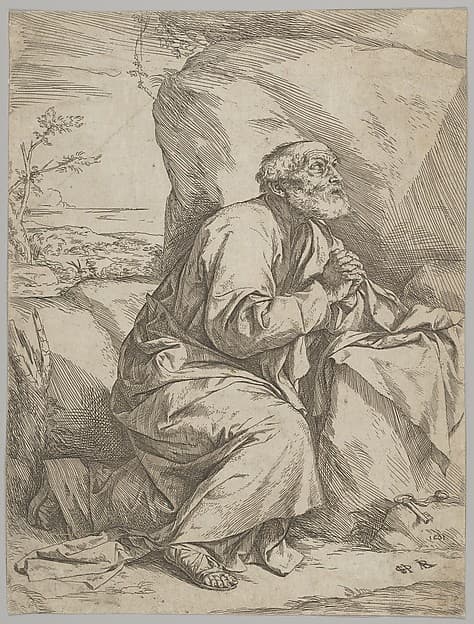
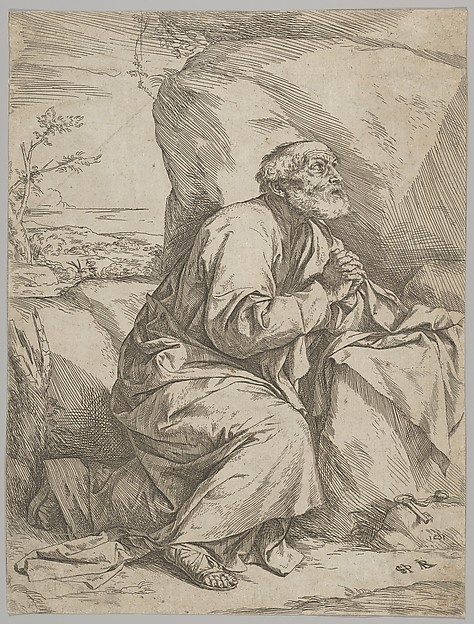
The Penitence of Saint Peter, painted by Jusepe de Ribera around 1621 in oil on canvas and now in the Metropolitan Museum of Art in New York, is a second Ribera treatment of the subject — Peter weeping after his denial of Christ — that he had earlier addressed in the 1612 Tears of Saint Peter. The 1621 version places the apostle in a similar three-quarter pose against a similarly dark neutral background, but the figural anatomy is more confident, the dramatic light is more sharply focused, and the compositional restraint is more austere. Ribera produced multiple versions of penitent-saint subjects across his career — the Magdalene, Jerome, Peter — that, taken together, define the Spanish Baroque devotional preoccupation with public displays of inward repentance and bodily contrition. The painting is one of the principal Ribera Peter subjects in any American collection.
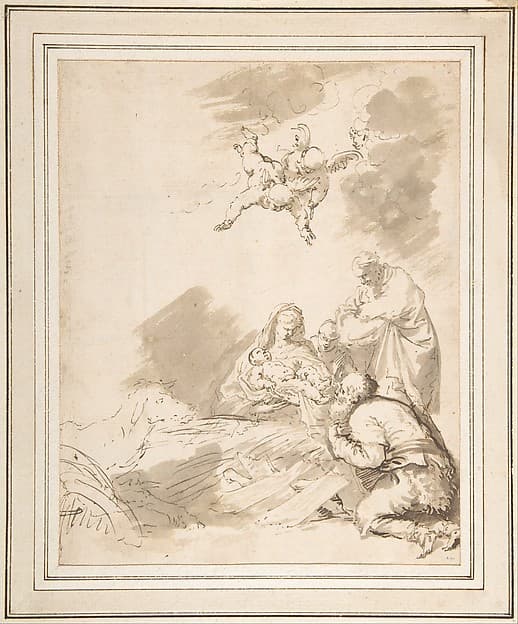
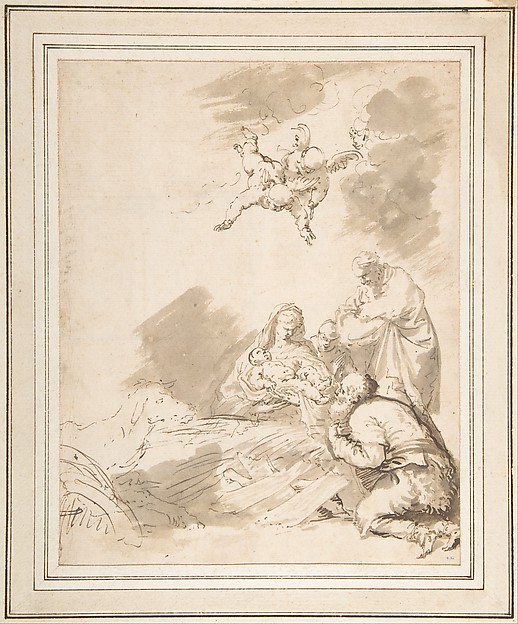
Adoration of the Shepherds, painted by Jusepe de Ribera around 1645 in oil on canvas and now in the Metropolitan Museum of Art in New York, is from the late Naples period of his career, the years after the Spanish viceregal patronage had stabilized his reputation as the city's leading religious painter. The composition shows the Holy Family in the center under a small thatched lean-to, with three Neapolitan-peasant shepherds gathered around the kneeling Virgin in the lower foreground; one shepherd kneels with his cap in his hands, another stands holding a small lamb as a gift, the third lifts up his hands in an attitude of recognition. The chromatic palette of warm earth tones and dramatic single-source candlelight is the unmistakable late-Ribera Naples signature, and the painting is among the principal late Ribera Adorations in any American collection.
Bible scenes Jusepe de Ribera (called Lo Spagnoletto) painted
Luke
Matthew
Romans