Painter of the Bible
Lippo Memmi (Filippo di Memmo)
Lippo Memmi (Filippo di Memmo) was the leading Sienese painter of the generation immediately after Duccio di Buoninsegna and the principal collaborator of his brother-in-law Simone Martini, with whom he produced the most…

Their faith
Why Lippo Memmi (Filippo di Memmo) painted Christ
Lippo Memmi, a prominent figure in the Sienese painting tradition, was deeply rooted in his Christian faith, which profoundly influenced his artistic endeavors. Born into a family of painters, he was trained in the workshop of his father, Memmo di Filippuccio, where he likely absorbed both technical skills and a reverence for sacred subjects. His collaboration with his brother-in-law, Simone Martini, further enriched his spiritual perspective, as they created works that were not only artistically significant but also deeply devotional. Memmi's faith is reflected in his meticulous attention to the spiritual narratives of the Bible, as he sought to convey the divine through his art. His works, characterized by elongated figures, vibrant colors, and gilded backgrounds, embody the Sienese Trecento style, which emphasizes a serene and contemplative approach to religious themes.
One of Memmi's most notable contributions to Christian art is the Annunciation altarpiece, created in collaboration with Simone Martini for the Cathedral of Siena. This work exemplifies his ability to blend beauty with spirituality, inviting viewers into a sacred moment of divine communication. Additionally, his Maestà fresco in San Gimignano showcases his devotion to the Madonna, presenting her in a manner that evokes both reverence and tenderness. Through these works, Memmi not only illustrated biblical stories but also inspired faith in those who beheld them. His legacy continues to resonate, as his devotion to Christ and the beauty of his art invite viewers to experience the divine presence in their own lives.
Life & work
Lippo Memmi (Filippo di Memmo) was the leading Sienese painter of the generation immediately after Duccio di Buoninsegna and the principal collaborator of his brother-in-law Simone Martini, with whom he produced the most reproduced single Sienese Trecento altarpiece — the Annunciation now in the Uffizi. Born in Siena around 1290 to the painter Memmo di Filippuccio (whose workshop he initially trained in), and active in Siena, San Gimignano, and Avignon (where he followed Simone Martini to the papal court in the 1330s) for the rest of his career, he died in Siena around 1356, possibly in the Black Death epidemic that killed a substantial portion of his generation.
His Christian religious work is concentrated in altarpieces, fresco cycles, and devotional Madonnas in the unmistakable Sienese Trecento manner — figures in elongated proportions, jewel-bright color, tooled-gold backgrounds, and the calm devotional sweetness that defined the Sienese school after Duccio. The Annunciation altarpiece (Uffizi, 1333 — painted in collaboration with his brother-in-law Simone Martini for the Cathedral of Siena, with Lippo Memmi traditionally credited as the painter of the side panels of Saints Ansanus and Margaret of Antioch), the Maestà fresco in the Palazzo Comunale of San Gimignano (1317 — directly influenced by Simone Martini's slightly earlier Maestà in the Palazzo Pubblico of Siena), the polyptych panels for the Servite church in Siena, and the small devotional Madonnas now in the Pinacoteca Nazionale of Siena, the Berlin Gemäldegalerie, and various American collections, fill the painted corpus.
His collaboration with Simone Martini was particularly close and (in the case of the Uffizi Annunciation) so intertwined that scholars still debate the exact division of labor between the two painters on the surviving panels. After Simone's death in Avignon in 1344 Lippo Memmi returned to Siena and continued to produce altarpieces in the standard Sienese workshop format until his own death in the city around 1356.
His son Federico Memmi continued the workshop briefly after his death, but the major Memmi tradition was carried forward not by his immediate family but by the next Sienese generation of the Lorenzetti brothers, Bartolo di Fredi, and Sano di Pietro who absorbed the Sienese late-medieval-into-Renaissance vocabulary directly from his and Simone Martini's example.
Notable works in detail
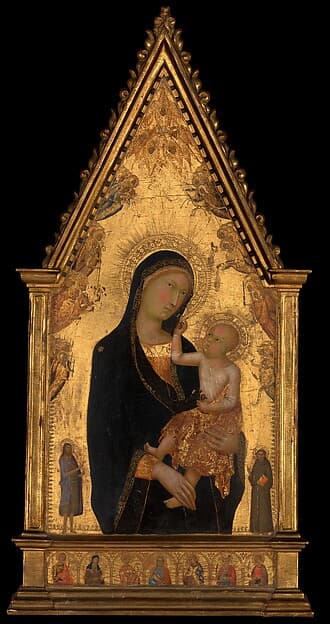
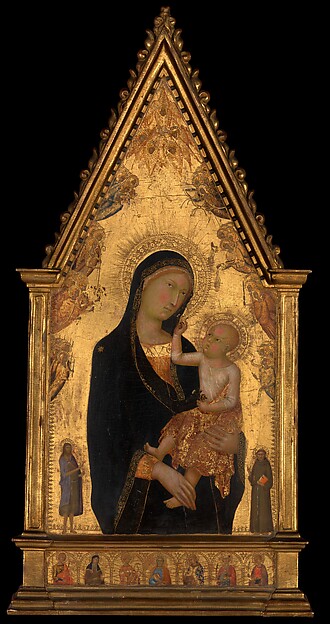
Madonna and Child with Saints and Angels
Madonna and Child with Saints and Angels, painted by Lippo Memmi around 1345 in tempera and gold on panel and now in the Metropolitan Museum of Art in New York, is one of the late Memmi sacra conversazione altarpieces from his final Sienese workshop years after his return from the Avignon papal court. The Virgin sits enthroned with the standing Christ Child upright on her lap; attendant saints and small attending angels stand on either side of the throne against the unmistakable Sienese Trecento tooled-gold background. The chromatic palette of saturated crimson, ultramarine, and tooled gold is characteristic of the late Memmi workshop manner, and the elongated figural proportions and calm devotional faces demonstrate his close stylistic relationship to his lifelong collaborator and brother-in-law Simone Martini.
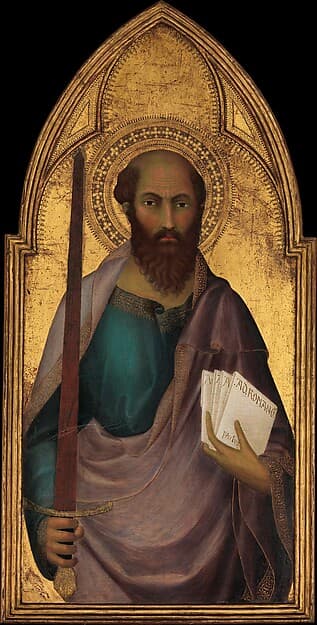
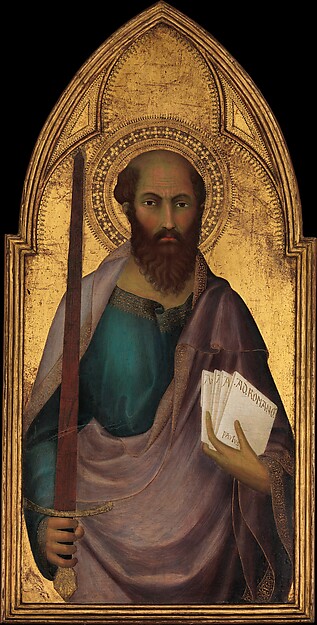
Saint Paul, painted by Lippo Memmi around 1325 in tempera and gold on panel and now in the Metropolitan Museum of Art in New York, is a small panel from one of the larger Memmi polyptychs of his early-mature Sienese workshop years. The painting shows Paul standing in three-quarter view holding a small book and a sword (the iconographic attributes of his apostolic teaching and his eventual martyrdom by beheading); the chromatic palette of saturated rose, ultramarine, and tooled gold against the patterned gold-tooled background is the unmistakable early Memmi signature. The panel was originally part of one of the standard Sienese Trecento polyptych altarpiece structures with the Virgin and Christ Child at the center and individual saints in the side panels.
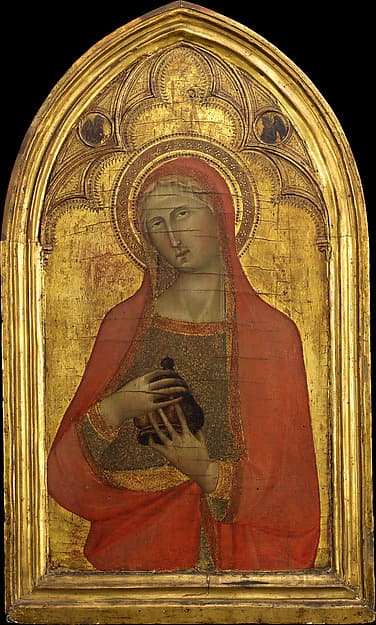
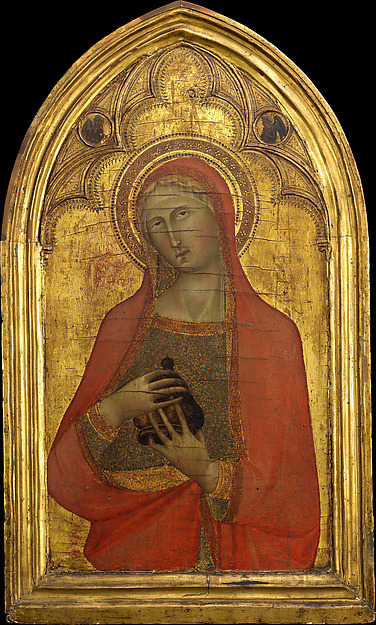
Saint Mary Magdalen, painted by Lippo Memmi around 1336 in tempera and gold on panel and now in the Metropolitan Museum of Art in New York, is another small panel from one of his Sienese polyptychs. The painting shows the Magdalene standing in three-quarter view holding her ointment jar (the iconographic attribute that distinguishes her from any other female saint and that refers to the Gospel episode of her anointing of Christ's feet); the chromatic palette and the tooled-gold background are characteristic of the mid-career Memmi manner. The panel belongs to the same polyptych structure as the Saint Peter panel of the same date now also in the Metropolitan.
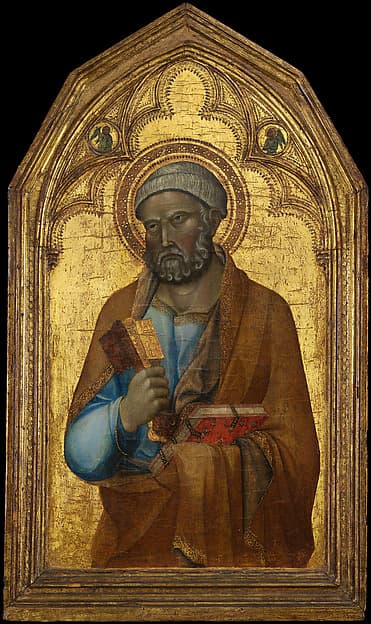
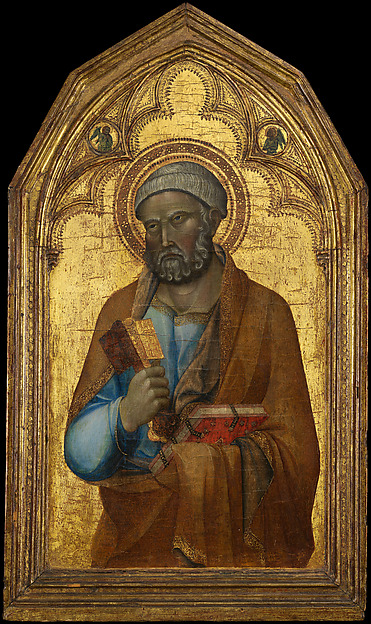
Saint Peter, painted by Lippo Memmi around 1336 in tempera and gold on panel and now in the Metropolitan Museum of Art in New York, is a small panel from the same Sienese polyptych as the Saint Mary Magdalen panel of the same date. The painting shows Peter standing in three-quarter view holding the keys of the kingdom and a small book — the iconographic attributes of his apostolic primacy and his role as the first leader of the early Church. The chromatic palette of saturated rose, ultramarine, and tooled gold against the patterned gold-tooled background is the unmistakable mid-career Memmi Sienese workshop signature.