Painter of the Bible
Nicolas Poussin
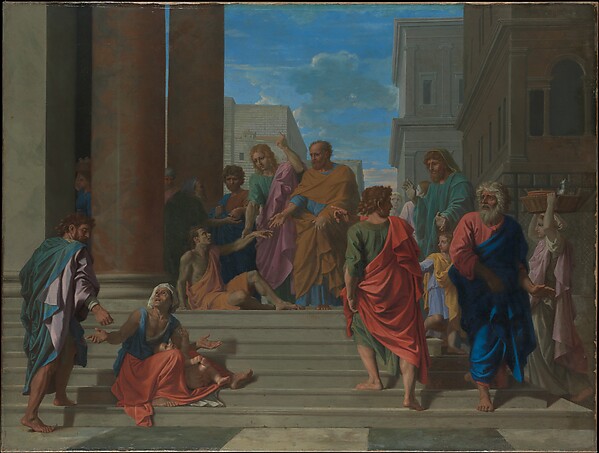
Nicolas Poussin spent forty of his sixty-six years in Rome and produced there the founding body of French Classicism.

Their faith
Why Nicolas Poussin painted Christ
Nicolas Poussin was deeply influenced by his Christian faith throughout his life, which is evident in his dedication to biblical themes and narratives. Settling in Rome, he immersed himself in the rich tradition of Christian art, drawing inspiration from scripture and the teachings of the Church. Poussin's approach to painting was methodical and reflective, often engaging with the theological implications of the scenes he depicted. His correspondence with patrons, especially Cassiano dal Pozzo, reveals a commitment to historical accuracy and a desire to convey the spiritual significance of the biblical stories he portrayed. This devotion to his craft and faith is reflected in the meticulous detail and reverence found in his works.
Poussin's faith profoundly shaped his artistic vision, particularly in his biblical paintings. For instance, his series on the Seven Sacraments showcases his understanding of the essential rites of the Christian faith, presented in a way that invites contemplation and reverence. Similarly, his Old Testament cycles, such as the Crossing of the Red Sea and the Israelites Gathering Manna, blend narrative and landscape to create a meditative experience for viewers. These works not only demonstrate his technical skill but also serve as a testament to his spiritual journey, inviting viewers to engage with the divine. Poussin's legacy continues to inspire, as his devotion to Christ and the beauty of scripture resonates through his art, encouraging all who encounter his paintings to reflect on their own faith journeys.
Life & work
Nicolas Poussin spent forty of his sixty-six years in Rome and produced there the founding body of French Classicism. Born in Normandy in 1594, trained in Paris, settled in Rome from 1624 — apart from a difficult eighteen-month return to Paris on a royal commission from Cardinal Richelieu in 1640–42 — he painted easel pictures, mostly for a small circle of erudite Roman and Parisian patrons, until his death in 1665. His most important early supporter was Cassiano dal Pozzo, the Roman antiquarian and amateur archaeologist whose paper museum of ancient monuments shaped Poussin's habits of historical accuracy.
His biblical work is methodical, restrained, and saturated with references. He painted the Seven Sacraments twice — first for dal Pozzo in the late 1630s, then again for Paul Fréart de Chantelou in 1644–48 — laying out Eucharist, Penance, Baptism, Confirmation, Ordination, Marriage, and Extreme Unction as discrete tableau-vivants in archaeologically reconstructed early-Christian settings. The second set, which left France with the Earl of Rutland in the eighteenth century, now hangs in the Scottish National Gallery in Edinburgh.
His Old Testament cycles include the Crossing of the Red Sea (Melbourne, with the pendant Adoration of the Golden Calf in London), the Israelites Gathering Manna (Louvre), the Plague at Ashdod (Louvre), the Finding of Moses (multiple versions), and the four-painting Seasons (Louvre, 1660–64), each of which folds an Old or New Testament narrative — Adam and Eve in Spring, Ruth and Boaz in Summer, the Spies returning from Canaan in Autumn, the Flood in Winter — into a meditative landscape.
He wrote no treatise, but his letters to Chantelou contain his theory of the painter's "modes" — Dorian, Phrygian, Lydian, Hypolydian, Ionic — borrowed loosely from Greek music theory and applied to picture composition. The doctrine influenced French academic teaching for two centuries.
By the late nineteenth century Poussin was the painter Cézanne quoted as wanting "to do over from nature." He is buried in the Roman church of San Lorenzo in Lucina, where Chantelou's circle erected his monument.
Bible scenes Nicolas Poussin painted
Acts