- Starting price
- Free, then ~$10/yr Premium
- Free tier
- Yes
- Platforms
- iOS · Android
- Developer
- St. Mary & Archangel Michael Coptic Orthodox Church (Houston)
- Launched
- 2012
- Updated
- May 25, 2026
The verdict
Coptic Reader is the de facto standard for Coptic Orthodox prayer and liturgy on a phone. If you are Coptic Orthodox - or attending a Coptic liturgy and want to follow along - this is the one to install. For everyone else, it is the clearest window into a tradition most apps ignore entirely.
Try Coptic Reader ↗Opens copticreader.com
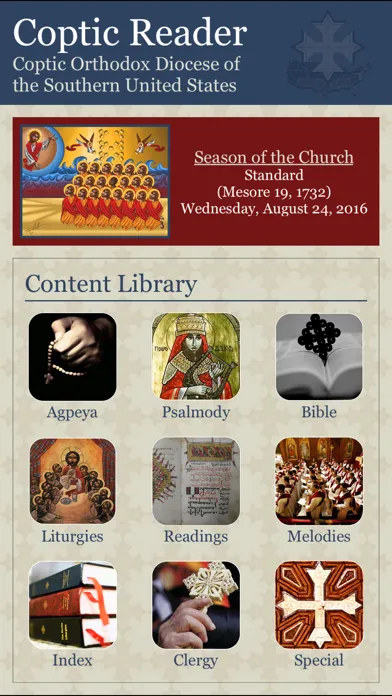
Coptic Reader has quietly become the single app every Coptic Orthodox household keeps installed. Walk into a Coptic Orthodox parish on a Sunday morning and you will see it on phones in every pew - deacons following the responses, teenagers tracking the priest in English while their grandparents read the same prayers in Arabic, visitors squinting at the Coptic script and then sliding over to the parallel column. It is, in a very practical sense, the prayer book of an entire diaspora.
It is not a Bible reading app. It is not a meditation app. It is not a generic "Christian app" with a denominational skin. Coptic Reader is the digital version of a very specific physical object: the layered, multilingual service books that Coptic Orthodox priests, deacons, and congregants have used for centuries. The whole point of the app is that those books - the Khulagy, the Agpeya, the Synaxarion, the Coptic Bible - are now in your pocket, indexed by date, and synced to the liturgical calendar.
It is also free at its core, with a small Premium tier (around $10/year) that unlocks extras like additional hymn audio, presentation mode, and some of the deeper reference content. The base experience - full liturgy of St. Basil, full Agpeya, full Synaxarion, the Coptic Bible - costs nothing. That pricing model is part of why the app has become near-universal in the Coptic community: the parish does not need a license, the family does not need a subscription, and a kid serving as a deacon for the first time can just download it on the way to church.
✓ The good
- Official Coptic Orthodox app - built by clergy and liturgists, used and endorsed across Coptic dioceses worldwide
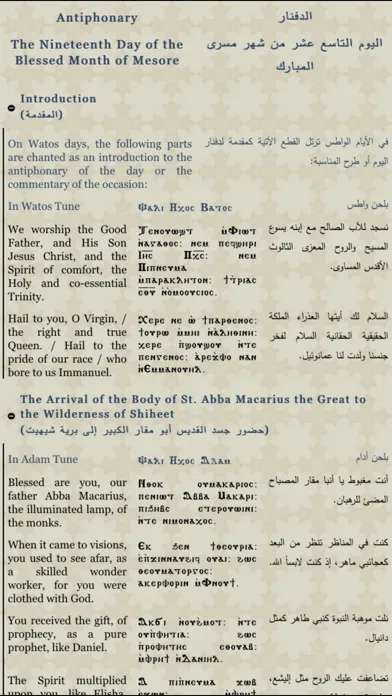
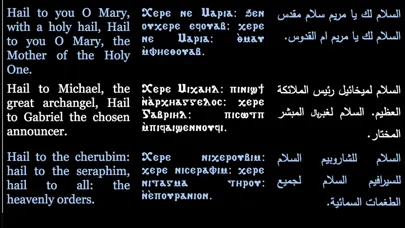
- Three-language parallel display - Coptic, Arabic, and English shown side by side, the single biggest reason this app exists
- Full liturgical content out of the box - Liturgy of St. Basil, St. Gregory, and St. Cyril, plus the Agpeya (Hours) and the Synaxarion
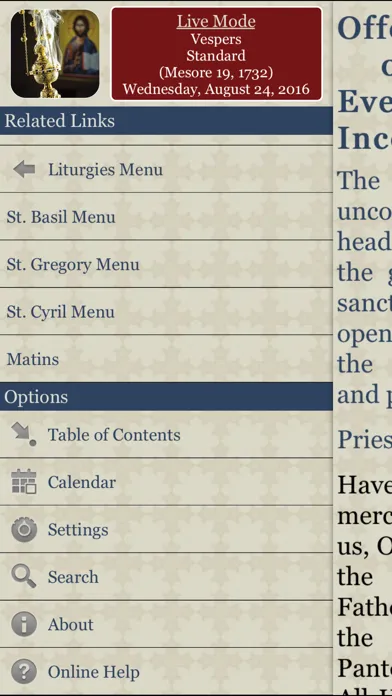
- Date-aware service generation - the app builds the correct service for today automatically, including the right readings, doxologies, and commemorations
- Coptic Bible included - the Bohairic Coptic text with parallel English and Arabic, a resource that is genuinely hard to find anywhere else
- Hymns and tunes - recorded chant for many of the responses, useful for deacons learning the cantillation
- Free at the core - the full liturgy, Hours, Bible, and Synaxarion cost nothing; Premium only adds extras
✗ Watch out
- Coptic Orthodox only - this is not a pan-Orthodox app; Greek, Russian, Antiochian, and other Eastern Orthodox traditions are not served here
- No web version - iOS and Android only, no desktop or browser access for study at a laptop
- Steep first-time learning curve - the app mirrors the structure of physical Coptic service books, which assumes you already know roughly how a Coptic liturgy is organized
- Sparse general Bible-study features - no cross-references, concordance, or commentary in the way a YouVersion or Olive Tree user would expect
- English typography is functional rather than beautiful - the app is built for liturgical use, not for leisurely reading
- Updates can be heavy - feast-day content and corrections roll out as full updates, which on older devices can feel slow
Best for
- Coptic Orthodox laypeople, deacons, and clergy
- Visitors attending a Coptic Orthodox liturgy who want to follow along
- Coptic diaspora families balancing English-speaking kids and Arabic-speaking grandparents
- Anyone curious about Oriental Orthodox liturgy or the Bohairic Coptic biblical text
Avoid if
- You want a general-purpose Bible reading app - try YouVersion or Olive Tree
- You are Eastern Orthodox (Greek, Russian, Antiochian, OCA) - Daily Readings or OrthoPrax fit better
- You want Catholic or Protestant liturgical content - this app does not include either
- You need desktop or web access for sermon prep or study at a computer
What Coptic Reader is
Coptic Reader is the official mobile prayer book and service guide of the Coptic Orthodox Church. The Coptic Orthodox Church is one of the Oriental Orthodox churches - a tradition distinct from Eastern Orthodox bodies like the Greek, Russian, or Antiochian churches, and distinct again from Roman Catholic and Protestant traditions. Its liturgical life centers on the Divine Liturgies of St. Basil, St. Gregory, and St. Cyril, the seven Hours of the Agpeya, and the daily commemoration of saints from the Synaxarion. The app exists to put all of that into your hands in the language you actually pray in.
Practically, the app generates the right service for the right day. Open it on the Feast of the Nativity and it produces the Nativity liturgy with the correct hymns, readings, and commemorations. Open it during the Fast of the Apostles and the Hours and propers shift accordingly. The user does not have to assemble the service from scratch - the calendar does that work, the way a printed annual liturgical guide would, but updated automatically.
Why the Coptic community keeps Coptic Reader installed
The single biggest practical difference between Coptic Reader and any general Christian app is the parallel language display. In a typical Coptic Orthodox parish in North America, Europe, or Australia, the congregation includes immigrants who pray most fluently in Arabic, second-generation kids who think in English, and a smaller core that can actually read the Coptic. The priest moves between all three. Coptic Reader shows them at the same time - Coptic on one side, Arabic in the middle, English on the other - so a fifteen-year-old serving as a deacon can read the response in English while still seeing the Coptic original his grandfather grew up with.
This sounds like a small thing. In practice it is transformative. It is the difference between a community whose language is fading in the next generation and a community whose teenagers can actually participate in the service the way their parents did. The app is loved not because it is technically impressive - it is workmanlike - but because it solved a real, urgent problem for an entire diaspora.
Multi-language liturgy display: the differentiator
Every major service in the app - the three Divine Liturgies, the Hours, the Psalmody, the rites for baptism, marriage, and the departed - can be rendered with up to three languages shown at once. Coptic appears in its own Coptic script (with optional transliteration), Arabic appears in Arabic script, and English appears in a clean modern translation. The user can toggle which languages display, reorder the columns, and adjust font sizes per language. Long responses wrap across the columns so that the Coptic, Arabic, and English of the same line stay visually aligned.
In practical use, this is the feature that makes the app indispensable. A deacon chanting the response can keep his eyes on the Coptic while a visiting friend follows the English in the same paragraph. A grandmother who never learned to read Coptic fluently can rest in the Arabic. The priest can call out a verse number and the entire congregation, in three different languages, is reading the same line at the same time. No general-purpose Bible app does this - because no general-purpose Bible app was built around a community whose liturgy is genuinely trilingual.
The Coptic Bible and the Synaxarion: the reference engine
Coptic Reader includes a full Coptic Orthodox Bible, with the Bohairic Coptic text in parallel with English and Arabic translations. The canon follows Coptic Orthodox usage, which includes books some other traditions categorize as deuterocanonical or apocryphal. Readings are linked to the liturgical calendar - when the app generates today's liturgy, the assigned Pauline, Catholic, Acts, and Gospel readings appear in line, in whichever languages the user has enabled, so the congregation never has to flip to a separate Bible to follow along.
Alongside the Bible is the Synaxarion - the Coptic Orthodox book of saints, with a commemoration for every day of the Coptic year. Open the app on a given date and the saints commemorated that day appear with a short life of each: the third-century martyrs, the desert fathers, the bishops and ascetics whose feast days shape the rhythm of Coptic spirituality. For someone outside the tradition, this is also the clearest single window into how Oriental Orthodox Christianity actually remembers its history - not as a list of doctrines but as a calendar of human lives.
The Agpeya: the Hours in your pocket
The Agpeya is the Coptic book of the Hours - seven daily prayer services keyed to roughly First Hour (morning), Third, Sixth, Ninth, Eleventh (Vespers), Twelfth (Compline), and the Midnight Praise. Each Hour follows a fixed structure of psalms, a gospel reading, short prayers, and concluding petitions. Coptic Reader builds the right Hour automatically based on the time of day, the season of the liturgical year, and whether you are in a fast. The user opens the app, taps the current Hour, and the entire service is laid out - in whichever languages they choose - ready to pray.
This is the feature most Coptic laypeople actually use day-to-day, more often than the Sunday liturgy view. A commuter prays the Third Hour on the train. A mother prays the Sixth Hour after lunch. A teenager prays Compline before bed. The Hours are short - most take five to fifteen minutes - and the app removes every friction point: no flipping through a paperback Agpeya, no working out which season modifies which response. The Hours are simply there, in your language, ready when you are.
Pricing
Free
Free
Full Liturgy of St. Basil, the Agpeya (Hours), the Synaxarion, the Coptic Bible in three languages, and the standard hymn and tune library. This is what most users will ever need.
Premium
~$10/year
Adds extended hymn audio, presentation mode for projecting in church or Sunday school, and additional reference content. A small, optional support tier - not a paywall in front of the core liturgy.
Donations
Optional
In-app donations to the developing parish that maintains the project. Treated as supporting ongoing work, not unlocking features.
The free tier is the real product. Full Liturgy of St. Basil, the Agpeya, the Synaxarion, the Coptic Bible, and the core hymn library all cost nothing. Most Coptic Orthodox users will never need to upgrade.
Premium runs around $10 a year and exists more as a way to support the developing parish than as a paywall. It adds extended hymn audio (helpful for deacons learning unfamiliar tunes), a presentation mode for projecting in a Sunday school classroom, and some additional reference material. None of it is required to participate in the liturgy.
There is no per-user license, no parish license, no enterprise tier - a parish can simply tell every member to install the app, and that is the entire deployment plan. For a community where the operating logic is "we are a family, not a customer base", this matters.
Compared with Hallow at around $70 a year or Logos at hundreds to thousands one-time, Coptic Reader is essentially uncosted. The Premium tier is the cost of a coffee per year, and only if you want to be generous.
Where Coptic Reader falls behind
No web or desktop version. The app is iOS and Android only. If you want to study at a laptop, copy text into a sermon, or project from a desktop in a parish hall, you are working around the lack of a desktop client. For a tool that is fundamentally a service book, that is defensible - but it is a real gap for clergy doing prep work.
No general Bible-study layer. There are no cross-references, no concordance, no commentary notes, no original-language word studies in the way a Logos or Olive Tree user would expect. The Coptic Bible is there to be read and prayed, not dissected. Users who want serious exegetical tooling will need a second app - Logos, Accordance, or Blue Letter Bible - alongside Coptic Reader.
Limited search. You can find services by date and prayers by name, but full-text search across the whole library is not the app's strong suit. Finding a specific phrase across the Hours, the liturgy, and the Bible is harder than it should be.
Steep onboarding for outsiders. The app assumes you already know roughly how a Coptic service is structured - what the Offering of Incense is, what the Psalmody does, how the Lectionary maps to the year. For a Coptic teenager who has grown up in the church, that knowledge is in the water. For a visitor or convert, the first few opens of the app can be disorienting. Some in-app onboarding for newcomers would be welcome.
English typography is purely functional. The app is built for liturgical use, not aesthetic reading. The English translation is clear and accurate, but the typesetting will not delight anyone who loves a beautifully set page the way ESV.org or the printed Saint John's Bible do.
Coptic Reader vs. Daily Readings (Greek Orthodox) vs. OrthoPrax
Different traditions, different apps. Coptic Reader serves the Coptic Orthodox Church - an Oriental Orthodox body. Daily Readings is the Greek Orthodox Archdiocese of America's app, serving the Eastern Orthodox tradition. OrthoPrax is a third-party Eastern Orthodox calendar and prayer companion used across multiple Eastern Orthodox jurisdictions. Oriental Orthodox and Eastern Orthodox are two distinct communions, with different liturgies, different calendars, and different historical trajectories - so these apps are not really substitutes for one another.
Different strengths. Coptic Reader is better at trilingual liturgical participation - the Coptic, Arabic, English parallel is unmatched and is the entire reason a Coptic family installs it. Daily Readings is broader for an Eastern Orthodox user: it integrates the daily lectionary, saints, fasting rules, and a small audio library across the Greek Orthodox calendar, with a clean modern UI. OrthoPrax is more configurable across Eastern Orthodox jurisdictions, with multiple calendars (Old Calendar, New Calendar) and richer customization, but a steeper learning curve.
How to choose. If you are Coptic Orthodox or Ethiopian, Eritrean, Syriac, or another Oriental Orthodox tradition, Coptic Reader (and its sister apps) is the obvious starting point. If you are Greek, Antiochian, OCA, Romanian, Bulgarian, or any other Eastern Orthodox jurisdiction, Daily Readings or OrthoPrax is the better fit. Visitors and inquirers should install whichever app matches the parish they are actually visiting - the apps are not interchangeable.
The bottom line
Coptic Reader is the rare app that almost perfectly serves its intended community and makes no apology for not serving anyone else. For Coptic Orthodox laypeople, deacons, and clergy, it is the standard - the trilingual liturgy, the date-aware Hours, the Synaxarion, and the Coptic Bible all in one free app are exactly what a tradition with a global diaspora needs. For Catholic, Protestant, Eastern Orthodox, or LDS readers, it is a fascinating window into a tradition that most apps simply ignore. Either way, the app has earned its near-universal install rate in Coptic homes - and a 4.7.
Alternatives to Coptic Reader
 OCAThe Orthodox Church in America's official site, with the daily lectionary, saints of the day, and a substantial reading library. Eastern Orthodox in tradition; web-first rather than app-first.OrthoChristianA large Eastern Orthodox news and spiritual reading site, with articles, saints' lives, and homilies across multiple Eastern Orthodox jurisdictions. Reading-room companion, not a service book.
 HallowPremium guided audio prayer app, shaped primarily by Catholic spirituality. Different tradition, different format - but the closest equivalent if what you want is daily prayer audio rather than a service book.
Frequently asked questions
Is Coptic Reader free?
Yes. The full Liturgy of St. Basil, the Agpeya, the Synaxarion, the Coptic Bible in three languages, and the standard hymn library are all free. A small Premium tier (around $10/year) adds extras like extended hymn audio and a presentation mode, but the core experience does not require any payment.
What tradition is Coptic Reader?
Coptic Reader is the official app of the Coptic Orthodox Church, which belongs to the Oriental Orthodox communion. Oriental Orthodox is a distinct tradition from Eastern Orthodox (Greek, Russian, Antiochian, OCA), Roman Catholic, and Protestant traditions. The app's content - liturgy, calendar, lectionary, saints - is shaped entirely by Coptic Orthodox practice.
Will Coptic Reader work for a Greek or Russian Orthodox user?
Not really. The Coptic liturgy, calendar, and Synaxarion are distinct from those used by Eastern Orthodox jurisdictions. Greek Orthodox users tend to use Daily Readings (the GOARCH app), and pan-jurisdiction Eastern Orthodox users often use OrthoPrax. Coptic Reader is the right app specifically for Coptic Orthodox (and is also useful as a window into the tradition for visitors).
Does it include a full Bible?
Yes. The app includes the Coptic Orthodox Bible - the Bohairic Coptic text with parallel English and Arabic translations. The canon follows Coptic Orthodox usage. Readings assigned by the liturgical calendar appear in line with the relevant service, so the user does not have to flip between apps.
Can I follow a Coptic liturgy as a visitor with no Coptic Orthodox background?
Yes, with patience. Set the language display to English (or English plus whichever other language helps you), open the app on a Sunday morning, and tap the current liturgy. The service will be laid out roughly in the order it unfolds. The first time can feel disorienting because Coptic liturgy assumes a structure most non-Coptic Christians are unfamiliar with - but the parallel English makes it followable.
Is there a web version?
No. Coptic Reader is iOS and Android only. There is no desktop client and no browser version, which is the app's main missing feature for clergy doing study or sermon prep at a laptop.
Who maintains Coptic Reader?
The app is developed and maintained by St. Mary and Archangel Michael Coptic Orthodox Church in Houston, in coordination with the broader Coptic Orthodox Church. It is treated as an official church resource rather than a third-party project, which is part of why it has become near-universal across Coptic parishes worldwide.
Sources & further reading
More Orthodox Christian Apps
 Patristic NectarA remarkably deep, donation-supported Orthodox audio library makes patristic teaching, saints, Scripture, and catechesis easy to hear—while clearly serving one tradition rather than pretending to be neutral.Daily Readings (GOARCH)The official daily companion of the Greek Orthodox Archdiocese of America - today’s appointed readings, the saints commemorated, the fasting rule, and a small library of prayers, all keyed to the Orthodox calendar and given away for free.OrthoPraxA daily-practice companion for the Eastern Orthodox Christian - a prayer book, the liturgical calendar with its feasts and fasts, the lives of the saints, and a library of icons, gathered into one freemium app.English Orthodox PrayersA focused digital prayer book that gathers the prayers of the Eastern Orthodox tradition in English - morning and evening prayers, the prayers around communion, akathists and canons, and prayers for various needs - in one free app.Pray Always!An Eastern Orthodox prayer companion whose name echoes “pray without ceasing” - a structured prayer rule, the Jesus Prayer, the daily prayers, and the liturgical calendar, gathered into one free app to help a daily rhythm of prayer take hold.
 B1 ChurchA genuinely free, open-source church platform - app, website, giving and check-in on one database - run by an Oklahoma nonprofit. The catch is not the price - it is that the vendor own docs call the native app deprecated.