
- Starting price
- Free
- Free tier
- Yes
- Platforms
- iOS · Android · Web
- Developer
- Fr. Paolo Padrini
- Launched
- 2009
- Updated
- May 24, 2026
The verdict
iBreviary is the closest thing to an official Liturgy of the Hours app - completely free, multilingual, and stocked with the texts a priest actually carries: the Office, the Roman Missal, and the full ritual book. The interface looks like it was designed in 2012 and largely still is. For anyone praying the Hours daily, that trade is easy.
Try iBreviary ↗Opens ibreviary.org
iBreviary has quietly become the default Liturgy of the Hours app in the pockets of Catholic priests, deacons, religious, and laypeople who pray the Office every day. It was built in 2009 by Fr. Paolo Padrini, an Italian priest, with backing from the Pontifical Council for Social Communications, and it carries the air of something semi-official - even though it is not technically a Vatican product. The app is free. There are no ads. There is no upsell tier. The texts are simply there, every morning, in the language you choose, on the day the Church is actually praying them.
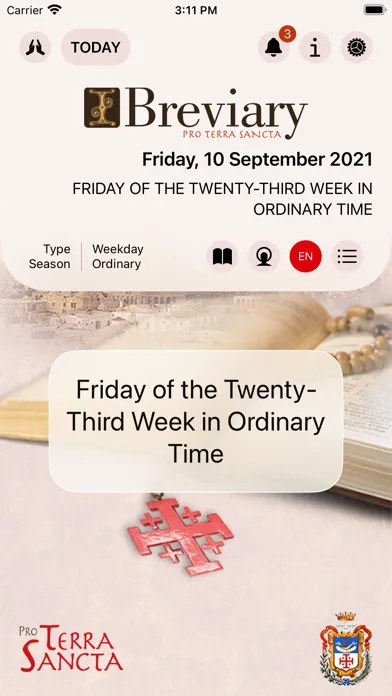
It doesn't try to be a devotional aggregator. It doesn't try to gamify prayer. It doesn't try to sell you a meditation library. It opens to today's date, shows you the Office of Readings, Lauds, the Office during the Day, Vespers, and Compline, and gets out of the way. The Roman Missal sits one tap away with the day's Mass propers. A separate tab carries the rituals - Baptism, Confirmation, Marriage, Anointing of the Sick, Funerals, and the full Book of Blessings - which is why so many priests keep it on the home screen as a working tool, not just a prayer companion.
The reason iBreviary feels different from the slick Catholic apps that have launched in the last few years is that it was built for the breviary, not for the App Store. The design is utilitarian. The typography is plain. There is no audio narration of the Hours, no soundtrack, no celebrity voice. What you get instead is correctness, completeness, and the kind of multilingual reach - English, Latin, Spanish, Italian, French, Portuguese - that no competing app comes close to matching.
✓ The good
- Completely free with no ads, no subscription, no in-app purchases - unusual for an app of this scope
- Full Liturgy of the Hours in English, Latin, Spanish, Italian, French, and Portuguese, with each language switchable per Hour
- Roman Missal with the day's Mass propers, including the full Order of Mass and seasonal prefaces
- Pro tab with the full sacramental rituals - Baptism, Marriage, Anointing of the Sick, Funerals, and the Book of Blessings
- Vatican publications and select papal documents available inline, refreshed regularly
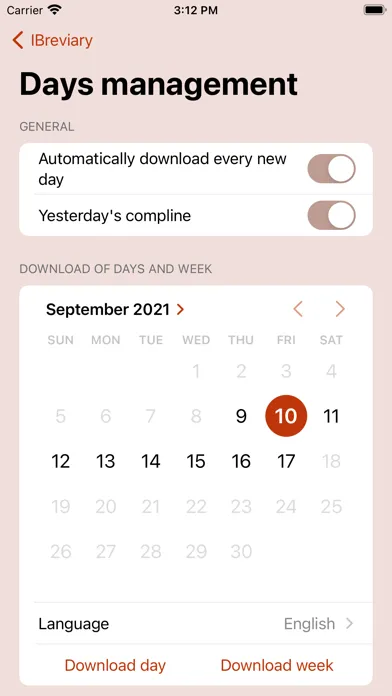
- Works offline once today's texts are downloaded - usable in a sacristy, hospital room, or anywhere signal is patchy
- Same texts and structure used by clergy worldwide, so a layperson praying along is genuinely on the same page
✗ Watch out
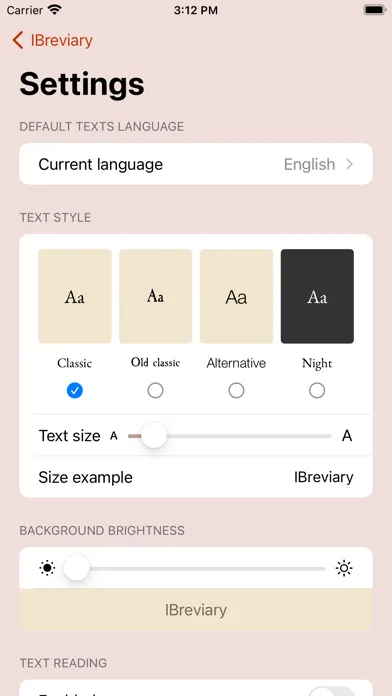
- Interface looks dated - circa-2012 lists, small tap targets, occasional layout quirks
- No audio narration of any Hour (yet) - everything is read on screen
- No reading-streak, journaling, or community features that the newer Catholic apps lean on
- Onboarding is thin - new users have to figure out the Office structure (Invitatory, hymn, psalmody, reading, intercessions) without much in-app guidance
- Search across the app is limited; finding a specific blessing or ritual sometimes means scrolling
- Notifications for the Hours exist but are basic compared to dedicated prayer apps
Best for
- Priests, deacons, and religious obligated to pray the Office
- Laypeople committed to praying the Liturgy of the Hours daily
- Multilingual clergy or seminarians who switch between English, Latin, Spanish, Italian, French, or Portuguese
- Anyone who wants the same texts the universal Church is praying today, with no editorial framing
Avoid if
- You want guided, audio-led prayer with music and narration
- You prefer a modern, polished UI with onboarding and progress tracking
- You want a single app that also handles meditation, sleep stories, and devotionals
- You are brand new to the Liturgy of the Hours and need someone to walk you through how it works before you can pray it
What iBreviary is
iBreviary is a free mobile and web app that delivers the Liturgy of the Hours, the Roman Missal, the Catholic sacramental rituals, and a curated set of Vatican publications, automatically configured to today's date in the liturgical calendar. The texts follow the post-Vatican II reformed Office and the current edition of the Roman Missal, with English, Latin, Spanish, Italian, French, and Portuguese available as parallel languages a user can switch between at any time.
It was developed by Fr. Paolo Padrini, a priest of the Diocese of Tortona, Italy, and launched in 2009 with technical collaboration from Italian developers and the support of the Pontifical Council for Social Communications. The app is available on iOS, Android, and the web at ibreviary.org, with the same content across all three. There is no paid tier - the project is supported by donations and goodwill rather than a subscription.
Why daily Office prayers prefer iBreviary
The single biggest practical difference between iBreviary and almost every other Catholic app is that it was built by a priest, for the people who pray the Office every day, and it has never tried to be anything else. When you open the app at 6:00 a.m., you do not get a splash screen, a streak counter, or a suggested meditation. You get the Invitatory psalm for today, in the language you set last week, ready to pray.
That restraint is the whole product. The Hours are correct. The Mass propers match what is being celebrated at every parish using the Roman Rite that day. The rituals are the actual ritual books, not summaries. For a priest anointing someone in a hospital, or a deacon presiding at a graveside, or a layperson committing to pray Vespers each evening, the question is not 'is this nicer than Hallow.' The question is 'does it have the right text, today, in my language, offline if I need it.' iBreviary answers yes to all four - which is why it has stayed on so many home screens for so long.
The Liturgy of the Hours in six languages plus Latin
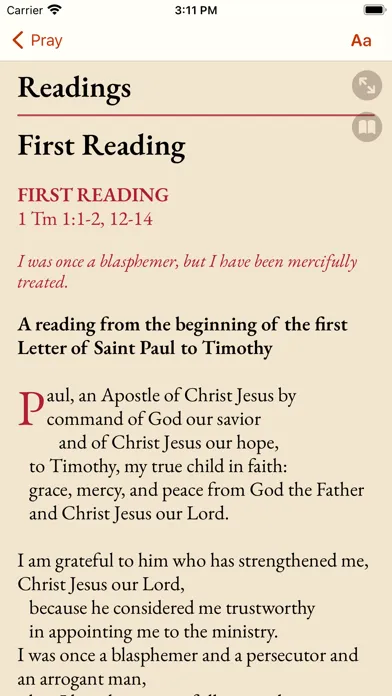
The core of iBreviary is the full Liturgy of the Hours - Office of Readings, Morning Prayer (Lauds), Daytime Prayer (Terce, Sext, None), Evening Prayer (Vespers), and Night Prayer (Compline) - generated for today's date in the liturgical calendar. The proper antiphons, psalmody, scripture readings, patristic or hagiographical second readings, hymns, intercessions, and collects are all pulled from the approved current editions. The Office of Readings on a saint's day shows the patristic reading appointed for that saint; the Sunday Office cycles correctly through the four-week psalter and the proper of seasons.
What makes the Hours feature distinctive is the language switching. A bilingual user can pray Lauds in English and Vespers in Spanish on the same day without changing any settings - each Hour has its own language picker at the top. Latin is fully available alongside the vernaculars, which matters for religious communities that pray the Office in choir in Latin, for seminarians studying the texts, and for laypeople who want to pray Compline in Latin even if they pray the rest of the Office in their native tongue. English, Latin, Spanish, Italian, French, and Portuguese are all present, and the texts in each language are the approved liturgical editions for that language area, not informal translations.
Roman Missal and rituals: the priest-grade content
Tap the Missal tab and iBreviary loads today's Mass - the entrance antiphon, collect, first reading, responsorial psalm, second reading where applicable, Gospel acclamation, Gospel, prayer over the offerings, preface, communion antiphon, and prayer after communion - for whichever rank of feast the day actually carries. The full Order of Mass is there, including the four main Eucharistic Prayers, the Eucharistic Prayers for various needs, the prefaces, and the optional elements (sprinkling rite, prayer of the faithful templates). A celebrant who forgets the booklet at the sacristy door can run Mass from the app and not miss a word.
Then there is the Pro tab - the part of iBreviary that explains why it shows up in so many clergy backpacks. It contains the actual rituals: the Order of Baptism of Children, the rites of Confirmation and Marriage, the Pastoral Care of the Sick (visits, communion of the sick, anointing, viaticum, commendation of the dying), the Order of Christian Funerals, and the full Book of Blessings - house, vehicle, religious article, expectant mother, sick child, new ministry, the whole catalog. A deacon prepping a baptism, a priest called to an emergency anointing, a chaplain at a funeral home - these are the exact texts they need, formatted to be read aloud from a phone screen if the printed book is not at hand. No other free app carries this content at this depth.
Multilingual breadth that no competitor matches
Most Catholic prayer apps ship in English first, add Spanish later, and stop there. iBreviary launched in Italian and English simultaneously and has expanded steadily ever since - currently English, Latin, Spanish, Italian, French, and Portuguese for the Liturgy of the Hours and the Missal, with several of the rituals available in multiple languages as well. The language is not a UI overlay; it is the actual liturgical text in that language, as approved by the relevant bishops' conferences.
This matters more than it sounds. A Brazilian seminarian studying in Rome can pray Vespers in Portuguese alongside his community praying it in Italian, both reading from the same app, both on the same psalmody. A bilingual parish team in the United States can run an English Mass in the morning and a Spanish Mass in the evening from a single device. A traveling priest can pray the Office in Latin all week and switch to French for a wedding on Saturday. For multilingual Catholic life - which is most Catholic life worldwide - iBreviary is the only mobile tool that handles all of it natively.
Pricing
iBreviary
Free
The entire app - Liturgy of the Hours in six languages plus Latin, Roman Missal, the Pro ritual tab, Vatican texts. No tiers, no ads, no in-app purchases.
iBreviary is free. There is no premium tier, no subscription, no in-app purchase, no advertising, and no upsell screen. Every feature listed in this review is included for every user on day one.
The project is supported by donations through the iBreviary website and by the personal work of Fr. Padrini and the small team around him. If the app is part of your daily prayer, the donate link on ibreviary.org is the right place to say thank you - and the only commercial relationship the app will ever ask you to enter.
For an app that carries the full Liturgy of the Hours, the Roman Missal, and the sacramental rituals in seven languages, the free model is genuinely unusual. Most apps with a fraction of this content sit behind a paywall. Most users do not need to consider any other plan, because there is no other plan.
Where iBreviary falls behind
No audio narration of the Hours. Every other major Catholic prayer app - Hallow, Laudate's add-ons, the Magnificat app - offers some form of recorded or AI-voiced narration for at least part of the Office. iBreviary is text-only. For users who pray in the car, on a walk, or with tired eyes at the end of the day, this is a real limitation, and it is the single most common complaint in the reviews.
Dated interface. The visual design has been refreshed incrementally rather than rebuilt, and it shows. Lists are dense, tap targets are small, and the navigation between Hours, Missal, Pro, and Vatican texts is functional but not elegant. Compared to the design polish of Hallow or the Ascension App, iBreviary looks like what it is - a working tool maintained by a priest, not a venture-funded startup.
Thin onboarding for newcomers. The app assumes you already know what the Liturgy of the Hours is, how the Invitatory works, when to add the Te Deum, and how the four-week psalter cycles. A first-time pray-er can muddle through, but there is no built-in tutorial, no 'pray the Office in 10 minutes' walkthrough, and no explanatory rubrics in plain language. The Word on Fire-style guided introductions live in other apps, not this one.
Limited community and tracking features. There are no streaks, no shared intentions, no journaling, no friend feeds, and no way to mark which Hours you have prayed this week. For users motivated by habit-tracking, this is a gap. For users who consider the Office itself the structure, it is not.
Search and discoverability inside the rituals are basic. Finding a specific blessing in the Book of Blessings - say, the blessing of an expectant mother - usually means scrolling rather than searching. A priest who knows the structure can navigate fast; a layperson hunting for a particular text may need patience.
iBreviary vs. Laudate vs. Magnificat
All three are go-to apps for serious Catholic users, and they solve overlapping but different problems. iBreviary is the Office and the priest-grade liturgical books in seven languages, free, no frills. Laudate is the Swiss Army knife - Hours, Mass readings, rosary, chaplets, examination of conscience, Stations of the Cross, the Catechism, a calendar of saints, and dozens of other small tools in one free app, with a famously busy menu and the same dated look as iBreviary. Magnificat is the digital edition of the long-running Magnificat monthly prayer booklet - beautifully designed, paid subscription, with the daily Mass readings, a shortened Morning and Evening Prayer (not the full Liturgy of the Hours), meditations, and saint biographies in a curated, magazine-style layout.
Different strengths. iBreviary is better at the full Office and the rituals - it is the only one of the three carrying the sacramental ritual books in this depth, and the multilingual coverage is unmatched. Laudate is broader - if you want one app that has every Catholic prayer practice in it, this is the one, though no single component is best-in-class. Magnificat is more curated - if you want a daily devotional experience with the Mass readings and a shortened Office, written and edited by a known team, and you do not mind paying for a subscription, it is the most beautiful of the three.
Most Office-praying Catholics end up with iBreviary as the primary tool and either Laudate or Hallow installed alongside for the things iBreviary deliberately does not do - audio rosaries, guided meditations, examination of conscience prompts, and the like. Clergy almost universally keep iBreviary as the daily driver, because no other app carries the Missal and the rituals at the same level.
The bottom line
iBreviary is the thoughtful person's Liturgy of the Hours app - and, more quietly, the working priest's app for the Missal and the sacramental rituals. It is free, multilingual at a depth no competitor approaches, and it does the boring, important job of putting the correct text of today's prayer on the screen without theatrics. The interface is dated and there is no audio, which are real gaps, but they are worth knowing about going in rather than dealbreakers. If you pray the Office daily, or you carry the rituals as part of your ministry, this app belongs on your home screen.
Alternatives to iBreviary
 LaudateThe all-in-one free Catholic app - Hours, Mass readings, rosary, chaplets, Stations, Catechism, examination of conscience, and dozens of other tools in one cluttered, capable menu.
 HallowThe polished, audio-led Catholic prayer app - guided rosaries, meditations, sleep prayers, and night prayer with name-brand narrators. Subscription-based after a free tier.
 Ascension AppHome of the Bible in a Year and Catechism in a Year podcasts with Fr. Mike Schmitz, plus Ascension's growing library of Catholic studies and prayer content.Ancient FaithThe Orthodox counterpart for daily prayer and reading - podcasts, the Daily Lectionary, prayer book content, and a deep catalog of Orthodox teaching across an app and website.
Frequently asked questions
Is iBreviary really free, with no in-app purchases?
Yes. The full Liturgy of the Hours in all six vernacular languages plus Latin, the Roman Missal, the Pro ritual tab, and the Vatican texts are all available at no cost, with no advertising and no premium upsell. The project is sustained by donations.
Is iBreviary an official Vatican app?
No. It is an independent project by Fr. Paolo Padrini, a priest of the Diocese of Tortona, Italy. It was launched with support from the Pontifical Council for Social Communications and uses the approved liturgical texts, but it is not formally a Vatican publication.
Does iBreviary include the full Liturgy of the Hours or just a shortened version?
The full Office is included - Office of Readings, Morning Prayer, the three Daytime Prayers, Evening Prayer, and Night Prayer - for every day of the liturgical year, with the proper antiphons, psalmody, readings, hymns, and intercessions.
Which languages are supported?
English, Latin, Spanish, Italian, French, and Portuguese for the Liturgy of the Hours and the Roman Missal. Several of the rituals are available in multiple languages as well. Each Hour has its own language picker, so a bilingual user can switch per prayer.
Does iBreviary work offline?
Yes, once the day's texts are downloaded. This is intentional - the app is designed to be usable in sacristies, hospitals, retreat houses, and other places where data signal is unreliable.
Does it have audio narration of the Office?
No. iBreviary is text-only. Users who want audio-led prayer typically pair it with a separate app such as Hallow or Laudate's audio rosaries.
Is iBreviary good for someone brand new to the Liturgy of the Hours?
It is excellent at delivering the texts, but it does not teach the structure. A complete beginner will benefit from reading a short guide to praying the Office first - Sing the Hours, the USCCB explainer, or any introductory book - and then using iBreviary as the daily tool once the rhythm is familiar.
Sources & further reading
More Catholic Apps
 Latria - Bible & CommentariesLatria brings a Catholic Bible, patristic commentary, early Christian writings, councils, Lectio-style reflections, prayers, and a Scriptural Rosary into a quiet offline iPhone library—but source-text documentation, accessibility, export, and its lifetime-price math need closer inspection.
 FioA genuinely useful Catholic audio home that pays creators more and combines podcasts, music, and audiobooks—much smaller than Spotify, but far more intentional about what Catholic listeners can discover.
 Heroic MenA donor-funded Catholic media library built to move men from watching into prayer, friendship, and small groups—generous in content, but muddled across its media and community products.
 Word on Fire InstituteBishop Barron’s Institute combines serious Catholic formation, live seminars, prayer groups, and a large online community for $27 a month—far more than a video library, and priced accordingly.
 FormedThe Augustine Institute’s “Catholic Netflix” is now a much larger formation library—movies, studies, daily reflections, books, audio, parish programs, and children’s content for $99.99 a year or through a sponsoring parish.
 AmenAmen is the Augustine Institute's free Catholic prayer and audio Scripture app, and it is free in the strict sense - no subscription, no in-app purchase list, no locked sessions. The reason to read past the 4.9 rating is what the nonprofit still does not carry.