
- Starting price
- $24.99 one-time (per device) or ~$14.99/yr subscription
- Free tier
- No
- Platforms
- Web · iOS · Android · Kindle · Windows · Mac
- Developer
- Universalis Publishing (Steve van Roode), UK
- Launched
- 1997 (web) · 2010 (iOS)
- Updated
- May 24, 2026
The verdict
Universalis is the gold standard Liturgy of the Hours app for English-speaking Catholics. It is unmatched on offline reliability, calendar accuracy, and breadth of approved scripture translations - and the pay-once-then-yours pricing makes it a rare bargain in the modern app economy.
Try Universalis ↗Opens universalis.com
Universalis has quietly become the favorite of Anglophone Catholic clergy worldwide. Priests, deacons, and seminarians who travel - to retreats, conferences, foreign dioceses, hospital chaplaincies, the back of a parish van on the way to a funeral - overwhelmingly carry it on their phone. It has been around since 1997 as a website, since 2010 as an iOS app, and in that time it has done one thing relentlessly well: deliver the complete Liturgy of the Hours in English on whatever device you happen to have, with or without a network connection.
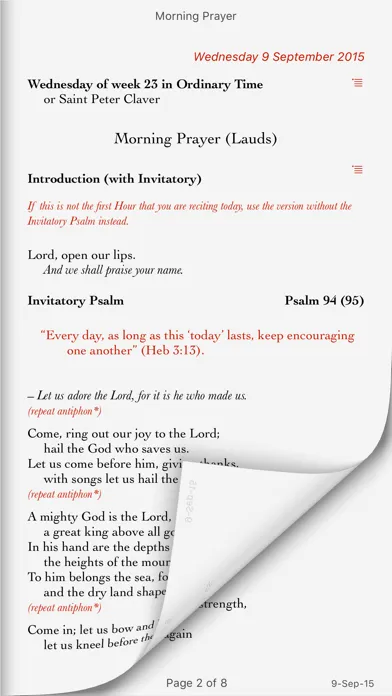
It is not flashy. It does not gamify your prayer life. It does not push notifications about streaks. It does not try to be a Catholic super-app the way some newer entrants do. What it does, instead, is render the Office of Readings, Morning Prayer, Daytime Prayer, Evening Prayer, and Night Prayer for the correct day on the correct calendar, with the correct antiphons, the correct psalter week, and the correct memorials of the saints - and it does so whether you are on a London train, a transatlantic flight, or a retreat house in rural Tanzania with no signal.
The economics are also worth saying out loud, because they are increasingly rare. Universalis on iOS or Android is a single in-app purchase - currently around $24.99 - and after that the app is yours. There is an optional subscription (~$14.99/yr) for users who want it on multiple devices and the web all at once, but most readers will never need it. In a category where every competitor is racing toward $70 to $150 per year, this is the model that respects your work.
✓ The good
- Complete Liturgy of the Hours in English - Office of Readings, Lauds, Daytime, Vespers, and Compline are all there, every day, in full, with no upsell
- Best-in-class offline reliability - once installed, it works on a plane, in a basement chapel, in a foreign country with no SIM card, year after year
- Pay-once-then-yours pricing - the one-time $24.99 in-app purchase remains the cleanest deal in Catholic apps, and most users never need the subscription tier
- Multiple approved Mass-readings translations - including the Jerusalem Bible, RSV-CE, NRSV-CE, NABRE, and the new ESV-CE adopted by several English-speaking conferences
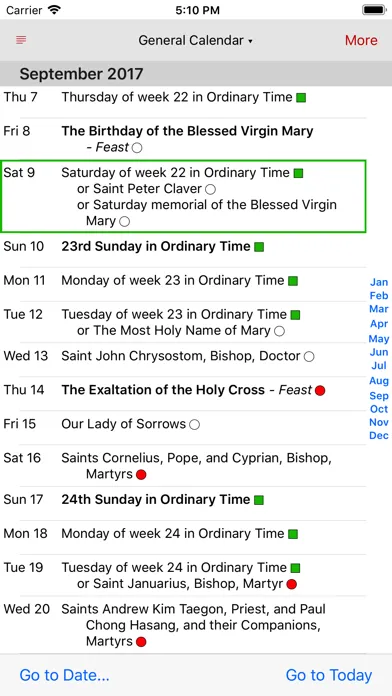
- Calendar precision that clergy actually trust - the right antiphons for the right day, regional calendars for England, Wales, Ireland, Scotland, the US, Australia, and more
- Audio recordings of the Hours and Mass readings (in-app purchase) - useful for commute prayer or readers with low vision
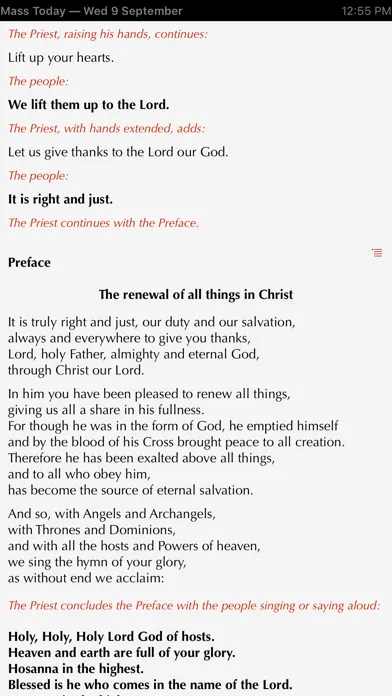
- Lives of the saints, Order of Mass, and a built-in liturgical calendar that work as a quick reference even outside of prayer time
✗ Watch out
- The interface is austere - clean, fast, and readable, but visually closer to a 2014 reference app than a 2026 lifestyle app
- No community, streaks, or social layer - by design, but worth knowing if that is what motivates your prayer
- No guided meditations or commentary - Universalis gives you the texts of the Hours; it does not narrate or explain them
- The one-time purchase is per platform - buying on iOS does not unlock Android (the cross-device subscription exists for exactly this reason)
- No native Spanish, French, Italian, or Latin breviary - Universalis is an English-language project; multilingual users should look at iBreviary
- Visually traditional design will feel dated next to apps like Hallow or Word on Fire - function over form, every time
Best for
- Catholic clergy, religious, and seminarians obligated to pray the Office daily
- Lay Catholics committed to praying any or all of the Hours
- Travelers and missionaries who need a 100% offline breviary
- Anyone who prefers a one-time purchase over a perpetual subscription
Avoid if
- You want a guided, audio-led prayer experience with music and reflections (Hallow fits better)
- You need the Liturgy of the Hours in multiple languages (iBreviary is the move)
- You want a free Catholic prayer app and are willing to live with limits (Laudate)
- You are looking for a daily devotional rather than the formal Divine Office
What Universalis is
Universalis is a Catholic Liturgy of the Hours and daily Mass companion app developed by Steve van Roode and his small UK-based publishing house, Universalis Publishing. The Liturgy of the Hours - also called the Divine Office or the Breviary - is the Catholic Church’s daily cycle of psalms, scripture readings, hymns, antiphons, and prayers prayed at fixed times throughout the day: Office of Readings, Morning Prayer (Lauds), Daytime Prayer, Evening Prayer (Vespers), and Night Prayer (Compline). It is obligatory for clergy and religious and increasingly prayed by lay Catholics.
Universalis provides the full text of every Hour, for every day, in English, with the correct seasonal and saintly variations baked in - plus the daily Mass readings in several Vatican-approved English translations, the Order of Mass, the Catholic liturgical calendar (general and regional), and short biographies of the saints whose feasts fall on each day. It works as a website, an iOS and Android app, a Kindle subscription, and downloadable Windows and Mac apps. The app version is the one most people use.
Why Anglophone clergy default to Universalis
The single biggest practical difference between Universalis and every other Liturgy of the Hours app is that Universalis treats English as a first-class language rather than one option in a multilingual menu. The English text of every Hour is complete, formatted for prayerful reading rather than reference lookup, and includes the regional calendars that most other apps either skip or bury - England and Wales, Scotland, Ireland, the US, Australia, New Zealand, India, and others all have their proper memorials in the right place on the right day.
Combined with the offline-first architecture, this is why Universalis quietly became the working tool of Anglophone clergy. A priest can land in another country, open his phone in airplane mode at the gate, and pray Vespers - correctly - without thinking about it. That is the boring superpower the app has spent nearly thirty years polishing. Nothing else in the category does it as reliably.
Complete English Liturgy of the Hours: the differentiator vs. iBreviary
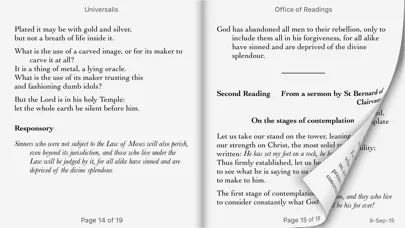
Universalis ships the full Liturgy of the Hours in English - every psalm, every antiphon, every reading, every responsory, every intercession, every concluding prayer - for every day of the liturgical year, including seasonal propers (Advent, Christmas, Lent, Easter), the sanctoral cycle, and the four-week psalter. There is no paywall hiding the Office of Readings behind a premium tier, no abbreviated form for the free user, no "lite" version of Compline. You get the same text a priest would pray from a printed four-volume breviary, formatted for a phone screen.
This is also where the most-asked comparison comes in. iBreviary, the Italian-developed alternative, is famous for its multilingual breadth - Italian, English, French, Spanish, Latin, Romanian, more. Universalis is famous for its English depth. If you pray exclusively in English and want the cleanest, most reliably maintained English text with regional calendars handled well, Universalis is the one. If you switch between languages - say, an English-speaking priest serving a Spanish-speaking parish, or a religious community that prays Latin Lauds - iBreviary will serve you better. Different strengths. Universalis is better at English. iBreviary is broader (Latin, Italian, French, Spanish, more).
Offline reliability: the killer feature for travel, conferences, and chapels with no signal
Once installed and updated, Universalis works entirely offline. The texts for the current liturgical year (and several years forward, depending on settings) are stored locally on the device, so the app does not need to phone home to render Vespers. This sounds like a small thing. In practice it is transformative - and it is the single reason clergy who travel internationally tend to default to Universalis over flashier competitors that require a network connection to load the day’s prayers.
The real-world scenarios are mundane and constant: a priest on a transatlantic flight, a hospital chaplain in a basement room with no signal, a missionary in a region with intermittent data, a retreat house in the mountains, a deacon on a parish bus, a seminarian in a chapel with thick stone walls. In every one of those settings, a subscription app that needs to verify your account before showing today’s Office is a problem. Universalis is not. You opened it once, it downloaded what it needed, and it is ready - for years.
Pay-once-then-yours: the model that respects your work
Universalis on iOS or Android is sold as a single in-app purchase - currently around $24.99 per platform - and after that the app is permanently unlocked on that device, with no recurring fee, no annual renewal, no degraded features over time. Updates to the text, the calendar, and the underlying engine continue to ship for free. This is now genuinely unusual. Most Catholic apps with comparable scope - Hallow, Magnificat, Word on Fire - are subscription products at $50 to $150 per year. The math over a decade is striking.
There is also an optional Universalis subscription (~$14.99/yr) for users who want the app and website unlocked across iOS, Android, web, Kindle, Mac, and Windows on a single account. This is the right call for clergy who genuinely rotate between a phone, a tablet, and a desktop. But most users do not need it. If you pray on one phone, buy the one-time unlock and move on.
Pricing
Universalis Website
Free
The full Liturgy of the Hours and daily Mass readings are readable for free at universalis.com - no login, no paywall, just a browser. Many users start here.
iOS / Android App (one-time)
~$24.99 one-time
Unlocks the full app on a single platform - fully offline, no expiry, no recurring charge. The cleanest deal in Catholic apps.
Universalis Subscription
~$14.99/yr
Cross-device access - iOS, Android, web, Kindle, Windows, Mac all unlocked on one account. Useful for clergy who pray on a phone, tablet, and laptop in the same week.
Audio add-on
~$9.99/yr (in-app)
Optional spoken-word recordings of the Hours and Mass readings. A nice-to-have, not required for the core prayer experience.
The Universalis website is free. Anyone can read the day’s Office and Mass readings at universalis.com without an account, without a login, without a paywall. This is a real public service and a perfectly good way to test whether the texts and the calendar are what you want before spending anything.
The app on iOS or Android is a one-time in-app purchase - currently around $24.99 - and that price is per platform. Buying on iOS does not unlock Android, which is the most common complaint and the precise reason the subscription exists. For users who live on a single device, the one-time unlock is the bestValue tier without question.
The Universalis subscription runs around $14.99/year and unlocks the full app and full website across every supported platform on one account - iOS, Android, web, Kindle, Mac, Windows. Clergy who genuinely use three or more devices in a typical week tend to land here. Everyone else can skip it.
There is also an optional in-app audio package (~$9.99/yr) with spoken-word recordings of the Hours and the Mass readings. Useful for commute prayer, for readers with low vision, or for households who want the Office read aloud while they cook dinner - but entirely optional. The core text experience does not need it.
Where Universalis falls behind
No guided audio prayer experience. Universalis will read the Hours aloud to you (with the paid audio add-on), but it does not produce the kind of guided, reflection-led, music-scored prayer sessions that Hallow has built a category around. If you want a voice walking you through Compline with an ambient pad underneath, Universalis is not that app.
No social, community, or streak layer. There are no friends, no shared reading plans, no badges, no notifications nudging you back. By design - and many users consider this a feature, not a bug - but if external accountability is what gets you to open the app at 6:30 a.m., Universalis will not provide it.
No native non-English breviary. Universalis is a single-language product done extremely well. There is no Spanish, French, Italian, Latin, or Polish text in the app. For multilingual ministries, iBreviary is the obvious sibling tool.
Visually traditional design. The typography is clean and the reading experience is excellent, but the overall look is closer to a well-maintained 2014 reference app than a 2026 lifestyle product. Users coming from Hallow or Word on Fire will notice immediately. Most regular users stop noticing within a week.
No commentary or formation content. Universalis gives you the prayers of the Church; it does not explain them. If you want catechesis on what the Office of Readings is doing, or homiletic notes on the day’s Mass readings, you will need a separate resource - the Catechism, a study Bible, or something like Word on Fire or Magnificat alongside it.
Universalis vs. iBreviary vs. Laudate
These three are the apps most often weighed against each other by Catholics looking for a Liturgy of the Hours tool, and they actually solve different problems. Universalis is the English-language specialist - deepest, most reliably maintained English text, best regional calendar handling, fully offline, pay-once. iBreviary is the multilingual generalist - the Italian-developed, free app with the broadest language support, including Latin, and the one most international religious orders default to. Laudate is the free Catholic super-app - Liturgy of the Hours plus rosary plus chaplets plus Catechism plus saints plus daily Mass plus more, all bundled together at no charge.
Different strengths. Universalis is better at English depth, offline reliability, and the one-time pricing model. iBreviary is broader (Latin, Italian, French, Spanish, Romanian, more). Laudate is broader still in feature scope (rosary, devotions, Catechism, prayers) but thinner on the Office itself and more dependent on a network connection. For an English-speaking Catholic who specifically wants the Divine Office and wants it to work everywhere, Universalis wins. For a Spanish-speaking priest in an English-speaking diocese, iBreviary wins. For a casual Catholic who wants one free app with a little of everything, Laudate is the obvious starting point.
A note on the increasingly common Hallow comparison: Hallow is not really in this category. It is a guided prayer and meditation app that includes some elements of the Liturgy of the Hours, but it is not a complete breviary and is not built to replace one. Clergy and religious obligated to pray the Office will not find Hallow sufficient. Hallow and Universalis are complements, not competitors - many users carry both.
The bottom line
Universalis is the gold standard Liturgy of the Hours app for English-speaking Catholics, and it has earned that reputation by being unflashy, reliable, and fairly priced for nearly thirty years. If you pray the Divine Office in English - daily or aspirationally - the one-time iOS or Android unlock is the easiest yes in Catholic apps. Multilingual users should look at iBreviary; users who want guided audio prayer should look at Hallow; users who want a free general-purpose Catholic app should start with Laudate. For the specific job of putting the complete English breviary in your pocket, nothing else does it as cleanly.
Alternatives to Universalis
 iBreviaryThe free, Italian-developed Liturgy of the Hours app with the broadest language support - including Latin, Italian, French, Spanish, and English. The natural alternative for multilingual users and international religious communities.
 LaudateA free, all-in-one Catholic app bundling the Office, rosary, chaplets, Catechism, daily Mass, and saints. Best as a starter Catholic app for casual users; the Office itself is thinner than Universalis.
 MagnificatThe digital edition of the popular monthly Catholic prayer magazine - daily Mass readings, Morning and Evening Prayer in a simplified form, plus essays and reflections. A devotional companion rather than a full breviary.
 HallowThe leading Catholic guided prayer and meditation app. Excellent for audio-led prayer, Lenten challenges, and celebrity-narrated content - but not a substitute for a complete Liturgy of the Hours.
Frequently asked questions
Is Universalis approved for clergy to fulfill the obligation to pray the Liturgy of the Hours?
Universalis publishes the texts of the Liturgy of the Hours in approved English translations and is widely used by Catholic clergy, religious, and seminarians around the English-speaking world. Whether use of a digital edition satisfies a particular cleric’s obligation is a question for that person’s bishop or religious superior; the texts themselves are the standard approved English versions.
Do I really only pay once?
For the iOS or Android app, yes - the in-app purchase (currently around $24.99) is a one-time charge that unlocks the full app on that device permanently, with free updates. The catch is that the one-time unlock is per platform; buying on iOS does not unlock Android. The optional Universalis subscription (~$14.99/yr) is for users who want all devices and the web on one account.
Does Universalis work offline?
Yes - and famously well. Once installed and updated, the app stores the texts for the current liturgical year (and several years forward depending on your settings) locally on the device. You can pray the full Office on a plane, in a basement chapel, in a foreign country with no SIM card, with no degradation. Offline reliability is the single most-cited reason clergy default to Universalis.
Which English Bible translations are included for the daily Mass readings?
Universalis offers several Vatican-approved English translations for the Mass readings, including the Jerusalem Bible, the RSV Catholic Edition, the NRSV Catholic Edition, the NABRE used in the United States, and the ESV-CE adopted by several English-speaking conferences. You can choose the translation that matches your region or preference in the app settings.
How is Universalis different from iBreviary?
Universalis is the English-language specialist - deepest English text, best regional calendar handling, fully offline, one-time purchase. iBreviary is the multilingual generalist - free, with the broadest language support including Latin, Italian, French, and Spanish, and the default choice for international religious orders. Choose Universalis if you pray exclusively in English; choose iBreviary if you need multiple languages.
Is there an audio version of the Liturgy of the Hours in Universalis?
Yes - there is an optional in-app audio package (currently around $9.99/yr) that provides spoken-word recordings of the Hours and the Mass readings. It is genuinely useful for commute prayer, for readers with low vision, or for households who want the Office read aloud during meals. The core text experience does not require it.
Can I try Universalis before buying the app?
Yes - the Universalis website at universalis.com is free and shows the full Liturgy of the Hours and daily Mass readings for the current day, with no login required. Most users browse the site for a week or two to confirm the texts and calendar match what they want before buying the app.
Sources & further reading
More Catholic Apps
 Latria - Bible & CommentariesLatria brings a Catholic Bible, patristic commentary, early Christian writings, councils, Lectio-style reflections, prayers, and a Scriptural Rosary into a quiet offline iPhone library—but source-text documentation, accessibility, export, and its lifetime-price math need closer inspection.
 FioA genuinely useful Catholic audio home that pays creators more and combines podcasts, music, and audiobooks—much smaller than Spotify, but far more intentional about what Catholic listeners can discover.
 Heroic MenA donor-funded Catholic media library built to move men from watching into prayer, friendship, and small groups—generous in content, but muddled across its media and community products.
 Word on Fire InstituteBishop Barron’s Institute combines serious Catholic formation, live seminars, prayer groups, and a large online community for $27 a month—far more than a video library, and priced accordingly.
 FormedThe Augustine Institute’s “Catholic Netflix” is now a much larger formation library—movies, studies, daily reflections, books, audio, parish programs, and children’s content for $99.99 a year or through a sponsoring parish.
 AmenAmen is the Augustine Institute's free Catholic prayer and audio Scripture app, and it is free in the strict sense - no subscription, no in-app purchase list, no locked sessions. The reason to read past the 4.9 rating is what the nonprofit still does not carry.