
- Starting price
- Free
- Free tier
- Yes
- Platforms
- iOS · Android · Web
- Developer
- Franciscan Media
- Launched
- 2014
- Updated
- May 24, 2026
The verdict
The single most-used English-language "saint of the day" resource - a short biography, a reflection, and a closing prayer, delivered every morning, free, with no upsell.
Try Saint of the Day ↗Opens franciscanmedia.org
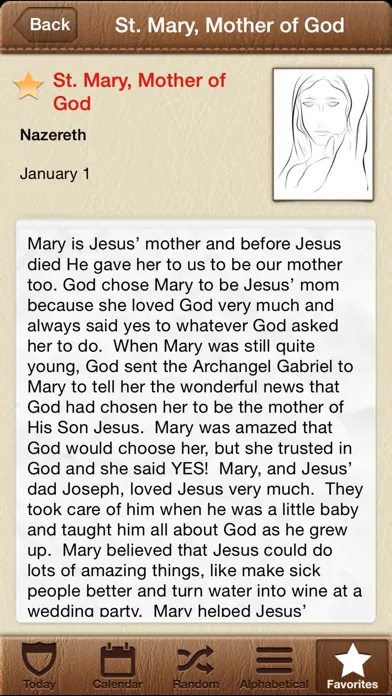
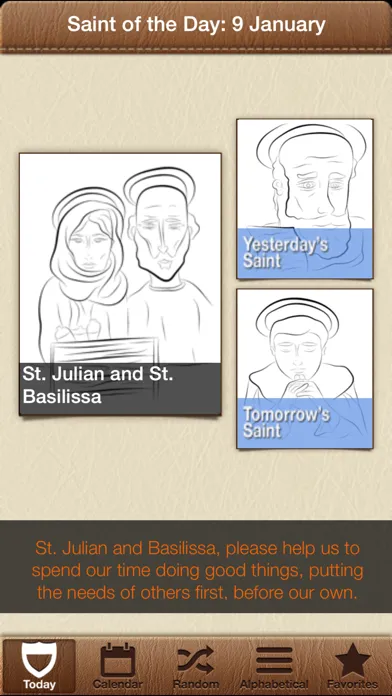
Saint of the Day has quietly become the favorite daily Catholic feature in English. Open the app on May 24 and you get the saint whose feast falls on May 24 - a roughly 300-word biography, a one-paragraph reflection on what their life means for ours, and a short closing prayer or meditation. Tap forward and you get tomorrow. Tap backward and you get yesterday. That is the whole product, and it is the reason Franciscan Media’s little app sits on so many Catholic phones.
It doesn’t try to be a prayer hub. It doesn’t try to be a Liturgy of the Hours breviary. It doesn’t try to be a Catholic streaming service. It is one thing - the daily saint - and the editorial team at Franciscan Media has been doing exactly that one thing in some form since 1973, when the first "Saint of the Day" volume edited by Leonard Foley OFM went into print. The app is the latest delivery channel for a Franciscan tradition that long predates smartphones.
The result is something rare in the Catholic app market: a free utility that actually feels finished. No paywall. No prompts to upgrade. No "premium reflections" locked behind a subscription. You install it, you read 300 words a day, and over a year you absorb a remarkable cross-section of the Church’s memory - desert mothers, medieval mystics, Jesuit martyrs, twentieth-century parish priests, and a steady current of Franciscans the publisher knows particularly well.
✓ The good
- Best-in-class for daily saint formation - the ~300-word format is the right length for a coffee or a commute, not too short to be devotional and not too long to be skipped
- Genuinely free with no upsell - Franciscan Media treats this as ministry, not a funnel, and the app reflects that
- Warm, accessible editorial voice - readable for newcomers without being thin for catechized adults
- Decades-deep archive - every day of the year has a saint loaded, and you can scroll backward or forward through the calendar freely
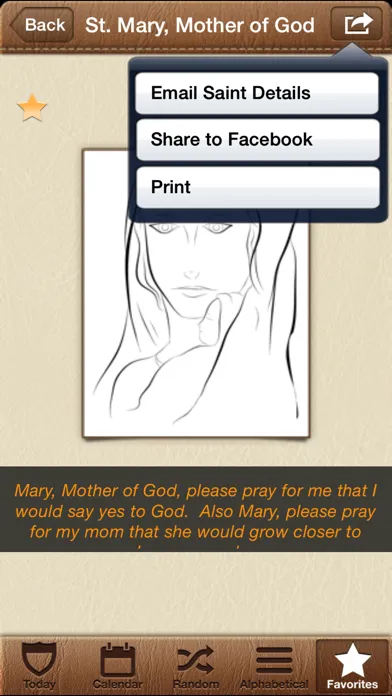
- Closing prayer or reflection on every entry - turns a biography into something you can actually pray with
- Notifications are well-behaved - one gentle morning ping, no engagement-bait re-notifications
- Works as a web page too - the same feature is published daily at franciscanmedia.org for readers who prefer the browser
✗ Watch out
- No audio narration (yet) - every entry is text only, which matters if you wanted to listen on a walk
- Light search and filtering - you can move day to day, but searching by patronage, religious order, or century is limited
- Single-saint-per-day model - on busy feast days the Church remembers several saints, and the app picks one rather than presenting the full slate
- No Liturgy of the Hours, no daily Mass readings - strictly a saint feature, so most users pair it with another app
- Franciscan bias in tone and saint selection - not a flaw, but worth knowing the publisher is OFM-run and Franciscan saints get warm treatment
Best for
- Catholics who want one short daily formation read
- RCIA candidates and recent converts learning the saints
- Catechists looking for a reliable daily classroom hook
- Anyone who likes the rhythm of the liturgical calendar
Avoid if
- You want an all-in-one Catholic prayer hub (try Hallow or Laudate)
- You need the Liturgy of the Hours or daily Mass readings in the same app
- You prefer audio devotionals over reading
- You want a saint resource tied to a specific non-Catholic tradition
What Saint of the Day is
Saint of the Day is a free iOS, Android, and web feature from Franciscan Media - the publishing arm of the Franciscan Friars of the Province of Our Lady of Guadalupe - that surfaces one saint per day, drawn from the Roman calendar and the broader Catholic sanctoral cycle. Each entry runs roughly 300 words and follows the same three-part shape: a short biography of who the saint was, a one-paragraph reflection on what their life still means, and a closing line of prayer or meditation. That structure has been the house format since the print editions of the 1970s.
The app is the digital expression of a much older project. Franciscan Media’s "Saint of the Day" began in print under editor Leonard Foley OFM in 1973, moved onto the web in the 1990s as one of the first Catholic daily features online, and arrived on smartphones in the mid-2010s. Across all three channels the editorial standard has stayed the same - warm, historically grounded, accessible to a person who has never heard the name "Hildegard of Bingen" before, but not so thin that a theologian rolls their eyes.
Why everyday Catholics prefer Saint of the Day
The single biggest practical difference between Saint of the Day and the larger Catholic apps is restraint. Hallow, Laudate, and Magnificat all do far more - Hallow leans into guided audio prayer, Laudate bundles a dozen tools into one shell, Magnificat publishes a monthly missal-style booklet. Saint of the Day does the saint, and only the saint. For a reader who already has a Mass app or a Bible app and just wants a small, consistent daily formation moment, that focus is the whole appeal.
There is also a trust premium. Franciscan Media has been editing this feature, in some form, for over fifty years. The voice is the voice of a religious order with a long publishing tradition - not a startup writing devotional content to fill an app. Catholic readers who care that their daily devotional is published by an identifiable religious community, with editorial oversight by a real religious institute, tend to settle on this one and stop shopping.
The daily saint biography: the ~300-word format that built the franchise
Every entry follows a tight three-beat structure. First, a biography of roughly 200 to 250 words - when and where the saint lived, what shaped them, the work or witness they’re remembered for, and how they died. Second, a one-paragraph reflection that pulls a thread from the biography into the reader’s own life. Third, a short closing prayer or meditation, sometimes drawn from the saint’s own writing, sometimes composed editorially. The whole thing is calibrated to be read in three or four minutes.
That length is the killer feature. Two paragraphs feels devotional but thin. A full-length saint biography is wonderful at a desk and impossible at a bus stop. Three hundred words sits exactly in the gap where a reader can actually keep up daily, every day, for years - which is the point of a sanctoral feature in the first place. The editorial team has held this length steady across print, web, and app, and the consistency is part of what makes the habit stick.
Franciscan Media’s editorial voice: warm, accessible, theological
The house style is unusually balanced for a Catholic publisher. Entries are warm without being saccharine, theologically grounded without academic jargon, and historically careful without disappearing into footnotes. A reader who knows nothing about the Church will not be lost; a reader with a graduate degree in spirituality will not be condescended to. That balance is the result of decades of editorial polishing on the same daily slot.
The voice is also recognizably Franciscan. There is a quiet emphasis on the poor, on creation, on the dignity of small daily fidelities, and - naturally - a slightly higher proportion of Franciscan saints than a non-OFM publisher might include. None of this is hidden. It is, in fact, part of the appeal: readers know they are getting a Franciscan reading of the Church’s memory, told in the gentle, plainspoken cadence Franciscan Media has been refining since the magazine St. Anthony Messenger began in 1893.
Feast-day calendar integration: the sanctoral cycle as a daily rhythm
Saint of the Day is tied to the liturgical calendar, not just the civil one. Open the app on a solemnity and you get that solemnity. Open it on the optional memorial of a lesser-known confessor and you get that confessor. The selection follows the Roman calendar in use across the Latin Church, with editorial judgment used on days where the calendar offers multiple options - the app picks one saint per day rather than presenting a full slate.
Over a year, this turns the app into a quiet catechesis in the shape of the Church’s memory. Readers absorb why certain seasons have certain saints, why some weeks cluster with martyrs and others with mystics, and why some names recur - Mary, Joseph, the apostles - at marked points across the year. For a Catholic reader trying to internalize the liturgical calendar, that drip-by-drip exposure is more effective than any single explainer article could be.
Pricing
Free
$0
The entire app. Daily saint biography, reflection, closing prayer, full back-and-forward calendar access, gentle morning notification.
Web edition
$0
Same daily feature published at franciscanmedia.org for readers who prefer not to install anything.
Franciscan Media books
Varies
The publisher sells deeper saint compendiums and devotional titles separately - never pushed inside the app.
Pricing is the simplest section of any Saint of the Day review: the app is free, and there is nothing inside it that costs money. No subscription. No premium tier. No "upgrade for audio" prompt. Franciscan Media publishes the feature as part of its mission, the way it has published the daily saint in print and on the web for decades.
The web version at franciscanmedia.org is also free and updates daily, so readers who don’t want another app installed can simply bookmark it. Both surfaces draw from the same editorial pipeline.
Franciscan Media does sell related books - saint compendiums, devotionals, Franciscan classics - but those are sold on their own website, not pushed inside the app. The lack of in-app commerce is one of the quieter reasons readers stay.
Most users do not need anything beyond the free app. There is no premium tier to consider. If you want to support Franciscan Media’s work directly, the publisher accepts donations on its website, and book purchases route revenue back to the same ministry.
Where Saint of the Day falls behind
No audio narration. Every entry is text only. For a reader who wants to listen on a walk or a commute, that’s a real limitation - Hallow, Pray.com, and Laudate all offer audio devotionals, and Saint of the Day doesn’t (yet) compete on that axis.
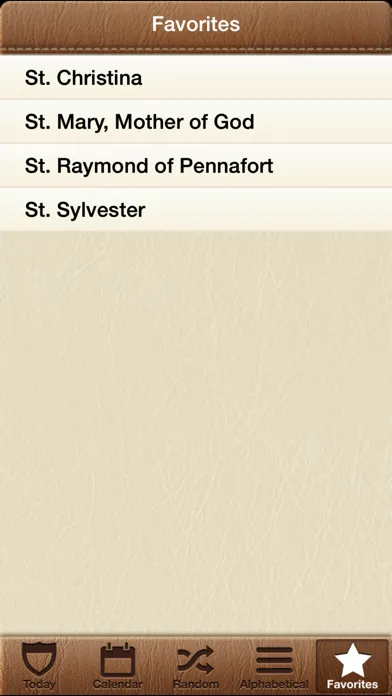
Light search and filtering. The app is built for chronological browsing - yesterday, today, tomorrow - and it does that well. But if you want to filter saints by patronage (patron of cooks, patron of lost causes), by religious order, or by century, the tools are minimal. Power users tend to keep a second resource for that kind of lookup.
Single-saint-per-day model. On a busy feast day the Church may remember several saints, and the Roman calendar offers options. Saint of the Day chooses one. That keeps the daily reading short and clean, but readers occasionally find a name missing on a day when their parish or religious community is celebrating it.
No Liturgy of the Hours, no Mass readings, no rosary. By design. Saint of the Day is not trying to be the Catholic super-app - it is one feature done well. That focus is its strength, but it does mean most users pair it with a second app (often iBreviary, Laudate, or Magnificat) to round out the daily prayer rhythm.
Franciscan house style is unmistakable. Not a flaw, but worth naming. The editorial perspective is Franciscan, the saint selection skews gently toward OFM figures, and the spirituality reflected throughout is recognizably the spirituality of Francis and his successors. Readers from other Catholic spiritualities - Dominican, Jesuit, Carmelite, Opus Dei - sometimes feel that pull and prefer a publisher whose voice matches their own school.
Saint of the Day vs. Laudate vs. Magnificat
Different products for different jobs. Saint of the Day is a single-purpose daily feature. Laudate is the long-running free Catholic Swiss army knife - daily readings, the rosary, a chaplet collection, the Catechism, a saint feature of its own, and roughly a dozen other tools bundled into one app. Magnificat is the paid digital edition of the monthly Magnificat booklet, with the day’s Mass readings, a morning and evening prayer, meditations, and a daily saint reflection, all packaged in the missal-style layout the print edition is known for.
Different strengths. Saint of the Day is better at the saint - the entries are longer, the voice is warmer, the editorial tradition is older. Laudate is broader (rosary, chaplets, Catechism, multiple devotionals, no cost). Magnificat is more liturgical (Mass readings, full daily prayer, monthly print-style cohesion, paid subscription). A Catholic who wants only the daily saint will reach for Saint of the Day. A Catholic who wants one app for everything Catholic will reach for Laudate. A Catholic who wants a digital missal experience will pay for Magnificat.
It is worth naming the bigger context, too. Devotion to saints - invoking their intercession, marking their feast days, holding them up as models of holiness - is a Catholic and Orthodox practice, framed differently in those two traditions, and approached differently again in Protestant and Latter-day Saint traditions. Saint of the Day is a resource built squarely inside the Roman Catholic tradition, and the reflections are written from within that frame. Readers from other traditions can still mine it for biography and history, but the prayers at the end of each entry are written for Catholic devotional use.
The bottom line
Saint of the Day is the thoughtful person’s daily Catholic devotional app - a free, focused, warmly written ~300-word saint feature that has been the house standard at Franciscan Media for over fifty years and has translated cleanly onto phones. It is not trying to replace a breviary, a missal, or a prayer hub, and it doesn’t pretend to. Pair it with whichever app handles your Mass readings and prayer rhythm, and let this one do the saint. The absence of audio and the light search are real gaps, but they’re worth knowing about going in rather than dealbreakers.
Alternatives to Saint of the Day
 LaudateThe free Catholic Swiss army knife - daily readings, rosary, chaplets, Catechism, and a saint feature bundled into one app.
 MagnificatPaid digital edition of the monthly Magnificat booklet - Mass readings, morning/evening prayer, daily meditation, in missal-style layout.
 Ascension AppCatholic media app from Ascension Press - Bible in a Year, Catechism in a Year, and a deep podcast library.
 HallowThe leading Catholic guided-prayer app - audio rosary, meditation, sleep prayers, and celebrity-led sessions.
Frequently asked questions
Is Saint of the Day really completely free?
Yes. The app is free on iOS and Android, the same content publishes daily on franciscanmedia.org, and there is no premium tier, in-app subscription, or paywalled content. Franciscan Media treats it as ministry.
Where does the content come from?
Franciscan Media’s editorial team. The "Saint of the Day" feature began in print under Leonard Foley OFM in 1973, moved to the web in the 1990s, and arrived on mobile in the mid-2010s. The same editorial standard runs across all three formats.
How long is each daily entry?
Roughly 300 words - a short biography, a one-paragraph reflection on what the saint’s life means, and a closing prayer or meditation. About three to four minutes of reading.
Does it follow the Roman Catholic liturgical calendar?
Yes. The selection tracks the Roman calendar used across the Latin Church, with editorial judgment on days that offer multiple options. The app presents one saint per day rather than the full slate.
Is there an audio version?
Not currently. Entries are text only. Readers who want audio devotionals usually pair it with an app like Hallow, Pray.com, or Pray as You Go.
Is it useful for non-Catholic readers?
The biographies and historical content are useful to anyone interested in Christian history and the lives of the saints. The closing prayers and reflections are written from within the Catholic tradition, so readers from Protestant, Orthodox, or Latter-day Saint backgrounds will read those through their own framework.
What pairs well with Saint of the Day?
Most users pair it with one app that handles daily Mass readings and prayer - commonly iBreviary, Laudate, or Magnificat - and let Saint of the Day handle the sanctoral feature on its own.
Sources & further reading
More Catholic Apps
 Latria - Bible & CommentariesLatria brings a Catholic Bible, patristic commentary, early Christian writings, councils, Lectio-style reflections, prayers, and a Scriptural Rosary into a quiet offline iPhone library—but source-text documentation, accessibility, export, and its lifetime-price math need closer inspection.
 FioA genuinely useful Catholic audio home that pays creators more and combines podcasts, music, and audiobooks—much smaller than Spotify, but far more intentional about what Catholic listeners can discover.
 Heroic MenA donor-funded Catholic media library built to move men from watching into prayer, friendship, and small groups—generous in content, but muddled across its media and community products.
 Word on Fire InstituteBishop Barron’s Institute combines serious Catholic formation, live seminars, prayer groups, and a large online community for $27 a month—far more than a video library, and priced accordingly.
 FormedThe Augustine Institute’s “Catholic Netflix” is now a much larger formation library—movies, studies, daily reflections, books, audio, parish programs, and children’s content for $99.99 a year or through a sponsoring parish.
 AmenAmen is the Augustine Institute's free Catholic prayer and audio Scripture app, and it is free in the strict sense - no subscription, no in-app purchase list, no locked sessions. The reason to read past the 4.9 rating is what the nonprofit still does not carry.