
- Starting price
- Around $4.99/mo digital · ~$50/yr print
- Free tier
- No
- Platforms
- iOS · Android · Web · Print
- Developer
- Magnificat
- Launched
- 1998
- Updated
- May 24, 2026
The verdict
Magnificat is the premium daily-prayer subscription for Catholic readers - a single, beautifully edited monthly volume that holds the Mass readings, morning and evening prayer, Lectio Divina, and the lives of the saints in one place. The app is a faithful digital twin of the print edition rather than a reinvention, which is exactly the point.
Try Magnificat ↗Opens us.magnificat.net
Magnificat has quietly become the favorite of Catholic readers who want one curated companion for the day rather than a stack of apps and books. It started in France in the early 1990s, arrived in the United States in 1998, and now publishes monthly editions in English, French, and Spanish - plus children’s and youth editions. For most of its life it was a pocket-sized paperback you carried to Mass. For the last several years it has also been an iOS, Android, and web app that mirrors the print edition page for page.
It is not a Bible app. It is not a sermon library. It is not trying to be the Catholic answer to YouVersion. What it is, instead, is a single monthly volume - print or digital - that gives you every Mass reading, a shortened morning and evening prayer drawn from the Liturgy of the Hours, the daily Gospel set up for Lectio Divina, a meditation, a brief life of the day’s saint, hymns, and a rotating set of essays on sacred art, music, and the spiritual life.
That bundle is the whole pitch. If you are Catholic and you want a single, edited, monthly thing that walks you through prayer and Mass without making you assemble it yourself from a missal, a breviary, and a devotional, Magnificat is the category-defining choice. The app is the same product on a phone - same content, same layout, with a few quality-of-life upgrades like audio prayer and offline downloads.
✓ The good
- One curated daily companion - morning prayer, Mass readings, evening prayer, and a saint of the day all in one flow, no app-switching required
- Editorial quality is genuinely high - the meditations, art commentary, and essays are written by working theologians, monastics, and Catholic writers rather than crowdsourced
- Print + app hybrid actually works - the digital edition is a faithful twin of the paperback, so households can share a print copy and individuals can carry the app
- Liturgy of the Hours in miniature - the shortened morning and evening prayer is a realistic on-ramp for readers who find the full four-volume breviary intimidating
- Lectio Divina is built in - every day’s Gospel is laid out with the four-step structure (lectio, meditatio, oratio, contemplatio) ready to use
- Trilingual - English, French, and Spanish editions are all first-class, not afterthoughts
- Children’s and youth editions - Magnifikid (ages 6-12) and the youth supplement give families a unified resource across ages
✗ Watch out
- No free tier - there is a sample issue but the product itself is a paid subscription, unlike most prayer apps that offer a free shell
- Not a Bible app - you get the Mass-reading pericopes for the day, not the whole Bible to search, bookmark, or compare translations
- The app is a digital twin, not a reinvention - navigation mostly mimics flipping pages, which feels conservative next to apps like Hallow or Lectio 365
- Audio is limited (compared to Hallow) - read-aloud and chanted prayer exist, but it is not a full guided-audio experience
- Liturgy of the Hours is shortened, not complete - readers who want the full breviary will still need iBreviary, Universalis, or the paperback Christian Prayer
- Pricing structure varies by region and format - print, digital, and combined plans are priced separately and can be confusing to compare at first glance
Best for
- Catholics who want one curated daily companion instead of stitching together several apps
- Daily Mass attendees who want the readings, Responsorial Psalm, and Gospel in their hand
- Readers easing into the Liturgy of the Hours without committing to the full four-volume breviary
- Households who want a shared print copy on the kitchen table plus an app for the commute
Avoid if
- You want a full searchable Bible with multiple translations and study tools
- You want a free Catholic prayer option - Laudate and iBreviary are the better starting points
- You want guided meditation audio and celebrity-narrated content in the Hallow style
- You want the complete Liturgy of the Hours in all its psalter cycles, not a shortened daily form
What Magnificat is
Magnificat is a monthly Catholic prayer and Mass-reading periodical, published as a pocket-sized paperback and mirrored in an iOS, Android, and web app. Each issue runs for a single liturgical month and is organized day by day, so you open today’s date and find that day’s morning prayer, Mass readings, meditation, evening prayer, and saint’s life in one continuous flow. It is published in the United States, France, several Spanish-speaking countries, and elsewhere, with each edition liturgically and linguistically localized.
The publisher, Magnificat, is a Catholic publishing house founded by Pierre-Marie Dumont in France in the early 1990s. The U.S. edition launched in 1998 and has grown into a household subscription for a wide slice of practicing Catholics - from daily Mass attendees to families who use it for grace before meals to commuters who pray morning prayer on the train. The app extends that same monthly volume to anyone who would rather not carry the paperback.
Why Catholic readers prefer Magnificat
The single biggest practical difference between Magnificat and a free Catholic app like Laudate is curation. Laudate is a Swiss-army knife of links - readings here, rosary there, a separate tab for the Liturgy of the Hours, another for the Catechism. Magnificat is the opposite: one editor has already chosen, sequenced, and laid out the day’s prayer for you. Open the issue, find today’s date, and the next hour of prayer is already decided.
That editorial sequencing is the thing longtime subscribers describe as transformative. It is the same logic that makes a missalette feel different from a parish bulletin - someone who knows the liturgical calendar has already done the work. For readers who have tried and abandoned the full Liturgy of the Hours because the ribbons and antiphons defeated them, the shortened Magnificat form is often what finally sticks. The art on the cover, the saint’s life on the facing page, the brief essay at the end of the issue - all of it is part of a single edited object rather than a feed.
The monthly liturgical companion: one volume, every day mapped out
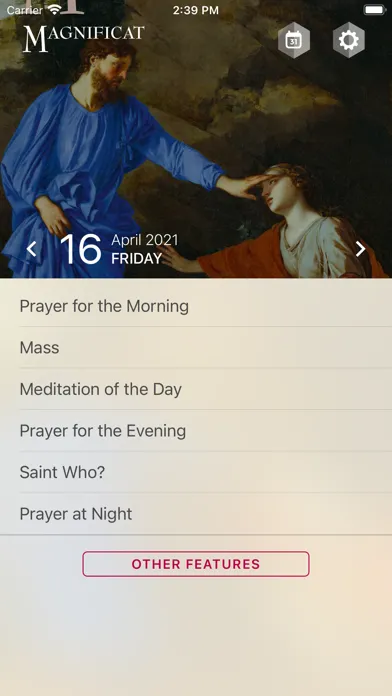
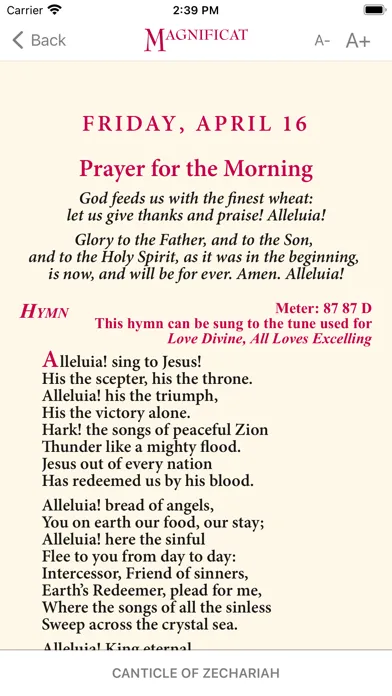
Each Magnificat issue covers one calendar month and is structured around the liturgical year. Open today’s date and the spread is consistent: morning prayer first (a hymn, a psalm or two, a short scripture reading, the Benedictus, intercessions, and a closing prayer), then the day’s Mass readings in full - First Reading, Responsorial Psalm, Gospel Acclamation, Gospel - then a brief meditation written for that specific Gospel, then evening prayer (similar shape to morning, ending with the Magnificat canticle that gives the publication its name), then a one-page life of the day’s saint or commemoration. At the front and back of each issue sit a calendar, a sacred-art commentary on the cover image, a few essays, and a section of seasonal hymns with music.
The reason this matters is that it eliminates the assembly problem. Catholics who pray daily often end up juggling a Bible, a missalette or daily-readings app, a breviary or shortened breviary, a devotional, and a book of saints. Magnificat collapses that stack into one pocket-sized object. You do not have to plan tomorrow’s prayer; you only have to open tomorrow’s page. For people whose obstacle to daily prayer is decision fatigue more than time, that is the whole game.
Lectio Divina plus morning and evening prayer: a realistic daily office
The Lectio Divina pages take the day’s Gospel and walk the reader through the classic four-step structure: lectio (read the passage slowly), meditatio (sit with a word or phrase), oratio (respond in prayer), and contemplatio (rest in God’s presence). Each step is prompted in plain language so a first-time reader can follow without prior training. The meditation that follows the Mass readings is a short reflection, typically half a page, written by a working theologian, monastic, parish priest, or Catholic author - names like Fr. Donald Haggerty, Magnus MacFarlane-Barrow, Sr. Anne Flanagan, and many others rotate through.
The morning and evening prayer pages are a deliberate compression of the Liturgy of the Hours. They are not the full four-volume office, and Magnificat does not pretend they are. What they are is a single-page, ten-to-fifteen-minute version that follows the same basic shape - hymn, psalmody, scripture, gospel canticle, intercessions, closing prayer - set up so a reader can pray it without flipping ribbons or looking up antiphons. For readers who want the office but have repeatedly bounced off the complexity of the full breviary, this shortened form is the realistic on-ramp. Combined with the Lectio Divina pages, it gives most subscribers two anchor points in the day plus a structured way into the Gospel.
The print + app hybrid: same content, two surfaces
The Magnificat app is a faithful digital twin of the paperback rather than a reinvention. The layout mirrors the print edition page for page, so a reader who knows the paperback can find anything in the app immediately, and vice versa. The app adds practical things you cannot do on paper: search the issue, jump straight to today’s date, download the issue for offline use on a plane, and play audio versions of selected prayers and readings where available. The web reader works in any browser, which is useful for families who want to project morning prayer on a TV during Lent or read on a desktop while traveling.
The hybrid model is what most longtime subscribers actually settle into. The paperback lives on the kitchen table or the nightstand and gets used for morning prayer, grace before meals, and Sunday Mass. The app travels on the phone for the commute, the doctor’s waiting room, and the daily Mass on a workday. Because both surfaces are showing the same edited content for the same day, a household can move between them without losing the thread. This is the thing Magnificat does that no purely-digital prayer app can match - the print edition is a real artifact, with cover art and a binding and a sense of weight to the month, and the app is a convenience layer on top of it rather than a replacement.
Pricing
Digital Only (App + Web)
Around $4.99/mo or ~$24.99/yr
Full access to the current month and several months of back issues across iOS, Android, and web. Includes audio prayer where available.
Print Only
Around $50/yr (US)
Twelve pocket-sized paperback issues mailed monthly, plus special Holy Week, Advent, and Christmas companions ordered separately.
Print + Digital Bundle
Around $60-$70/yr
Both formats together - the paperback at home and the app on the phone. The combination most longtime subscribers settle into.
Magnifikid (Kids 6-12)
Around $40-$45/yr print
Weekly four-color leaflet for children with the Sunday Mass readings, activities, and a saint of the week. Sold separately.
Pricing varies by region and format, but the rough shape in the United States is: around $4.99 a month or roughly $24.99 a year for digital-only access; around $50 a year for the print-only subscription; and roughly $60-$70 a year for the print-plus-digital bundle. Prices in France, Spanish-speaking countries, and the UK differ. Always check the current rate on the official site before subscribing.
There is no permanent free tier. Magnificat does publish a free sample issue and occasionally bundles free trial months, but the product is a paid subscription. If you are looking for a free Catholic prayer app to start with, Laudate or iBreviary are the conventional first stops.
The print-plus-digital bundle is the choice most longtime subscribers settle into, which is why it is marked as the best-value tier here. A household gets the paperback for shared use and the app for individual carry, and the price difference over digital-only is small enough that most subscribers stop optimizing after the first year.
Special liturgical companions - Holy Week, Advent, Christmas - are sold separately and are not included in the standard subscription. The children’s edition Magnifikid is a separate subscription as well. None of these are required, but they are the upsell pattern to know going in.
Where Magnificat falls behind
No full Bible. Magnificat gives you the Mass-reading pericopes for each day in full, but it is not a searchable Bible. If you want to compare translations, search by keyword, or read a whole book of scripture straight through, you need a separate app - the USCCB site for the NABRE, or a general Bible app, or a study Bible.
No full Liturgy of the Hours. The morning and evening prayer in Magnificat are a compressed daily form, not the complete four-volume office. Readers who want the full psalter cycle, the Office of Readings, Daytime Prayer, and Compline as the Church prays them will need iBreviary, Universalis, or the paperback Christian Prayer.
Limited audio (compared to Hallow). Magnificat does offer audio versions of selected prayers and readings, but it is not a full guided-audio experience with celebrity narration, sleep stories, and themed prayer series. If audio is the primary way you want to pray, Hallow is the more obvious tool.
The app is conservative. Navigation mostly mimics flipping pages, search is functional but not powerful, and there is no robust note-taking, highlighting, or sharing system. None of this is a dealbreaker for the core use case - daily prayer and Mass - but power users coming from YouVersion or Logos will notice the difference.
No free tier. This is the single most-cited complaint in app-store reviews. Magnificat’s answer is that the product is a curated monthly volume with paid contributors and printing costs behind it, and that the sample issue plus occasional trials let interested readers test it before buying.
Magnificat vs. Laudate vs. iMissal
These three are the apps most often compared by Catholic readers shopping for a daily prayer and Mass-reading companion, and they are genuinely different products that solve different problems.
Different strengths. Magnificat is the curated monthly companion - one editor, one volume, every day already laid out from morning prayer through saint of the day. Laudate is the free Swiss-army knife - dozens of separate features (readings, rosary, Stations of the Cross, Liturgy of the Hours links, Catechism, prayers) gathered behind one menu, no editing, no monthly arc. iMissal is the missal-focused option - a high-quality digital missal with the Mass readings, prayers, and ordo, plus podcasts and a rosary, structured around the Mass itself rather than around a daily office.
In practice, readers who want one beautifully edited thing they can open and trust each morning pick Magnificat. Readers who want a free starter kit and do not mind assembling their own daily rhythm from a feature menu pick Laudate. Readers whose primary need is the Mass - daily readings, the order of the Mass, prayers before and after Communion - and who want a focused missal app rather than a full daily office pick iMissal. Many practicing Catholics end up with two of the three on their phone: Magnificat for the morning, and either Laudate or iMissal for the specific extras Magnificat does not include.
The bottom line
Magnificat is the premium Catholic monthly companion, and it earns the label. If you want one curated volume that holds morning prayer, the day’s Mass readings, Lectio Divina, evening prayer, and the lives of the saints in a single edited flow - in print, on a phone, or both - nothing else in the Catholic app landscape matches it. The cost is real (there is no free tier) and the app is conservative rather than flashy, but for daily Mass attendees, families building a prayer rhythm, and anyone easing into the Liturgy of the Hours, it is the category-defining choice.
Alternatives to Magnificat
 LaudateThe free Catholic Swiss-army-knife app - Mass readings, rosary, Liturgy of the Hours links, Catechism, and dozens of prayers gathered in one menu. The conventional starting point for cost-conscious readers.
 iBreviaryFree app focused on the full Liturgy of the Hours and the Roman Missal in multiple languages. The go-to for readers who want the complete office rather than a shortened daily form.
 Ascension AppHome of the Bible in a Year and Catechism in a Year podcasts with Fr. Mike Schmitz. Stronger on guided audio and structured study plans than on daily Mass readings and prayer.
 HallowThe premium guided-audio Catholic prayer app - meditations, celebrity-narrated rosaries, sleep prayers, and themed challenges. Different category than Magnificat but the obvious pick if audio is your primary mode.
Frequently asked questions
Is Magnificat Catholic?
Yes. Magnificat is a Catholic monthly publication, published by Magnificat (founded in France in the early 1990s), and it follows the Roman Catholic liturgical calendar. The Mass readings, prayers, and saints’ lives are all drawn from Catholic sources, and the U.S. edition uses the NABRE translation of scripture used at Mass in the United States.
Do I need the print edition if I have the app?
No - the digital edition contains the same content as the print edition, laid out the same way. Most longtime subscribers end up with the bundle anyway because the paperback lives on the kitchen table or nightstand for shared household use while the app travels on the phone, but either format alone is a complete subscription.
What languages is Magnificat available in?
The main editions are English, French, and Spanish, each as a first-class localized product rather than a translation of the others. There are also editions in additional languages depending on the country. The app lets you choose your edition at sign-up.
Is the morning and evening prayer in Magnificat the full Liturgy of the Hours?
No. It is a shortened, single-page daily form that follows the same basic shape as the Liturgy of the Hours but does not include the full psalter cycle, the Office of Readings, Daytime Prayer, or Compline. Readers who want the complete office should use iBreviary, Universalis, or the paperback Christian Prayer.
Is there a free version of Magnificat?
There is a free sample issue on the official site and occasional free trial months, but no permanent free tier. The product is a paid subscription. If you want a free Catholic prayer app to start with, Laudate and iBreviary are the conventional first stops.
What is Magnifikid?
Magnifikid is the children’s edition of Magnificat, aimed at ages 6-12. It is a weekly four-color leaflet with the Sunday Mass readings, activities, and a saint of the week, sold as a separate subscription from the main Magnificat issue.
How does Magnificat compare to Hallow?
They are different categories. Magnificat is a curated monthly print-and-app companion centered on the day’s Mass readings, shortened morning and evening prayer, and Lectio Divina. Hallow is a guided-audio prayer app centered on meditations, narrated rosaries, and themed prayer challenges. Many Catholic readers use both - Magnificat for the daily office and Mass readings, Hallow when they want a guided audio session.
Sources & further reading
More Catholic Apps
 Latria - Bible & CommentariesLatria brings a Catholic Bible, patristic commentary, early Christian writings, councils, Lectio-style reflections, prayers, and a Scriptural Rosary into a quiet offline iPhone library—but source-text documentation, accessibility, export, and its lifetime-price math need closer inspection.
 FioA genuinely useful Catholic audio home that pays creators more and combines podcasts, music, and audiobooks—much smaller than Spotify, but far more intentional about what Catholic listeners can discover.
 Heroic MenA donor-funded Catholic media library built to move men from watching into prayer, friendship, and small groups—generous in content, but muddled across its media and community products.
 Word on Fire InstituteBishop Barron’s Institute combines serious Catholic formation, live seminars, prayer groups, and a large online community for $27 a month—far more than a video library, and priced accordingly.
 FormedThe Augustine Institute’s “Catholic Netflix” is now a much larger formation library—movies, studies, daily reflections, books, audio, parish programs, and children’s content for $99.99 a year or through a sponsoring parish.
 AmenAmen is the Augustine Institute's free Catholic prayer and audio Scripture app, and it is free in the strict sense - no subscription, no in-app purchase list, no locked sessions. The reason to read past the 4.9 rating is what the nonprofit still does not carry.