
- Starting price
- Free
- Free tier
- Yes
- Platforms
- iOS · Android
- Developer
- Aycka Soft
- Launched
- 2010
- Updated
- May 24, 2026
The verdict
Laudate is the Swiss Army knife of Catholic apps - and it's completely free. It is not the prettiest tool in the drawer, but no other free app comes close to its breadth.
Try Laudate ↗Opens itunes.apple.com
Laudate has quietly become the default Catholic app on more phones than any of its glossier competitors. It was first published in 2010 by a small developer called Aycka Soft, and in the years since it has held the #1 spot in the App Store's free Catholic category through a combination of breadth, stubborn updates, and a price tag of zero. If a Catholic in the pew next to you has any Catholic app on their phone, statistically it is probably this one.
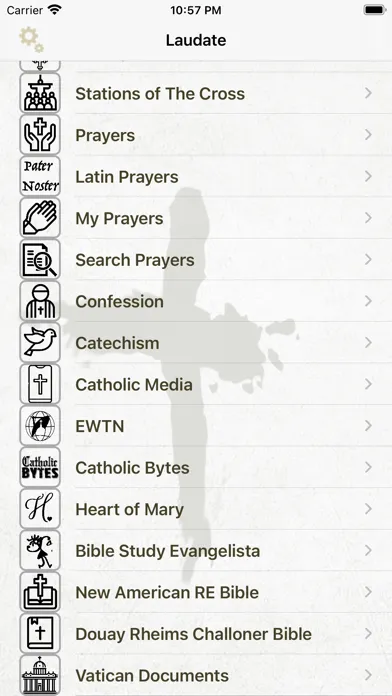
It is not the slickest app you will ever open. It doesn't have celebrity narrators. It doesn't have a curated daily story arc. It doesn't try to make prayer feel like a meditation product. What it does have is the actual contents of Catholic daily practice - the Liturgy of the Hours, the day's Mass readings, the Catechism of the Catholic Church, the Rosary in audio and text, the Stations of the Cross, confession examinations, the major Catholic prayers in Latin and English (and Spanish, Italian, French, Portuguese, and more), several Bible translations including the Douay-Rheims, and a rolling library of saint biographies.
For a free app, that is an almost absurd amount of material. The trade-off is the interface: Laudate looks like an app from the era it was born in - a tile grid of icons, a lot of small text, a few ads tucked along the bottom. Once you accept that it is a utility, not a designed experience, the value becomes obvious. This review walks through what Laudate actually does, what it does better than anyone else at its price, where it falls behind newer paid apps like Hallow, and who should download it today.
✓ The good
- Completely free - every feature, no paywall, no premium tier, no upsell screen
- The Liturgy of the Hours included at no cost - the killer feature that costs ~$70/year elsewhere
- Daily Mass readings every morning - Old Testament, Psalm, New Testament, and Gospel for the current liturgical day
- Full Catechism of the Catholic Church searchable in-app - paragraph numbers, cross-references, the whole thing
- Prayers in many languages - Latin alongside English, Spanish, Italian, French, Portuguese, and more for the Our Father, Hail Mary, Apostles' Creed, and the rest
- Audio Rosary, Stations of the Cross, Divine Mercy Chaplet, and Marian devotions built in
- Works offline for most static content once downloaded - useful in adoration chapels with no signal
✗ Watch out
- Interface looks dated - tile grid, small fonts, no modern design language
- Liturgy of the Hours is pulled from a third-party feed and can occasionally lag or hiccup on feast-day overrides
- Ad-supported - small banner ads appear in some sections (a fair trade for the price)
- No guided audio prayer experiences in the Hallow sense - no celebrity narrators, no music beds, no sleep stories
- Search is functional but not polished - finding a specific Catechism paragraph is faster than scrolling, but slower than on a dedicated reference site
- Updates ship at the developer's pace - this is a small-team app, not a venture-funded one
Best for
- Catholics who want the full daily prayer toolkit at no cost
- Travelers and pilgrims who need Mass readings and the Rosary in a second language
- Anyone praying the Liturgy of the Hours who refuses to pay a subscription
- Catechists, RCIA candidates, and curious inquirers who want the Catechism in their pocket
Avoid if
- You want a polished, guided audio prayer experience with music and narration
- You prefer a designed app over a utility
- You only want one specific feature and a beautiful single-purpose app would serve you better
- Banner ads are a dealbreaker for you
What Laudate is
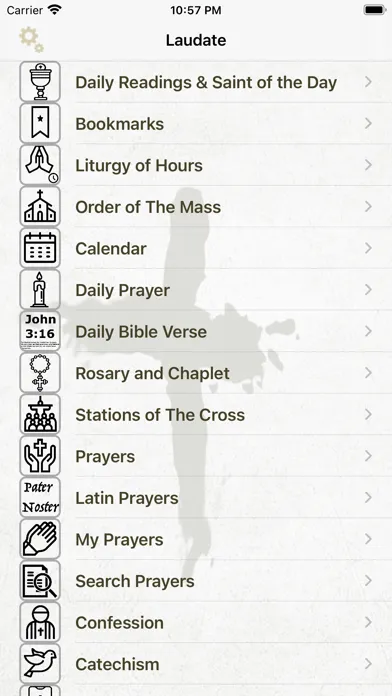
Laudate is a free iOS and Android app published by Aycka Soft that bundles a wide array of Catholic devotional and reference material into one download. The home screen is a grid of tiles - Liturgy of the Hours, Mass readings, Rosary, Stations, Chaplet, Catechism, Bible, Prayers, Saints, Podcasts, Confession - and tapping any tile drops you into that section. There is no account to create, no onboarding flow, no subscription decision. You install the app, open it, and the day's content is already waiting.
Under the hood, Laudate is essentially a beautifully comprehensive directory app. It pulls daily Mass readings from the USCCB feed, the Liturgy of the Hours from a Universalis-compatible source, the Catechism from a complete in-app text, and the Rosary from pre-recorded audio. None of that is groundbreaking individually. What makes Laudate Laudate is that all of it sits in one place, for free, on a single icon - which is exactly what most Catholic users actually want.
Why everyday Catholics use Laudate
Most Catholic apps in 2026 are subscription products. Hallow is the obvious example - beautifully produced, celebrity-narrated, and around $70 per year. Ascension's app is similar. Even iBreviary, which is also free, focuses narrowly on the Hours and the Missal. Laudate is the one app that says: here is essentially everything a practicing Catholic touches in a normal week, and you don't have to pay for it.
That positioning matters more than it sounds. A parent with three kids, a parishioner on a fixed income, a college student walking into RCIA - none of them want to evaluate four different $70/year subscriptions before they can pray the Rosary on a Tuesday. Laudate removes that decision entirely. The trade is aesthetic: you give up the produced-podcast feel of Hallow, and in return you get the Hours, the readings, the Catechism, and the prayers, today, for nothing. For a large share of Catholic users, that trade is the right one - which is exactly why Laudate has stayed at the top of the free chart for more than a decade.
Liturgy of the Hours: the killer feature for free
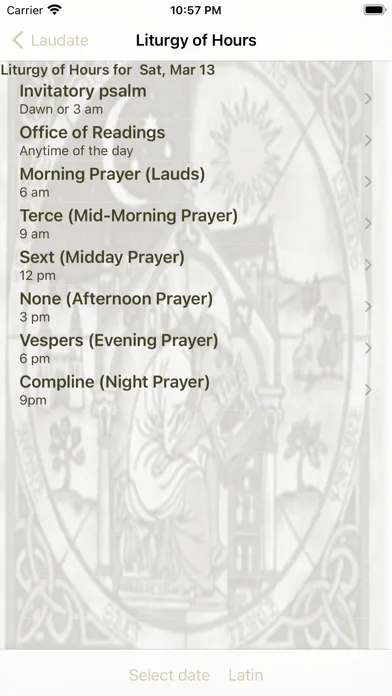
The Liturgy of the Hours - the structured daily prayer cycle the Church has prayed for centuries - is the single most expensive thing to access digitally as a Catholic. A four-volume physical Breviary runs around $200. The widely-loved Universalis app charges a one-time fee. iBreviary is free but narrower. Laudate offers a complete Hours implementation - Office of Readings, Morning Prayer (Lauds), Daytime Prayer, Evening Prayer (Vespers), and Night Prayer (Compline) - built directly into the app at no cost. For anyone trying to build a habit of praying the Hours, that alone is worth the install.
The experience is functional rather than fancy. You tap Liturgy of the Hours from the tile grid, choose the hour you want to pray, and the full text loads - antiphons, psalms, readings, intercessions, the Our Father, closing prayer. Feast days, memorials, and seasonal variations all flow through. It is the same text you would read in a printed Breviary, formatted for a phone screen. There are no audio recordings of someone praying it with you (Hallow does that), and the typography is plain. But it works, it loads quickly, and on a Tuesday at 6 a.m. when you want to pray Lauds before the kids wake up, plain and working is exactly what you need.
Daily Mass readings and the Catechism: reference that actually opens
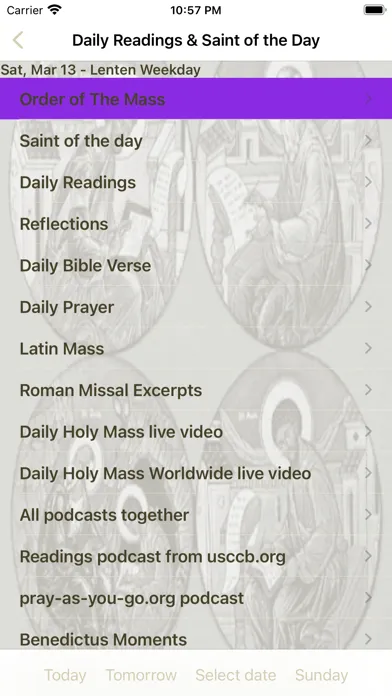
Every morning, Laudate refreshes the day's Mass readings - the Old Testament reading, the Responsorial Psalm, the New Testament reading (on Sundays and solemnities), and the Gospel - pulled from the USCCB. Tap the Mass tile and the readings for today are right there, with the proper liturgical date, the feast or memorial if applicable, and the option to scroll to upcoming days. It is the simplest possible implementation of "what is the Church reading at Mass this morning," and that simplicity is its strength.
Sitting one tile over is the full Catechism of the Catholic Church. All 2,865 paragraphs, the four pillars (Profession of Faith, Celebration of the Christian Mystery, Life in Christ, Christian Prayer), the prologue, the index - the whole document, in-app, searchable, and free. For RCIA candidates working through the faith, for parents fielding a kid's question at dinner, for anyone wanting to look up what the Church actually teaches on a given topic, the in-pocket Catechism is genuinely useful. It is not as fast as a dedicated reference site, but it is faster than digging out the physical book - and unlike a website, it works in airplane mode once the text is cached.
Multi-language Rosary and prayers: the global Catholic toolkit
Laudate's prayer section is where its breadth shows. The major Catholic prayers - the Our Father, Hail Mary, Glory Be, Apostles' Creed, Nicene Creed, Memorare, Hail Holy Queen, Angelus, and a long tail of devotionals - are available in Latin alongside English, Spanish, Italian, French, Portuguese, and additional languages. Tap a prayer, tap a language, and the full text appears. For Catholics who travel, for parishes that pray in more than one language, for anyone learning the Latin tradition, this is genuinely hard to find anywhere else in one app at no cost.
The Rosary itself is built out as a full audio experience: choose Joyful, Sorrowful, Glorious, or Luminous mysteries, press play, and a recorded voice prays through all five decades with you. The Stations of the Cross, the Divine Mercy Chaplet, the Seven Sorrows, and other devotionals are wired the same way - audio plus text, no payment, no signup. It is not the produced-celebrity-narrator feel of Hallow, but it works in a hospital waiting room, on a walk, or in adoration when you want a Rosary partner and don't want to make a meditation product out of it.
Pricing
Laudate (free)
Free
The only tier. Includes Liturgy of the Hours, daily Mass readings, the full Catechism, audio Rosary, Stations of the Cross, Divine Mercy Chaplet, multiple Bible translations including the Douay-Rheims, confession examination, lives of the saints, podcasts, and the major Catholic prayers in Latin, English, Spanish, Italian, French, Portuguese, and more.
There is nothing to evaluate here. Laudate is free. There is no premium tier, no annual subscription, no $1.99 in-app purchase to unlock the Hours. Install the app, open it, use everything.
The app is supported by small banner ads in some sections. They are unobtrusive - banners along the bottom of certain tile screens - and they do not appear in the middle of a Rosary or in the Mass readings text. If banner ads are a personal dealbreaker, Laudate is not the app for you. For the rest of the audience, getting the Liturgy of the Hours and the Catechism for the cost of looking at the occasional banner is a trade most Catholics happily take.
Compared to the alternatives - Hallow at around $69.99/year, Ascension at a similar tier, Universalis as a one-time purchase - Laudate is in a category of one. No competitor at zero dollars offers comparable breadth. The closest free competitor is iBreviary, which is excellent at the Hours and the Missal specifically but doesn't carry the Catechism, the saint biographies, or the multilingual prayer library.
Most users do not need to pay for a Catholic app at all. Laudate covers the daily-practice essentials. If you later decide you want celebrity-narrated audio prayer, you can layer Hallow on top - but you do not need to start there.
Where Laudate falls behind
No produced audio experience. Laudate's Rosary and Chaplet audio are functional recordings, not the cinematic, music-bedded, celebrity-narrated experience Hallow has built its brand on. If "pray with Jonathan Roumie" is the thing that gets you to actually open the app, Laudate will feel flat by comparison.
Dated interface. The home screen is a tile grid. The typography is plain. There is no dark mode in some sections. There is no swipe-driven onboarding, no daily streak, no friend feed. For users who expect a 2026-grade app design, Laudate looks and feels like the early-2010s utility it is. Many users like that - it gets out of the way - but it is worth knowing going in.
No personalization or community layer. There are no reading plans, no journal, no shared prayer lists with friends, no parish features. You open the app, pray what you need, close it. That is by design, but it means Laudate does not build the daily engagement loop that newer apps lean on.
Occasional feed hiccups. Because the Hours and the Mass readings are pulled from upstream sources, on rare occasions a feast-day override or a calendar variation arrives a day late. Most days everything is correct; on a complicated solemnity, double-check against your parish bulletin or the USCCB site.
Ads - small, but present. The banner placements are a fair price for what you get, but they are real. A few users will prefer an ad-free paid app over a free ad-supported one. That is a legitimate preference.
Laudate vs. iBreviary vs. Hallow
Different strengths. Laudate is the broadest free Catholic app. iBreviary is the cleanest free implementation of the Hours and the Missal specifically. Hallow is the most polished paid prayer-experience app on the market. None of the three is strictly better than the others - they answer different questions.
Laudate is better if you want one app that does almost everything a practicing Catholic touches in a week - the Hours, the Mass readings, the Catechism, the Rosary, the Stations, the Chaplet, multilingual prayers, the saints, several Bible translations including the Douay-Rheims - for zero dollars. The interface is dated and the audio is plain, but the coverage is unmatched at the price.
iBreviary is better if you primarily want the Liturgy of the Hours and the Roman Missal, you care about clean typography in the Hours specifically, and you want Latin alongside English text in the same view. It is also free, with no ads, and it is the app many priests and seminarians prefer for the Office. It is narrower than Laudate by design.
Hallow is better if you want celebrity-narrated audio prayer, guided meditations, sleep stories, music-bedded Rosaries, and a designed daily experience - and you are willing to pay around $70 per year for it. Hallow does not replace Laudate's reference depth (the Catechism, the saints, the multilingual prayers), but it produces the daily prayer experience itself at a level no free app can match.
A common stack among Catholic users is to install Laudate as the everyday utility, add iBreviary if they pray the Hours seriously, and add Hallow if they want produced audio prayer. None of them conflict - they answer different needs.
The bottom line
Laudate is the most-downloaded free Catholic app for a reason. It bundles the Liturgy of the Hours, the daily Mass readings, the full Catechism, the Rosary, the Stations, the Chaplet, multilingual prayers, several Bible translations, and a saint library into one no-cost download. The interface is dated and the audio is plain - those are real gaps, but they're worth knowing about going in rather than dealbreakers. For nearly any Catholic looking for a single daily-practice app and unwilling to start with a subscription, Laudate is the first install. Add Hallow or iBreviary later if a specific need calls for it.
Alternatives to Laudate
 HallowThe most-produced Catholic prayer app - guided audio meditations, celebrity narrators, music-bedded Rosaries. About $70/year. Better experience, narrower scope than Laudate.
 iBreviaryFree, focused Liturgy of the Hours and Roman Missal app. Cleaner typography for the Hours specifically; doesn't carry the Catechism or the multilingual prayer library.
 Ascension AppHome of the Bible in a Year and Catechism in a Year podcasts with Fr. Mike Schmitz, plus Ascension's broader Catholic content library. Subscription required for most premium content.
 Exodus 90Structured 90-day Catholic men's spiritual discipline program - fasting, prayer, asceticism, fraternity. Narrower and more intense than Laudate; a complementary tool, not a replacement.
Frequently asked questions
Is Laudate really completely free?
Yes. Every feature - the Liturgy of the Hours, daily Mass readings, the Catechism, the Rosary, the Stations, the Chaplet, multilingual prayers, Bible translations, and the saint library - is included at no cost. The app is supported by small banner ads in some sections. There is no premium tier and no in-app purchase to unlock content.
Does Laudate include the Liturgy of the Hours?
Yes - and this is its most valuable feature for the price. The app includes the Office of Readings, Morning Prayer (Lauds), Daytime Prayer, Evening Prayer (Vespers), and Night Prayer (Compline) with the proper antiphons, psalms, readings, and intercessions for each day. It is a complete implementation of the Hours at no cost.
Which Bible translations does Laudate include?
Laudate includes several Bible translations, with the Douay-Rheims as a notable inclusion alongside other versions commonly used in Catholic contexts. Translations available vary by platform and update, so check the in-app library for the current list.
Does Laudate work offline?
Most static content - the Catechism, the major prayers, the Rosary text, the Stations - works offline once the app has been opened. The daily Mass readings and the Liturgy of the Hours rely on upstream feeds, so they update with a connection but can be viewed once loaded. Useful for adoration chapels and travel.
How does Laudate compare to Hallow?
Different products. Hallow is a paid (~$70/year) guided audio prayer experience with celebrity narrators, music, and meditation production. Laudate is a free reference and devotional utility with the Hours, the Mass readings, the Catechism, and the prayers. Many Catholics use both - Laudate for daily reference, Hallow for produced audio prayer when they want it.
Who makes Laudate?
Laudate is published by Aycka Soft, a small developer that has maintained the app since its launch around 2010. It is not affiliated with the USCCB, the Vatican, or any single Catholic publisher - it pulls content from established Catholic sources (USCCB Mass readings, a complete Catechism text, standard prayer texts) and packages them in one app.
Is Laudate the same as iBreviary?
No. They are different apps from different developers. iBreviary is a free, more focused app centered on the Liturgy of the Hours and the Roman Missal, with strong Latin/English text presentation. Laudate is broader - it includes the Hours plus the Catechism, multilingual prayers, the Rosary audio, the saints, and more. Many users install both.
Sources & further reading
More Catholic Apps
 Latria - Bible & CommentariesLatria brings a Catholic Bible, patristic commentary, early Christian writings, councils, Lectio-style reflections, prayers, and a Scriptural Rosary into a quiet offline iPhone library—but source-text documentation, accessibility, export, and its lifetime-price math need closer inspection.
 FioA genuinely useful Catholic audio home that pays creators more and combines podcasts, music, and audiobooks—much smaller than Spotify, but far more intentional about what Catholic listeners can discover.
 Heroic MenA donor-funded Catholic media library built to move men from watching into prayer, friendship, and small groups—generous in content, but muddled across its media and community products.
 Word on Fire InstituteBishop Barron’s Institute combines serious Catholic formation, live seminars, prayer groups, and a large online community for $27 a month—far more than a video library, and priced accordingly.
 FormedThe Augustine Institute’s “Catholic Netflix” is now a much larger formation library—movies, studies, daily reflections, books, audio, parish programs, and children’s content for $99.99 a year or through a sponsoring parish.
 AmenAmen is the Augustine Institute's free Catholic prayer and audio Scripture app, and it is free in the strict sense - no subscription, no in-app purchase list, no locked sessions. The reason to read past the 4.9 rating is what the nonprofit still does not carry.