
- Starting price
- Free
- Free tier
- Yes
- Platforms
- iOS · Android · Web
- Developer
- Our Daily Bread Ministries
- Launched
- 1956 (print) · app circa 2011
- Updated
- May 24, 2026
The verdict
Our Daily Bread has quietly become the default devotional for readers who want one short, gentle, scripture-anchored page a day and nothing else. The app is free, the archive runs back decades, and the format has barely changed since 1956 - which is exactly the point.
Try Our Daily Bread ↗Opens odb.org
Our Daily Bread has quietly become the most-read daily devotional in the English-speaking world. Since 1956 it has shipped as a small quarterly booklet that lands in mailboxes, gets stacked on hospital carts, and ends up dog-eared in dashboard cupholders. The app - free, ad-free, login-optional - is essentially that booklet, with audio and an archive that goes back decades.
It is not a Bible-reading platform. It is not a community app. It is not a prayer companion in the Hallow sense. It is one page a day: a short scripture, a roughly 200-word reflection drawn from a real-life moment, a one-line prayer, and a verse-for-further-reading. That is the entire product. The discipline of the format is what readers come back for.
For Learn of Christ readers - Protestants, Catholics, Latter-day Saints, anyone who wants a gentle daily on-ramp into the text - the question is whether a devotional that was designed for a 1956 grandmother still works on a 2026 phone. The short answer is yes. The longer answer, including where it falls behind newer apps like First 5 and She Reads Truth, is what the rest of this review is for.
✓ The good
- Completely free, no paywall, no premium tier - the full devotional, full archive, and full audio are all in the free tier
- Audio version of every devotional - narrated by a small rotating cast, three-to-five minutes, perfect for a commute or a dishwasher load
- Massive searchable archive - decades of past devotionals, searchable by keyword, scripture reference, author, or date
- Distributed in 50+ countries and 40+ languages - one of the few devotionals with serious global infrastructure
- The format is the feature - a verse, a 200-word reflection, a prayer, a "further reading" verse, and you are done in five minutes
- No account required to read - open the app and today's page is just there, which is rarer than it sounds
- Broadly evangelical Protestant voice, but written with enough restraint that it travels across traditions better than most
✗ Watch out
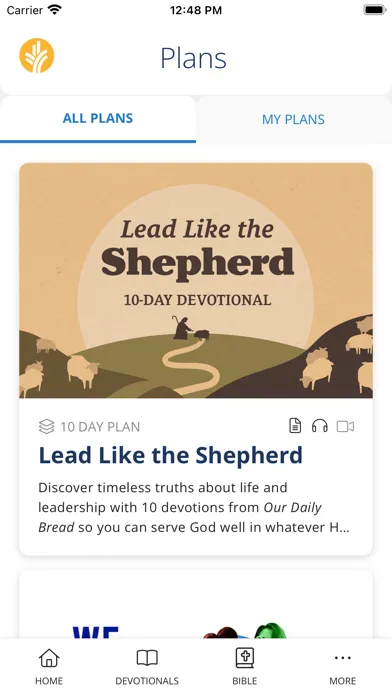
- No reading plan engine - you cannot build a custom plan or get nudged toward a book of the Bible the way YouVersion does (yet)
- Almost no community features - no friends, no shared highlights, no comments, no streaks
- The in-app Bible reader is functional but thin - most users will want a separate Bible app open alongside it
- Visual design is dated compared to She Reads Truth or Glorify - the app does its job, but it will not make anyone gasp
- No journaling field tied to each devotional - you can save favorites, but there is no built-in "what is God saying to me today" prompt
- Notification cadence is limited - one daily reminder, no smart timing, no streak gamification (which some readers will count as a pro)
Best for
- Readers who want one short, gentle page a day with no friction
- Older readers and their children who grew up with the print booklet
- Commuters and morning-coffee readers who want a 3-minute audio devotional
- Multi-generational households where grandparents, parents, and kids can all use the same daily reading
Avoid if
- You want a structured one-year Bible reading plan with progress tracking
- You want a community feed, shared highlights, or social accountability
- You want a deep theological or original-language study experience
- You want a polished, design-forward app in the She Reads Truth or Glorify mold
What Our Daily Bread is
Our Daily Bread is a one-page daily devotional published by Our Daily Bread Ministries - the non-profit formerly known as RBC Ministries (Radio Bible Class), founded in Grand Rapids, Michigan in 1938. The devotional itself launched in 1956 as a quarterly print booklet and has been published continuously ever since. The app is the same content, plus audio, plus an archive that stretches back decades.
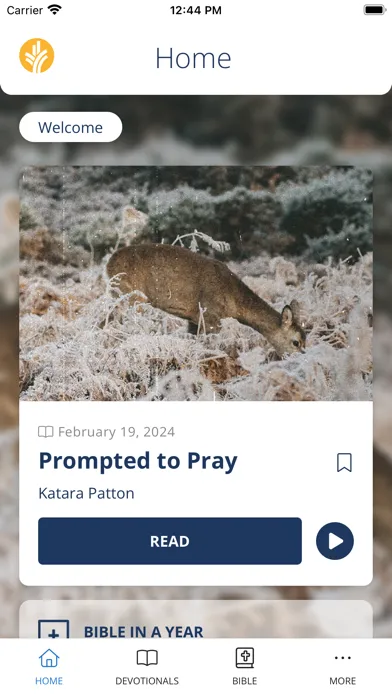
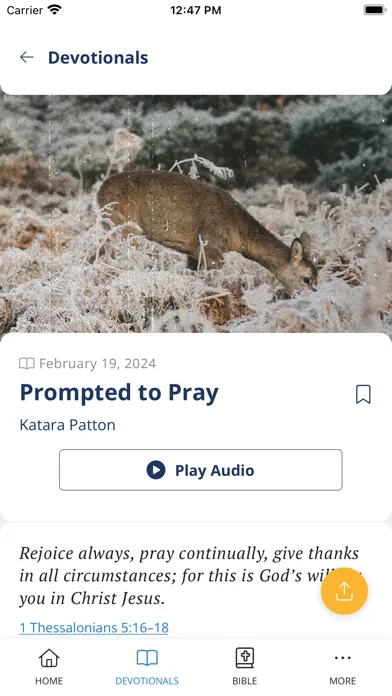
Each daily entry follows the same fixed format: a short scripture reading, a brief title, a 200-word reflection usually grounded in a real-life anecdote, a one-sentence prayer, a one-line takeaway ("Today's Thought"), and a "Bible in a Year" reference. The whole page takes about three minutes to read or five minutes to listen to. The voice is broadly evangelical Protestant, non-denominational, and deliberately written to travel across church backgrounds.
Why everyday readers prefer Our Daily Bread
The single biggest practical difference between Our Daily Bread and almost every other devotional app is the absence of ambition. It does not want to be a Bible platform. It does not want to be a social network. It does not want to upsell you to a $69.99/year tier. It wants to give you one short, gentle page a day, and then get out of your way. For readers who have tried five other apps and quietly stopped opening them, that restraint is the entire appeal.
The other underrated factor is continuity. The same family of writers, the same format, the same tone has run for nearly seventy years. A reader who first picked up the booklet in their grandmother's kitchen in 1972 can open the app in 2026 and find an entry that feels recognizably the same. In a category dominated by reinvention every eighteen months, that is the thoughtful person's reason to stay.
The daily devotional format: verse + 200-word reflection + prayer
The format is fixed, and that is the point. Every entry opens with a scripture reading (usually 4-10 verses), a short title pulled from the reflection's central image, and a "Today's Reading" cite. The body is a roughly 200-word reflection that almost always starts with a small real-life moment - a grandfather's woodworking shop, a missed flight, a hospital waiting room, a question from a child - and then walks gently into the verse. It closes with a one-sentence prayer, a single-line "Today's Thought," and a one-line "Bible in a Year" reference. The whole page is engineered to be read in three minutes.
This sounds like a small thing. In practice it is transformative. The fixed length is what makes the daily habit sustainable - you always know exactly what you are signing up for when you open the app. There is no "today's plan is 14 minutes" anxiety, no "I skipped three days, my streak is broken" guilt, no infinite scroll. Just a single page, with the same shape it had yesterday and the same shape it will have tomorrow. For readers whose previous devotional app gradually slid into the graveyard of unopened icons, the discipline of the format is the actual differentiator.
The audio version: a three-minute narrated devotional for commutes and dishes
Every daily devotional in the app is also available as audio - a clean, three-to-five-minute narration read by a small rotating cast of staff voices. The audio sits as a simple play button at the top of each entry; tap it and you have the day's reading in your ears with no menus, no upsell screen, no "subscribe to unlock." The audio reads the scripture, the reflection, and the prayer in one continuous take, lightly produced, no music bed, no sound effects.
The reason this matters is the use case. A surprisingly large share of Our Daily Bread readers are not sitting on a couch with a coffee - they are driving to work, folding laundry, walking the dog, or making breakfast for a four-year-old. The audio turns the devotional into something you can actually finish on a normal weekday morning, instead of saving it for a quiet moment that may never come. Compared to a podcast-style devotional that runs twenty minutes, the three-minute audio cut is the version that respects your morning.
The archive: decades of past devotionals, searchable by scripture or keyword
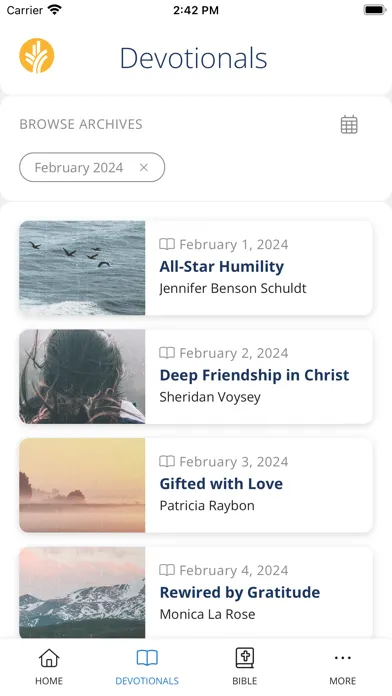
The archive is the quiet superpower of the app. Our Daily Bread has been published continuously since 1956, and the app surfaces an enormous backlog of past entries - searchable by keyword, scripture reference, author, and date. If you are studying Psalm 23, you can pull every devotional that has ever cited it. If you remember a reflection about a lighthouse from years ago, a keyword search will usually find it. If you want to read what Our Daily Bread published on the day you were born, that is a real, working feature.
For a free app, the depth of the archive is unusual. Most devotional apps give you today's entry and maybe the last thirty days. Our Daily Bread effectively hands you a searchable, scripture-indexed library of decades of short reflections - useful for personal study, sermon prep, small-group leaders looking for an illustration, and anyone who wants to read backward through a familiar author's catalog. None of it is gated. None of it requires an account.
Pricing
App (iOS / Android / Web)
Free
Today's devotional, full searchable archive, audio for every entry, and the full multilingual library. No login required.
Print Booklet (quarterly)
Free (donation-supported)
The classic pocket-sized quarterly. Mailed at no cost anywhere Our Daily Bread Ministries distributes - funded entirely by donor gifts.
Email / Daily Digest
Free
The day's devotional delivered to your inbox each morning. Useful if you live in Outlook or Gmail more than your phone.
Donation (optional)
Pay what you can
Our Daily Bread Ministries is a 501(c)(3) and the entire operation runs on donor gifts. Nothing in the app is gated behind giving.
The pricing section is short because the price is zero. The app, the archive, the audio, the email digest, and the quarterly print booklet are all free at the point of use, in every country Our Daily Bread Ministries distributes to.
The operation is funded by donor gifts, not by subscriptions or in-app purchases. There is no premium tier, no "unlock the archive" upsell, no paywall on the audio, no ads inside the app. The donation page exists, and the ministry will tell you that donor giving is what keeps the lights on, but nothing in the user experience is gated behind opening your wallet.
This is genuinely unusual in 2026. Most devotional apps in this category either run a $50-$70/year subscription (Hallow, Pray.com, Dwell) or sell a freemium tier where the good stuff sits behind a paywall. Our Daily Bread does neither. If "free with no asterisks" is a feature you care about - and for a lot of older readers, multi-generational households, and readers in countries where a $69/year subscription is a meaningful expense, it is - this is the rare app that delivers it.
If you do want to support the work, the donation flow is one tap from the menu. Most users do not need to give to use the app, and that is by design.
Where Our Daily Bread falls behind
No reading-plan engine. If you want a structured one-year-through-the-Bible plan with progress tracking, streaks, and a "you are on day 47 of 365" dashboard, Our Daily Bread is not it. There is a "Bible in a Year" reference at the bottom of each entry, but it is a suggestion, not an integrated tracker. YouVersion and She Reads Truth own this category by a wide margin.
No community layer. There are no friends, no shared highlights, no group reading plans, no comment threads, no streak comparisons. For solitary readers this is a feature; for readers who want a sense of "I am doing this with other people," it is a real gap. YouVersion has spent fifteen years building exactly this layer, and Our Daily Bread has not tried to compete.
A dated visual design. The app is functional, readable, and uncluttered, but next to She Reads Truth or Glorify it looks like what it is - a print devotional ported to a phone screen. Typography is plain, the color palette is conservative, and there are no full-bleed photographs or animated transitions. Readers who care about design-as-experience will notice.
A thin in-app Bible reader. Tapping a scripture reference opens a basic in-app passage view, but it is not a serious Bible study environment - no translations to switch between in a sophisticated way, no parallel view, no cross-references, no original-language tools. Most serious readers will keep YouVersion, Logos, or Olive Tree open alongside Our Daily Bread, and use Our Daily Bread purely as the daily on-ramp.
No journaling. There is no built-in space to write a response, a prayer, or a "what is God saying to me here" reflection tied to each day's entry. You can save favorites, but you cannot journal inside the app. This is a meaningful miss for readers who want their devotional and their journal in one place.
Our Daily Bread vs. First 5 vs. She Reads Truth
These are the three classic short-form daily devotional apps in the broadly evangelical Protestant space, and they aim at very different readers. Our Daily Bread is the most universal - a single short page a day, the same format for nearly seventy years, no paywall, no community layer, no design ambition. It is the devotional you give to your grandmother and your fourteen-year-old, and both of them will find it usable.
First 5, from Proverbs 31 Ministries, is built around a single discipline - read the Bible in the first five minutes of your day, before email, before social media. Each entry is shorter than Our Daily Bread and is paired with a specific scripture-led teaching that walks through a book of the Bible over weeks. It is more structured and more focused than Our Daily Bread, and it appeals strongly to women who want a daily teaching arc, not just a standalone reflection. The app is free.
She Reads Truth is the design-forward option - beautifully typeset reading plans, full color, premium photography, paid print companion books, and a strong sense that the app was built for women in their twenties and thirties who care how things look on the screen. The free tier is generous; the print books and a few advanced plans are paid. Compared to Our Daily Bread, She Reads Truth is a richer experience and a more demanding daily commitment.
Different strengths. Our Daily Bread is the best at the universal daily five-minute page across generations. First 5 is the best at "make this the first thing you read each morning, and stick with one book of the Bible for a while." She Reads Truth is the best at design-led, plan-based reading for women who want their devotional to feel curated. They are not really competitors - most serious readers eventually try at least two of the three and keep the one that fits their actual morning.
The bottom line
Our Daily Bread is not the right choice for everyone. If you want streaks, community, original-language tools, a yearly reading plan engine, or a design-forward app, you will be happier with YouVersion, Logos, or She Reads Truth. But for the much larger pool of readers who simply want one short, gentle, scripture-anchored page a day - for free, with audio, with decades of archives, with no account required and no paywall to dodge - Our Daily Bread is the quiet default. Seventy years of continuous publishing and a global distribution footprint earn it the benefit of the doubt. The free price seals it.
Alternatives to Our Daily Bread
 Daily Bible Devotion & PrayerA brief morning-and-evening alternative with NLT, KJV, and NIV choices, but intrusive ads and broad privacy terms make the ad-free checkout worth checking.
 d365 Daily DevotionalsA free, ad-free five-step devotional written especially for youth and young adults, with group guidance and a searchable archive.
 She Reads TruthThe design-forward devotional. Beautifully typeset reading plans, premium photography, strong free tier, paid print companions.
 YouVersionThe Bible-reading platform. Reading plans, community, streaks, hundreds of translations - completely free.
 GlorifyA design-led daily prayer and devotional app. Calmer and more visual than Our Daily Bread; freemium with a paid tier.
 Pray.comAudio-first devotionals, bedtime Bible stories, and guided prayer. Broadly Christian, paid Premium tier around $69.99/yr.
Frequently asked questions
Is the Our Daily Bread app actually free?
Yes - completely. The full daily devotional, the entire archive, the audio version, the email digest, and the quarterly print booklet are all free. There is no premium tier, no in-app purchase, no ads, and no paywall on the archive. Our Daily Bread Ministries is a non-profit funded by donor gifts, and giving is entirely optional.
What tradition is Our Daily Bread written from?
Our Daily Bread is published by Our Daily Bread Ministries (formerly RBC Ministries), a non-denominational evangelical Protestant ministry founded in Grand Rapids, Michigan in 1938. The devotional is deliberately written to travel across denominational lines, and many readers from Catholic, mainline Protestant, and Latter-day Saint backgrounds use it as a daily on-ramp into the text.
How long is each daily devotional?
The fixed format is a short scripture reading, a roughly 200-word reflection, a one-sentence prayer, a one-line "Today's Thought," and a "Bible in a Year" reference. The whole page takes about three minutes to read or three-to-five minutes to listen to in the audio version.
Does the app have an audio version?
Yes - every daily devotional has a free audio version narrated by a small rotating cast. The play button sits at the top of each entry, no subscription required. The audio reads the scripture, the reflection, and the prayer in one continuous three-to-five-minute take.
How far back does the archive go?
The app's searchable archive includes decades of past devotionals, searchable by keyword, scripture reference, author, and date. For a free app, the depth of the archive is unusual - most devotional apps give you today's entry and maybe the last month.
Is Our Daily Bread available in other languages?
Yes. Our Daily Bread Ministries distributes the devotional in 50+ countries and 40+ languages, with translated editions of the app and the print booklet available in many of them. It is one of the few daily devotionals with serious global infrastructure.
How does Our Daily Bread compare to YouVersion?
They are different products. YouVersion is a full Bible-reading platform with hundreds of translations, reading plans, a community feed, and streaks. Our Daily Bread is a single short daily devotional with audio and an archive - it is not trying to be a Bible reader. Most serious readers use both: YouVersion for the Bible itself, Our Daily Bread as the gentle daily on-ramp.
Sources & further reading
More Devotional Apps
 365 Christian Men365 Christian Men delivers short, memorable stories of faith and courage across history, now inside the broader 365 Christian Stories ministry—most useful as a free conversation starter when biography is sourced, contextualized and never confused with Scripture.
 Contagious Disciple MakingThe Contagious Disciple Making app gathers free stories, training, Scripture lists and community tools around Discovery Bible Study and DMM—useful as a doorway when coaching, local church accountability and participant safety remain larger than the app.
 ReflectReflect builds a calm two-minute rhythm from Scripture, a personalized AI reflection, prayer and one honest question, with strong privacy documentation and no ads—but intimate context still reaches cloud services, and generated theology needs human judgment.
 Overflow Quiet Time CompanionOverflow is a free iPhone companion for turning a Bible, devotional or Christian app into a five-minute quiet-time rhythm—but its thoughtful simplicity comes with a tiny public track record and few recent feature additions.
 Following JesusFollowing Jesus gives new believers a free pocket companion for seven Christian foundations, devotionals, Bible reading, worship and video—useful immediately, though its iOS build and privacy label lag the much newer Subsplash Android app.
 helloHOPEhelloHOPE offers free Scripture-centered encouragement, prayer, calming music and stories for families facing a child’s diagnosis—but advertising and cross-app tracking labels are a poor match for such a sensitive moment.