1 Chronicles 24
People in this chapter
An aged king sits down to do paperwork. Near the end of his life, David sorts the sons of Aaron into shifts so the worship will never lapse. He does not pick the order himself. He casts lots1, and in the faith of Israel the lot was never chance - it was where the choice was handed back to God. The great houses and the small were thrown in together. None was seeded ahead of another.
Tap any highlighted phrase to jump to the commentary that unpacks it.
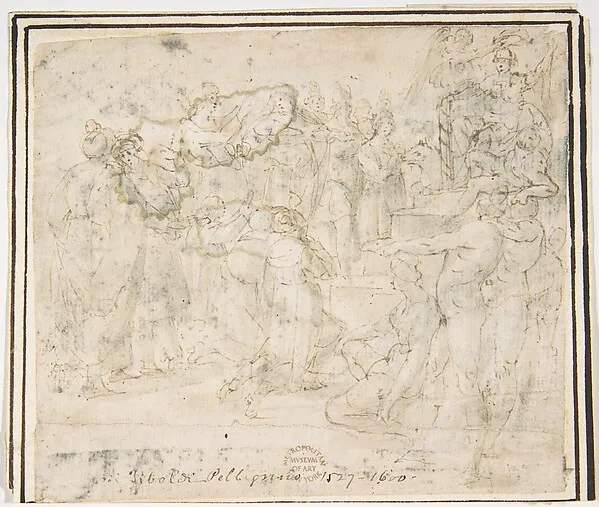
1 Chronicles 24:1-3The Sons of Aaron, and Their Two Surviving Lines
1Now these are the divisions of the sons of Aaron. The sons of Aaron; Nadab, and Abihu, Eleazar, and Ithamar. 2But Nadab and Abihu died before their father, and had no children: therefore Eleazar and Ithamar executed the priest’s office. 3And David distributed them, both Zadok of the sons of Eleazar, and Ahimelech of the sons of Ithamar, according to their offices in their service.
Four sons are named, and at once two of them are gone. The Chronicler does not retell how Nadab and Abihu died; he assumes you already know they had offered strange fire before the LORD and were taken in their own youth, in their father's lifetime, before they had sons of their own. What he records is the consequence for the priesthood: with no children to carry their lines, the office could not descend through them.
The priesthood that might have run through four houses now runs through two - Eleazar and Ithamar - and through those two it goes on. There is something sober in beginning a chapter of careful order with a memory of disorder and loss. The structure David builds is built over a grave. Yet the line is not broken; it is narrowed and carried, and the worship of God continues through the sons who remain.
David does not order the priests alone. He works with two men who themselves embody the two surviving lines: Zadok of the sons of Eleazar, and Ahimelech of the sons of Ithamar. The arrangement is deliberate and even-handed - a representative of each house stands beside the king as the divisions are drawn, so that neither line can claim the work was done over its head. The count that follows is honest about the difference between them: there were more chief men found of the sons of Eleazar than of the sons of Ithamar, sixteen chief houses out of Eleazar and eight out of Ithamar, twenty-four in all.1 The larger house gets the larger share of the courses, by the plain reckoning of how many fathers' houses each line actually had.
The administration is careful to be fair, and careful to be seen to be fair - the work done openly, before the king, the princes, and the chief of the fathers, with a scribe to write it down.
1 Chronicles 24:4-6The Lot That Divided Them
4And there were more chief men found of the sons of Eleazar than of the sons of Ithamar; and thus were they divided. Among the sons of Eleazar there were sixteen chief men of the house of their fathers, and eight among the sons of Ithamar according to the house of their fathers. 5Thus were they divided by lot, one sort with another; for the governors of the sanctuary, and governors of the house of God, were of the sons of Eleazar, and of the sons of Ithamar. 6And Shemaiah the son of Nethaneel the scribe, one of the Levites, wrote them before the king, and the princes, and Zadok the priest, and Ahimelech the son of Abiathar, and before the chief of the fathers of the priests and Levites: one principal household being taken for Eleazar, and one taken for Ithamar.
Three small words carry the heart of the matter: one sort with another. Large house and small, prominent family and obscure, were all thrown into the same drawing. No house was seeded ahead of another. The lot levelled them. Whatever weight a family might have carried by its size or its name was set aside the moment the decision passed to the goral. This is the quiet theology of the whole arrangement: in the service of God's house, the order is received as a gift.
Every course took its place because God had given it that place, through a lot that played no favourites.
1 Chronicles 24:7-11The First Courses Cast, the Eighth to Abijah
7Now the first lot came forth to Jehoiarib, the second to Jedaiah, 8The third to Harim, the fourth to Seorim, 9The fifth to Malchijah, the sixth to Mijamin, 10The seventh to Hakkoz, the eighth to Abijah, 11The ninth to Jeshuah, the tenth to Shecaniah,
The lots come out, and the Chronicler simply records the names in the order they fell - twenty-four houses, twenty-four turns. The system is one of quiet genius. Each course would serve for a week, twice in the year, so that no priest was worn down by constant duty and yet the service never lapsed: someone was always at the altar, always before the LORD. The list itself is unadorned. It names no deeds, tells no stories; it is a schedule, and reads like one.
But notice the dignity the form confers. Every house, prominent or obscure, is written into the record with the same plain formula - the first… the second… the third - each given its number, its place, its season. In the house of God there are no nameless servants. Each course is set down, and each will come, in its turn, to stand where God has appointed it.
1 Chronicles 24:13-19The Last of the Courses, as the LORD Had Commanded
13The thirteenth to Huppah, the fourteenth to Jeshebeab, 18The three and twentieth to Delaiah, the four and twentieth to Maaziah. 19These were the orderings of them in their service to come into the house of the LORD, according to their manner, under Aaron their father, as the LORD God of Israel had commanded him.
The list closes with a sentence that grounds the whole arrangement in something older than David: These were the orderings of them in their service to come into the house of the LORD, according to their manner, under Aaron their father, as the LORD God of Israel had commanded him. The courses are new - David has just drawn them - but the priesthood they order is not. It reaches back through Aaron to the commandment of God Himself.
David is not inventing a worship of his own devising; he is organizing, for a settled people, the service that God had appointed at Sinai. The phrase as the LORD God of Israel had commanded him keeps the king in his place. He is the administrator of a worship he did not originate and does not own. The order is his to arrange; the priesthood, and the command that established it, are God's.
1 Chronicles 24:20-31The Rest of the Levites, the Principal Fathers with the Younger
20And the rest of the sons of Levi were these: Of the sons of Amram; Shubael: of the sons of Shubael; Jehdeiah. 21Concerning Rehabiah: of the sons of Rehabiah, the first was Isshiah. 22Of the Izharites; Shelomoth: of the sons of Shelomoth; Jahath. 23And the sons of Hebron; Jeriah the first, Amariah the second, Jahaziel the third, Jekameam the fourth. 24Of the sons of Uzziel; Michah: of the sons of Michah; Shamir.
The priests are ordered; now the Chronicler turns to the rest of the sons of Levi - the wider tribe who were not priests but who served the house of God in every other capacity. The lines are traced through the great Levitical families: from Amram (beyond the priestly line of Aaron), through Rehabiah, the Izharites, the sons of Hebron, the sons of Uzziel. These are the men who would do the work that surrounded the sacrifice - the singing and the gatekeeping, the care of the courts and chambers and vessels, the unseen labour by which the worship was kept running.
The roster is thinner here than the priestly one, a list of heads of houses rather than a full rotation, but the principle is the same: every family named, every line given its place. The house of God ran on far more than its priests, and the Chronicler will not let the supporting tribe go unrecorded.
28Of Mahli came Eleazar, who had no sons. 29Concerning Kish: the son of Kish was Jerahmeel. 30The sons also of Mushi; Mahli, and Eder, and Jerimoth. These were the sons of the Levites after the house of their fathers. 31These likewise cast lots over against their brethren the sons of Aaron in the presence of David the king, and Zadok, and Ahimelech, and the chief of the fathers of the priests and Levites, even the principal fathers over against their younger brethren.
A man whose line stops with him slips quietly into the Merarite list, easy to read past. Eleazar leaves no son to carry his name into the next generation of service - a dead end on the family tree. Yet the Chronicler does not hurry past him or drop him for having no descendants to list. He writes him down - Eleazar, who had no sons - and so the man is kept in the record even though his branch ends.
It is a quiet mercy, the same care that runs through all these genealogies: a name is not erased for being a dead end. To belong to the service of God's house is to be remembered, whether or not you leave anyone behind to remember you. Even the line that stops is written into the book.
The same lot that ordered the priests now orders the rest of the tribe. The Levites likewise cast lots over against their brethren the sons of Aaron - the very same casting, done in the very same presence: before David, before Zadok and Ahimelech, before the chief of the fathers. And the final phrase makes it unmistakable: even the principal fathers over against their younger brethren. Senior and junior were brought to the same lot on the same terms.
No house was assigned its place because it was prominent. None was passed over because it was small. The lot fell for the principal father exactly as it fell for his younger brother, and the great and the lesser stood together under one impartial decision.
Research trail
Sources & further study
These references support the historical, linguistic, manuscript, and contextual notes in this chapter. Scripture remains the primary text; external sources are provided so readers can inspect the research directly.
- 1 Chronicles 24 - Translators' NotesThe NET Bible's detailed footnotes on 1 Chronicles 24 - the sixteen-to-eight division between the houses of Eleazar and Ithamar (v. 4), the procedure of casting lots for the courses (vv. 5-6), and the list of the twenty-four orders of priests.
- I Chronicles 24 · Hebrew + classical Jewish commentaryThe Hebrew text of 1 Chronicles 24 with Rashi, Radak, and other classical commentators side by side - useful for goral (the “lot,” v. 5), for the machaloqot (“divisions,” “courses”) into which the priests were sorted, and for the order of the twenty-four houses in verses 7-18.
- 1 Chronicles 24 ↔ Luke 1 · Proverbs 16 · Hebrews 7Traces the threads tying the course of Abijah (v. 10) to the course of Abia still serving in Luke 1:5-8, the casting of the lot (v. 5) to the whole disposing thereof is of the LORD (Prov. 16:33), and the many rotating priests to the one unchangeable priesthood of Hebrews 7:23-24.
- Incense burner · Ancient Near Eastern cultic vesselsAn ancient Near Eastern incense burner from the Met's collection - the kind of vessel behind the priestly duty that put a man of the course of Abia at the altar of incense (Luke 1:9), the very station where Gabriel met Zacharias when his course came up in its turn.
Where this echoes in Scripture
The Lot That Divided Them
- Proverbs 16:33The lot is cast into the lap; but the whole disposing thereof is of the LORD.The faith beneath the casting of lots here - the result is not chance but the appointment of God.
- Leviticus 10:1-2Nadab and Abihu… offered strange fire before the LORD… and there went out fire from the LORD, and devoured them.The loss assumed in verse 2 - why the priesthood went forward through Eleazar and Ithamar alone.
- Acts 1:24-26And they gave forth their lots; and the lot fell upon Matthias.The same instinct in the early church - a decision handed back to the God who knows the hearts.
- Joshua 18:6That I may cast lots for you here before the LORD our God.The lot as the means of dividing what belongs to God's people - the land then, the courses now.
The Last of the Courses, as the LORD Had Commanded
- Luke 1:5A certain priest named Zacharias, of the course of Abia: and his wife was of the daughters of Aaron.The eighth course of verse 10, still serving centuries later - the roster running on into the gospel.
- Luke 1:8-9While he executed the priest's office before God in the order of his course… his lot was to burn incense.The angel meets Zacharias precisely while he serves his appointed turn - the ordinary duty David ordered here.
- Luke 1:13Thy wife Elisabeth shall bear thee a son, and thou shalt call his name John.What the assigned week became - the announcement of the forerunner, to a priest simply keeping his post.
- Nehemiah 12:17Of Abijah, Zichri; of Miniamin, of Moadiah, Piltai.The course of Abijah still named among the priestly houses after the exile - the rotation endured.
The Rest of the Levites, the Principal Fathers with the Younger
- Hebrews 7:23-24They truly were many priests, because they were not suffered to continue by reason of death: but this man… hath an unchangeable priesthood.Why the office had to be divided into courses - and the one Priest who needs no successor.
- Hebrews 7:25He is able also to save them to the uttermost that come unto God by him, seeing he ever liveth to make intercession for them.What the courses promised imperfectly - someone always before God - fulfilled in Christ's endless life.
- Acts 10:34Of a truth I perceive that God is no respecter of persons.The impartiality of the lot - the principal fathers and the younger ordered on the same terms.
- Romans 2:11For there is no respect of persons with God.The same justice woven through the chapter - great house and small brought to one impartial decision.