2 Samuel 22
People in this chapter
David has spent his life running. Hunted by Saul, hounded by enemies, tested by fear and hunger and betrayal. And here, at the end of it, he stops and sings. This is a testimony of help already given, the song of a man who has lived long enough to see that the God he trusted at twenty, at thirty, at fifty kept His word every time.1
Tap any highlighted phrase to jump to the commentary that unpacks it.
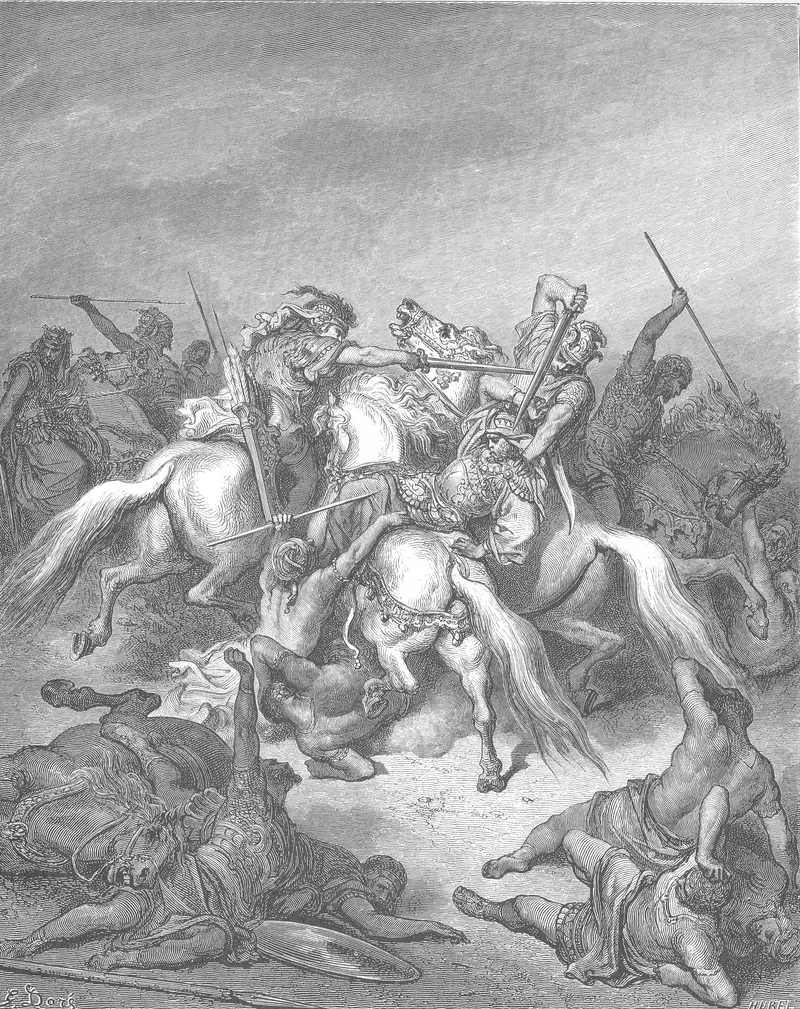
2 Samuel 22:1-4The Rock and the Fortress
1And David spake unto the LORD the words of this song in the day that the LORD had delivered him out of the hand of all his enemies, and out of the hand of Saul: 2And he said, The LORD is my rock, and my fortress, and my deliverer; 3The God of my rock; in him will I trust: he is my shield, and the horn of my salvation, my high tower, and my refuge, my saviour; thou savest me from violence. 4I will call on the LORD, who is worthy to be praised: so shall I be saved from mine enemies.
Of all the names David could have led with, he reaches for stone. A rock does not move. A rock does not betray. A rock stands in the middle of the flood and is still there when the water drops. His life had been one long study in instability - exile, pursuit, the throne won and nearly lost - so the first thing out of his mouth is the most immovable thing he knows. He has learned the hard way that the only security worth the name is the security God Himself is.123
A fortress is a place of war, a stronghold from which one can defend and prevail. God as fortress means more than safety - it means the backing to stand against enemies, the strength to fight, the assurance of victory. David declares himself equipped for what comes.
The God who is rock is also the God who acts - who "delivers." Deliverer is a title of active intervention. God breaks chains, He leads out of captivity, He changes the circumstance itself. David's rock is a God who moves.
2 Samuel 22:5-12The Call from the Depths
5When the waves of death compassed me, the floods of ungodly men made me afraid; 6The sorrows of hell compassed me about; the snares of death prevented me; 7In my distress I called upon the LORD, and cried to my God: and he did hear my voice out of his temple, and my cry did enter into his ears. 8Then the earth shook and trembled; the foundations of heaven moved and shook, because he was wroth.
David sings of deliverance. The song shifts from what God did in the past to what he does always. Thanksgiving becomes theology.
9There went up a smoke out of his nostrils, and fire out of his mouth devoured: coals were kindled by it. 10He bowed the heavens also, and came down; and darkness was under his feet. 11And he rode upon a cherub, and did fly: and he was seen upon the wings of the wind. 12And he made darkness pavilions round about him, dark waters, and thick clouds of the skies.
David refuses to shrink what nearly took him. Death came at him in waves, something vast and rising that closed over him from every side and pulled down. Picture a man overboard in a storm at sea, the water breaking again and again across his face, no shore anywhere in the dark. That is the honesty the song begins with before it ever gets to rescue.
The men who came after David were set against God Himself, sons of Belial - enemies of the covenant David carried. He stands as the anointed, and the flood breaking over him is really breaking against the purposes of the One who anointed him.
But David does not drown. "In my distress I called upon the Lord." This is the turning point of the song. The cry from the depths is heard. God "did hear my voice out of his temple." The call goes up from the waters, and it reaches the ears of the Most High. Deliverance is not that the waves stop; deliverance is that God hears and responds.
Now the song shifts to theophany - the appearing of God. From the depths, David looks up, and he sees God rising. Fire issues from His nostrils. The heavens are rolled up. The earth trembles. This is the God of judgment, of power, of terrible majesty. And this God rises because a man called out from the waters. God moves on behalf of the anointed.
God flies to David. He "rode upon a cherub" - the same cherub that stands at the throne room of heaven, the same creature that guards the holiest place. God is seen "upon the wings of the wind" - He moves with the swiftness of the storm. He is not slow. He does not hesitate. When the anointed cries, heaven itself mobilizes.
2 Samuel 22:13-20The Warrior God
13Through the brightness before him were coals of fire kindled. 14The LORD thundered from heaven, and the most High uttered his voice. 15And he sent out arrows, and scattered them; lightning, and discomfited them. 16And the channels of the sea appeared, the foundations of the world were discovered, at the rebuking of the LORD, at the blast of the breath of his nostrils.
David sings of deliverance. The song shifts from what God did in the past to what he does always. Thanksgiving becomes theology.
17He sent from above, he took me; he drew me out of many waters; 18He delivered me from my strong enemy, and from them that hated me: for they were too strong for me. 19They prevented me in the day of my calamity: but the LORD was my stay. 20He brought me forth also into a large place: he delivered me, because he delighted in me.
God descends and acts. He "sent from above, he took me, he drew me out of many waters." David uses the language of a rescuer reaching down into a flood and pulling someone to safety. David is being taken, drawn out by hands stronger than the water. Rescue is God's action.
David will not claim he defeated his enemy. Instead, he says God delivered him "from my strong enemy." The enemy was too strong for David. This is crucial: David is honest about his weakness. Saul was more powerful. The armies against him were vast. But God was stronger than the enemy. God prevailed where David could not.
David could have closed the rescue with his own faithfulness. Instead he gives the real reason, and it is almost embarrassingly tender: God drew him out “because he delighted in me.” God liked him. That is covenant language, and it is meant for you too - the God of this song delights in His own, and a God who delights in you is already in the water, reaching.
2 Samuel 22:21-28According to My Righteousness
21The LORD rewarded me according to my righteousness: according to the cleanness of my hands hath he recompensed me. 22For I have kept the ways of the LORD, and have not wickedly departed from my God. 23For all his judgments were before me: and as for his statutes, I did not depart from them. 24I was also upright before him, and have kept myself from mine iniquity.
David sings of deliverance. The song shifts from what God did in the past to what he does always. Thanksgiving becomes theology.
25Therefore the LORD hath recompensed me according to my righteousness; according to my cleanness in his eye sight. 26With the merciful thou wilt shew thyself merciful, and with the upright man thou wilt shew thyself upright. 27With the pure thou wilt shew thyself pure; and with the froward thou wilt shew thyself unsavoury. 28And the afflicted people thou wilt save: but thine eyes are upon the haughty, that thou mayest bring them down.
Here David makes a bold claim: "The Lord rewarded me according to my righteousness." David is saying that he sought to walk with God, that he kept God's ways when he could have broken them, that when he was hunted and feared, he held his moral compass. This is the voice of a man who can look back at his path and see that he pursued faithfulness even when it cost him.
Clean hands, from a man who had killed in battle and buried friends and made hard calls a king has to make. David claims hands free of the one guilt that would have disqualified him: he did not strike Saul down in the cave when the king was at his mercy, did not seize what was not his, did not climb to the throne over a trail of betrayals. He kept his covenants when breaking them was the faster road.
In verses 26-27, David articulates a principle that governs God's dealing: "With the merciful thou wilt shew thyself merciful." God meets people where they stand. He does not love capriciously; He responds. He is not unjust; He sees the orientation of the heart and responds accordingly. "With the froward thou wilt shew thyself unsavoury" - to those who turn away from Him, He becomes unsavory. But to those who keep covenant, He keeps covenant.
God's eyes are not neutral. They track in two directions at once: toward the afflicted, with intent to save, and toward the proud, with intent to bring them down. The God of this song leans - and He leans toward the one who has stopped pretending to be self-sufficient. The proud get His full attention too, but it is the attention of a God who will not let a high tower stand forever.
2 Samuel 22:29-37My Lamp and My Light
29For thou art my lamp, O LORD: and the LORD will lighten my darkness. 30For by thee I have run through a troop: by my God have I leaped over a wall. 31As for God, his way is perfect; the word of the LORD is tried: he is a buckler to all them that trust in him. 32For who is God, save the LORD? and who is a rock, save our God?
The shield holds firm; the Lord trains David's hands. Distress transforms into strength. The refuge proves real when the arrows fly.
33God is my strength and power: and he maketh my way perfect. 34He maketh my feet like hinds’ feet: and setteth me upon my high places. 35He teacheth my hands to war; so that a bow of steel is broken by mine arms. 36Thou hast also given me the shield of thy salvation: and thy gentleness hath made me great. 37Thou hast enlarged my steps under me; so that my feet did not slip.
This is one of the most crystalline images in Scripture. "Thou art my lamp, O Lord." David is in darkness - literal darkness in caves and deserts, but also metaphorical darkness: the darkness of uncertainty, of not knowing what God will do next, of being hunted and afraid. In that darkness, God is not absent. God is the lamp that dispels it. A lamp does not explain the darkness; it shines against it. God is the presence that makes visible what was hidden.
Notice the tense David chooses: “will lighten” - ongoing, open-ended, a lamp kept burning for as long as the dark lasts. He is counting on a God who keeps the wick lit. As long as he is walking in the dark, he will not be walking blind.
From the image of the lamp, David moves to the perfecting of his way: "God is my strength and power: and he maketh my way perfect." The way is made perfect by God's direction. God "setteth me upon my high places" - He elevates David to the high vantage point where David can see what God is doing. He "teacheth my hands to war" - even the skills David possesses are taught to him by God.
2 Samuel 22:47-51Mercy to His Anointed Forever
47The LORD liveth; and blessed be my rock; and exalted be the God of the rock of my salvation. 48It is God that avengeth me, and that bringeth down the people under me, 49And that bringeth me forth from mine enemies: thou also hast lifted me up on high above them that rose up against me: thou hast delivered me from the violent man. 50Therefore I will give thanks unto thee, O LORD, among the heathen, and I will sing praises unto thy name. 51He is the tower of salvation for his king: and sheweth mercy to his anointed, unto David, and to his seed for evermore.
David closes his song by turning outward. He will not keep this to himself. "Therefore I will give thanks unto thee, O Lord, among the heathen, and I will sing praises unto thy name." David's song becomes a public testimony and a proclamation. The heathen - those outside the covenant - will hear what God has done for David. This is the voice of a king who understands that his deliverance is also a word to the world.
"He is the tower of salvation for his king" - the image returns to fortification, to security. But now it is specified: God is the tower for His king. This is covenant language. God makes Himself a tower for the one anointed by His hand. The king has a particular security because he is the Lord's anointed.
And the final word is "mercy to his anointed, unto David, and to his seed for evermore." This is the Davidic Covenant sealed. God's mercy does not end with David; it extends to his seed forever. The covenant that anointed David is a permanent covenant. Future generations will inherit the promise that God makes Himself a tower for the anointed line.
Research trail
Sources & further study
These references support the historical, linguistic, manuscript, and contextual notes in this chapter. Scripture remains the primary text; external sources are provided so readers can inspect the research directly.
- David as King of IsraelDavid's consolidation of power and establishment of monarchy over united Israel.
- City of David ExcavationsContinuous excavation revealing David-era structures and urban development in Jerusalem.
- Jerusalem CapturedDavid's capture of the Jebusite city and establishment as Israel's capital.
Where this echoes in Scripture
My Lamp and My Light
- John 8:12I am the light of the world: he that followeth me shall not walk in darkness, but shall have the light of life.The lamp of verse 29 named as a Person - the Light Himself, burning from within the dark.
- Psalm 27:1The LORD is my light and my salvation; whom shall I fear?The same confession as verse 29 - God Himself is the light in the dark, whatever the circumstance.
- Psalm 119:105Thy word is a lamp unto my feet, and a light unto my path.A lamp shows the next step, illuminating the road one pace at a time - exactly the trust verses 29-30 ask for.
- Proverbs 4:18The path of the just is as the shining light, that shineth more and more unto the perfect day.The lightened darkness of verse 29 as a path that only brightens the farther you walk it.
Mercy to His Anointed Forever
- Luke 1:32-33the Lord God shall give unto him the throne of his father David: And he shall reign over the house of Jacob for ever; and of his kingdom there shall be no end.The mercy promised to David's seed in verse 51, picked back up by the angel and carried to a throne with no end.
- 2 Samuel 7:12-16I will set up thy seed after thee... and I will stablish his kingdom... and thine house and thy kingdom shall be established for ever before thee.The covenant David is singing about in verse 51 - the promise of an everlasting throne that this song treats as already sure.
- Romans 15:9For this cause I will confess to thee among the Gentiles, and sing unto thy name.Paul quotes verse 50 directly - David's vow to praise God among the nations becomes the church's mission.
- Psalm 89:28-29My mercy will I keep for him for evermore, and my covenant shall stand fast with him. His seed also will I make to endure for ever.The same chesed and the same everlasting seed as verse 51 - covenant mercy outlasting every failure in the line.