2 Samuel 21
People in this chapter
A famine grinds on three years. The kingdom is desperate, and David asks God why. The answer reaches back into the last reign: It is for Saul, and for his bloody house, because he slew the Gibeonites. Generations before, Israel had sworn to spare these people (Joshua 9); Saul broke the oath, and the shed blood still lay on the land like an unpaid debt. David turns to the wronged and asks how to make atonement.
What they require is grim - seven of Saul's sons, hanged before the LORD. The text lays it before you and does not pause to justify it.1
Tap any highlighted phrase to jump to the commentary that unpacks it.
2 Samuel 21:1-4It Is for Saul, and for His Bloody House
1Then there was a famine in the days of David three years, year after year; and David enquired of the LORD. And the LORD answered, It is for Saul, and for his bloody house, because he slew the Gibeonites. 2And the king called the Gibeonites, and said unto them; (now the Gibeonites were not of the children of Israel, but of the remnant of the Amorites; and the children of Israel had sworn unto them: and Saul sought to slay them in his zeal to the children of Israel and Judah.) 3Wherefore David said unto the Gibeonites, What shall I do for you? and wherewith shall I make the atonement, that ye may bless the inheritance of the LORD? 4And the Gibeonites said unto him, We will have no silver nor gold of Saul, nor of his house; neither for us shalt thou kill any man in Israel. And he said, What ye shall say, that will I do for you.
The catastrophe is slow, and the doubling of the phrase makes you feel it: three years, year after year. Not a single hard season a kingdom could ride out, but failure piled on failure until the land was desperate. And David does the right thing. He enquired of the LORD - he does not simply manage the crisis or blame the weather; he asks God to show him what lies behind it. The answer that comes drives the whole chapter: a specific and named cause.
It is for Saul, and for his bloody house, because he slew the Gibeonites. A wrong done in the previous reign, never answered, still lay over the land. The famine is the ground itself refusing to yield while an old debt of blood goes unpaid.1
The narrative pauses to explain who these people were, because everything turns on it. The Gibeonites were a remnant of the land's older peoples, Amorites who had lived in Canaan before Israel. Generations earlier, in the days of Joshua, they had come by a ruse and secured a sworn covenant of peace, and Israel had bound itself: the children of Israel had sworn unto them (Joshua 9:15). That oath, made in the name of the LORD, still held; an oath does not lapse because the parties grow old or the politics change.
Saul, however, sought to slay them in his zeal to the children of Israel and Judah. The text names his motive without praising it - a nationalistic fervour that trampled a standing covenant in the name of Israel's good. Zeal that breaks a sworn word is a sin, and it has now brought the famine. The oaths made before us still bind us, and to break faith is to run up a debt that does not simply vanish with time.
The posture David takes is worth noticing. He does not summon his counsellors and decide for the wronged; he goes to them and asks, wherewith shall I make the atonement? (v. 3). He does not presume to know what setting things right requires. And the word he reaches for is atonement - the language of a wrong that must be covered, a breach repaired, before the people of the LORD can be blessed again. The Gibeonites refuse what David might most easily have given: We will have no silver nor gold of Saul, nor of his house (v. 4).
This cannot be settled with money. What they require instead is seven of the sons of the very house that destroyed them, hanged… unto the LORD (v. 6). David answers, I will give them. The narrative reports the demand and the consent flatly, without comment, and we are meant to feel the full weight of what is being asked.
2 Samuel 21:5-9Let Seven Men of His Sons Be Delivered
5And they answered the king, The man that consumed us, and that devised against us that we should be destroyed from remaining in any of the coasts of Israel, 6Let seven men of his sons be delivered unto us, and we will hang them up unto the LORD in Gibeah of Saul, whom the LORD did choose. And the king said, I will give them. 7But the king spared Mephibosheth, the son of Jonathan the son of Saul, because of the LORD’s oath that was between them, between David and Jonathan the son of Saul. 8But the king took the two sons of Rizpah the daughter of Aiah, whom she bare unto Saul, Armoni and Mephibosheth; and the five sons of Michal the daughter of Saul, whom she brought up for Adriel the son of Barzillai the Meholathite: 9And he delivered them into the hands of the Gibeonites, and they hanged them in the hill before the LORD: and they fell all seven together, and were put to death in the days of harvest, in the first days, in the beginning of barley harvest.
What the chapter records here is grim, and it raises questions it does not answer. Seven sons and grandsons of Saul are delivered up and hanged “before the LORD” (vv. 6, 9) for a crime their father committed. The reader who knows the Law feels the strain at once, for it had said plainly, The fathers shall not be put to death for the children, neither shall the children be put to death for the fathers: every man shall be put to death for his own sin (Deut. 24:16).
That tension is real, and the text does not resolve it - it does not pause to defend the demand, to systematize it into a principle, or to celebrate it. It simply tells what was done, and that the king consented. One mercy is recorded inside the severity: the king spared Mephibosheth… because of the LORD's oath between David and Jonathan (v. 7). Where Saul had broken an oath, David keeps one, even now - the lame son of his dead friend is shielded by a promise.
The seven fall in the beginning of barley harvest (v. 9), a detail that will matter when, in the next scene, a mother refuses to let the harvest go on as if nothing has happened. We are left holding the moral weight of it, not handed a tidy account that explains it away.
2 Samuel 21:10-14Rizpah on the Rock · And After That God Was Intreated
10And Rizpah the daughter of Aiah took sackcloth, and spread it for her upon the rock, from the beginning of harvest until water dropped upon them out of heaven, and suffered neither the birds of the air to rest on them by day, nor the beasts of the field by night. 11And it was told David what Rizpah the daughter of Aiah, the concubine of Saul, had done. 12And David went and took the bones of Saul and the bones of Jonathan his son from the men of Jabeshgilead, which had stolen them from the street of Bethshan, where the Philistines had hanged them, when the Philistines had slain Saul in Gilboa: 13And he brought up from thence the bones of Saul and the bones of Jonathan his son; and they gathered the bones of them that were hanged. 14And the bones of Saul and Jonathan his son buried they in the country of Benjamin in Zelah, in the sepulchre of Kish his father: and they performed all that the king commanded. And after that God was intreated for the land.
Now the chapter slows, and one figure fills the frame. A concubine of Saul, a woman of no power whatever, the mother of two of the slain - Rizpah takes sackcloth and spreads it for herself upon the bare rock where the bodies lie. And she stays. The verse marks the span with quiet force: from the beginning of harvest until water dropped upon them out of heaven. That is months - through the heat of the dry season, through every night, until the first rains finally fall.
All that time she keeps one exhausting vigil, suffering neither the birds by day nor the beasts by night to touch the dead. To leave a body to the scavengers was, in that world, the deepest dishonour imaginable. She has no power to undo what was done to her sons, no way to reverse the reckoning. What she can do is refuse to let them be desecrated, and she does, day and night, for as long as it takes.
It is one of the most affecting pictures of grief in all of Scripture - love that has lost everything and still keeps watch.
Her vigil does not stay hidden. Word of what she had done reaches the king, and her steadfastness moves him to act. He goes and recovers the bones of Saul and Jonathan from the men of Jabeshgilead - the loyal townsmen who, long before, had braved the Philistines to take their king's body down from the wall of Bethshan and honour it (1 Samuel 31:11-13). David gathers those bones together with the bones of the seven, and buries them all in the sepulchre of Kish, Saul's father, in the family tomb in the land of Benjamin.
It is striking who does this. David honours the house of the king who hunted him for years, and gives an honoured burial even to the seven just put to death. The dead are not left abandoned on the rock. Whatever the reckoning required, it does not cancel reverence for the bodies of the dead - and it is a grieving mother's long refusal to look away that finally stirs the king to set things to rest.
The section ends on a single, weighty clause: and after that God was intreated for the land (v. 14). The famine that opened the chapter is over. Notice the careful shape of the line. It says God was intreated - moved to answer the cry of His people - once the wrong was owned and the dead were laid to rest at last. The narrative records the sequence without turning it into a formula: the broken oath was acknowledged, the bloodguilt was answered in the hard way the chapter has described, the bodies were honourably buried, and then God heard.
The text lets the sequence stand as it is. It does not invite us to admire the means or to read the rain as a tidy endorsement of everything that led to it. It simply tells us that, after a long and grievous reckoning, the heavens that had been shut for three years opened again over the land.
2 Samuel 21:15-17That Thou Quench Not the Light of Israel
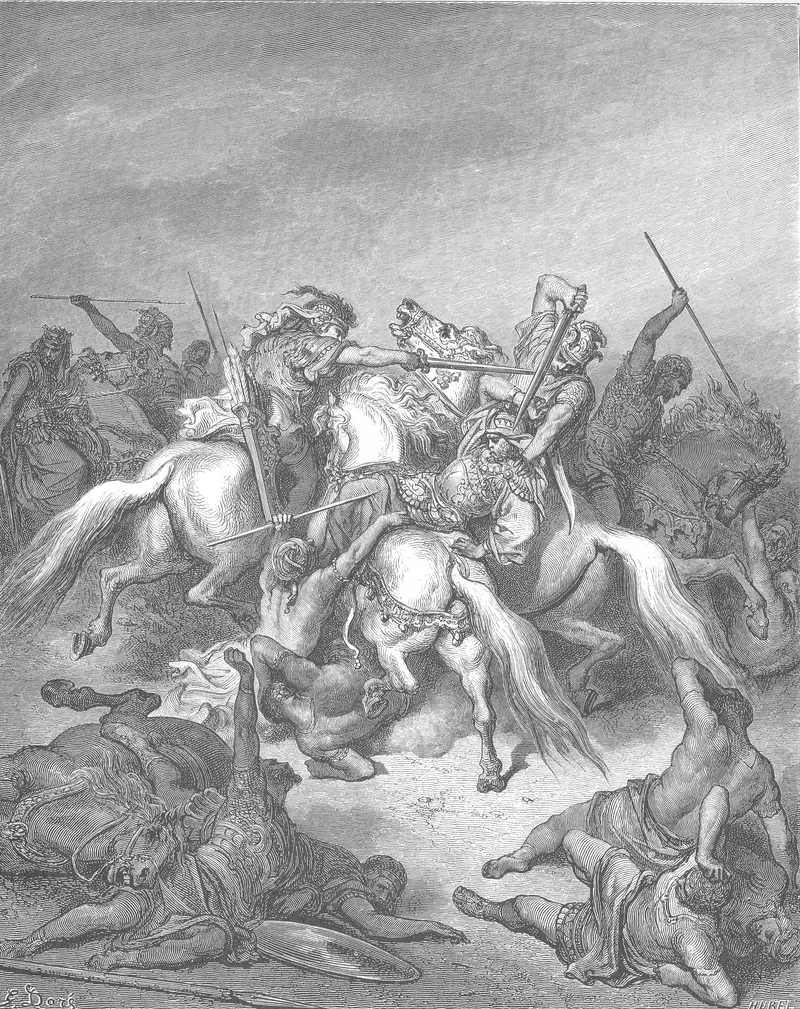
15Moreover the Philistines had yet war again with Israel; and David went down, and his servants with him, and fought against the Philistines: and David waxed faint. 16And Ishbibenob, which was of the sons of the giant, the weight of whose spear weighed three hundred shekels of brass in weight, he being girded with a new sword, thought to have slain David. 17But Abishai the son of Zeruiah succoured him, and smote the Philistine, and killed him. Then the men of David sware unto him, saying, Thou shalt go no more out with us to battle, that thou quench not the light of Israel.
The chapter's last movement turns to war, and to a David we have not seen before. The Philistines had yet war again with Israel, and the king goes down to fight as he always has - but now a new word appears: David waxed faint (v. 15). The shepherd who once ran at Goliath, the warrior of a hundred battles, is growing old, and his strength is failing in the field. Into that vulnerable moment steps a giant: Ishbibenob, which was of the sons of the giant, his spear-head alone weighing three hundred shekels of brass, freshly armed, who thought to have slain David (v. 16).
For the first time the giant nearly wins. The young David of 1 Samuel 17 cut down the towering Philistine and lived; the aging David of 2 Samuel 21 is at the point of being cut down himself. The text is honest about the passing of strength - even the greatest of Israel's warriors comes, at last, to the end of his own might.
Rescue comes from another hand. Abishai cuts the giant down, and David is saved by the loyalty of one of his men. And then the men of David do something tender and decisive: they put their king under oath never to go out to battle again, that thou quench not the light of Israel. The metaphor is arresting. David is their light - the lamp of the nation, the bearer of the covenant promise the LORD had bound to his house.
To lose him in some skirmish would be to snuff a flame far larger than one man's life. So they will not let him risk it. There is real love in the command, and real wisdom: they see that what their king carries matters more than his pride in still going out to fight. If you have ever loved someone enough to tell them, gently, that a fight is no longer theirs to wage - this is that, in armour.
They will spend themselves in the field to keep their lamp burning.
2 Samuel 21:18-22These Four Were Born to the Giant in Gath
18And it came to pass after this, that there was again a battle with the Philistines at Gob: then Sibbechai the Hushathite slew Saph, which was of the sons of the giant. 19And there was again a battle in Gob with the Philistines, where Elhanan the son of Jaareoregim, a Bethlehemite, slew the brother of Goliath the Gittite, the staff of whose spear was like a weaver’s beam. 20And there was yet a battle in Gath, where was a man of great stature, that had on every hand six fingers, and on every foot six toes, four and twenty in number; and he also was born to the giant. 21And when he defied Israel, Jonathan the son of Shimeah the brother of David slew him. 22These four were born to the giant in Gath, and fell by the hand of David, and by the hand of his servants.
The chapter closes with a roll of victories that answer the giant who nearly killed the king. Three more fall: Saph, struck down by Sibbechai the Hushathite (v. 18); the brother of Goliath the Gittite, whose spear-staff was like a weaver's beam - the very phrase once used of Goliath himself - killed by Elhanan (v. 19); and a strange and fearsome figure of great stature… six fingers on each hand and six toes on each foot, four and twenty in number, who defied Israel and was slain by Jonathan, David's nephew (vv. 20-21).
The summary gathers them up: These four were born to the giant in Gath, and fell by the hand of David, and by the hand of his servants (v. 22). Two things are quietly insisted on. The giants are not invincible - the same enemies that loomed so large in David's youth fall again, and keep falling. And the victory belongs to David and his servants together. The aging king can no longer slay every giant himself; now his men stand in the gap, finishing what he began.
The light of Israel is kept burning, and the giants of Gath come to nothing.
Research trail
Sources & further study
These references support the historical, linguistic, manuscript, and contextual notes in this chapter. Scripture remains the primary text; external sources are provided so readers can inspect the research directly.
- 2 Samuel 21 - Translators' NotesThe NET Bible's detailed footnotes on 2 Samuel 21 - the famine “year after year” and the charge against Saul's “bloody house” (v. 1), the standing of the Gibeonites and Israel's ancient oath (v. 2), the difficult hanging “before the LORD” (vv. 6, 9), the textual question behind “the brother of Goliath” (v. 19), and the giant with six fingers and six toes (v. 20).
- 2 Samuel (II Samuel) 21 · Hebrew + classical Jewish commentaryThe Hebrew text of 2 Samuel 21 with Rashi, Radak, and other classical commentators side by side - useful for kaphar (v. 3, the verb behind “make the atonement”), for damim (“blood, bloodguilt,” the “bloody house” of v. 1), for athar (v. 14, “God was intreated”), and for ner (v. 17, the “light” or lamp of Israel his men would not let be quenched).
- 2 Samuel 21 ↔ Genesis 4 · Numbers 35 · Hebrews 12 · John 1Traces the threads tying the defiled land of 2 Samuel 21 - blood that cries from the ground (Gen. 4:10) and a land that cannot be cleansed… but by the blood of him that shed it (Num. 35:33) - to the blood of Jesus that speaketh better things than that of Abel (Heb. 12:24), and the “light of Israel” his men shielded (v. 17) to the Light the darkness comprehended… not (John 1:5).
Where this echoes in Scripture
Let Seven Men of His Sons Be Delivered
- Joshua 9:15And Joshua made peace with them, and made a league with them, to let them live: and the princes of the congregation sware unto them.The oath behind the whole chapter (v. 2) - Israel's sworn covenant with the Gibeonites that Saul later broke.
- Numbers 35:33blood it defileth the land: and the land cannot be cleansed of the blood that is shed therein, but by the blood of him that shed it.The principle beneath the famine (v. 1) - shed blood defiles a land until it is answered.
- Deuteronomy 24:16The fathers shall not be put to death for the children... every man shall be put to death for his own sin.The Law that stands in real tension with the reckoning recorded in verses 6 and 9 - a tension the text leaves open.
- Genesis 4:10The voice of thy brother’s blood crieth unto me from the ground.The first instance of the truth this chapter turns on - innocent blood that cries out and must be answered.
- Hebrews 12:24to the blood of sprinkling, that speaketh better things than that of Abel.Where the cry of all such blood is finally answered - by the blood of Jesus, which speaks pardon where all prior reckonings could only speak justice.
- Hebrews 9:14shall the blood of Christ... purge your conscience from dead works to serve the living God?What the reckoning of verses 6 and 9 could not reach - blood that cleanses the conscience, not only the land.
- 1 John 1:7the blood of Jesus Christ his Son cleanseth us from all sin.The defiled land and people of verse 1 made clean at last - by the one blood the Law pointed toward.
Rizpah on the Rock · And After That God Was Intreated
- 1 Samuel 31:11-13the valiant men... took the body of Saul and the bodies of his sons from the wall of Bethshan... and buried their bones.The earlier loyalty David honours in verse 12 - the men of Jabeshgilead who first recovered Saul's body.
- Genesis 25:21And Isaac intreated the LORD for his wife... and the LORD was intreated of him, and Rebekah his wife conceived.The same verb as verse 14 - God moved to answer the cry of His people.
- Matthew 26:38Then saith he unto them, My soul is exceeding sorrowful, even unto death: tarry ye here, and watch with me.The faithful watch Rizpah keeps (v. 10) - the kind of staying-near in grief the greater King asked of His own.
- John 6:40every one which seeth the Son, and believeth on him, may have everlasting life: and I will raise him up at the last day.What Rizpah's watch could only long for (v. 10) - a King whose care for His own reaches past death itself.
- 1 Corinthians 15:52the trumpet shall sound, and the dead shall be raised incorruptible, and we shall be changed.Where the care Rizpah could only show in guarding the dead finds its answer - the dead kept, and raised.
- Psalm 30:5weeping may endure for a night, but joy cometh in the morning.The shape of verses 10-14 - a long night of grief on the rock, and then the rain at last.
These Four Were Born to the Giant in Gath
- 1 Samuel 17:49-51David... took thence a stone, and slang it, and smote the Philistine in his forehead... So David prevailed over the Philistine.The younger David who felled the giant (v. 16) - now grown faint and needing rescue himself.
- 1 Kings 11:36that David my servant may have a light alway before me in Jerusalem.The promise behind the title “light of Israel” (v. 17) - an unfailing lamp for David's house.
- John 1:4-5In him was life; and the life was the light of men. And the light shineth in darkness; and the darkness comprehended it not.The light David's men feared to lose (v. 17) - in the greater Son of David, a Light the darkness could not put out.
- John 10:11I am the good shepherd: the good shepherd giveth his life for the sheep.The foreshadow of verse 17 turned inside out - the King who went unshielded and laid down His life for the sheep.
- John 1:9That was the true Light, which lighteth every man that cometh into the world.The light of Israel (v. 17) opened wide - a Light given to every man who comes into the world.
- John 11:50it is expedient for us, that one man should die for the people, and that the whole nation perish not.The logic of verse 17 reversed - where David's men spared their king to save the nation, the King died to save His people.
- Romans 8:37Nay, in all these things we are more than conquerors through him that loved us.The truth of verse 22 carried forward - the giants fall, and the victory belongs to the King and His people together.