Ezekiel 46
People in this chapter
After the towering vision of the new temple and the river that flows from it, Ezekiel 46 comes down to the level of an ordinary week. It is a chapter of ordinances - when a certain gate opens, who stands where, what is brought, which way the crowd moves - and it would be easy to skim. But the details carry weight. The chapter opens at the east gate of the inner court, the very gate through which the glory of the LORD had returned to fill the house, and it lays down a rule about access: The gate of the inner court that looketh toward the east shall be shut the six working days; but on the sabbath it shall be opened, and in the day of the new moon it shall be opened (v. 1).
Closed through the working days, opened on the day of rest - the way to the presence of God is granted at the appointed time, on the day that itself speaks of rest.1
Tap any highlighted phrase to jump to the commentary that unpacks it.
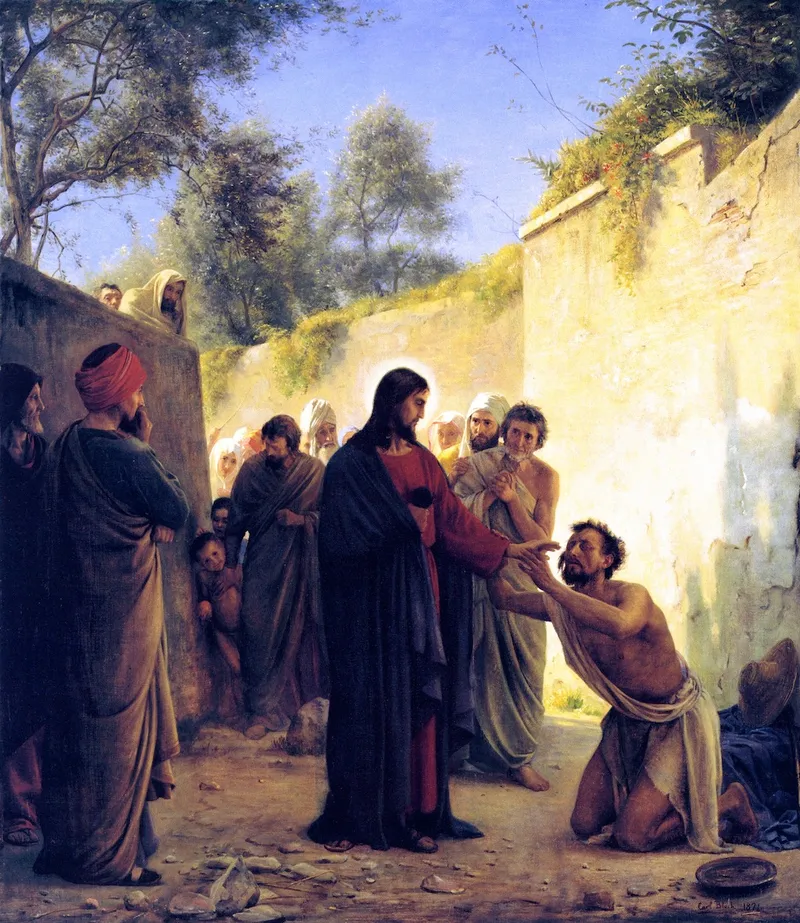
Ezekiel 46:1-8On the Sabbath It Shall Be Opened
1Thus saith the Lord GOD; The gate of the inner court that looketh toward the east shall be shut the six working days; but on the sabbath it shall be opened, and in the day of the new moon it shall be opened. 2And the prince shall enter by the way of the porch of that gate without, and shall stand by the post of the gate, and the priests shall prepare his burnt offering and his peace offerings, and he shall worship at the threshold of the gate: then he shall go forth; but the gate shall not be shut until the evening. 3Likewise the people of the land shall worship at the door of this gate before the LORD in the sabbaths and in the new moons. 4And the burnt offering that the prince shall offer unto the LORD in the sabbath day shall be six lambs without blemish, and a ram without blemish. 5And the meat offering shall be an ephah for a ram, and the meat offering for the lambs as he shall be able to give, and an hin of oil to an ephah. 6And in the day of the new moon it shall be a young bullock without blemish, and six lambs, and a ram: they shall be without blemish. 7And he shall prepare a meat offering, an ephah for a bullock, and an ephah for a ram, and for the lambs according as his hand shall attain unto, and an hin of oil to an ephah. 8And when the prince shall enter, he shall go in by the way of the porch of that gate, and he shall go forth by the way thereof.
The chapter opens at a single gate and lays down a rule about it: The gate of the inner court that looketh toward the east shall be shut the six working days; but on the sabbath it shall be opened, and in the day of the new moon it shall be opened (v. 1). This is the same east gate that, in the great vision a few chapters earlier, the glory of the LORD entered to fill the house - the gate where God came in.
Now we learn how it is used. Six days a week it stands shut. Then, on the sabbath and at the new moon - the appointed times of worship and gladness - it is opened. The detail repays attention. Access to the holy place is not constant and casual, available to anyone on any day for any reason; nor is it ever seized by force. It is appointed, and it is granted. The gate is opened - the verb is passive, the door swings from the inside - on the day set apart for rest and worship.
So the chapter begins by quietly teaching what every worshipper needs to know first: that to come before God is a gift held open at His invitation, not a right exercised at our convenience.1
Through the opened gate the prince comes, and the way he comes is striking: the prince shall enter by the way of the porch of that gate without, and shall stand by the post of the gate… and he shall worship at the threshold of the gate (v. 2). He stands at the post, at the threshold - on the very edge, at the doorway, where the people can see him, while the priests go deeper to prepare his offerings.
The priests prepare his offerings; he himself bows. And then a small phrase governs his whole movement: he shall go forth by the way thereof (v. 8) - he goes out the same way he came in, by the porch of that east gate. The prince is hemmed in by the same reverent order as everyone else. He has a place - a near and honoured place, at the threshold of the gate of God's coming - but it is a bounded place.
He worships where he is told, enters where he is told, leaves where he is told. The greatest man among the people is, before God, first of all a worshipper, standing at the doorway with the rest.
The people are drawn fully into this scene. Likewise the people of the land shall worship at the door of this gate before the LORD in the sabbaths and in the new moons (v. 3). While the prince worships at the threshold, the people gather at the door of the same gate - and the governing phrase is before the LORD. Prince and people stand together in one direction, faces toward the same opened gate, on the same appointed days.
The offerings the prince brings are not stingy tokens: six lambs without blemish, and a ram without blemish on the sabbath (v. 4), a young bullock and more at the new moon (v. 6), each animal without blemish, each meat offering measured out with its hin of oil. The repeated demand for what is without blemish sounds the old note of the whole sacrificial law: what is offered to God is the unflawed best, not the leftover and the lame.
Worship here is generous, costly, and shared - a leader bringing the best he has, and a people gathered with him at the door, all of them looking the same way, toward the LORD.
Ezekiel 46:9-15He Shall Not Return by the Way He Came
9But when the people of the land shall come before the LORD in the solemn feasts, he that entereth in by the way of the north gate to worship shall go out by the way of the south gate; and he that entereth by the way of the south gate shall go forth by the way of the north gate: he shall not return by the way of the gate whereby he came in, but shall go forth over against it. 10And the prince in the midst of them, when they go in, shall go in; and when they go forth, shall go forth. 11And in the feasts and in the solemnities the meat offering shall be an ephah to a bullock, and an ephah to a ram, and to the lambs as he is able to give, and an hin of oil to an ephah. 12Now when the prince shall prepare a voluntary burnt offering or peace offerings voluntarily unto the LORD, one shall then open him the gate that looketh toward the east, and he shall prepare his burnt offering and his peace offerings, as he did on the sabbath day: then he shall go forth; and after his going forth one shall shut the gate. 13Thou shalt daily prepare a burnt offering unto the LORD of a lamb of the first year without blemish: thou shalt prepare it every morning. 14And thou shalt prepare a meat offering for it every morning, the sixth part of an ephah, and the third part of an hin of oil, to temper with the fine flour; a meat offering continually by a perpetual ordinance unto the LORD. 15Thus shall they prepare the lamb, and the meat offering, and the oil, every morning for a continual burnt offering.
Here the chapter gives a rule that seems at first like mere crowd control and turns out to be one of its most searching images: he that entereth in by the way of the north gate to worship shall go out by the way of the south gate; and he that entereth by the way of the south gate shall go forth by the way of the north gate: he shall not return by the way of the gate whereby he came in, but shall go forth over against it (v. 9).
On the level of order it is plain enough - with the great feasts packing the courts, a one-way flow keeps the throng moving and prevents a crush at a single gate. But the wording lingers on something deeper than logistics. He shall not return by the way of the gate whereby he came in. No one leaves where he entered. Every worshipper goes straight through and out over against it, the far side. You cannot come before the LORD and then back out the door you came in by, retracing your steps as if nothing had happened.
To enter true worship is to be carried through and set down somewhere new. The geography itself preaches: the one who has been before God does not go back the way he came.2
In the middle of this moving crowd, one detail about the prince is easy to miss and worth pausing over: And the prince in the midst of them, when they go in, shall go in; and when they go forth, shall go forth (v. 10). At the great feasts the prince is not granted a private entrance or an exemption from the one-way rule. He is in the midst of them - among the people, moving with them, going in when they go in and coming out when they come out, subject to the same flow.
The leader is folded into the worshipping congregation, not lifted above it. And the chapter is careful to honour spontaneous devotion too: when the prince brings a voluntary burnt offering or peace offerings voluntarily unto the LORD, outside the set days, the east gate is opened specially for him - one shall then open him the gate - and shut again after he goes out (v. 12). Worship here has a settled rhythm and also room for the freewill gift; it is ordered without being mechanical.
But the abiding picture is the prince in the press of the crowd, one worshipper among many, going the same way they go.
After the feasts and the freewill offerings comes the quiet backbone of it all: Thou shalt daily prepare a burnt offering unto the LORD of a lamb of the first year without blemish… thou shalt prepare it every morning (v. 13). Underneath the sabbaths and the new moons and the great solemnities runs this steady, unspectacular thing - a lamb, every morning, day after day, without fail. The words press the regularity: every morning (twice), continually, a perpetual ordinance, a continual burnt offering (vv. 13-15).
Most of worship is not the high feast day; most of it is the morning lamb - the ordinary, repeated, unwitnessed offering that begins each day by giving it to God before anything else is done. There is a wisdom here the heart needs. The feasts give worship its peaks, but the daily morning offering gives it its spine. A life with God is built far more out of the unglamorous every morning than out of the rare mountaintop.
And the daily lamb, like the festival lambs, is without blemish - even the routine offering is the unflawed best, the day's first and finest given back to the One who gave the day.
Ezekiel 46:16-24Not by Oppression · The Boiling Places
16Thus saith the Lord GOD; If the prince give a gift unto any of his sons, the inheritance thereof shall be his sons’; it shall be their possession by inheritance. 17But if he give a gift of his inheritance to one of his servants, then it shall be his to the year of liberty; after it shall return to the prince: but his inheritance shall be his sons’ for them. 18Moreover the prince shall not take of the people’s inheritance by oppression, to thrust them out of their possession; but he shall give his sons inheritance out of his own possession: that my people be not scattered every man from his possession. 19After he brought me through the entry, which was at the side of the gate, into the holy chambers of the priests, which looked toward the north: and, behold, there was a place on the two sides westward. 20Then said he unto me, This is the place where the priests shall boil the trespass offering and the sin offering, where they shall bake the meat offering; that they bear them not out into the utter court, to sanctify the people. 21Then he brought me forth into the utter court, and caused me to pass by the four corners of the court; and, behold, in every corner of the court there was a court. 22In the four corners of the court there were courts joined of forty cubits long and thirty broad: these four corners were of one measure. 23And there was a row of building round about in them, round about them four, and it was made with boiling places under the rows round about. 24Then said he unto me, These are the places of them that boil, where the ministers of the house shall boil the sacrifice of the people.
The chapter turns now to the prince's property, and what looks like a dry inheritance statute is really a fence built around the people. If the prince give a gift unto any of his sons, the inheritance thereof shall be his sons' (v. 16) - a gift to a son stays in the family permanently. But a gift to a servant is different: it shall be his to the year of liberty; after it shall return to the prince (v. 17).
The year of liberty is the year of release, when in Israel's law debts were forgiven and alienated land returned to its original family. The prince may be generous, but he cannot permanently alienate the crown's holdings into private hands; everything granted away comes home at the jubilee. The point of the whole arrangement is named in the next verse: stability. The land is to stay where it belongs, generation after generation, so that no family is uprooted and scattered.
Even the inheritance of the highest figure in the land is governed by a law meant to protect the smallest landholder from being slowly dispossessed.
Then comes the verse that gives this section its moral spine: Moreover the prince shall not take of the people's inheritance by oppression, to thrust them out of their possession; but he shall give his sons inheritance out of his own possession: that my people be not scattered every man from his possession (v. 18). Here is the whole law of the prince in one sentence, and it cuts directly against the way power usually behaves.
The temptation of every ruler is to use his office to enlarge himself - to seize a vineyard he covets, to tax the small farmer off his ground, to provide for his own household out of the people's pockets. The prince in Ezekiel's vision is forbidden it absolutely. He must endow his sons out of his own possession, never by oppression, never by thrusting anyone out. The grief of Israel's history of bad kings - the Ahabs and the Jehoiakims who built their houses by wrong - is answered here by a leader bound to provide from what is his and to leave the people untouched in theirs.
Authority, in the renewed community, exists to protect the people's inheritance, not to consume it. The measure of the prince is how secure the least of his people are in what is theirs.
The vision that opened with the glory of God filling the temple ends, surprisingly, in the kitchens. Ezekiel is led to the holy chambers of the priests, and shown the place where the priests shall boil the trespass offering and the sin offering, where they shall bake the meat offering (vv. 19-20); then out to the four corners of the great court, where four smaller courts hold boiling places - the places of them that boil, where the ministers of the house shall boil the sacrifice of the people (vv. 21-24).
After chapter upon chapter of soaring measurement, the tour comes to rest at the cooking fires in the corners. Yet even these are measured, of one measure, deliberately placed. Two things are quietly taught. First, the priests' offerings are cooked apart, in the inner chambers, lest the holy be carried carelessly out into the utter court - what belongs to God is handled with care to its very last detail. Second, and more warmly: the corners matter.
There is no scrap of this house, down to the boiling pots where a meal is prepared, that lies outside the order of God's dwelling. The grand vision deliberately includes the kitchens - because in a place wholly given to God, nothing is too small or too ordinary to be brought within the pattern and set in its place.2
Research trail
Sources & further study
These references support the historical, linguistic, manuscript, and contextual notes in this chapter. Scripture remains the primary text; external sources are provided so readers can inspect the research directly.
- Ezekiel 46 - Translators' NotesThe NET Bible's detailed footnotes on Ezekiel 46 - the shut-and-opened east gate of verses 1-2, the prescribed sabbath and new-moon offerings, the much-discussed movement of the crowd in verse 9, the continual morning offering of verses 13-15, and the inheritance law that forbids the prince to oppress (vv. 16-18).
- Ezekiel 46 · Hebrew + classical Jewish commentaryThe Hebrew text of Ezekiel 46 with Rashi, Radak, and other classical commentators side by side - useful for the verb yippateach (vv. 1, 12, “it shall be opened”), for nasi (the “prince” of vv. 2, 8, 16-18), and for the puzzling traffic rule of verse 9 about entering one gate and leaving by the opposite one.
- Ezekiel 46 ↔ Hebrews 4 & 10 · 2 Corinthians 5 · Mark 10Traces the threads tying Ezekiel 46 to the rest of Scripture - the gate opened on the sabbath (v. 1) read beside the rest that remains for the people of God (Heb. 4:9-10), the worshipper who does not return the way he came (v. 9) beside the new creature for whom old things are passed away (2 Cor. 5:17), and the serving prince (v. 18) beside the Son of man who came… to minister (Mark 10:45).
Where this echoes in Scripture
On the Sabbath It Shall Be Opened
- Ezekiel 43:4And the glory of the LORD came into the house by the way of the gate whose prospect is toward the east.The same east gate of verses 1-2 - the gate through which the glory of the LORD had entered to fill the house.
- Hebrews 10:19-20Having therefore, brethren, boldness to enter into the holiest by the blood of Jesus, by a new and living way.The opened way of verse 1 fulfilled - access into God's presence consecrated through Christ.
- Hebrews 4:9-10There remaineth therefore a rest to the people of God... he also hath ceased from his own works.The rest the sabbath gate (v. 1) pointed toward - the rest that remains for the people of God.
- Psalm 100:4Enter into his gates with thanksgiving, and into his courts with praise: be thankful unto him, and bless his name.The posture of the worshippers in verse 3 - coming through the gate to worship before the LORD.
- Malachi 1:8And if ye offer the blind for sacrifice, is it not evil? ... offer it now unto thy governor.The reverse of verses 4-6 - the offerings here are pointedly “without blemish,” the unflawed best.
He Shall Not Return by the Way He Came
- 2 Corinthians 5:17If any man be in Christ, he is a new creature: old things are passed away; behold, all things are become new.The meaning of verse 9 in person - the one who truly comes before God goes out changed, made new.
- Luke 24:32-33Did not our heart burn within us... And they rose up the same hour, and returned to Jerusalem.Worshippers who went out changed (v. 9) - men who met the risen Christ and did not stay where they were.
- Exodus 29:38-39two lambs of the first year day by day continually. The one lamb thou shalt offer in the morning.The continual morning offering of verses 13-15 - the daily lamb commanded from the beginning of the tabernacle.
- Lamentations 3:22-23his compassions fail not. They are new every morning: great is thy faithfulness.The “every morning” rhythm of verse 13 - daily worship answering daily mercy.
- Romans 12:1present your bodies a living sacrifice, holy, acceptable unto God, which is your reasonable service.The continual, “without blemish” offering of verses 13-15 carried into the believer's daily life.
Not by Oppression · The Boiling Places
- Mark 10:42-45whosoever will be great among you, let him be your minister... the Son of man came not to be ministered unto, but to minister.The law of the serving prince (v. 18) named in person - greatness that ministers, bowing before God to serve the people.
- Ezekiel 34:23And I will set up one shepherd over them, and he shall feed them, even my servant David.The Shepherd-Prince behind the prince of this chapter - the leader who feeds the flock and keeps them safe in their own pasture.
- 1 Kings 21:18-19Hast thou killed, and also taken possession? ... In the place where dogs licked the blood of Naboth.The oppression of verse 18 named - the seized vineyard that the renewed prince is forbidden to repeat.
- Leviticus 25:10ye shall return every man unto his possession, and ye shall return every man unto his family.The “year of liberty” of verse 17 - the jubilee that returns alienated land to its family.
- Zechariah 14:20-21every pot in Jerusalem and in Judah shall be holiness unto the LORD.The sanctified kitchens of verses 19-24 - a day when even the cooking pots are holy to the LORD.