Joshua 14
People in this chapter
Joshua 14 opens the long account of how the Promised Land was parcelled out among the tribes. Two and a half tribes had already received their territory east of the Jordan from Moses; now the nine and a half tribes on the west side receive theirs. The work is done with great care and shared authority - Eleazar the priest, and Joshua the son of Nun, and the heads of the fathers of the tribes distribute the land together (v. 1), and they do it by lot, the method the Old Testament treats as God's own decision made visible.
The Levites alone receive no tribal land; they are given cities to dwell in among the others, for their portion is the service of the LORD. Everything is done, the text insists, as the LORD commanded Moses (v. 5).1
Tap any highlighted phrase to jump to the commentary that unpacks it.
Joshua 14:1-5The Inheritance Divided by Lot
1And these are the countries which the children of Israel inherited in the land of Canaan, which Eleazar the priest, and Joshua the son of Nun, and the heads of the fathers of the tribes of the children of Israel, distributed for inheritance to them. 2By lot was their inheritance, as the LORD commanded by the hand of Moses, for the nine tribes, and for the half tribe. 3For Moses had given the inheritance of two tribes and an half tribe on the other side Jordan: but unto the Levites he gave none inheritance among them. 4For the children of Joseph were two tribes, Manasseh and Ephraim: therefore they gave no part unto the Levites in the land, save cities to dwell in, with their suburbs for their cattle and for their substance. 5As the LORD commanded Moses, so the children of Israel did, and they divided the land.
The chapter opens on a scene of order and shared responsibility: these are the countries which the children of Israel inherited… which Eleazar the priest, and Joshua the son of Nun, and the heads of the fathers of the tribes… distributed for inheritance to them (v. 1). Three kinds of authority stand together over the work. Eleazar the priest represents the LORD before the people; Joshua is the leader who succeeded Moses; and the heads of the fathers are the elders who speak for each clan.
No single man parcels out the land by his own preference. The distribution is a corporate act, and the very listing of these names is a quiet guard against favoritism: a priest, a leader, and the family heads, all witnessing the same allotment. This is how God's people receive what He has promised - in an order that answers to Him and protects the whole.
The method of dividing is named at once: by lot was their inheritance, as the LORD commanded by the hand of Moses (v. 2). The casting of lots was, in Israel, a way of taking the decision out of human hands and placing it in God's. No tribe could complain that Joshua had played favorites; the portions fell as they fell, and the people received them as from the LORD. Notice too the long obedience behind the moment.
The command had come by the hand of Moses - years before, in the wilderness - and now it is carried out to the letter under Joshua. The bookends of the section say the same thing: as the LORD commanded by the hand of Moses (v. 2) and as the LORD commanded Moses, so the children of Israel did (v. 5). The inheritance is real estate, but it is handled as a sacred trust. What God promised, God apportions; the people's part is to obey the manner He set.
One tribe is singled out for a portion unlike all the others: unto the Levites he gave none inheritance among them… save cities to dwell in, with their suburbs for their cattle and for their substance (vv. 3-4). The arithmetic is worth following. Joseph's line had become two tribes, Manasseh and Ephraim, which would have made thirteen portions for twelve shares of land; so the Levites, set apart for the service of the tabernacle, receive no single territory of their own.
Instead they are given cities scattered through every other tribe's land, with surrounding pasture for their flocks. This is a calling. The tribe charged with teaching the Law and tending the worship of God is deliberately spread among all the others, so that no part of Israel is far from those who serve at the altar. Their portion, as the Law had already said, is the LORD Himself - and a people whose ministers own no rival kingdom of their own.
Joshua 14:6-9“I Wholly Followed the LORD My God”
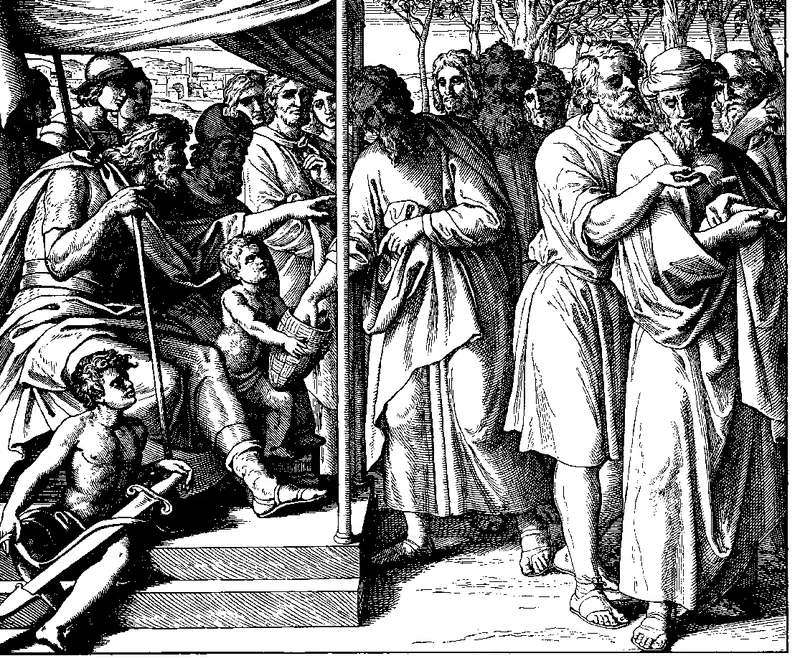
6Then the children of Judah came unto Joshua in Gilgal: and Caleb the son of Jephunneh the Kenezite said unto him, Thou knowest the thing that the LORD said unto Moses the man of God concerning me and thee in Kadeshbarnea. 7Forty years old was I when Moses the servant of the LORD sent me from Kadeshbarnea to espy out the land; and I brought him word again as it was in mine heart. 8Nevertheless my brethren that went up with me made the heart of the people melt: but I wholly followed the LORD my God. 9And Moses sware on that day, saying, Surely the land whereon thy feet have trodden shall be thine inheritance, and thy children’s for ever, because thou hast wholly followed the LORD my God.
Caleb opens not with a demand but with a memory: Thou knowest the thing that the LORD said unto Moses the man of God concerning me and thee in Kadesh-barnea (v. 6). Three things in that single sentence are worth weighing. First, he appeals to what Joshua himself knows - thou knowest. He is not inventing a claim; he is recalling a promise both of them witnessed. Second, he calls it the thing that the LORD said, not the thing Moses said; the promise was God's, and Moses only its mouthpiece.
Third, he ties the word to me and thee - Joshua too had been one of the faithful spies, so the two old men standing here are the last survivors of a generation that died in the wilderness. The detail the children of Judah came unto Joshua in Gilgal shows Caleb coming with his tribe and in good order, through the proper channel, to the appointed leader. He does not seize the land; he comes to the man God set over the dividing of it, and he asks for what God promised.
Caleb recounts his commission with quiet exactness: Forty years old was I when Moses the servant of the LORD sent me from Kadesh-barnea to espy out the land; and I brought him word again as it was in mine heart (v. 7). That last phrase is the hinge of his whole testimony. The other spies brought back a report shaped by what their eyes had measured - the height of the walls, the size of the men - and then by the fear those measurements stirred.
Caleb brought back word as it was in mine heart. His report flowed from settled trust in the God who had promised the land. He saw the same giants and the same fortifications the others saw; the difference was never in the eyes but in the heart behind them. A faithful witness is one whose inner conviction about God is larger than the danger he sees.
Then comes the contrast that defines Caleb against his peers: Nevertheless my brethren that went up with me made the heart of the people melt: but I wholly followed the LORD my God (v. 8). The phrase made the heart of the people melt is exact and terrible. The ten spies did not merely disagree; their report dissolved a whole nation's courage, and the people who heard it wept through the night and turned to go back to Egypt.
Unbelief is contagious, and it spreads downward into others. Over against that mass of melted hearts stands one man and one phrase: I wholly followed the LORD my God. Caleb says he wholly followed - that he gave God his whole allegiance, with nothing held back. That, and not any natural advantage, is what set him apart, and it is the one thing the chapter will repeat over him again and again.
Caleb closes this part of his appeal with the promise itself: And Moses sware on that day, saying, Surely the land whereon thy feet have trodden shall be thine inheritance, and thy children's for ever, because thou hast wholly followed the LORD my God (v. 9). The reward is fitted to the man. Caleb's feet had walked that land as a spy when ten others walked it in dread; now the very ground his feet had trodden would be his.
And the promise reaches past him: and thy children's for ever. Faithfulness does not buy a passing favor; it secures an inheritance that outlasts the faithful one and passes to his line. The ground of the gift is stated for the third time in four verses, hammered home so it cannot be missed: because thou hast wholly followed the LORD my God. The land is the LORD keeping His sworn word to a man who kept faith with Him.
Joshua 14:10-15Give Me This Mountain
10And now, behold, the LORD hath kept me alive, as he said, these forty and five years, even since the LORD spake this word unto Moses, while the children of Israel wandered in the wilderness: and now, lo, I am this day fourscore and five years old. 11As yet I am as strong this day as I was in the day that Moses sent me: as my strength was then, even so is my strength now, for war, both to go out, and to come in. 12Now therefore give me this mountain, whereof the LORD spake in that day; for thou heardest in that day how the Anakims were there, and that the cities were great and fenced: if so be the LORD will be with me, then I shall be able to drive them out, as the LORD said. 13And Joshua blessed him, and gave unto Caleb the son of Jephunneh Hebron for an inheritance. 14Hebron therefore became the inheritance of Caleb the son of Jephunneh the Kenezite unto this day, because that he wholly followed the LORD God of Israel. 15And the name of Hebron before was Kirjatharba; which Arba was a great man among the Anakims. And the land had rest from war.
Caleb's testimony turns now to the long, hidden faithfulness of God across four decades: And now, behold, the LORD hath kept me alive, as he said, these forty and five years… and now, lo, I am this day fourscore and five years old (v. 10). Pause over kept me alive. Caleb does not say he survived, or that he was lucky, or that he had a strong constitution. He says the LORD kept him - preserved him deliberately, with intention, through years that were not even his to enjoy.
Thirty-eight of those forty-five were the wilderness years, the penalty an unbelieving generation brought on itself, when Caleb wandered in a desert he had never deserved because others would not trust God. Yet he frames even those years as God's personal care, not as time stolen from him. There is a deep lesson in that accounting. The faithful often spend long stretches waiting in circumstances they did not choose, paying, in part, for the failures of others.
Caleb teaches us how to read such years: as God keeping us alive for a promise not yet come.
The old soldier makes a startling claim about his own vigor: As yet I am as strong this day as I was in the day that Moses sent me: as my strength was then, even so is my strength now, for war, both to go out, and to come in (v. 11). The phrase to go out, and to come in was a soldier's expression for active campaigning - marching out to battle and returning from it.
Caleb is not boasting of a comfortable old age; he is volunteering for the front line. The repetition is emphatic and exact: as my strength was then, even so is my strength now. This is told not as poetry but as fact - the concrete evidence of God's keeping. The same LORD who preserved Caleb's life through the wilderness also preserved his strength, and did not withdraw it the moment it was finally time to fight.
Forty-five years of waiting had not worn him soft. The man who trusted God at forty is, at eighty-five, still fit for the hardest work God might assign - because the strength was always the LORD's gift.
Then comes the request the whole chapter has been building toward, and the way Caleb frames it is the heart of the matter: Now therefore give me this mountain… for thou heardest in that day how the Anakims were there, and that the cities were great and fenced: if so be the LORD will be with me, then I shall be able to drive them out, as the LORD said (v. 12). He names the danger honestly - the giants, the great fenced cities - and asks for exactly that hard country anyway.
And he hangs the whole venture on one phrase: if so be the LORD will be with me. This is the language of faith that knows precisely where its power lies. Caleb does not say I am strong enough to take them - though he has just testified to his strength. He says his ability rests entirely on God's presence with him: if the LORD is with me, then I shall be able. After forty-five years of watching God keep His word, Caleb still refuses to lean on his own arm.
His confidence is total and his self-reliance is nil - and the two go together. The most assured faith is also the most dependent, resting its whole weight on the LORD who promised to be there.
Joshua's response is generous and glad: And Joshua blessed him, and gave unto Caleb the son of Jephunneh Hebron for an inheritance… because that he wholly followed the LORD God of Israel (vv. 13-14). Joshua does not begrudge his old comrade the choicest, hardest prize; he blesses him - speaks good over him - and grants the request. And the narrator, recording it from a later vantage, drives the refrain home one final time: Hebron remained Caleb's unto this day, because that he wholly followed the LORD God of Israel. This is the third time the phrase falls (vv. 8, 9, 14), and now it carries the full weight of the chapter.
Why does this one man, of all that generation, receive the mountain while the rest sleep in the wilderness? Because he wholly followed. Whole-hearted devotion to the LORD is the single thread running from the frightened camp at Kadesh-barnea to the granting of Hebron forty-five years later. It is the explanation the text gives, and it is the one it wants the reader to keep.
The chapter does not end on Caleb's triumph but on a wider peace: And the name of Hebron before was Kirjath-arba; which Arba was a great man among the Anakims. And the land had rest from war (v. 15). The old name is telling. Kirjath-arba means the city of Arba, who had been a great man among the Anakims - that is, the very stronghold Caleb asked for had belonged to the giants, named after the greatest of them.
The mountain he claimed was no symbolic victory; it was the concrete hill country of Israel's most feared enemies, and faith laid hold of it. And then the last line lifts the eye from the one man to the whole people: the land had rest from war. This is the note the book of Joshua keeps returning to - rest, the settled quiet that the promises were always aimed at. The conquest was the long road to a land at peace, where Israel could dwell under God's blessing.
Caleb's wholehearted faith won him a mountain, and the faithfulness of God won the nation its rest.
Research trail
Sources & further study
These references support the historical, linguistic, manuscript, and contextual notes in this chapter. Scripture remains the primary text; external sources are provided so readers can inspect the research directly.
- Joshua 14 - Translators' NotesThe NET Bible's detailed footnotes on Joshua 14 - the casting of lots and the shared authority of priest, leader, and clan-heads in verses 1-5, the Levites' cities in place of a land portion (v. 4), Caleb's undiminished strength at eighty-five (vv. 10-11), and the great fenced cities of the Anakim that he asks to drive out (v. 12).
- Joshua 14 · Hebrew + classical Jewish commentaryThe Hebrew text of Joshua 14 with Rashi, Radak, and other classical commentators side by side - useful for the recurring idiom mille acharei (vv. 8, 9, 14, “wholly followed,” literally “filled up after”), for ha-har hazzeh (v. 12, “this mountain”), and for the casting of the goral (v. 2, the “lot”) by which the land was divided.
- Joshua 14 ↔ Numbers 13-14 · Deuteronomy 1 · Hebrews 3Traces the threads tying Joshua 14 to the rest of Scripture - Caleb's minority report at Kadesh-barnea (Num. 13-14; Deut. 1:36), the oath Moses sware over the land his feet had trodden (v. 9), and the warning of Hebrews 3-4 that an unbelieving generation could not enter in because of unbelief while the faithful inherit the promised rest (v. 15).
Where this echoes in Scripture
The Inheritance Divided by Lot
- Numbers 26:55-56Notwithstanding the land shall be divided by lot... According to the lot shall the possession thereof be divided.The command, given in the wilderness, that verses 1-2 now carry out - the land apportioned by lot.
- Proverbs 16:33The lot is cast into the lap; but the whole disposing thereof is of the LORD.Why a whole land could be divided by lot without strife (v. 2) - the outcome was received as God's decision.
- Numbers 18:20Thou shalt have no inheritance in their land... I am thy part and thine inheritance among the children of Israel.The reason the Levites receive cities but no territory (vv. 3-4) - their inheritance is the LORD Himself.
- Ephesians 1:11In whom also we have obtained an inheritance, being predestinated according to the purpose of him who worketh all things.The inheritance apportioned by God's own counsel (v. 2) - carried from land to salvation.
- 1 Peter 1:4To an inheritance incorruptible, and undefiled, and that fadeth not away, reserved in heaven for you.The portion that outlasts every plot of ground divided here - the inheritance kept for those in Christ.
“I Wholly Followed the LORD My God”
- Numbers 13:30Caleb stilled the people before Moses, and said, Let us go up at once, and possess it; for we are well able to overcome it.The day at Kadesh-barnea Caleb recalls in verses 6-8 - the lone voice of faith against the fearful report.
- Numbers 14:24But my servant Caleb... hath followed me fully... him will I bring into the land whereinto he went; and his seed shall possess it.The LORD's own words behind the oath of verse 9 - the promise to the man who followed fully.
- Deuteronomy 1:36Save Caleb the son of Jephunneh; he shall see it, and to him will I give the land that he hath trodden upon... because he hath wholly followed the LORD.Moses recounting the same promise (v. 9) - the land Caleb's feet had trodden, given for wholly following.
- John 17:4I have glorified thee on the earth: I have finished the work which thou gavest me to do.The wholeness Caleb pictures (v. 8) carried to its fullness - the Son who completely did the Father's will.
- Romans 8:17And if children, then heirs; heirs of God, and joint-heirs with Christ.The inheritance given for wholly following (v. 9) opened to all who follow the One who wholly followed.
Give Me This Mountain
- Psalm 84:7They go from strength to strength, every one of them in Zion appeareth before God.The pattern of Caleb's undimmed vigor (vv. 10-11) - faith that gains strength rather than losing it.
- 2 Corinthians 4:16Though our outward man perish, yet the inward man is renewed day by day.How a man of eighty-five could still ask for the mountain (v. 12) - the inner renewal that outpaces the body.
- Hebrews 10:23Let us hold fast the profession of our faith without wavering; (for he is faithful that promised.)Caleb holding an unseen promise for forty-five years (v. 10) - faith anchored in the One who promised.
- Matthew 28:20Lo, I am with you alway, even unto the end of the world.The presence Caleb staked everything on - if so be the LORD will be with me (v. 12) - promised to all Christ sends.
- Joshua 21:44-45And the LORD gave them rest round about... There failed not ought of any good thing which the LORD had spoken.The rest the chapter ends on (v. 15) - the settled peace every promise of God was aimed at.