Judith 16
People in this chapter
How do you respond when the worst has been averted? The book of Judith answers with a song. The siege is broken, the great general lies dead, and the enemy that bragged it would burn Israel's borders and carry off her children has fled in panic. Judith, the widow whose courage saved a city, gathers the people and lifts a canticle to the Lord. Every line of it turns the glory back to God.
She names herself only as the instrument God used, "the daughter of Merari," and she names the Lord again and again as the one who truly fought and won. This is what a rescued people sound like when they remember who rescued them.
Tap any highlighted phrase to jump to the commentary that unpacks it.
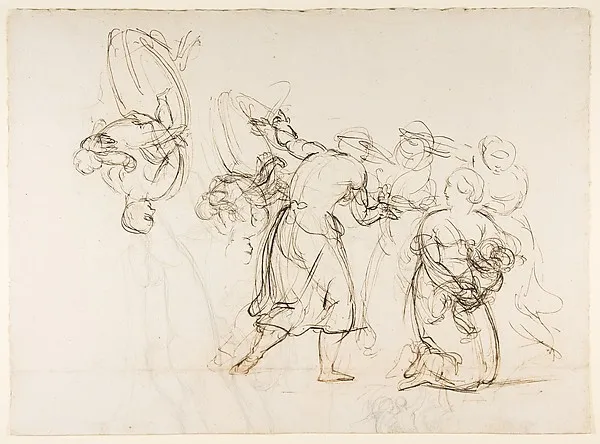
Judith 16:1-4A New Song to the God Who Ends Wars
1Then Judith sung this canticle to the Lord, saying: 2Begin ye to the Lord with timbrels, sing ye to the Lord with cymbals, tune unto him a new psalm, extol and call upon his name.
Deliverance breaks into music. As Miriam took the timbrel after the sea, and Deborah sang after the battle, so Judith leads the people in a "new psalm." The instruments are gathered, the voices are lifted, and the first instinct of a rescued people is praise. Notice that the song is commanded before it is sung: "Begin ye to the Lord." Worship here is the deliberate first act of a people who know who saved them, a choice made before the feeling has even settled. They call upon His name because the victory was never theirs to claim.
3The Lord putteth an end to wars, the Lord is his name. 4He hath set his camp in the midst of his people, to deliver us from the hand of all our enemies.
Here is the heart of the song. "The Lord putteth an end to wars, the Lord is his name." The God who saves Israel is not merely a stronger warrior among warriors; He is the one who brings the fighting itself to an end. The line echoes the Psalmist's "He maketh wars to cease unto the end of the earth" (Psalm 46:9). And then a tender image follows: God has pitched His camp in the very midst of His people.
The Almighty does not direct the battle from a distance. He dwells with the besieged, settles among the frightened, and delivers them from inside their own ranks.
Judith 16:5-12The Mighty One Fell by the Hand the Lord Chose
5The Assyrians came out of the mountains from the north in the multitude of his strength: his multitude stopped up the torrents, and their horses covered the valleys. 6He bragged that he would set my borders on fire, and kill my young men with the sword, to make my infants a prey, and my virgins captives.
The song recalls the terror it sprang from. The Assyrian host poured down from the north so vast that it choked the streams and blanketed the valleys with horses. And the enemy boasted, loudly, of what he would do: burn the borders, cut down the young men, seize the infants and the young women as plunder. The poem lets the threat stand in its full ugliness for a reason. Worship that forgets the size of the danger forgets the size of the rescue. By naming the brag, Judith sharpens the wonder of what God did to it.
7But the almighty Lord hath struck him, and hath delivered him into the hands of a woman, and hath slain him. 8For their mighty one did not fall by young men, neither did the sons of Titan strike him, nor tall giants oppose themselves to him, but Judith the daughter of Merari weakened him with the beauty of her face.
This is the line the whole book has been building toward. "The almighty Lord hath struck him, and hath delivered him into the hands of a woman." The grammar is careful: the Lord struck, the Lord delivered, and the hand He used was a woman's. The poem piles up the warriors who did not topple the general, the strong young men, the legendary giants of old story, the towering figures whose names ancient peoples used to conjure power.
None of them brought him down. God chose instead the one the world counted weakest, and through her courage the proud was undone. It is the pattern Scripture loves: God takes the unlikely instrument so that the glory cannot be mistaken for human strength.
11Her sandals ravished his eyes, her beauty made his soul her captive, with a sword she cut off his head. 12The Persians quaked at her constancy, and the Medes at her boldness.
The song does not soften the deed. The man who came to enslave a nation was disarmed by his own appetite and fell to the courage of the woman he meant to conquer. The poem holds her "constancy" and her "boldness" up for honor: the steadiness of one faithful heart is what makes enemies quake. Scripture tells such stories without dressing them up, the way it tells of Jael and the tent peg, because the point is that the proud who set themselves against God and His people do not stand, and that God can hang the deliverance of many on the nerve of one.
Judith 16:13-19A Hymn to the Creator Whom None Can Resist
15Let us sing a hymn to the Lord, let us sing a new hymn to our God. 16O Adonai, Lord, great art thou, and glorious in thy power, and no one can overcome thee.
The song lifts off from the battlefield and rises into pure adoration. "Let us sing a new hymn to our God." It opens with the holy name itself, Adonai, Lord, and declares Him great, glorious in power, and unconquerable. The deliverance from Holofernes was only a window; through it the singer sees the God who stands behind every rescue, the One no force in heaven or earth can overcome. A particular victory has opened out into the worship of the God of all victories.
17Let all thy creatures serve thee: because thou hast spoken, and they were made: thou didst send forth thy spirit, and they were created, and there is no one that can resist thy voice. 18The mountains shall be moved from the foundations with the waters: the rooks shall melt as wax before thy face.
The hymn now reaches all the way back to the beginning. God spoke, and the creatures came to be; He sent forth His spirit, and they were brought into being. The language leans on Genesis and the Psalms, where God says "Let there be" and it is so, and where "by the word of the LORD were the heavens made" (Psalm 33:6). The same breath that hovered over the deep at creation is the breath that brings life into all things.
And the conclusion is irresistible in every sense: "there is no one that can resist thy voice." The God who calls worlds into being and melts mountains like wax is the God who fights for the lowly. His creative power and His saving power are the same power.
After the trembling mountains and the melting rocks comes a line of pure tenderness: "they that fear thee, shall be great with thee in all things." The God before whom creation dissolves bends down to lift up those who revere Him. To "fear" the Lord here is the awe that bows low and finds itself raised, the reverence that steadies. The proud are warned in the next breath, but the God-fearing are promised greatness, held in Him, sharing in His own life and honor.
The whole arc of the hymn lands here: the smallness of the faithful is no barrier, because their greatness is held in God Himself.
Judith 16:20-25Up to Jerusalem, and the Spoils Laid Before God
20Woe be to the nation that riseth up against my people: for the Lord almighty will take revenge on them, in the day of judgment he will visit them. 21For he will give fire, and worms into their flesh, that they may burn, and may feel for ever.
The hymn closes with a solemn warning. The nation that rises against God's people brings judgment on itself, and the imagery is severe, drawn from the prophets' pictures of the doom of the proud. Scripture lets such language stand without softening it: those who set themselves against God and crush the helpless are not promised a comfortable end. The warning is the dark side of the same truth that comforts the faithful. The God who lifts up the lowly is the God who will not let cruelty have the last word, and the day of His visitation is real.
22And it came to pass after these things, that all the people, after the victory, came to Jerusalem to adore the Lord: and as soon as they were purified, they all offered holocausts, and vows, and their promises. 23And Judith offered for an anathema of oblivion all the arms of Holofernes, which the people gave her, and the canopy that she had taken away out of his chamber.
The song gives way to worship in the flesh. The whole people make the journey up to Jerusalem to adore the Lord, and they come purified, offering their sacrifices and paying the vows they had made in the dark hours of the siege. Then Judith does something striking. The spoils of war that were given to her, the weapons of Holofernes and the canopy from his tent, she does not keep as trophies. She devotes them wholly to God, setting them apart so that nothing of the victory enriches her.
The plunder that could have made her proud is laid before the Lord instead, a final refusal to take for herself any of the glory.
24And the people were joyful in the sight of the sanctuary, and for three months the joy of this victory was celebrated with Judith. 25And after those days every man returned to his house, and Judith was made great in Bethulia, and she was most renowned in all the land of Israel.
The promise of verse nineteen comes true before our eyes. "They that fear thee, shall be great with thee in all things," the hymn had said, and now Judith, who feared the Lord and gave Him every scrap of the glory, is "made great in Bethulia" and renowned across all Israel. The greatness is given, freely and in God's own time. For three months the people rejoice in the sight of the sanctuary, their joy rooted in worship, in the living reality of what God has done.
Then ordinary life resumes; every man goes home. Honor settles on the woman who never reached for it, the quiet shape of a God who exalts the humble in His own time.
Judith 16:26-31A Land at Peace, and a Day Kept Holy
28And she abode in her husband’s house a hundred and five years, and made her handmaid free, and she died, and was buried with her husband in Bethulia. 29And all the people mourned for seven days.
The story closes with the gentle cadence of a long life well lived. Judith remains in her husband's house, honored and constant, to a great age, and before she dies she sets her faithful handmaid free, a last act of generosity from a woman who kept giving things away. She is buried beside her husband Manasses, and all the people mourn her for seven days, the full measure of grief Israel gave its most beloved.
A life that reached its summit in one night of terrible courage comes to rest in peace, surrounded by a people who never forgot what God did through her.
30And all the time of her life there was none that troubled Israel, nor many years after her death. 31But the day of the festivity of this victory is received by the Hebrews in the number of holy days, and is religiously observed by the Jews from that time until this day.
The book's final note is peace. As long as Judith lived, and for many years after, no enemy troubled Israel. One faithful life left a long wake of safety behind it. And the deliverance was not allowed to fade from memory; the day of victory was taken into the calendar of holy days and kept by the people from that time on. This is how Israel remembered: with a day set apart, a recurring return to recall what God had done, a feast that carried the story into every generation.
The story ends by handing the memory forward, so that those who never saw the siege would still keep the feast and tell the reason for it.
Where this echoes in Scripture
A New Song to the God Who Ends Wars
- Exodus 15:20-21And Miriam the prophetess... took a timbrel in her hand... Sing ye to the LORD, for he hath triumphed gloriously.A woman leads the timbrels in song after God breaks the enemy, the same pattern as Judith.
- Psalm 46:9He maketh wars to cease unto the end of the earth; he breaketh the bow, and cutteth the spear in sunder.The exact claim of Judith's opening line: the Lord ends wars.
- Psalm 98:1O sing unto the LORD a new song; for he hath done marvellous things.The new song is the standing response to a fresh act of God's salvation.
The Mighty One Fell by the Hand the Lord Chose
- Judges 4:21Then Jael... took a nail of the tent... and smote the nail into his temples... so he died.Another time God delivers a whole army into the hand of one resolute woman.
- 1 Corinthians 1:27God hath chosen the weak things of the world to confound the things which are mighty.The exact logic of verse 8: God uses the unlikely so the glory is His.
- 1 Samuel 17:50So David prevailed over the Philistine with a sling and with a stone... but there was no sword in the hand of David.The giant falls to the one God chose; the same pattern as Holofernes.
A Hymn to the Creator Whom None Can Resist
- Psalm 33:6By the word of the LORD were the heavens made; and all the host of them by the breath of his mouth.The very claim of verse 17: God spoke and sent His breath, and creation was.
- Psalm 97:5The hills melted like wax at the presence of the LORD, at the presence of the Lord of the whole earth.The melting mountains of verse 18 are a standing image of God's overwhelming presence.
- John 1:1-3In the beginning was the Word... All things were made by him; and without him was not any thing made that was made.The Word who spoke creation into being, the voice no power can resist.
Up to Jerusalem, and the Spoils Laid Before God
- Psalm 116:17-18I will offer to thee the sacrifice of thanksgiving... I will pay my vows unto the LORD now in the presence of all his people.The people fulfill exactly this: purified, they offer sacrifice and pay their vows.
- 1 Samuel 2:7The LORD maketh poor, and maketh rich: he bringeth low, and lifteth up.Judith is "made great" because the Lord lifts up the lowly, just as Hannah sang.
- Luke 14:11For whosoever exalteth himself shall be abased; and he that humbleth himself shall be exalted.Honor settles on the woman who refused to grasp it, the law of the kingdom Jesus names.
A Land at Peace, and a Day Kept Holy
- Esther 9:28That these days should be remembered and kept throughout every generation... and that these days... should not fail from among the Jews.Like Purim, Judith's deliverance is fixed into the calendar so the memory never dies.
- Judges 5:31So let all thine enemies perish, O LORD... And the land had rest forty years.A faithful deliverer gives way to a land at rest, the same closing note as Judith.
- Psalm 78:4Shewing to the generation to come the praises of the LORD, and his strength, and his wonderful works that he hath done.The kept feast is exactly this: handing the memory of God's works to the next generation.