Judith 8
People in this chapter
The book of Judith has been building toward a breaking point. A vast Assyrian army has surrounded the mountain town of Bethulia and seized its springs, and after days without water the people have begged their leaders to surrender. The chief elder, Ozias, struck a bargain to quiet them: hold out five more days, and if God has not delivered the city by then, they will open the gates. It is the kind of compromise that sounds like faith and is really an ultimatum. Into this moment chapter 8 introduces the woman whose name the book carries.
Tap any highlighted phrase to jump to the commentary that unpacks it.
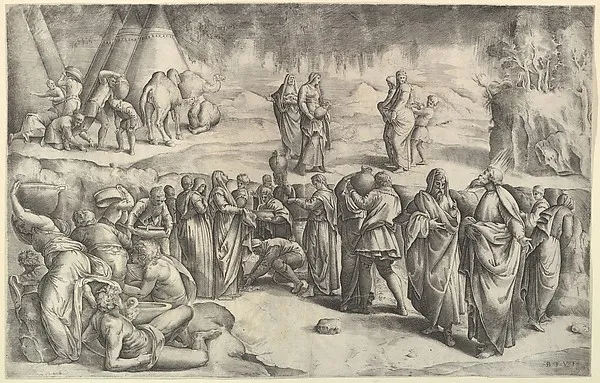
Judith 8:1-8A Widow Whom No One Could Reproach
4And Judith his relict was a widow now three years and six months. 6And she wore haircloth upon her loins, and fasted all the days of her life, except the sabbaths, and new moons, and the feasts of the house of Israel.
Before Judith says a single word, we are told who she is. Her husband Manasses died of sunstroke during the barley harvest, and for three and a half years she has lived as a widow. In the ancient world a widow was among the most vulnerable people alive, with no husband to provide or protect. Judith's strength, when it comes, will not rise from a position of safety. It rises from a woman the world counted as weak, which is exactly how God so often works His deliverance.
The portrait the chapter paints is one of steady, hidden devotion. Judith has made a private chamber on the roof of her house and lives shut away with her maids, wearing rough sackcloth and fasting nearly every day, pausing only for the sabbaths and feasts that the Law itself sets aside for gladness. This is a life given over to God in the years when no crisis demanded it. The courage Bethulia will need has been quietly forming in the dark, one ordinary act of faithfulness at a time, long before the day of testing arrives.
7And she was exceedingly beautiful, and her husband left her great riches, and very many servants, and large possessions of herds of oxen, and flocks of sheep. 8And she was greatly renowned among all, because she feared the Lord very much, neither was there any one that spoke an ill word of her.
Judith has everything the world prizes: beauty, wealth, servants, lands. Yet the chapter keeps her reputation where it belongs: she is honored among all the people because she fears the Lord, and because no one can find a true accusation to lay against her. Reputation here is the visible fruit of an invisible root. A life lived in genuine reverence for God eventually shows, and it earns a kind of authority that money and beauty never could. When Judith finally speaks, the city listens because of who she has long been.
Judith 8:9-13You Do Not Set a Clock on the Mercy of God
11And who are you that tempt the Lord? 12This is not a word that may draw down mercy, but rather that may stir up wrath, and enkindle indignation.
When Judith hears that the elders have promised to surrender after five days, she summons them and goes straight to the heart of their error. Their bargain was meant to sound like faith, a brave wager that God would surely act in time. Judith names it for what it is: testing God. To say "we will give Him five days to prove Himself" is to put the Creator on trial and make His help conditional on a schedule of our own choosing.
It is the same temptation Satan would later set before Christ in the wilderness, the urge to demand that God perform on command.
13You have set a time for the mercy of the Lord, and you have appointed him a day, according to your pleasure.
Judith's sharpest line exposes the quiet arrogance buried in the elders' plan. They have "set a time for the mercy of the Lord" and "appointed him a day." The roles have been reversed. The servants are dictating to the Master the terms and the timetable of His own grace. It is a posture so familiar that we rarely notice it in ourselves: deciding in advance how and by when God must answer, then treating our deadline as the measure of His faithfulness.
Judith insists that mercy moves on God's clock, not ours, and that demanding otherwise insults the very God we claim to be trusting.
Judith 8:14-20Humble Your Souls and Wait for His Consolation
14But forasmuch as the Lord is patient, let us be penitent for this same thing, and with many tears let us beg his pardon: 15For God will not threaten like man, nor be inflamed to anger like the son of man.
Having torn down the false solution, Judith builds the true one. The right response to a desperate hour is to humble ourselves before God. Because the Lord is patient, there is still time to repent of the very impatience that set the deadline. She calls the elders to tears and to pardon-seeking, turning the energy of the crisis toward genuine penitence. The first move of faith under pressure is to bow before God.
Verse 15 gives the reason such repentance is safe: "God will not threaten like man, nor be inflamed to anger like the son of man." Human anger flares and lashes out and is often beyond appeal. God is not like that. His patience is real, His mercy steady, His character unshaken by the moods that drive human wrath. This is the bedrock of Judith's counsel. We can humble ourselves before this God without fear, because the One we approach is patient and merciful, slow to anger and waiting to be gracious.
16And therefore let us humble our souls before him, and continuing in an humble spirit, in his service: 17Let us ask the Lord with tears, that according to his will so he would shew his mercy to us: that as our heart is troubled by their pride, so also we may glorify in our humility.
Judith sets pride and humility against each other as the two opposing powers in the whole drama. The Assyrians come in towering pride, certain of their strength. Israel's only fitting answer is to humble its soul before God and serve Him in lowliness of spirit. The contrast is the engine of the entire book: the proud will be brought down, and the humble who trust God will be lifted up. Judith asks God to act "according to his will," not according to hers, which is the very release of control her rebuke required of the elders.
20Let us humbly wait for his consolation, and the Lord our God will require our blood of the afflictions of our enemies, and he will humble all the nations that shall rise up against us, and bring them to disgrace.
Judith's counsel ends in confident expectation. "Let us humbly wait for his consolation." Waiting, in her mouth, is an act of strength. It holds two things together that the human heart finds hard to keep at once: deep humility before God and unshaken confidence that He will act. She is sure that the God who is patient and merciful will, in His own time, bring low every power that rises against His people. The waiting leans the whole weight of the city upon the faithfulness of God.
Judith 8:21-27Proven, as Abraham Was, Through Tribulation
22They must remember how our father Abraham was tempted, and being proved by many tribulations, was made the friend of God. 23So Isaac, so Jacob, so Moses, and all that have pleased God, passed through many tribulations, remaining faithful.
Judith now reframes the siege itself. God is proving Bethulia, as He proved every saint before. She reaches back to Abraham, who was tested by many trials and, enduring them, "was made the friend of God." That phrase is one of the most tender in all of Scripture, repeated of Abraham in the New Testament. The same fire that feels like destruction is, in God's hand, the means by which a soul is refined into friendship with Him. The trial is one of love's deepest instruments.
Judith widens the witness: Isaac, Jacob, Moses, and "all that have pleased God passed through many tribulations, remaining faithful." She is teaching the elders to read their suffering inside a much larger story. The faithful have always walked this road. Hardship is the well-worn path of the godly, and those who walk it stand in a long and honored line. To the frightened rulers this is steadying news. They stand with those whom God has tested and kept, and the call is simply to remain faithful as the fathers did.
25Were destroyed by the destroyer, and perished by serpents. 27But esteeming these very punishments to be less than our sins deserve, let us believe that these scourges of the Lord, with which like servants we are chastised, have happened for our amendment, and not for our destruction.
Judith sets a warning beside the comfort. She recalls those in the wilderness who received their trials with murmuring and impatience rather than the fear of the Lord, and so "perished by serpents." Both the fathers who became friends of God and those who fell endured hardship; what separated them was the response to it. Trial proves what is already in the heart. The same affliction can refine a trusting soul or expose a rebellious one, and the outcome turns on whether it is met with faith or with complaint.
Judith's final note transforms how the city is to understand its pain. These hardships, she says, are the loving correction of God, sent "for our amendment, and not for our destruction." Like a parent who disciplines a beloved child, God uses adversity to mend and mature His people, never to ruin them. She even calls the people to receive the affliction as less than their sins deserve, a humility that disarms all bitterness. To read suffering this way is to find in it the shaping hand of a Father who means His children for life, a hand reaching deeper than any enemy's wrath.
Judith 8:28-34Pray for Me, and Test Whether My Plan Is of God
29Now therefore pray for us, for thou art a holy woman, and one fearing God. 31So that which I intend to do prove ye if it be of God, and pray that God may strengthen my design.
The elders' answer is humble and immediate. Ozias and the rulers confess, "All things which thou hast spoken are true," and ask her to pray for them, "for thou art a holy woman." It is a striking moment of leadership recognizing wisdom wherever it is found. The chapter quietly honors what the world often overlooks. The decisive voice in this crisis belongs to a widow, and the rulers have the humility to listen, to repent, and to ask her intercession.
Judith now reveals that she has a plan, but she will not explain it. She asks the elders only to "prove" whether her purpose is of God and to pray that He will strengthen it. Notice the care in her words. After warning them so sternly against testing God, she does not now exempt herself from testing. She submits her own design to the same standard, asking whether it is truly of God before she acts. Her boldness is anchored in the conviction that any plan worth pursuing must first be His.
32You shall stand at the gate this night, and I will go out with my maidservant: and pray ye, that as you have said, in five days the Lord may look down upon his people Israel. 34And Ozias the prince of Juda said to her: Go in peace, and the Lord be with thee to take revenge of our enemies. So returning they departed.
Judith takes the elders' own five days and gives them back transformed. They had set the deadline as a test of God; she takes the same span and fills it with prayer, asking that within those days "the Lord may look down upon his people." The arrogance has been drained out of the timetable and replaced with petition. She asks them only to stand watch at the gate and to refrain from prying into her plan, trusting her and trusting God. The crisis that began with an ultimatum is now wrapped entirely in intercession.
Ozias sends her out with a blessing: "Go in peace, and the Lord be with thee." The leaders who had been ready to surrender now release a single faithful woman into the dark with their prayers behind her. The chapter closes on a hinge of the whole book. Everything that follows, the deliverance of Bethulia and the fall of the Assyrian host, will flow from this moment of humble trust. The city has stopped dictating to God and started depending on Him, and into that changed posture God will pour an unlooked-for rescue.
Where this echoes in Scripture
A Widow Whom No One Could Reproach
- Proverbs 31:30Favour is deceitful, and beauty is vain: but a woman that feareth the LORD, she shall be praised.Judith is honored for the one thing this proverb prizes above beauty and wealth.
- 1 Timothy 5:5She that is a widow indeed, and desolate, trusteth in God, and continueth in supplications and prayers night and day.The very portrait of Judith: a widow who gives herself to fasting and prayer.
- Matthew 6:6But thou, when thou prayest, enter into thy closet, and... pray to thy Father which is in secret.Judith's rooftop chamber is the hidden place where devotion is formed.
You Do Not Set a Clock on the Mercy of God
- Deuteronomy 6:16Ye shall not tempt the LORD your God, as ye tempted him in Massah.The command Judith presses on the elders: do not put God to the test.
- Matthew 4:7Jesus said unto him, It is written again, Thou shalt not tempt the Lord thy God.Christ refuses the very thing Judith condemns: forcing God to perform on demand.
- Psalm 31:15My times are in thy hand: deliver me from the hand of mine enemies.The opposite of appointing God a day: entrusting one's times to Him.
Humble Your Souls and Wait for His Consolation
- Lamentations 3:25-26The LORD is good unto them that wait for him... It is good that a man should both hope and quietly wait for the salvation of the LORD.The very posture Judith urges: to wait quietly and with hope for God's deliverance.
- James 4:10Humble yourselves in the sight of the Lord, and he shall lift you up.Judith's whole strategy in one verse: humble yourselves, and God will raise you.
- Isaiah 30:18And therefore will the LORD wait, that he may be gracious unto you... blessed are all they that wait for him.The God who is patient waits to be gracious, and blesses those who wait for Him.
Proven, as Abraham Was, Through Tribulation
- James 2:23Abraham believed God... and he was called the Friend of God.The very title Judith gives Abraham, confirmed in the New Testament.
- Hebrews 12:6-7For whom the Lord loveth he chasteneth... God dealeth with you as with sons.Judith's claim exactly: chastening is for amendment, the mark of a loved child.
- 1 Peter 1:7That the trial of your faith... might be found unto praise and honour and glory at the appearing of Jesus Christ.Trial refines faith like gold, proving the saints as Judith says the fathers were proved.
Pray for Me, and Test Whether My Plan Is of God
- Proverbs 16:3Commit thy works unto the LORD, and thy thoughts shall be established.Judith commits her design to God and asks that He establish it.
- 1 Thessalonians 5:21Prove all things; hold fast that which is good.She asks the elders to do exactly this: prove whether her plan is of God.
- Joshua 1:9Be strong and of a good courage... for the LORD thy God is with thee whithersoever thou goest.The blessing Ozias speaks over Judith: the Lord be with thee as you go.