Ruth 2
People in this chapter
Ruth 2 opens onto a field at harvest. After the famine and the funerals of chapter 1, Naomi has come home to Bethlehem with nothing, and the only one beside her is Ruth - a Moabite widow, an outsider in Israel, with no land, no husband, and no claim on anyone. So Ruth does what the poor in Israel were permitted to do. The law commanded that a landowner not strip his field bare but leave the corners and the dropped ears for the poor and stranger (Lev. 19:9-10); and Ruth, who is both, asks Naomi's leave to glean ears of corn after him in whose sight I shall find grace (v. 2).
The chapter quietly tells us where she is headed before she knows it herself: Naomi has a kinsman of her husband's, a mighty man of wealth, of the family of Elimelech… Boaz (v. 1).1
Tap any highlighted phrase to jump to the commentary that unpacks it.
Ruth 2:1-7Her Hap Was to Light on the Field of Boaz
1And Naomi had a kinsman of her husband’s, a mighty man of wealth, of the family of Elimelech; and his name was Boaz. 2And Ruth the Moabitess said unto Naomi, Let me now go to the field, and glean ears of corn after him in whose sight I shall find grace. And she said unto her, Go, my daughter. 3And she went, and came, and gleaned in the field after the reapers: and her hap was to light on a part of the field belonging unto Boaz, who was of the kindred of Elimelech.
The chapter opens by quietly setting a piece on the board the reader can see and Ruth cannot. And Naomi had a kinsman of her husband's, a mighty man of wealth, of the family of Elimelech… Boaz (v. 1). Before Ruth takes a single step toward the fields, we are told who is waiting at the other end of her day. The phrase a mighty man of wealth renders a Hebrew expression that means more than money; it speaks of substance, standing, capability - a man of weight in the community.1 And the words of the family of Elimelech are doing the deepest work of all, for Elimelech was Naomi's dead husband.
This is not a stranger with full barns; this is family, a man bound to Naomi's house by blood and so bound, under Israel's law, by obligation. The reader holds this knowledge like a lit candle while Ruth walks out into the dark of an ordinary morning, knowing nothing except that she is hungry and that the poor are allowed to glean.
Ruth is the one who moves. Let me now go to the field, and glean ears of corn after him in whose sight I shall find grace (v. 2). She does not wait to be rescued; she takes up the one provision Israel's law made for people like her. The harvest laws commanded that a landowner not reap to the very edges of his field nor go back over it for what was dropped, but leave the corners and the gleanings for the poor and stranger (Lev. 19:9-10; Deut. 24:19).2 Gleaning was legal, but it was lowly and exposed - bending all day behind the reapers for whatever they missed, at the mercy of how the workers treated you.
Notice the humility in Ruth's words: she does not presume on anyone's kindness but hopes to find someone in whose sight she might find grace. The Hebrew word is chen, favour - the kindness you cannot demand and can only receive. This is the prayer of the destitute: not for what is owed, but for a kind eye to fall on her.
Then comes one of the most loaded sentences in the Old Testament, and its power is in how plain it sounds: her hap was to light on a part of the field belonging unto Boaz (v. 3). The KJV word hap means chance, luck, accident - and the Hebrew is just as casual, as if to say her happenstance happened to happen. From Ruth's side of things it is pure coincidence: she had no map to Boaz's field, no way of knowing one furrow from another, no idea whose ground she had wandered onto.
But the reader, who heard Boaz named only two verses ago, sees the whole shape of it at once. There is no luck here. The same God who is never named as acting in this book is acting in every line of it, and the studied casualness of the wording is the point: He works most often not by splitting seas but by arranging the small turns of an ordinary day so that a hungry woman “happens” to bend down in exactly the field where grace is waiting.
What she calls chance the story calls providence - the hand of God moving, unseen, beneath the surface of an errand to gather grain.
4And, behold, Boaz came from Bethlehem, and said unto the reapers, The LORD be with you. And they answered him, The LORD bless thee. 5Then said Boaz unto his servant that was set over the reapers, Whose damsel is this? 6And the servant that was set over the reapers answered and said, It is the Moabitish damsel that came back with Naomi out of the country of Moab: 7And she said, I pray you, let me glean and gather after the reapers among the sheaves: so she came, and hath continued even from the morning until now, that she tarried a little in the house.
The first words we ever hear from Boaz tell us the kind of man he is: The LORD be with you (v. 4). He comes from Bethlehem into his own field, and the thing on his lips is not a command or a complaint about the pace of the work but a blessing - and his workers answer him in the same coin: The LORD bless thee. A whole world is sketched in that exchange. This is a household where the name of the LORD passes warmly between master and laborers, where work is done under blessing rather than under the lash.
It is no small thing that the man into whose field providence has steered Ruth turns out to be a man whose ordinary speech is shot through with the awareness of God. Then his eye falls on the one person in the field who does not belong: Whose damsel is this? (v. 5). He notices the stranger. The overseer's answer is careful and kind - she is the Moabitess who came back with Naomi, who asked leave to glean, and who has worked steadily from the morning until now with scarcely a rest (vv. 6-7).
Every detail is a quiet defense of her: she is not idle, not presumptuous, not entitled. She asked; she labored; she is a worker. The stranger has been seen, and what is seen is her diligence.
Ruth 2:8-13Under Whose Wings Thou Art Come to Trust
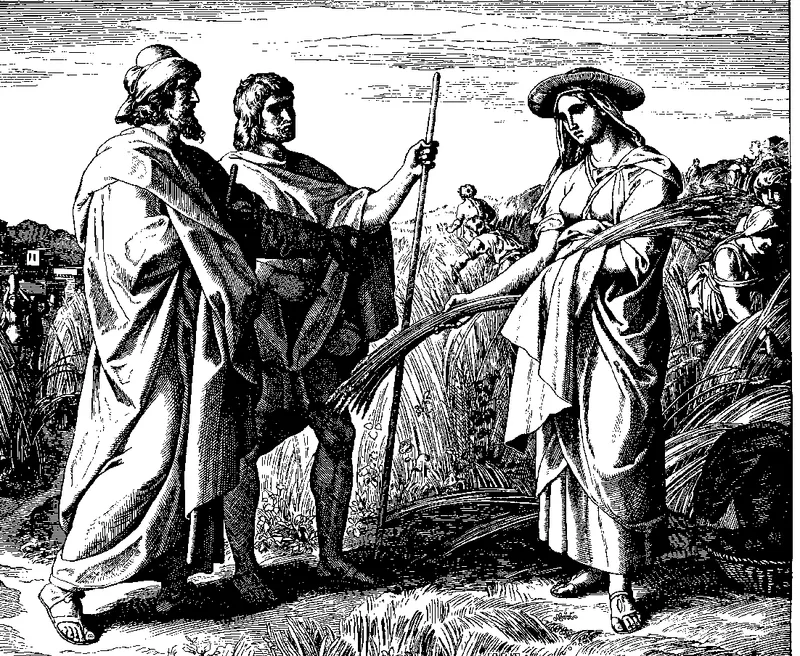
8Then said Boaz unto Ruth, Hearest thou not, my daughter? Go not to glean in another field, neither go from hence, but abide here fast by my maidens: 9Let thine eyes be on the field that they do reap, and go thou after them: have I not charged the young men that they shall not touch thee? and when thou art athirst, go unto the vessels, and drink of that which the young men have drawn. 10Then she fell on her face, and bowed herself to the ground, and said unto him, Why have I found grace in thine eyes, that thou shouldest take knowledge of me, seeing I am a stranger?
Boaz turns from speaking about Ruth to speaking to her, and what he gives her runs far past anything the law could compel. He does three things at once. He tells her to stay - Go not to glean in another field… abide here fast by my maidens (v. 8) - granting a homeless gleaner a settled place under his protection rather than the daily uncertainty of begging from field to field. He guards her body: have I not charged the young men that they shall not touch thee? (v. 9).
A foreign widow gleaning alone among hired men was exposed to harassment and worse, and Boaz throws a wall around her with a word. And he opens his own provision to her thirst: when thou art athirst, go unto the vessels, and drink of that which the young men have drawn. Stop and measure how much of this the gleaning law never asked. The law said the poor could gather the leftovers; it said nothing about a landowner offering a stranger a guaranteed place, a personal guard, and water his own workers had drawn.
This is not law being obeyed; it is grace overflowing the banks of the law. Long before Boaz ever stands up in the gate to redeem her in chapter 4, he is already, here in the field, treating her like one of his own.
Ruth's answer is to fall to the ground in wonder: she fell on her face, and bowed herself to the ground, and said unto him, Why have I found grace in thine eyes, that thou shouldest take knowledge of me, seeing I am a stranger? (v. 10). She does not argue with the kindness or wave it off; she receives it - and she names, with disarming honesty, exactly why it astonishes her. Seeing I am a stranger. She is a Moabitess, a daughter of a people long at odds with Israel, with no birthright in this land and no claim on this man.
That he should take knowledge of her - notice her, single her out, care what becomes of her - cannot be something owed; it can only be gift. There is a quiet theology in her question. The word she reaches for is the same word she used at the start, chen, grace: the favour that is never earned and never demanded but only given. Ruth grasps what is happening to her with a clarity that itself is a kind of grace: she knows she is receiving what she has no right to receive, and instead of pride or entitlement, her response is to bow her face to the ground.
11And Boaz answered and said unto her, It hath fully been shewed me, all that thou hast done unto thy mother in law since the death of thine husband: and how thou hast left thy father and thy mother, and the land of thy nativity, and art come unto a people which thou knewest not heretofore. 12The LORD recompense thy work, and a full reward be given thee of the LORD God of Israel, under whose wings thou art come to trust.
Boaz answers her wonder by telling her that her story has reached him before she ever entered his field: It hath fully been shewed me, all that thou hast done unto thy mother in law since the death of thine husband (v. 11). And notice what he sees when he looks at her. Not a foreigner to be tolerated, not a poor widow to be pitied, but a woman of remarkable loyalty - one who left thy father and thy mother, and the land of thy nativity, and art come unto a people which thou knewest not heretofore. The words deliberately echo the call of Abraham, who was told to get thee out of thy country, and from thy kindred, and from thy father's house (Gen. 12:1).
Ruth, a Moabitess, has made an Abraham-like departure - leaving everything familiar to bind herself to Naomi's people and Naomi's God, with no promise of reward and every reason to expect hardship. Boaz has weighed that, and it is her costly faithfulness, not her need, that fills his sight. He looks past her scarcity to her character, and what he finds there moves him to bless.
13Then she said, Let me find favour in thy sight, my lord; for that thou hast comforted me, and for that thou hast spoken friendly unto thine handmaid, though I be not like unto one of thine handmaidens.
Ruth's reply circles back to the same word she began with, but its weight has changed: Let me find favour in thy sight, my lord (v. 13). At the start of the chapter, favour - chen, grace - was a hope she carried out to the fields, a thing she prayed someone might show her. Now it is something received, and her words turn to gratitude. And listen to what she names as the gift: not the grain, not the water, not the protection first of all, but the kindness of his speech.
Thou hast comforted me… thou hast spoken friendly unto thine handmaid. The Hebrew behind spoken friendly is literally to speak to the heart - warm, reassuring words that reach the inner person. Boaz's tongue has done as much for Ruth as his provision; he has spoken to her heart. And still she keeps her humility intact - though I be not like unto one of thine handmaidens. She does not let the kindness inflate her; she receives it as gift while remembering she has no claim on it.
Gratitude and humility together: she takes the grace fully, and presumes upon it not at all.
Ruth 2:14-23Handfuls of Purpose, and a Near Kinsman
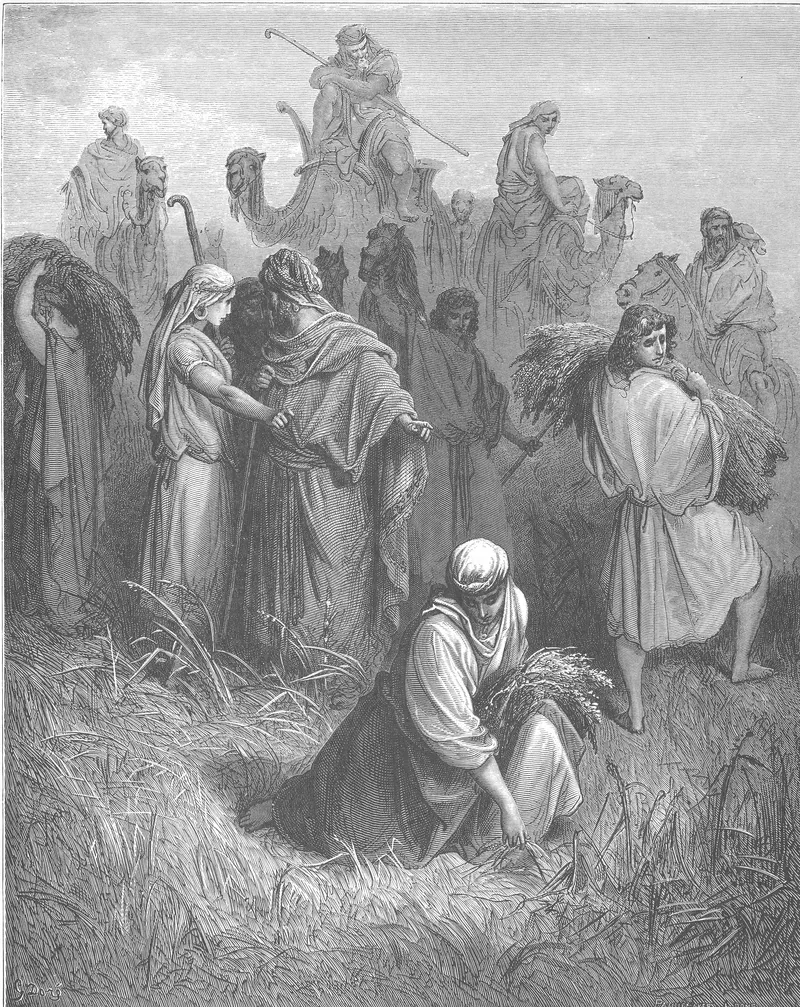
14And Boaz said unto her, At mealtime come thou hither, and eat of the bread, and dip thy morsel in the vinegar. And she sat beside the reapers: and he reached her parched corn, and she did eat, and was sufficed, and left.
When the workers break for the midday meal, Boaz does not leave the gleaner standing at a distance; he calls her in. At mealtime come thou hither, and eat of the bread, and dip thy morsel in the vinegar (v. 14). The fare is plain - bread, a sour-wine dip to soften and flavor it, roasted grain - but the honor is enormous. A foreign widow who came to gather scraps is seated beside the reapers, inside the circle of the household, at the table of the master's own workers.
And Boaz serves her himself: he reached her parched corn, passing food into her hand. She did eat, and was sufficed, and left - she ate her fill and there was still some over. That little phrase quietly tells the whole story of the day: the one who set out hoping to gather a few dropped ears is now eating until she is satisfied with food to spare, at the table of the man whose field she “happened” to enter.
He is establishing her, meal by gesture by word, as one who belongs under his care.
15And when she was risen up to glean, Boaz commanded his young men, saying, Let her glean even among the sheaves, and reproach her not: 16And let fall also some of the handfuls of purpose for her, and leave them, that she may glean them, and rebuke her not. 17So she gleaned in the field until even, and beat out that she had gleaned: and it was about an ephah of barley.
After the meal, when Ruth rises to work again, Boaz goes further still - and he does it where she cannot hear. Let her glean even among the sheaves, and reproach her not (v. 15): ordinarily a gleaner kept well back from the bound bundles, but Boaz tells his men to let her in close, into the richest part of the harvest. Then the deepest kindness of all: let fall also some of the handfuls of purpose for her, and leave them, that she may glean them (v. 16).
They are to pull grain from the very sheaves and drop it deliberately in her path - not to scatter it carelessly, but to leave it on purpose, so that she will gather it thinking it merely fell.1 This is generosity that hides itself. He arranges her abundance without letting her feel like a charity case, so that her dignity is kept whole even as her basket is filled. The result lands at evening: it was about an ephah of barley (v. 17) - somewhere near thirty pounds of grain, far beyond what an ordinary day of gleaning could ever yield.
What looked like a humble day of gathering scraps has become a day of overflowing provision, enough to feed two widows for a long while - and Ruth never saw the hands that made it so.
18And she took it up, and went into the city: and her mother in law saw what she had gleaned: and she brought forth, and gave to her that she had reserved after she was sufficed. 19And her mother in law said unto her, Where hast thou gleaned to day? and where wroughtest thou? blessed be he that did take knowledge of thee. And she shewed her mother in law with whom she had wrought, and said, The man’s name with whom I wrought to day is Boaz.
Ruth carries the day's harvest home, and the sheer size of it speaks before she does: her mother in law saw what she had gleaned (v. 18). An ephah of barley laid down in the doorway is not the take of an ordinary gleaning day, and Naomi knows it. Ruth also brought forth, and gave to her the food she had saved from her own meal - even her gratitude turns outward, sharing the leftovers of the kindness she received.
Naomi's questions come quick and warm: Where hast thou gleaned to day? and where wroughtest thou? blessed be he that did take knowledge of thee (v. 19). She blesses the unknown benefactor before she even hears his name - she can read the kindness in the size of the basket. And then Ruth speaks the name, set deliberately at the very end of her sentence like the turn of a key: The man's name with whom I wrought to day is Boaz. The whole chapter has been waiting for that name to land in Naomi's ears.
20And Naomi said unto her daughter in law, Blessed be he of the LORD, who hath not left off his kindness to the living and to the dead. And Naomi said unto her, The man is near of kin unto us, one of our next kinsmen.
The name changes everything, and Naomi sees it all in an instant. Blessed be he of the LORD, who hath not left off his kindness to the living and to the dead (v. 20). This is the woman who came home from Moab insisting she be called Mara, bitter, certain the LORD's hand had gone out against her. Now, for the first time in the book, she blesses the LORD - and notice the careful grammar of her praise.
The he who has not left off his kindness is, in the same breath, both Boaz and the LORD; the kindness of the man and the kindness of God have become impossible to tell apart. Naomi had thought God had stopped being good to her house; the ephah of barley and the name of Boaz tell her she was wrong - His kindness has been at work the whole time, reaching even to the dead, to the lost line of Elimelech and her sons.
Then she names the thing the reader has known since verse 1: The man is near of kin unto us, one of our next kinsmen. The word is goel - redeemer. Boaz is not merely a generous landowner; he is family, a man with both the right and the duty to redeem Naomi's emptied house. What looked like a chance day in a random field is suddenly revealed as the opening move of redemption. Hope has a name now, and the name is a kinsman.
21And Ruth the Moabitess said, He said unto me also, Thou shalt keep fast by my young men, until they have ended all my harvest. 22And Naomi said unto Ruth her daughter in law, It is good, my daughter, that thou go out with his maidens, that they meet thee not in any other field. 23So she kept fast by the maidens of Boaz to glean unto the end of barley harvest and of wheat harvest; and dwelt with her mother in law.
The chapter closes not with a sudden reversal but with a season of being kept. Ruth reports Boaz's further word - keep fast by my young men, until they have ended all my harvest (v. 21) - and Naomi, who only verses ago was naming herself bitter, now gives counsel like a woman whose hope has begun to stir: It is good, my daughter, that thou go out with his maidens, that they meet thee not in any other field (v. 22).
Stay where you are safe. Stay under his covering. And Ruth does, gleaning beside Boaz's maidens unto the end of barley harvest and of wheat harvest - through the whole long span of the season, weeks of harvest - and dwelt with her mother in law. The book that opened in famine and funerals ends this chapter in a steady rhythm of provision: a foreign widow, once empty, now fed and guarded day after day, safe under the eye of a kinsman who is also a redeemer.
The redemption is not finished - that waits for the threshing floor and the gate - but it has surely begun. Ruth came to Bethlehem with nothing; by the end of this chapter she is seen, fed, protected, and quietly woven into the household of the LORD's people.
Research trail
Sources & further study
These references support the historical, linguistic, manuscript, and contextual notes in this chapter. Scripture remains the primary text; external sources are provided so readers can inspect the research directly.
- Ruth 2 - Translators' NotesThe NET Bible's detailed footnotes on Ruth 2 - the force of the phrase rendered a mighty man of wealth in verse 1, the irony built into Ruth's “hap” in verse 3, the legal background of gleaning, and the idiom behind the handfuls of purpose Boaz commands his workers to drop in verse 16.
- Ruth 2 · Hebrew + classical Jewish commentaryThe Hebrew text of Ruth 2 with Rashi, Ibn Ezra, and other classical commentators side by side - useful for goel (the near kinsman who redeems, named in v. 20), for kanaph (v. 12, the “wings” of refuge that are also the “skirt” or hem of a garment), and for the gleaning vocabulary of verses 2, 7, and 15-16 that reaches back to the harvest laws of Leviticus and Deuteronomy.
- Ruth 2 ↔ Leviticus 19 · Psalm 36 & 91 · Matthew 1 & 23 · Hebrews 2Traces the threads tying Ruth 2 to the rest of Scripture - the gleaning command of Leviticus 19:9-10 lived out in Boaz's field; the “wings” of refuge (v. 12) sung in Psalm 36:7 and 91:4 and longed over by Christ in Matthew 23:37; the kinsman-redeemer read beside the One who took part of the same flesh and blood (Heb. 2:14); and Ruth herself named in the royal line in Matthew 1:5.
Where this echoes in Scripture
Her Hap Was to Light on the Field of Boaz
- Leviticus 19:9-10thou shalt not wholly reap the corners of thy field... thou shalt leave them for the poor and stranger.The gleaning law Ruth lives out in verses 2-3 - the field's edges reserved by God for the poor and the foreigner.
- Deuteronomy 24:19When thou cuttest down thine harvest... and hast forgot a sheaf... it shall be for the stranger, for the fatherless, and for the widow.The same provision behind Ruth's gleaning - the dropped sheaf left, by command, for the widow and the stranger.
- Proverbs 16:9A man’s heart deviseth his way: but the LORD directeth his steps.The truth hidden inside Ruth's “hap” (v. 3) - a step that seemed her own choice, directed all along by the LORD.
- Leviticus 25:25If thy brother be waxen poor... then shall his kinsman... come to redeem it, and redeem that which his brother sold.The law of the goel named in verse 1 - the near kinsman's duty to redeem what his own family has lost.
- Exodus 6:6I will redeem you with a stretched out arm, and with great judgments.The same verb that makes Boaz a redeemer (vv. 1, 20) - God Himself as the goel of His people.
Under Whose Wings Thou Art Come to Trust
- Psalm 91:4He shall cover thee with his feathers, and under his wings shalt thou trust: his truth shall be thy shield and buckler.The refuge Boaz names in verse 12 - the sheltering wings of the LORD under which the trusting are kept.
- Psalm 36:7How excellent is thy lovingkindness, O God! therefore the children of men put their trust under the shadow of thy wings.The same image as verse 12 - the children of men finding refuge beneath the wings of God.
- Matthew 23:37how often would I have gathered thy children together, even as a hen gathereth her chickens under her wings, and ye would not!The wings of verse 12 on the lips of Christ - the refuge He longed to gather His own beneath.
- Hebrews 2:11For both he that sanctifieth and they who are sanctified are all of one: for which cause he is not ashamed to call them brethren.The kinsman-redeemer of this chapter answered in Christ - the Son who takes our kin and is not ashamed to call us brethren.
- Genesis 12:1Get thee out of thy country, and from thy kindred, and from thy father’s house, unto a land that I will shew thee.The departure Boaz praises in verse 11 - Ruth's Abraham-like leaving of homeland and kindred for the people of God.
Handfuls of Purpose, and a Near Kinsman
- Luke 6:38Give, and it shall be given unto you; good measure, pressed down, and shaken together, and running over.The overflowing measure of the handfuls of purpose (v. 16) - grace given beyond what is asked or earned.
- Proverbs 11:24-25There is that scattereth, and yet increaseth... The liberal soul shall be made fat.The principle behind Boaz's lavish dropping of grain (vv. 15-16) - the generous hand that is never the poorer for it.
- Job 19:25For I know that my redeemer liveth, and that he shall stand at the latter day upon the earth.The goel Naomi names in verse 20 lifted to its highest note - the living Redeemer of His people.
- Ruth 4:14Blessed be the LORD, which hath not left thee this day without a kinsman... that his name may be famous in Israel.Where the hope first glimpsed in verse 20 arrives - the kinsman-redeemer who restores Naomi's emptied house.
- Matthew 1:5And Salmon begat Booz of Rachab; and Booz begat Obed of Ruth; and Obed begat Jesse.The foreigner gleaning in verse 3 written into the royal line - Ruth the Moabitess, ancestress of David and of Christ.