Sirach 27
Sirach 27 is a chapter about pressure and what it brings to the surface. It begins where most lives are tested without anyone noticing: in the ordinary business of buying and selling, where the hunger to get ahead can quietly bend a person until sin is lodged in them like a wedge driven between two stones. The fear of the Lord, the writer says, is the thing that keeps a house from being quickly overthrown.
And then the great image of the book arrives. The furnace tries the potter's vessels, and the trial of affliction tries just men. Heat does not create the flaw or the strength; it reveals what was there all along.
Tap any highlighted phrase to jump to the commentary that unpacks it.
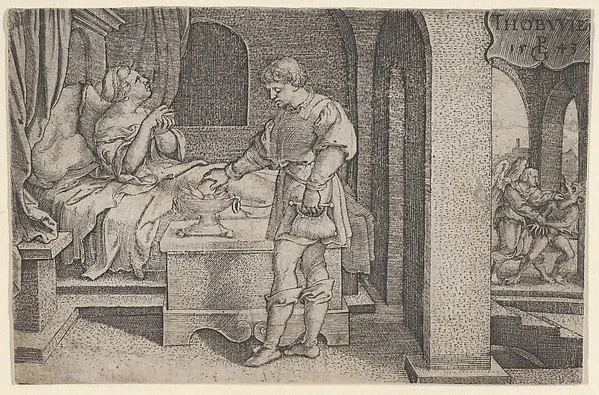
Sirach 27:1-4The Wedge of Gain and the House That Stands
1Through poverty many have sinned: and he that seeketh to be enriched, turneth away his eye. 2As a stake sticketh fast in the midst of the joining of stones, so also in the midst of selling and buying, sin shall stick fast.
The chapter opens with a sharp observation about money and the soul. Hardship has driven many to sin, but the writer immediately turns to a subtler danger: the person so set on getting rich that he "turneth away his eye." He looks away on purpose, refusing to see the corner he is cutting or the neighbor he is shortchanging. The danger here is not wealth itself but the willed blindness that the chase for it can produce. A heart fixed on gain learns to not-notice the very things conscience would otherwise catch.
The image is precise and unsettling. In the dry-stone walls of the ancient world, a wooden stake could be driven so tightly between two fitted stones that it could never be worked back out. Just so, the writer says, sin wedges itself into the ordinary traffic of "selling and buying." Commerce is not condemned; it is named as a place of pressure, where small dishonesties get lodged so firmly they become part of the structure. The warning is to watch the seams of daily business, because that is exactly where the wedge goes in.
4Unless thou hold thyself diligently in the fear of the Lord, thy house shall quickly be overthrown.
Against the wedge of sin the writer sets one safeguard: holding oneself "diligently in the fear of the Lord." This is the steadying reverence that keeps a person honest when no auditor is watching and no profit hangs on the truth. Without it, the chapter says, a house is "quickly" overthrown, and the speed is the point. A life built on the chase for gain looks solid until the day pressure arrives, and then it comes down fast. The fear of the Lord is the foundation under everything that lasts, the beginning of wisdom Scripture returns to again and again.
Sirach 27:5-8The Furnace Tries the Vessel; the Word Reveals the Heart
6The furnace trieth the potter’s vessels, and the trial of affliction just men. 7Be the dressing of a tree sheweth the fruit thereof, so a word out of the thought of the heart of man.
Here is the chapter's central image. A clay vessel is shaped soft, but it is the furnace that proves whether it will hold; the fire does not make the pot, it tests it, and any hidden crack shows under the heat. Affliction, the writer says, does the same for the just. Trial is not presented as God's rejection but as the revealing fire, the pressure that brings to light what a person is truly made of. The flaw was there before the heat, and so was the strength. Hardship simply tells the truth about both.
The second image moves from clay to orchard. The way a tree has been tended, its "dressing," shows finally in the fruit it bears; you cannot fake a harvest. In the same way a person's word rises "out of the thought of the heart." Speech is the fruit of an inner cultivation, and over time it cannot help but reveal the root it grew from. This is why words matter so much in this chapter. They are not a surface to be managed but a harvest that discloses what has been quietly growing within.
8Praise not a man before he speaketh, for this is the trial of men.
The practical counsel follows naturally. Do not praise a person before you have heard them speak, "for this is the trial of men." Appearance, manner, and reputation can all be arranged; speech, drawn out over time, is the test that cannot be staged. The writer is not telling us to be suspicious of everyone, but to be patient and discerning, to let the fruit appear before we pronounce on the tree. Real character announces itself in words and deeds under pressure, and that takes time to see.
Sirach 27:9-15Justice Is a Robe; Truth Returns to Those Who Keep It
9If thou followest justice, thou shalt obtain her: and shalt put her on as a long robe of honour, and thou shalt dwell with her: and she shall protect thee for ever, and in the day of acknowledgment thou shalt find a strong foundation. 10Birds resort unto their like: so truth will return to them that practise her.
After the testing comes the reward of those who pass it. Pursue justice, the writer says, and you will obtain her, wear her like a robe of honor, and dwell with her as with a companion. The images pile up on purpose: justice becomes a garment that dignifies, a household that shelters, a protection that lasts "for ever," and on the day of reckoning a "strong foundation." Righteousness is not a burden the just carry but a covering they are clothed in, and it holds them up when everything that could be shaken is shaken.
The proverb about birds is gentle and exact: birds flock to their own kind, and "truth will return to them that practise her." Truth is drawn home to the truthful the way a bird returns to its own. The person who lives honestly creates a life that truth keeps coming back to, settling in, making its nest. There is a quiet promise here. Practice truth long enough, and you become the kind of place truth recognizes as home.
12A holy man continueth in wisdom as the sun: but a fool is changed as the moon. 13In the midst of the unwise keep in the word till its time: but be continually among men that think.
A luminous contrast. The wise person "continueth in wisdom as the sun," steady, constant, giving the same light day after day. The fool "is changed as the moon," waxing and waning, bright one night and dark the next, never the same shape twice. The difference is reliability. You can build on the one whose character holds steady; you cannot build on the one whose convictions shift with every change of company or mood. Wisdom is not only insight but constancy, the kind of dependable light others can steer by.
Two counsels about company close this turn. Among the foolish, "keep in the word till its time," hold your deeper thoughts until the moment is right rather than scattering them where they will be trampled. But seek out and stay "continually among men that think." Who we sit with shapes who we become; the people around us tend our character the way a gardener tends a tree. The wise person chooses thoughtful company on purpose, knowing that constant companionship slowly forms the soul.
Sirach 27:16-24The Wound That Cannot Be Bound: Betraying a Friend
17He that discloseth the secret of a friend loseth his credit, and shall never find a friend to his mind. 18Love thy neighbour, and be joined to him with fidelity.
The chapter turns to the most intimate test of character: what a person does with a secret entrusted to them. To disclose a friend's secret, the writer says, is to lose your "credit," the trust that is the very currency of friendship, and the consequence is lasting: such a person "shall never find a friend to his mind." Word travels. The betrayer of one confidence becomes known as unsafe to all, and the ground for deep friendship dries up beneath him.
Keeping a confidence is presented not as a minor courtesy but as the thing that makes friendship possible at all.
The positive command sits at the heart of the passage: "Love thy neighbour, and be joined to him with fidelity." This is the great commandment of the Law, woven here into the texture of ordinary loyalty. Love that is real is faithful; it binds itself to the other and keeps faith over time. Fidelity is what turns affection into something a person can lean their weight on. To love a neighbor and to be trustworthy toward him are, in this chapter, the same act.
21And as one that letteth a bird go out of his hand, so hast thou let thy neighbour go, and thou shalt not get him again. 24But to disclose the secrets of a friend, leaveth no hope to an unhappy soul.
The writer reaches for an image of irreversibility. A betrayed friend is like a bird released from the hand: open your fingers and it is gone, fled "as a roe escaped out of the snare," and you will not get it back. Some breaches can be mended, but the wound of betrayed trust is described here as a thing that does not simply heal because we wish it would. The point is not despair but sober weight: handle the trust of another as something that, once let go, may never return to your hand.
The passage draws a careful line. Even a curse, the writer has just said, can find reconciliation; harsh words can be repented of and a torn friendship rejoined. But to disclose the secret of a friend "leaveth no hope to an unhappy soul." Of all the ways to wound a friend, the betrayal of a confidence is named the gravest, because it strikes at the trust everything else was built on. This is not a closing of the door on God's mercy; it is a clear-eyed measure of how deep this particular wound goes, and a plea to never inflict it.
Sirach 27:25-33The Pit-Digger Falls In: How Malice Returns
26In the sight of thy eyes he will sweeten his mouth, and will admire thy words: but at the last he will writhe his mouth, and on thy words he will lay a stumblingblock. 28If one cast a stone on high, it will fall upon his own head: and the deceitful stroke will wound the deceitful.
The chapter turns to the flatterer who is secretly an enemy. To your face he "sweetens his mouth" and admires your words; behind your back he twists your own sayings into a trap. The portrait is of two-faced speech, warmth in the open and sabotage in the dark, and it is precisely the doubleness this whole book hates. The warning is to recognize that admiration and loyalty are not the same thing. A mouth that sweetens too easily in your presence may be setting a stumblingblock the moment you turn away.
Now the chapter states the law that governs all such scheming. Throw a stone straight up, and it falls back on your own head; the "deceitful stroke will wound the deceitful." There is a moral physics built into the world, the writer insists, as reliable as gravity: malice does not simply fly off and disappear. It returns to its source. This is not a promise that we engineer our enemies' downfall, but a confidence that the world is so made that cruelty carries its own recoil.
What is hurled at the innocent comes back down on the one who hurled it.
29He that diggeth a pit, shall fall into it: and he that setteth a stone for his neighbour, shall stumble upon it: and he that layeth a snare for another, shall perish in it. 33Anger and fury are both of them abominable, and the sinful man shall be subject to them.
The principle gathers force through three matched images: the pit-digger falls into his pit, the one who sets a stumbling stone trips over it, the trapper is caught in his own snare. Each trap is built for a neighbor and springs on its maker. This is one of the oldest convictions in Scripture, that the schemes of the wicked curve back upon them, and Sirach states it with the steady certainty of a proverb.
The chapter even adds that those "delighted with the fall of the just" will themselves be caught, "and sorrow shall consume them before they die." Malice is its own slow punishment.
The chapter ends by naming the soil all this grows from. "Anger and fury are both of them abominable, and the sinful man shall be subject to them." The schemes and snares trace back to an inner rage that the sinful person serves rather than masters. Notice the verb: the sinful man is "subject" to anger, ruled by it, owned by it. The final word of the chapter is therefore a diagnosis. Beneath the traps and the flattery and the deceit lies a heart enslaved to its own fury, and freedom begins where that mastery is broken.
Where this echoes in Scripture
The Wedge of Gain and the House That Stands
- Proverbs 28:20A faithful man shall abound with blessings: but he that maketh haste to be rich shall not be innocent.The same warning: the hurry to get rich is where guilt slips in.
- 1 Timothy 6:10For the love of money is the root of all evil: which while some coveted after, they have erred from the faith.It is the love of gain, not money itself, that wedges sin into a life.
- Matthew 7:24-25Whosoever heareth these sayings of mine, and doeth them... built his house upon a rock.The house that stands when the storm hits is the one founded on the right thing.
The Furnace Tries the Vessel; the Word Reveals the Heart
- Proverbs 17:3The fining pot is for silver, and the furnace for gold: but the LORD trieth the hearts.The same furnace image: testing is how the heart is proven.
- Matthew 12:34For out of the abundance of the heart the mouth speaketh.Jesus states the chapter's law of speech: the word reveals the heart.
- James 1:3-4The trying of your faith worketh patience. But let patience have her perfect work.Affliction tries the just so that what is proven may be made complete.
Justice Is a Robe; Truth Returns to Those Who Keep It
- Isaiah 61:10He hath clothed me with the garments of salvation, he hath covered me with the robe of righteousness.Justice worn as a robe of honour, exactly the image here.
- Proverbs 13:20He that walketh with wise men shall be wise: but a companion of fools shall be destroyed.Why the writer says to stay among those who think.
- James 1:17The Father of lights, with whom is no variableness, neither shadow of turning.The unchanging steadiness the wise person reflects, sun and not moon.
The Wound That Cannot Be Bound: Betraying a Friend
- Proverbs 17:9He that covereth a transgression seeketh love; but he that repeateth a matter separateth very friends.Repeating what was confided is exactly what divides close friends.
- Proverbs 11:13A talebearer revealeth secrets: but he that is of a faithful spirit concealeth the matter.The faithful spirit keeps the confidence; the talebearer loses his credit.
- John 15:13Greater love hath no man than this, that a man lay down his life for his friends.The fidelity this chapter asks is fulfilled in the love that keeps faith to the end.
The Pit-Digger Falls In: How Malice Returns
- Psalm 7:15-16He made a pit, and digged it, and is fallen into the ditch which he made. His mischief shall return upon his own head.The chapter's law of the returning stone, stated almost word for word.
- Galatians 6:7Be not deceived; God is not mocked: for whatsoever a man soweth, that shall he also reap.The moral physics Sirach describes, carried into the New Testament.
- Romans 12:19Avenge not yourselves... for it is written, Vengeance is mine; I will repay, saith the Lord.Because the stone returns of itself, we are freed from digging pits of our own.